AdCreative.ai vs Pencil AI (2026): A Practical, Performance-Focused Comparison for Marketers



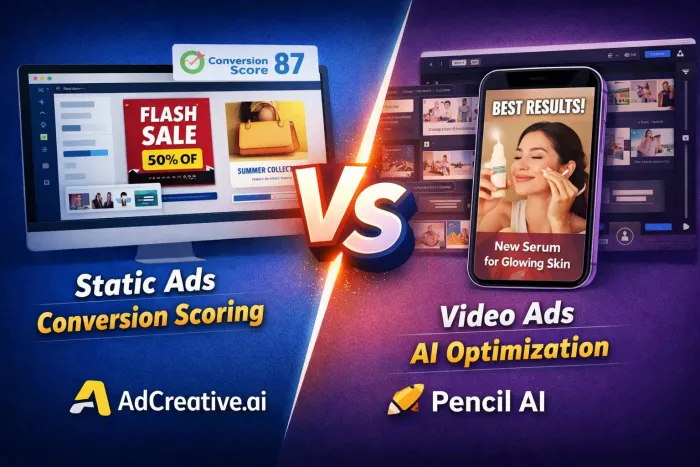
AI ad generation has matured significantly by 2026. What used to be basic template automation has evolved into predictive creative systems that attempt to improve performance outcomes, not just speed up design. Two platforms consistently discussed in performance marketing circles are AdCreative.ai and Pencil AI.
Both promise better ads, faster production, and measurable impact. However, they are built on different philosophies. One prioritizes high-volume static ad testing with predictive scoring. The other focuses on iterative, video-first creative that evolves with campaign data. This in-depth comparison breaks down how each platform works, what it costs, where it excels, and where it struggles, with clear recommendations based on real business scenarios.
What AdCreative.ai Is and How It Works
AdCreative.ai is primarily a static ad generation platform built for direct response marketers. Its core value proposition centers around speed and predicted performance. Users input product details, brand assets, and copy angles, and the system generates multiple ad variations optimized for platforms like Meta and Google Display.\
What differentiates AdCreative.ai from generic design automation tools is its performance scoring model. The platform assigns a “conversion score” to creatives based on trained AI models that analyze patterns from historical ad data. While this score is predictive rather than guaranteed, many marketers use it as a filtering mechanism before launching campaigns.
The workflow is straightforward. You define brand elements once, generate multiple creatives in bulk, select top-scoring versions, and export them for deployment. The system favors efficiency and speed over artistic experimentation. As a result, it tends to perform well for structured performance campaigns but may feel templated for brands that require high creative differentiation.
What Pencil AI Is and How It Works
Pencil AI takes a more iterative and video-focused approach. Instead of emphasizing static display ads, it concentrates on generating short-form video creatives designed for paid social platforms such as Meta and TikTok.
The platform can generate video ads from product URLs or structured inputs, automatically building storyboards with hooks, product shots, captions, and calls to action. What makes Pencil different is its feedback loop system. Once connected to ad accounts, it analyzes which creatives perform best and uses that data to inform future generations.
This creates a continuous optimization cycle. Rather than just producing large volumes of content, Pencil aims to refine and evolve creative based on campaign results. That model tends to work best for brands running significant paid spend where meaningful performance data exists to guide improvements.
Key Features Compared
| Feature Category | AdCreative.ai | Pencil AI |
| Primary Creative Format | Focuses heavily on static image ads optimized for Meta, Google Display, and LinkedIn. Ideal for direct response campaigns that rely on headline + product image combinations. | Primarily built for short-form video ads across Meta, TikTok, and YouTube. Designed for motion-first platforms where video drives engagement. |
| AI Generation Method | Generates multiple static ad variations from product details, brand assets, and copy prompts. Emphasizes speed and bulk output. | Builds structured video storyboards from URLs or product inputs. AI assembles hooks, product scenes, captions, and CTAs into a cohesive video flow. |
| Performance Prediction / Learning | Provides a “conversion score” based on trained AI models using historical ad patterns. Offers predictive guidance before launch. | Connects directly to ad accounts and learns from live campaign data. Improves future creative generation using real performance feedback. |
| Creative Iteration Model | Manual testing workflow. Marketers generate multiple creatives and choose which to test. AI scoring helps narrow options but does not auto-evolve creatives. | Iterative loop system. Performance data influences new creative batches. Designed to refine messaging and structure over time. |
| Copy Generation | AI-assisted headline, primary text, and CTA suggestions. Optimized for direct response clarity and conversion framing. | Generates video scripts, hooks, captions, and scene text overlays. Focused on narrative flow and scroll-stopping intros. |
| Bulk Generation Capabilities | Strong bulk generation. Users can produce dozens of static variations quickly for large-scale A/B testing. | Generates multiple video variants but not typically at the same high-speed bulk volume as static image tools. |
| Brand Management | Brand kit system for logos, fonts, colors, and product catalog integration. Ensures visual consistency across static creatives. | Supports brand guidelines and templates, but more focused on video structure and dynamic scenes than static design systems. |
| E-commerce Integration | Shopify integration for product data import and catalog-driven ads. Suitable for product-based static campaigns. | Strong Shopify integration. Optimized for DTC brands running video ads tied directly to product feeds and landing pages. |
| Collaboration & Workflow | Basic team access depending on plan. More focused on solo marketers and small teams. | More advanced collaboration tools including approvals, versioning, and structured workflows. Built with agencies and growth teams in mind. |
| Analytics & Reporting Depth | Provides AI scoring and limited performance insights. More predictive than analytical. | Offers deeper feedback loops connected to real ad account data. Designed for ongoing optimization rather than one-time generation. |
| Platform Deployment | Exports creatives for Meta, Google, LinkedIn. Static-first approach. | Built for Meta, TikTok, and video-driven channels. Better aligned with short-form video ecosystems. |
| Learning Curve | Relatively simple interface. Low onboarding friction. Suitable for beginners. | More advanced setup. Requires data syncing and structured workflow to unlock full optimization benefits. |
| Best Use Case | Rapid static ad testing at scale with predictive scoring guidance. | Structured video testing with performance-driven creative refinement. |
Pricing Structure and Cost Dynamics (2026)
Pricing is one of the biggest decision factors between these platforms.
AdCreative.ai typically uses a subscription model with monthly creative generation limits. Entry-level plans often start around the $29 to $39 per month range, though generation credits are limited. Mid-tier plans can range between $99 and $199 per month, depending on brand slots and creative volume. Enterprise pricing scales based on output needs and includes API or dedicated support options.
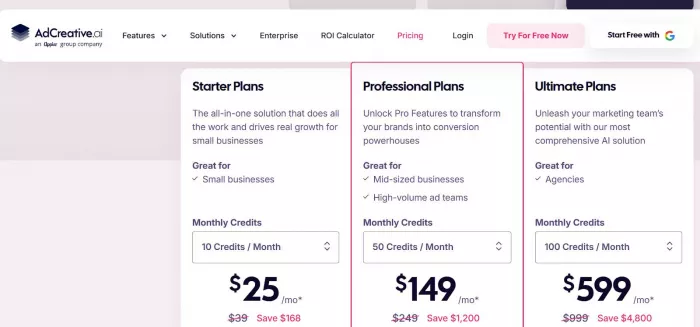
The most common criticism here is credit exhaustion. Marketers running aggressive testing cycles often report that entry plans run out quickly, requiring upgrades.
Pencil AI positions itself at a higher pricing tier. Starter access typically exceeds $100 per month, with growth and agency plans moving into several hundred dollars monthly. Enterprise tiers are custom-priced and designed for high-spend DTC brands.
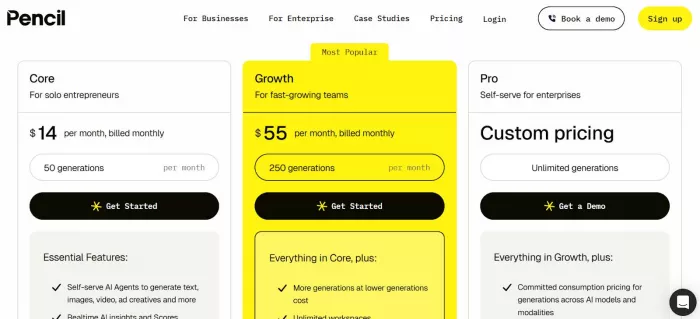
Because Pencil is video-centric and data-driven, the cost makes more sense for businesses investing heavily in paid media. For smaller advertisers, the pricing can feel disproportionate to output volume.
Unique Selling Points
AdCreative.ai’s strongest differentiator is predictive scoring. Even though it is not a guarantee of performance, many marketers appreciate having a data-informed signal before launching ads. It also excels at speed. Generating dozens of static ads within minutes makes it ideal for quick iteration cycles.
Pencil AI stands out through its iterative learning model. Rather than treating ad generation as a one-time action, it attempts to improve over time using campaign feedback. Its emphasis on short-form video aligns well with modern paid social trends where motion creative often outperforms static imagery.
The contrast is clear: AdCreative.ai optimizes for volume and immediate output. Pencil AI optimizes for long-term creative refinement.
Limitations and Reported Criticisms
AdCreative.ai’s primary weakness is creative sameness. Because it relies heavily on structured templates and AI layouts, some users report that ads can look formulaic. Additionally, the predictive score, while useful, is not always aligned with real-world performance outcomes.
Pencil AI’s limitations are largely cost-related. Smaller brands often struggle to justify pricing unless they are running sufficient volume to feed the algorithm. Some users also mention that video quality depends heavily on the input assets. Poor product images or weak messaging result in mediocre outputs.
In both cases, AI does not replace strategic thinking. Teams that treat these platforms as fully autonomous solutions often experience disappointment.
When You Should Choose AdCreative.ai
Choose AdCreative.ai if you are primarily running static ads, operating on a limited budget, or need rapid creative volume for testing multiple angles quickly. It is particularly effective for direct response marketers who want structured, performance-oriented designs without investing in video production.
When You Should Choose Pencil AI
Choose Pencil AI if your brand relies heavily on video advertising and you are running sufficient ad spend to generate meaningful performance data. It is more appropriate for DTC brands scaling on paid social and agencies managing video-first clients.
Final Recommendation Based on Business Goals
If your goal is affordability, high-volume static testing, and fast deployment, AdCreative.ai is likely the more practical option. If your goal is iterative creative evolution, structured video experimentation, and data-driven refinement at scale, Pencil AI may deliver stronger long-term value.
The decision ultimately depends on three variables: your monthly ad spend, your reliance on video versus static formats, and your tolerance for pricing relative to output volume. Matching the platform to your creative strategy is far more important than choosing the more advanced tool on paper.


Comments