From $5 to $199/Month: Best AI Tools for Social Media Scheduling



The social media scheduling market looks crowded, but the differences between tools are more structural than feature-based. Most platforms today can schedule posts, suggest captions, and provide basic analytics. What actually separates them is pricing logic and workflow design. Some tools are built for individuals trying to stay consistent, while others are designed for teams managing approvals, reporting, and multiple stakeholders.
This is why pricing varies so sharply. A solo user can operate comfortably under $20 per month, while a brand team can easily spend $199 or more per user. The cost increase is not about better scheduling. It reflects added layers such as collaboration, analytics depth, and operational control. Understanding this difference makes choosing the right tool much easier.
Quick Comparison Snapshot
| Tool | Starting Price | G2 Rating | Capterra Rating | Trustpilot Rating | Where It Actually Fits |
| Buffer | $5/month | 4.3 | 4.5 | 2.6 | Best for individuals who want a fast, minimal setup to schedule posts without dealing with complex workflows or heavy analytics |
| Publer | $12/month | 4.7 | 4.8 | 4.8 | Strong for users handling multiple accounts who need bulk scheduling, automation, and content recycling at a low cost |
| Metricool | ~$20/month | 4.5 | 4.6 | 4.0 | Ideal for freelancers and small agencies managing multiple clients with a need for basic analytics and centralized dashboards |
| Later | $18.75/month | 4.5 | 4.6 | 1.4 | Designed for creators and brands focused on visual platforms where previewing feeds and planning campaigns visually is important |
| SocialBee | $29/month | 4.7 | 4.6 | 3.9 | Works best for businesses running structured content strategies with recurring posts and category-based scheduling |
| Hootsuite | $199/user/month | 4.3 | 4.4 | 1.4 | Built for teams that need collaboration features like approvals, shared inboxes, and managing conversations at scale |
| Sprout Social | $199/user/month | 4.4 | 4.4 | 1.9 | Best suited for agencies and brands that rely heavily on reporting, analytics, and presenting performance data to clients |
What Actually Changes Between These Tools
The biggest misconception is that all tools are competing directly. They are not. Each one is solving a slightly different problem, even if the interface looks similar.
1. Buffer and Publer are built around simplicity and speed
2. Metricool focuses on managing multiple brands at low cost
3. SocialBee emphasizes structured content workflows
4. Later is designed for visual planning and campaign execution
5. Hootsuite and Sprout Social are built for team collaboration and reporting
This is why comparing them purely on features often leads to the wrong decision. The better comparison is how each tool fits into a real workflow.
Buffer vs Publer: Simplicity vs Value
Buffer remains one of the simplest tools in the market. Its pricing starts at around $5 per channel per month, making it accessible to individuals. The interface is clean, and scheduling is fast. However, its analytics are relatively basic, and it does not scale well for teams. (https://buffer.com/)

Publer, on the other hand, offers more automation at a slightly higher starting price of around $12 per month. It supports bulk scheduling, recycling posts, and managing multiple accounts more efficiently. This is why Publer often feels like a stronger value proposition, especially for users handling higher content volumes. (https://publer.com/)

The trade-off is clear. Buffer prioritizes ease of use, while Publer prioritizes capability per dollar. Users who want simplicity tend to prefer Buffer, while those looking for more control without paying premium prices often lean toward Publer.
Metricool vs SocialBee: Structure vs Flexibility
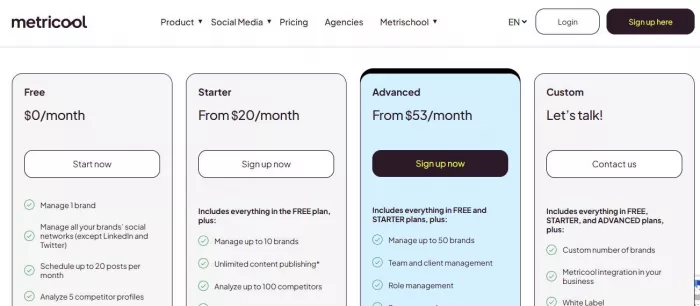
Metricool is built for users managing multiple brands. Its pricing model is based on brands rather than users, which makes it cost-efficient for freelancers and small agencies. It also includes analytics and competitor tracking, which adds more depth than most budget tools. (https://metricool.com/)
SocialBee takes a different approach. Instead of focusing on brands, it focuses on content structure. It allows users to organize posts into categories and recycle evergreen content automatically. This makes it particularly useful for businesses that rely on consistent, repeatable posting strategies. (https://socialbee.com/)

The difference comes down to workflow. Metricool is better for handling multiple clients, while SocialBee is better for managing content systems within a single brand.
Later: The Middle Ground
Later sits between budget tools and enterprise tools. Its pricing starts around $18.75 per month and scales based on social sets and users. The platform is built around visual planning, which makes it especially useful for Instagram and TikTok-focused workflows. (https://later.com/)
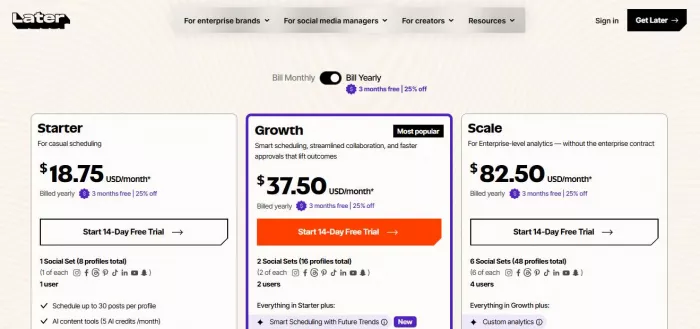
The key advantage of Later is how it presents content before publishing. Teams can preview posts, plan campaigns visually, and maintain consistency across platforms. This makes it more structured than Buffer or Publer, but still far more affordable than Hootsuite or Sprout.
Its limitation is analytics depth. While it performs well for planning and scheduling, it does not offer the same level of reporting or operational control as higher-end tools.
Hootsuite vs Sprout Social: Operations vs Insights
Hootsuite and Sprout Social operate in a different category entirely. Both start at around $199 per user per month, and both are designed for teams rather than individuals.
Hootsuite focuses on operations. It includes features like shared inboxes, approval workflows, and social monitoring. This makes it useful for teams that need to manage conversations and coordinate across multiple users. (https://www.hootsuite.com/)

Sprout Social focuses more on analytics. It offers deeper reporting, better data visualization, and tools designed for presenting insights to stakeholders or clients. This makes it more appealing for agencies and brands that rely heavily on reporting. (https://sproutsocial.com/)
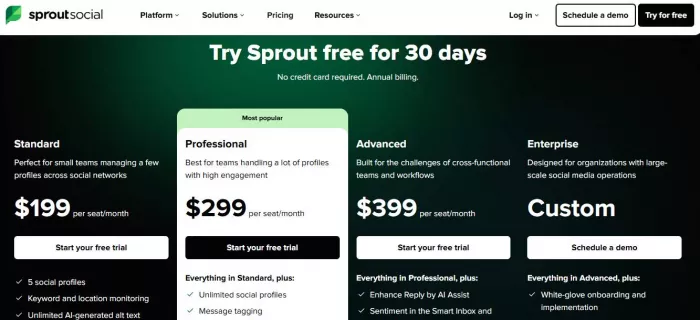
The key difference is where the value comes from. Hootsuite improves workflow efficiency, while Sprout improves decision-making through data.
How to Choose the Right Tool
Choosing the right tool depends less on features and more on how you work.
● Working alone and need consistency? Buffer or Publer is usually enough
● If you manage multiple clients, Metricool offers better cost efficiency
● When your strategy relies on structured content, SocialBee is more effective
● When visual planning matters, Later provides a better workflow
● If you work in a team, Hootsuite or Sprout becomes necessary
The decision becomes straightforward once the workflow is clear. Problems arise when users choose tools designed for a different scale than their own.
Key Takeaway
The social media scheduling space is not about finding the most powerful tool. It is about finding the right level of complexity.
Tools like Buffer and Publer succeed because they remove friction. Tools like Hootsuite and Sprout succeed because they add structure and control. Neither approach is better on its own.
The best choice depends entirely on whether the goal is to publish efficiently or to manage social media as a coordinated operation.


Comments