Cadillac LYRIQ Driving Modes Explained: Do They Affect Battery Range?


Introduction
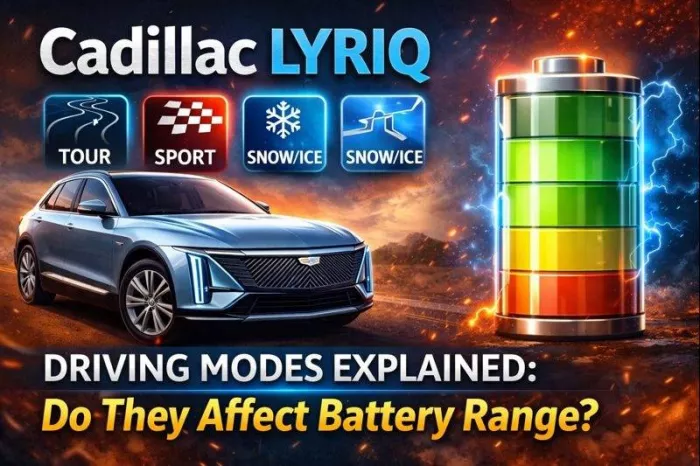
Cadillac’s LYRIQ includes multiple driver-selectable modes (commonly Tour, Sport, Snow/Ice, and My Mode) that “adjust multiple systems to suit specific driving needs,” with availability depending on trim/region/options.
What doesn’t change is the battery’s physical capacity modes mainly change how the vehicle responds (pedal tuning, steering effort, etc.), which can indirectly affect efficiency and range based on how you drive.
Do driving modes change the LYRIQ’s “official” range?
Not directly. The official EPA-estimated range of the LYRIQ is determined primarily by the vehicle’s hardware configuration, not by the driving mode you select on a daily basis.
Vehicles from Cadillac are tested for range under standardized EPA procedures, and those tests are based on factors such as:
- Powertrain configuration (single-motor RWD vs dual-motor AWD)
- Vehicle weight
- Wheel and tire size
- Aerodynamics
- Battery capacity
- Motor efficiency
For example:
- Single-motor rear-wheel-drive (RWD) versions achieve higher range because they use less energy.
- All-wheel-drive (AWD) models have two motors, which increases performance but slightly reduces efficiency.
- Performance versions like LYRIQ-V focus more on power, which typically lowers range compared to efficiency-focused trims.
Driving modes such as Tour, Sport, or Snow/Ice do not change the battery size or motor hardware, so the official EPA number stays the same regardless of which mode you choose.
However, driving modes can influence real-world range indirectly. For instance:
- Sport mode may encourage stronger acceleration.
- Snow/Ice mode softens throttle response.
- Tour mode tends to promote smoother driving.
So while the official range rating stays fixed, your actual daily range can vary depending on how the mode affects your driving behavior.
How Driving Modes Affect EV Range and Battery
Driving modes can change energy use per mile by influencing:
1) Accelerator mapping (how hard the car “pushes” for the same pedal input)-
● Snow/Ice explicitly slows/softens pedal response to help traction.
● Sport is described as changing “pedal tuning” and other dynamics-related settings.
Range impact (typical): A more aggressive pedal map can make it easier to accelerate harder (using more energy), while a gentler map can help smoother driving.
2) How the vehicle prioritizes performance vs efficiency-
● Sport mode can modify steering effort, pedal tuning, sound enhancement, adaptive cruise behavior, and suspension tuning (if equipped).
Some of these don’t meaningfully change energy use (like steering feel), but they can encourage a more performance-oriented driving style.
3) Your actual driving behavior (the biggest factor)-
Even if the mode itself isn’t “burning the battery,” it can nudge you toward:
● faster launches
● higher average speeds
● more frequent passing bursts
Those are what usually reduce range.
Additional Features Impacting Range
These often matter as much or more than drive modes:
1) Regenerative braking settings (can help efficiency in stop-and-go)-
Cadillac explicitly frames Regen On Demand as something that can “help enhance driving range,” allowing you to slow the vehicle using a steering-wheel paddle.
One-Pedal Driving also increases deceleration when you lift off the accelerator.
2) HVAC and cabin comfort loads-
Heat/AC can noticeably affect consumption (especially heat in colder weather). (Cadillac doesn’t quantify this on the cited pages, so treat this as general EV behavior rather than a LYRIQ-specific claim.)
3) Tire pressure, wheels/tires, and road conditions-
Underinflation, winter tires, rough roads, and cold temperatures can reduce efficiency. (Again: general EV behavior; not quantified in the cited sources above.)
4) Speed profile (highway vs city)-
Independent road tests commonly note real-world highway driving can land below EPA figures for many EVs; Car and Driver notes it can be “difficult to achieve” the EPA number mostly on highway miles.
Cadillac LYRIQ Driving Modes Compared
Below is an evidence-based comparison of what the modes do, plus the likely range direction based on how they shape driving.
| Mode | What it changes | What it’s for | Likely range effect |
| Tour | Listed as a core mode in Driver Mode Control. | Everyday driving / balanced feel | Usually best baseline for efficiency if you drive smoothly |
| Sport | Modifies steering effort, pedal tuning, sound enhancement, adaptive cruise, suspension tuning (if equipped). | Sharper response / more dynamic feel | Can reduce range if it leads to harder acceleration or higher speeds |
| Snow/Ice | Adjusts pedal tuning/map to optimize traction; helps prevent wheel slip; can compromise acceleration on dry roads. | Slippery conditions | Efficiency may improve or worsen depending on conditions; traction stability is the priority |
| My Mode | Lets you personalize subsystem settings (examples shown include acceleration feel and brake feel). | Custom daily setup | Could be efficient or inefficient depending on your chosen settings |
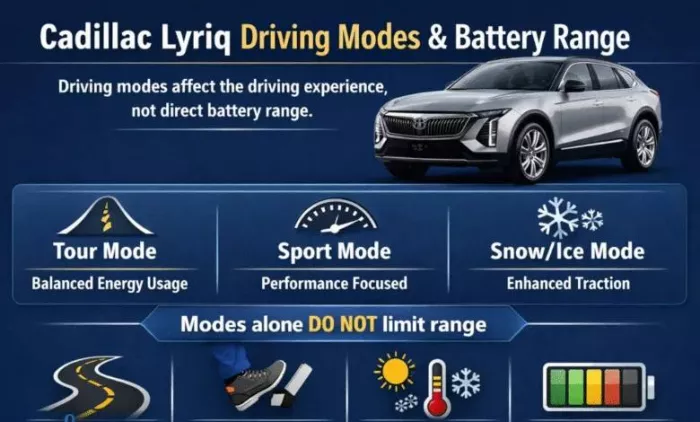
Key takeaway: Modes mostly change vehicle behavior, not battery size so the “range difference” is usually a driver-behavior difference.
How to Maximize Your Cadillac LYRIQ’s Range
1. Use Tour mode for daily driving-
Tour mode is tuned for smooth, balanced response. It helps prevent overly aggressive acceleration, which typically consumes more battery power. Sport mode is fun, but using it constantly can encourage faster starts and higher energy use.
2. Use regenerative braking in traffic-
Instead of wasting energy as heat through normal braking, regenerative braking sends some energy back to the battery when slowing down.
● Regen On Demand lets you manually slow the car and recover energy.
● One-Pedal Driving automatically increases deceleration when you lift off the accelerator, making stop-and-go traffic more efficient.
3. Accelerate smoothly and keep steady speeds-
Hard acceleration and constant speed changes drain battery faster. Smooth acceleration and steady cruising especially on highways have the biggest impact on range.
4. Use Snow/Ice mode for safety, not efficiency-
Snow/Ice mode is meant to improve traction on slippery roads. It softens power delivery, but the main purpose is control and safety, not maximizing range.
5. Set My Mode for relaxed driving-
If you customize My Mode, choosing calmer throttle response and smoother settings can help maintain efficiency during daily commuting.
Bottom line
Yes, driving modes can lead to different real-world range outcomes but mostly because they change pedal response and driving dynamics, which change how people drive. Cadillac’s documentation shows Sport and Snow/Ice alter pedal tuning/map and other subsystems, while My Mode can customize response.
No, they don’t create a different “battery” or a separate official range rating the way changing trims/powertrains does.


Comments