Chub AI Honest Review: Custom Characters, NSFW Freedom and Hidden Limits




Chub AI sits in a very specific corner of the AI world: it is less a productivity bot and more a sandbox for long‑form, often NSFW, character roleplay and interactive storytelling. Used well, it feels like a highly configurable narrative engine; used poorly, it is an unfiltered distraction with real safety and value trade‑offs.
Strip away the marketing and you get this: a highly customizable frontend interface that connects user-designed character personalities to powerful AI backends either through native models or your own API keys and wraps it in one of the largest community-built character libraries anywhere on the internet. The platform is built for creative writers, roleplay enthusiasts, world-builders, and technically inclined users who want absolute control over how their AI characters behave, remember, and respond.
The Architecture: What Chub AI Actually Is
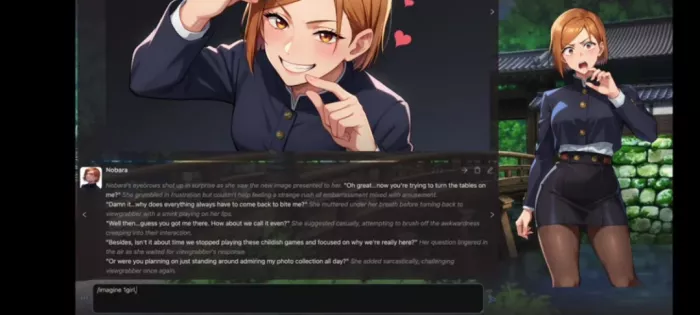
The single most common source of user frustration with Chub AI is a fundamental misunderstanding of its design. People arrive expecting it to work like Character AI, open the app, pick someone, start talking. Chub requires considerably more involvement, and the payoff for that involvement is commensurate.
◈ The Interface Layer : Chub itself the website and Android app. Manages character libraries, chat UI, memory scaffolding, Lorebooks, and prompt engineering. Generates nothing on its own.
◈ The Character Layer : Community-created or user-built character cards. Persona, backstory, tone, sample dialogue. This is what makes the AI feel like "someone" rather than a generic assistant.
◈ The Memory Layer : Lorebooks keyword-triggered context injection. The AI's long-term memory system. Stores lore, facts, and world rules that re-enter the context window when relevant keywords appear.
◈ The Model Layer : The actual AI brain. Either Chub's native Soji models (paid tiers), rotating free test models, or your own API keys (OpenAI, Claude, Gemini, NovelAI, OpenRouter, Kobold).
This layered structure is both the platform's greatest strength and its steepest learning curve. When all four layers are configured well, the result is AI storytelling of a quality and consistency that simpler platforms cannot replicate. When any one layer is poorly set up, the experience degrades fast; characters go off-script, forget key facts, or produce responses that feel generic and repetitive.
Chub is not a product you consume. It is a workshop you build things in. That distinction explains almost every positive review and almost every negative one; it depends entirely on whether the user brought the blueprint.
Feature Inventory: Depth Over Breadth
1. Character Cards : The foundational unit of the Chub experience. A character card is essentially a structured prompt package persona, backstory, scenario, example dialogues that shapes how an AI model behaves within a conversation. The community library contains hundreds of thousands of these cards, covering original creations, fictional universes, historical figures, and interactive scenario setups. The tagging and search system is granular enough to find remarkably specific content quickly.
2. Lorebooks — The Memory System : This is the feature that separates Chub from every simpler competitor. A Lorebook is a keyword-triggered context injection system. You define entries essentially facts, lore, or world-building details and attach trigger keywords to each. When those keywords appear in conversation, the relevant information is silently injected into the AI's context window, simulating long-term memory within the constraints of token limits.
The Lorebook system is genuinely brilliant when you invest in it. My character remembers that the silver locket was her mother's, that she's afraid of heights, that the village burned because I put it all there. It takes time, but the consistency is unlike anything else I've tried. - Reddit user · r/CharacterAI community · 2025
3. Flexible Model Backends : Chub's model-agnostic approach is a genuine differentiator. Rather than being locked into a single AI, users can route conversations through OpenAI, Anthropic's Claude, Google Gemini, NovelAI, or locally-run models via Kobold/Ooba. This means power users can bring their own high-performance API keys and use Chub purely as a character management and memory layer effectively getting world-class model quality at the cost of their API usage, not Chub's subscription.
4. Group Chats and Stages : Multi-character conversations talking to two or more AI personas simultaneously is a feature that roleplay writers find genuinely valuable for narrative construction. The Stages feature allows users to embed custom interactive elements (choices, scene transitions, conditional branches) into conversations, approaching the territory of interactive fiction rather than simple chat.
5. The Wizard — Multimedia Generation : Chub's generative toolkit extends to text, images, AI voice, music, and 3D assets within a single platform on higher-tier plans. This is ambitious, and reviews suggest it's impressive in concept but inconsistent in execution the quality of generated outputs varies considerably depending on what you're asking for.
| Feature | Free | Mercury ($5/mo) | Mars ($20/mo) | Key Limitation |
| Character library access | Full | Full | Full | Content quality depends on community creators |
| Native AI models | Rotating test models | 13B models, 8K memory | 70B+ Soji, unlimited | Free models are inconsistent in quality |
| Lorebook support | Available | Available | Full | Requires manual setup; steep learning curve |
| BYO API keys (OpenAI, Claude, etc.) | Available | Available | Available | Separate API costs apply; not counted in subscription |
| Group chats / multi‑character | Basic | Available | Full | Complexity rises sharply with multiple personas |
| Context window (memory) | Limited | 8K tokens | Extended | “Dementia” (context loss) is a persistent user complaint |
| Image / voice / 3D generation (Wizard) | Not available | Partial | Full | Quality inconsistent; multimedia outputs need polish |
| NSFW content access | User‑controlled | User‑controlled | User‑controlled | Depends on backend model’s own policy |
| iOS app | Not available | Not available | Not available | Android only; major mobile revenue gap |
| Chat data privacy | Browser‑local storage | Browser‑local storage | Browser‑local storage | Clearing cache deletes conversation history |
More Control Behind the Chat
Chub gives experienced users considerably more control over the prompt than a typical character chatbot. System prompts, post-history instructions, prompt notes, assistant prefills, and model-specific presets can all influence how a character responds.
That means two people using the same character card can still get noticeably different conversations depending on how their settings are configured. Tone, response length, roleplay style, and how closely the AI follows a character description can all change.
The downside is that these controls add another learning curve. For users willing to experiment, however, they are one of the reasons Chub feels more flexible than simpler AI companion platforms.
Pricing: Reasonable on Paper, Contested in Practice
| Plan | Price | AI Model Access | Context Window | Value Assessment |
| Free | $0 | Rotating test models | Limited | Enough to evaluate the platform; not enough for serious use |
| Mercury | $5/month | 13B parameter models | 8K tokens | Good entry point; moderate memory; fine for casual storytelling |
| Mars | $20/month | 70B+ Soji models, uncensored | Extended | Competitive value contested; community compares to sub-$10 DeepSeek alternatives |
| BYO API | API costs only | Your choice (GPT-4, Claude, etc.) | Model-dependent | Best quality at potentially highest cost; ideal for power users |
The Mercury tier at $5/month is generally considered reasonable; it's an accessible entry point that unlocks enough functionality to meaningfully explore the platform. The Mars tier at $20/month is where reviews become more polarized. Community members frequently draw direct comparisons to competitors offering DeepSeek-based models at lower price points, and the question of whether Soji's quality justifies the premium is genuinely contested rather than settled.
One notable nuance: subscribers report paying partly to support the platform's infrastructure rather than exclusively for model access, an unusual but not uncommon dynamic in community-built tools where user goodwill plays a real role in sustainability.
What Real Users Are Saying
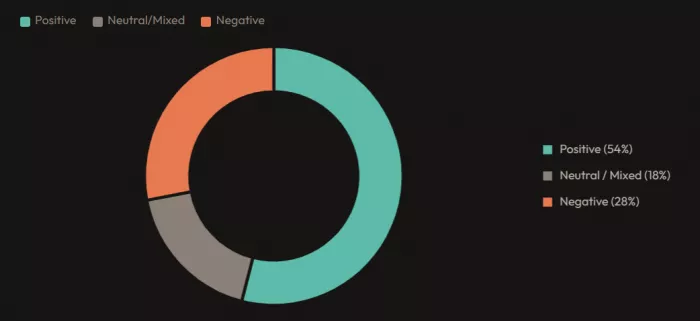
Overall sentiment across review platforms and community forums sits at 54% positive, 18% neutral, and 28% negative. That's a more divided picture than platforms like Character AI, and it maps almost perfectly to the technical divide: users who invested the time to learn the system love it; users who arrived expecting simplicity are frustrated.
| Source | Score | Star Rating | Notes |
| Community sentiment (overall) | 54% | ★★★½☆ | Positive reviews (aggregated) |
| Reddit (r/roleplay / forums) | 3.9 | ★★★★☆ | Power users, highly vocal |
| Android (Play Store) | 3.6 | ★★★½☆ | Stability + model complaints |
| Independent reviews | 3.8 | ★★★¾☆ | Mixed; strong for power users |
What Users Praise
● The Lorebook and character customization system are consistently described as unmatched among comparable platforms. Writers building complex fictional universes repeatedly cite this as the deciding factor in choosing Chub over alternatives. reddit
● The BYO API model flexibility bringing Claude or GPT-4 as the backend while using Chub's character and memory infrastructure is described as a genuinely powerful combination by technically sophisticated users.
● Community size and character diversity the sheer volume of community-created characters across every genre, franchise, and original concept means most users find existing content without needing to build from scratch.
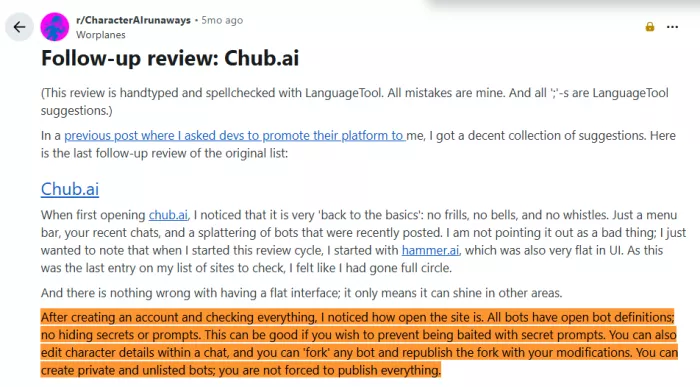
● Developer responsiveness the development team's presence in community forums and openness to feedback is noted positively and contrasts favorably with how larger, more corporate platforms handle user input.
● No intrusive ads on the free tier compared to apps like Question AI, Chub's free experience is considerably less disruptive.
What Users Criticize
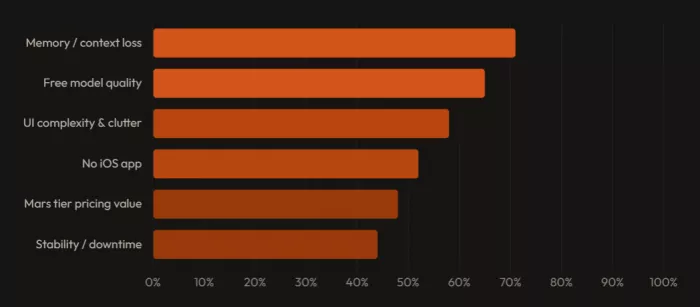
● The "dementia" problem context window limitations cause characters to forget key facts mid-conversation. This is the single most common complaint in long-form roleplay communities, described with notable frustration.
● Free model quality rotating test models available to non-paying users are inconsistent, frequently repetitive, and described as struggling with complex multi-character scenarios.
● UI complexity and visual clutter the interface evolved from separate platforms (CharacterHub and Venus AI merged in May 2024) and still shows the seams. Navigation is non-obvious, and update rollouts have introduced confusion.
● No iOS app - the absence from the App Store is a material competitive disadvantage in a mobile-first market where 64% of AI companion spending happens on smartphones.
● Pricing value perception at the Mars tier $20/month draws frequent comparison to competitors offering DeepSeek-based models for under $10. Users question whether the premium is justified by model quality alone.
The "dementia" issue broke my 80-message campaign. The character forgot her own name, her motivation, and the entire plot setup from the first ten messages. Lorebooks help, but only if you've built them perfectly which takes hours before you even start the actual story. - Community forum · Chub AI alternatives thread · 2026
User sentiment breakdown
Aggregated across community forums, Reddit, Android reviews, and third-party analysis (2025–2026)
Top complaint themes — negative reviews
Ranked by mention frequency across review platforms and community discussions
The Memory Problem : Chub's Structural Achilles Heel
Context window limitations are not unique to Chub. Every AI platform faces them. What makes the issue particularly visible here is the expectation mismatch: users investing hours building rich character lore expect that lore to remain intact across long sessions. When it doesn't, when a character abruptly forgets their own backstory or contradicts established facts from 30 messages ago the collapse is jarring in a way that a simple hallucination in a factual assistant isn't.
The Lorebook system exists precisely to address this, and it works but only for users who understand it deeply enough to build it properly. The information doesn't live in the AI's working memory; it's injected only when specific keywords appear in the conversation. Miss a keyword, forget to update the Lorebook as the story evolves, or structure your entries poorly, and the system provides no protection at all.
The core tension : Chub's memory architecture places the burden of continuity entirely on the user. Lorebooks are not automatic. Chat summaries are not automatic. The platform gives you the tools; it doesn't deploy them for you. For experienced users, this is control. For everyone else, it's the thing that makes their characters lose their minds.
Competitors like Kindroid are gaining meaningful traction specifically by addressing this gap offering cascaded memory systems with manual "memory pinning" that persists key story milestones regardless of context window state. It's a significant UX advantage, and Chub's community forums reflect awareness of it.
The "Unfiltered" Question : What It Actually Means
The word "unfiltered" brings users to Chub. It is also the most misunderstood word in the platform's vocabulary.
Chub AI the interface applies no content filters of its own. It will not interrupt your conversation, flag your prompts, or block you from exploring mature or dark themes at the platform level. But Chub is an interface, not an AI. The "brain" behind your conversations whatever backend model you connect operates under its own rules entirely. Connect to OpenAI's API, and OpenAI's content policy governs the responses. Connect to Anthropic's Claude, and Claude's values apply. The only way to experience genuinely unfiltered responses is to either use Chub's own Mars-tier models (specifically positioned as uncensored) or connect to local/open-source models you run yourself.
Critical distinction : Chub = no platform-level filter. Your AI backend = its own rules still apply. Most users who discover this are using OpenAI or Anthropic as their backend, which means they are not actually "unfiltered" in the way they expected. This is the most common source of disappointed reviews about Chub's freedom.
The NSFW content ecosystem within Chub is also a legitimate concern from a content moderation standpoint. The platform's search and reporting tools for problematic content are described by multiple community reviewers as insufficient for the scale of the library. The responsibility is explicitly user-side, which works for adult communities with self-governance capacity but creates real risks in a broader access environment.
Competitive Position: Leading on Depth, Trailing on Scale
| Dimension | Chub AI | Character AI | Janitor AI |
| Character customization depth | Best-in-class | Moderate | Good |
| Long-term memory continuity | Manual (Lorebooks) | Strong | Moderate |
| Ease of use for beginners | Low | High | Moderate |
| NSFW / content flexibility | High (user-controlled) | Restricted | High |
| iOS app availability | No | Yes | Yes |
| BYO model / API flexibility | Excellent | None | Good |
| Conversation automation / workflow | Moderate | Low | Strong |
The competitive gap in raw traffic is enormous: Character AI's 180 million monthly visits against Chub's 7–14 million. But this comparison is somewhat misleading, because they're not competing for the same user in the same way. Character AI is a mass-market companion app; Chub is a specialist creative tool. The more meaningful competitive threat comes from platforms like Kindroid on the memory side and JanitorAI on the ease-of-use side platforms that serve similar audiences with meaningfully better execution on specific dimensions.
Privacy and Data: A Structure Worth Understanding
Chub's privacy architecture is genuinely different from most platforms, and the difference matters.
● Conversation history is stored in your browser's local storage, not on Chub's servers. This means clearing your browser cache deletes your entire chat history permanently. It's a meaningful privacy benefit and a meaningful usability risk users regularly report lost conversations from cache clears or browser switches.
● Your prompts are processed by your backend AI provider OpenAI, Anthropic, or whoever you connect. Those providers have their own data policies and logging practices, which Chub does not control or account for in any meaningful way from the user's perspective.
● Public character cards and Lorebooks are stored on Chub's servers because they're community assets. Private characters you mark non-public have a different treatment.
● The platform's open content ecosystem user-generated characters with minimal vetting creates meaningful content safety gaps, particularly for younger users who may not realize what they're navigating into.
The privacy upside : For privacy-conscious users, the browser-local chat storage model is actually a meaningful advantage over platforms that centrally log all conversations. You control the data as long as you understand that control means you're also solely responsible for backing it up.
Chat Export Is Surprisingly Useful
Chub is not completely locked into its own interface. Users can export conversations in formats such as plain text, PNG, or JSONL, including files that can work with tools like SillyTavern.
This is particularly useful for longer roleplay sessions where losing a conversation would be frustrating. Writers can keep personal backups, save useful character interactions, or move conversations into another compatible setup instead of depending entirely on Chub to store everything.
For users who spend a lot of time building detailed characters and storylines, that portability is a small feature that becomes much more valuable over time.
The Model Quality Debate : Soji and Its Limits
Chub's native model, Soji, is the centerpiece of the paid tiers. The community's assessment of it is nuanced: Soji performs well for creative, emotionally-toned roleplay scenarios the domain it was tuned for but shows meaningful weaknesses in extended logical coherence, complex multi-character reasoning, and the kind of deep narrative consistency that long-form collaborative fiction requires.
A substantive Reddit discussion on the topic revealed something telling: the community is split between users who prioritize UI improvements and users who want model quality upgrades. Those who engage in deep, complex story sessions consistently argue that model quality is the engine improving the interface without improving what's underneath is rearranging the furniture while the foundation has cracks. The development roadmap's weighting between these two priorities is an open and contentious question in the community.
Soji is great for emotional depth and atmospheric prose. But ask it to track five characters across 60 messages with consistent motivations and it starts making everyone sound the same. For that kind of complexity I bring my own Claude API key and just use Chub for the character scaffolding. _ Power user · Community forum · Late 2025

The fact that many of Chub's most satisfied users bypass the native models entirely using the platform purely as a character interface for external APIs is simultaneously a strength (the platform is genuinely useful as a standalone orchestration layer) and a concern (it suggests the native model offering isn't winning on its own merits).
Who Chub AI Is For And Who Should Look Elsewhere
| User Type | Verdict | Notes |
| Experienced writers & world-builders | Excellent fit | Lorebooks and character depth reward the investment |
| Roleplay communities (anime, fantasy, RPG) | Strong fit | Character library and customization purpose-built for this |
| Technical users who want API flexibility | Strong fit | BYO API model is genuinely powerful |
| Casual users wanting simple AI chat | Poor fit | Setup complexity will frustrate and disappoint |
| Mobile-primary users (iPhone) | Not available | No iOS app; web experience on mobile is not optimized |
| Users seeking emotional companionship | Partial fit | Possible with right setup; less turnkey than competitors |
| Game developers, interactive fiction authors | Good fit | Stages and branching scenario tools offer real value |
| Under-18 users | Not appropriate | Open NSFW content ecosystem; limited moderation |
Final Assessment
For the user who knows exactly what they want, deep character control, flexible AI backend, a massive community library, and the patience to build their world properly Chub AI remains the most capable platform in its specific niche. Nothing else offers the Lorebook system's precision, the API flexibility's power, and the community library's breadth in a single environment.
But the platform is visibly at a crossroads. Traffic declined 21.8% in mid-2025 and has only partially recovered. Competitors are catching up on memory management the one area where Chub's architecture is genuinely lagging. The lack of an iOS app is a structural revenue gap in a mobile-first market. And the native Soji model, while competent, doesn't consistently justify the $20/month Mars tier against the backdrop of cheaper alternatives using similar base architectures.
The most honest version of this verdict: Chub AI is still the best tool on the market for what it specifically does. The question heading into 2026 is whether "what it specifically does" is a sufficiently large and stable market to sustain a platform that has made almost no concessions to accessibility, mobile, or mainstream appeal. For now, the answer is yes but the margin is narrowing.


Robertson Wallerstein
Sep 22, 2026Lorebooks took a little time to understand but they made a noticeable difference once I set one up properly. The character remembered small story details much better and the conversation felt more consistent. There’s definitely more control here than in most character chat apps I’ve used.
Login To Reply ↪