Google Block Breaker: The Game You’re Sure You Played


Type “Google Block Breaker” into a search bar and something curious happens.
You do not land on a clean, official Google page explaining a game. Instead, you fall into a maze of half-remembered experiences, forum posts, YouTube clips, browser games, and nostalgic comments that all seem to agree on one thing: yes, this existed—even if no one can quite agree how, where, or when.
Some people swear they played it directly inside Google Search. Others remember colored blocks falling apart across an image grid. A few are convinced it was just another name for something else. And slowly, a deeper realization creeps in.
“Google Block Breaker” might not be a single, official product at all.
It might be a cultural blur.
The Almost-Game That Lives in Search Memory
The phrase “Google Block Breaker” feels specific. Too specific to be random. Yet vague enough to escape precise definition.
Unlike well-documented Google Easter eggs, there is no product page, no press announcement, no archived Google blog post titled “Block Breaker.” And yet, millions of people seem confident they encountered something—a block-breaking game tied to Google, played casually, discovered accidentally.
That tension between certainty and absence is the heart of the mystery.
What people are usually remembering is not a single game called Google Block Breaker, but a collision of three things:
● A classic arcade genre built around breaking bricks
● Google’s long history of playful, hidden interactive experiences
● The way memory compresses similar digital moments into one label
To untangle it, we have to rewind far before Google existed.
When Breaking Bricks Was Revolutionary
In 1976, a simple idea changed arcade gaming forever: a paddle, a ball, and rows of blocks that shattered on impact.
That idea became Atari Breakout.
There was no story. No characters. No ending, really. Just momentum, physics, and escalating difficulty. The appeal was immediate and strangely hypnotic. Players were not exploring a world; they were maintaining balance, reacting to failure in milliseconds, and chasing the small pleasure of perfect angles.
Breakout’s influence spread everywhere.
Home consoles, early PCs, school computers, and later browsers all inherited the same DNA. Decades passed, graphics evolved, but the core loop stayed untouched because it worked.
By the time the internet became mainstream, brick-breaker games were already a cultural muscle memory.
How Google Accidentally Became a Game Platform
Google never set out to be a game company. But it did become something else just as powerful: a place where people discovered surprise.
Search engines are supposed to be serious. Utility-driven. Predictable.
Google quietly broke that expectation.
Over the years, users discovered that typing certain phrases did more than return links. It triggered moments of delight. Gravity flipped. Pages spun. Dinosaurs ran endlessly across offline screens.
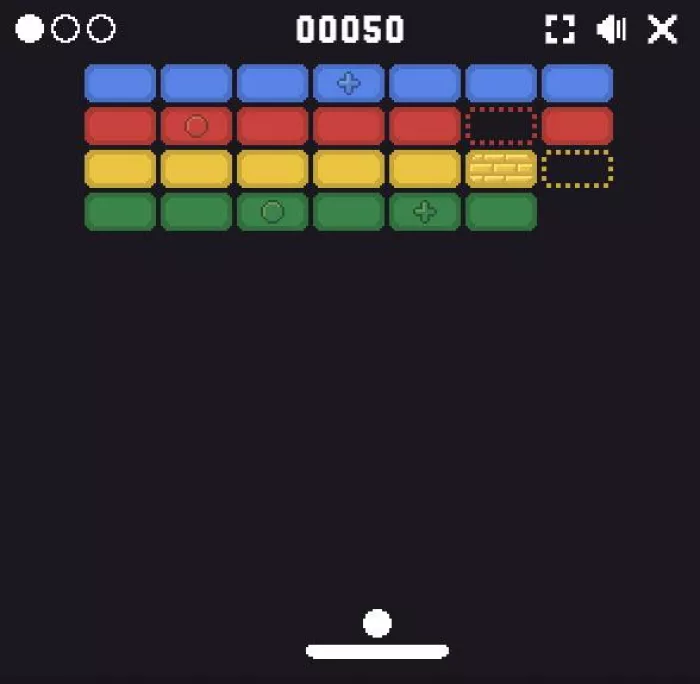
One of the most famous moments happened when users searched images for “Atari Breakout.” The entire image grid transformed into a playable brick-breaker, with thumbnails becoming destructible blocks.
It was clever. It was unexpected. And crucially, it was unannounced.
You found it by accident or by word of mouth.
That single experience did more to plant the idea of a “Google block-breaking game” in people’s minds than any official release ever could.
When a Search Bar Became a Playground
What made Google’s playful experiments feel magical was not complexity. It was restraint.
These games were:
- Instantly accessible
- Unbranded or lightly branded
- Free of menus, accounts, or explanations
- Discovered, not advertised
You did not decide to play. You stumbled into play.
That distinction matters.
When people talk about “Google Block Breaker,” they are often recalling a moment when work blurred into play. A five-minute break turned into ten. Curiosity turned into muscle memory. And the browser briefly stopped being a tool and became a toy.
Memory, Misnaming, and the Internet’s Mandela Effect
Human memory is not a recording. It is a remix.
Over time, we compress experiences. We rename them. We merge similar moments into a single label that feels right. “Google Block Breaker” is one of those labels.
It is easier to remember a generic name than a specific search trick. Easier to say “Google had a block breaker game” than “there was an image search Easter egg tied to Atari Breakout.”
Search engines amplify this effect. When thousands of people type the same approximate phrase, it starts to feel real simply because it is shared.
The internet rewards familiarity over precision.
And so the name sticks.
Why Simple Games Refuse to Die
There is a reason brick-breaker games keep resurfacing across decades, platforms, and generations.
They sit at a perfect psychological intersection.
● Low cognitive load
Brick-breaker games are instantly understandable. There are no mechanics to memorize or systems to learn. Within seconds, the brain knows what to do, which removes friction and makes starting feel effortless rather than demanding.
● Immediate feedback
Every action produces a clear result. When the ball hits a block, it disappears. When the paddle misses, the consequence is immediate. This tight cause-and-effect loop keeps attention engaged without requiring long-term focus.
● Near-miss tension
Failure rarely feels random. When the ball slips past the paddle, it feels like it almost could have been saved. That sense of control encourages quick retries without creating real frustration.
● Short, self-contained sessions
The games fit naturally into brief breaks. You can play for thirty seconds or five minutes without losing context, making them ideal for moments of boredom or mental reset.
● Aligned with fragmented attention
Modern attention comes in short bursts. Brick-breaker games match that rhythm perfectly, allowing players to drop in and out without commitment.
● Low emotional investment
You are not attached to a story or character. You are simply reacting, adjusting, and continuing. That makes the experience feel light and repeatable.
Together, these qualities explain why simple games never disappear. You do not commit to them. You briefly visit them and that is enough to keep them alive.
Official Play vs. The Clone Explosion
As interest grew, so did imitation.
Countless browser-based “block breaker” games now claim inspiration from Google, even when they have no official connection at all. Some are lovingly built. Others are rushed copies designed to capture search traffic.
The difference matters more today than it did ten years ago.
Here is a clear snapshot of how these experiences typically differ:
| Aspect | Classic Breakout | Google-Style Easter Eggs | Modern Browser Clones |
| Intent | Full arcade game | Playful surprise | Traffic-driven or casual |
| Trust | High | Very high | Varies widely |
| Ads & tracking | None | None | Often heavy |
| Discovery | Arcades, consoles | Accidental search | Direct links or SEO |
| Longevity | Timeless | Temporary | Inconsistent |
The risk is not just annoyance. Poorly built clones can introduce aggressive ads, misleading buttons, or even security issues. The nostalgia that pulls people in can also lower their guard.
That contrast highlights why Google’s minimalist approach felt so safe and refreshing.
Why the Name Still Gets Searched
People are not just searching for a game. They are searching for a feeling.
They remember:
- A sudden smile in the middle of work
- The joy of discovery without instruction
- A reminder that the internet used to surprise them
Search queries like “Google Block Breaker” are attempts to retrace that moment. To see if it still exists. To confirm it was not imagined.
Sometimes the answer is disappointing. Sometimes it leads to a decent clone. Sometimes it leads back to a YouTube clip of the original Easter egg.
But the search itself is the point.
The Quiet Legacy of a Game That Was Never Named
Google Block Breaker may never have been an official title. It may never appear in a product archive. It may never have had a launch date.
Yet it lives on because it captures something rare.
A time when the web felt smaller. Kinder. More curious.
A time when productivity tools occasionally winked back at us and said, go ahead, play for a minute.
And maybe that is why the memory refuses to fade.
Not because the game mattered.
But because the moment did.


Comments