Hacks for Blooket Explained: System Mastery, Game Mechanics, and Why “Cheats” Don’t Work

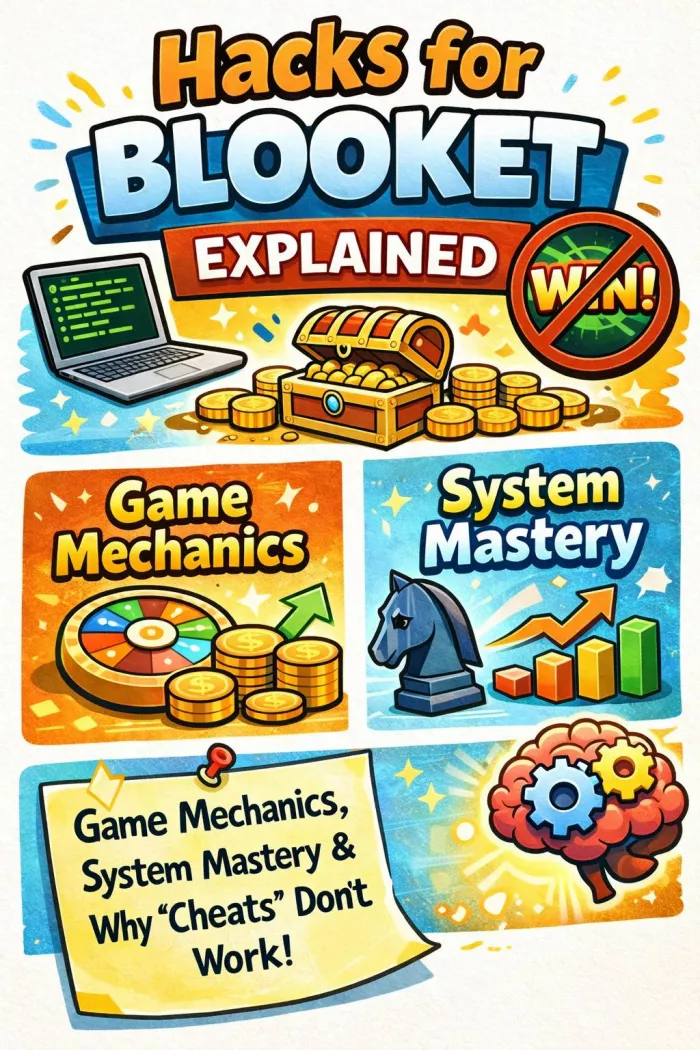
The Misuse of the Word “Hack”
The word hack has become a linguistic shortcut for frustration. In educational games like Blooket, it rarely means what players think it means. Search results are filled with promises of instant wins, secret buttons, or “unpatched exploits.” Almost none of these claims survive even basic scrutiny.
What players are actually looking for is control over outcomes.
Blooket presents itself as a knowledge-driven quiz game, but it is also a layered system of probabilities, economies, and behavioral feedback loops. When outcomes diverge sharply between players with similar knowledge, the losing side often assumes foul play. This assumption is emotionally convenient but analytically wrong.
The real divide in Blooket is between:
● players who interact with surface rules, and
● players who understand what the system truly rewards over time
The most effective “hacks” are legal, repeatable, and dull. They do not bypass effort. They align effort with compounding mechanics.
Why Players Search for “Hacks” in Blooket
Most players do not wake up wanting to cheat. They arrive at that idea after repeated experiences of perceived unfairness.
Common triggers that lead players to search for hacks:
- Losing despite answering accurately
- Watching another player snowball uncontrollably
- Seeing outcomes decided early with no clear recovery path
- Feeling punished for playing carefully
This creates a psychological narrative:
“If I did everything right and still lost, the system must be broken or someone else must be cheating.”
What actually happens is subtler. Blooket rewards early leverage, risk calibration, and decision discipline, not just correctness.
Cheating vs Exploiting vs Mastery
| Term | Definition | Allowed? |
| Cheating | Violating rules or ToS | No |
| Exploiting | Using legal mechanics in unintended but permitted ways | Yes |
| Mastery | Playing exactly how the system rewards over time | Yes |
Most dominant players fall into the mastery category, even if observers label them as exploiters.
Inside the Game Engine
Blooket’s outcomes are shaped by three invisible forces:
1. Randomness (Variance)
Random events create emotional spikes but do not average out in short games. Players who emotionally overreact to bad rolls amplify losses.
2. Probability (Expected Value)
Repeated small advantages beat rare big wins. This is not intuitive to younger players.
3. Timing (Compounding)
Early advantages multiply. Late optimization rarely catches up.
Why two equally skilled players diverge
| Factor | Player A | Player B |
| Early decisions | Conservative, compounding | Risky, reactive |
| Response to bad luck | Absorbs variance | Panics |
| Resource usage | Planned | Impulsive |
| Outcome | Stable growth | Volatile collapse |
Mode-by-Mode Weakness Analysis
01. Gold Quest
What it claims to reward:
Speed, risk-taking, excitement.
What it actually rewards:
Risk calibration and emotional restraint.
Key system truth:
Gold transfers punish panic, not slowness.
Hidden advantage behaviors:
- Avoiding large transfers unless mathematically justified
- Letting others trigger volatility
- Preserving position rather than chasing lead
Exponential decision point:
One reckless steal can erase ten correct answers.
02. Crypto Hack
What it claims to reward:
Constant upgrading and aggressive clicking.
What it actually rewards:
Upgrade timing and probability awareness.
Misunderstood mechanic:
Early inefficient upgrades permanently slow growth.
| Strategy Type | Short-Term Gain | Long-Term Outcome |
| Fast upgrades | Looks strong | Plateaus early |
| Delayed upgrades | Feels slow | Dominates late |
Players who understand compounding curves quietly win while others churn.
03. Tower Defense
What it claims to reward:
Reflexes and fast placement.
What it actually rewards:
Path efficiency and foresight.
Key insight:
Correct placement beats high rarity towers.
Myth: “Better blooks = better defense”
Reality: Geometry and spacing decide outcomes.
04. Factory
What it claims to reward:
Collecting rare blooks.
What it actually rewards:
Production efficiency and role balance.
Economic trap:
Over-investing in rarity instead of throughput.
| Focus | Result |
| Rare blooks early | Slower scaling |
| Balanced workforce | Stable dominance |
05. Café
What it claims to reward:
Speed and multitasking.
What it actually rewards:
Error minimization and pacing.
Hidden punishment:
Mistakes scale faster than success.
Slower accuracy beats frantic guessing every time.
Speed Is Not Reflex, It’s Preparation
Fast players are not fast because they click quickly. They are fast because they recognize patterns instantly.
Cognitive shortcuts elite players use:
- Memorizing question structures, not answers
- Recognizing distractor logic
- Predicting outcomes before prompts finish
Why guessing fast loses over time
| Approach | Accuracy | Compounding Effect |
| Fast guessing | Low | Negative |
| Slower certainty | High | Positive |
In long sessions, accuracy always wins.
Psychological Warfare in Multiplayer
Multiplayer Blooket is a social game disguised as a quiz.
Behavioral manipulation tactics (legal):
- Delayed actions to bait mistakes
- Predictable pacing to induce impatience
- Letting opponents self-destruct
Why this feels like cheating:
- Opponents blame external causes
- Loss feels intentional, not earned
In reality, this is behavioral economics, not exploitation.
The Truth About Blooks
Why rarity is mostly cosmetic
| Scenario | Blook Impact |
| Early game | Minimal |
| Mid game | Situational |
| Late game | Often irrelevant |
Players overvalue rarity because it is visible. Systems value efficiency because it compounds.
When blooks actually matter
- Factory role optimization
- Certain Tower Defense synergies
- Psychological intimidation (perceived, not real)
Fake Hacks, Clickbait, and YouTube Lies
Common fake claims:
- “Guaranteed win methods”
- “Secret admin settings”
- “Unpatched tricks”
Why they spread:
- Results are staged
- Viewers cannot verify
- Algorithms reward spectacle, not truth
Reality check
If a tactic:
- works instantly
- requires no understanding
- looks magical
…it is almost certainly fake or ToS-violating.
Why Real Hacks Are Boring (But Effective)
Real mastery looks like:
- Repetition
- Pattern recognition
- Emotional regulation
- Incremental improvement
There is no dramatic reveal. Just quiet dominance.
Final Synthesis: The Only Framework That Works
Stop searching for:
- Hacks
- Shortcuts
- Secret tricks
Start learning:
- Incentives
- Probabilities
- Compounding effects
- Behavioral responses
The real “hack” formula
Understanding over speed
Discipline over aggression
Patterns over luck
Systems over gimmicks
If players understood how Blooket actually rewards behavior, “hack” videos would disappear overnight.
But understanding systems is harder than clicking links.
That is why misinformation survives—and mastery stays rare.


Comments