Haiper AI: The Rise, Reality, and Shutdown of a Promising Video Generator



In February 2025, users logging into Haiper AI were greeted with a jarring 404 error. The promising AI video generator that had raised $13.8 million in funding and gained a loyal following among content creators had abruptly shut down its consumer platform. This isn't just another story of a failed startup, it's a revealing case study in the harsh economics of AI video generation, the gap between marketing promises and user reality, and what happens when venture capital meets the brutal costs of running generative AI at scale.
What makes Haiper's story particularly instructive is the transparency of its failure. Founded by former Google DeepMind researchers Dr. Yishu Miao and Ziyu Wang, the company had impeccable AI credentials and significant venture backing from Octopus Ventures. Yet within two years of operation, it pivoted from consumer product to enterprise service before its founders joined Microsoft AI. This article examines what happened, drawing from actual user reviews, technical performance data, and market analysis to understand both what Haiper got right and where it fundamentally miscalculated.
● $13.8M Seed funding raised from Octopus Ventures
● 2.7/5 Trustpilot rating at shutdown (7 reviews)
● 65% Success rate in comparative testing
● Feb 2025 Consumer platform shutdown date
The timeline: from DeepMind pedigree to Microsoft acquisition
Understanding Haiper's trajectory requires examining the key inflection points that shaped its brief but eventful existence. The company's journey from promising startup to shuttered consumer platform unfolded rapidly, with each phase revealing deeper truths about the AI video generation market.
2021
Company founded by Dr. Yishu Miao and Ziyu Wang in London, leveraging their Google DeepMind backgrounds. Initial focus on neural radiance fields (NeRF) technology for transforming 2D images into 3D virtual environments.
Early 2024
Strategic pivot to video generation. The company shifted focus from 3D environments to generative video, recognizing larger market demand. Raised $13.8 million in seed funding led by Octopus Ventures. Public beta launch with text-to-video and image-to-video capabilities.
March 2024
Haiper 1.0 release. Initial version offered basic 2-second video clips with free tier generating significant user interest. Platform gained traction for being one of the few truly free AI video generators with no mandatory watermarks on free tier.
October 2024
Haiper 2.0 launch. Major upgrade introduced hyper-realistic video generation, faster processing, improved temporal coherence for smoother motion, and extended video length to 4 seconds. Introduced paid subscription tiers while maintaining free option.
December 2024
Haiper 2.5 and API integration. Released API capabilities enabling integration with platforms like VEED. Added "diamond credits" payment system that frustrated many existing subscribers who felt features degraded while costs increased.
February 2025
Consumer platform shutdown. Company abruptly closed public web application, citing pivot to enterprise/B2B model. Founders and key engineering staff joined Microsoft AI. Users lost access to all projects and credits without refunds or data export options.
March 2025
Technology acquisition. Core video generation models sold to NetMind.AI, a decentralized AI compute platform. Platform officially declared discontinued for individual users with no recovery path for trapped projects or unused subscription credits.
What Haiper AI actually was: technology and capabilities
Before examining its failures, it's worth understanding what Haiper genuinely accomplished technically. The platform represented a legitimate attempt to democratize AI video generation, built on sophisticated foundation models that went beyond simple frame interpolation.
The underlying technology
Haiper's foundation model was trained not just on visual datasets but also on physics simulations, enabling it to generate more realistic representations of natural phenomena. The system could simulate rain splashes, wind effects on hair and clothing, and lighting that responded plausibly to scene geometry. This physics-aware approach differentiated it from purely visual-pattern-matching systems that often produced physically implausible results.
The technical architecture combined diffusion models with transformers, similar to OpenAI's Sora approach. The transformer component helped maintain consistency between frames, one of the hardest challenges in generative video. While the platform never achieved perfect temporal coherence (no current AI video generator does), it performed credibly in this dimension relative to its price point.
1. Text-to-Video Generation
Convert written prompts into 2-4 second video clips. The AI interpreted text descriptions and generated corresponding visual sequences with motion, though quality varied significantly based on prompt complexity and subject matter.
2. Image-to-Video Animation
Upload static images and add motion, transitions, and effects. Particularly effective for simple animations like camera pans across landscapes or subtle movement in portraits, less successful with complex motion.
3. Video Repainting
Modify existing videos by altering colors, textures, styles, and specific elements. Allowed users to transform the aesthetic of clips without full regeneration, though results were inconsistent.
4. Camera Controls
Adjust camera movements including pans, zooms, and static positioning. Gave users more directional control than pure prompt-based systems, though actual implementation often ignored specified camera movements.
5. Template Library
Pre-built templates organized by categories (Hot, Meme, Portrait) to accelerate creation. Useful for users lacking creative direction, though templates were limited and sometimes produced dated aesthetics.
6. Generation Settings
Control over duration (2s or 4s), aspect ratios (16:9, 9:16, 1:1), and style preferences. More granular than many competitors but still far less control than professional tools offered.
What real users actually said: Trustpilot and Reddit feedback
The gap between Haiper's marketing and user experience becomes stark when examining actual customer reviews. With a Trustpilot rating of 2.7 out of 5 stars based on seven reviews, the platform struggled with fundamental service issues that technical capabilities couldn't overcome.
"They are money-hungry, and that is all they care about. I never get a response from them at all. Very bad customer support no responses at all. Now they are filtering the content and now a lot of the AI creations are blocked when there is nothing bad about the creations. The new 2.1 is terrible its nothing what you ask and it takes your diamond credits when even when your content is filtered out."
— Trustpilot review, February 2025
This review captures multiple critical failures simultaneously: non-existent customer support, aggressive content filtering that blocked innocent creations, charging users for failed generations, and declining output quality. These weren't isolated complaints but recurring themes across the limited review base.
"I paid for the yearly plan and I'm still getting watermarks on my videos. And not to mention they are still taking 10 Dollars a month from me which at this point is stealing. I've reached out about this issue before and they showed no care in the world by not reaching to resolve this issue."
— Trustpilot review on billing issues
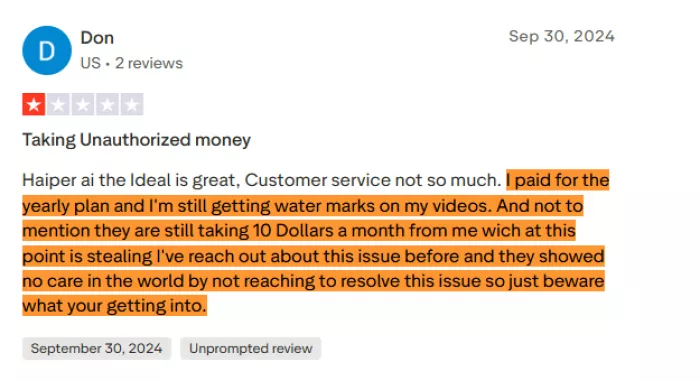
Billing problems plagued paying customers. Users reported being charged multiple times, subscription features not activating despite payment, and complete inability to get refunds or support responses. When the platform shut down, many users had prepaid annual subscriptions with thousands of unused credits that simply vanished.
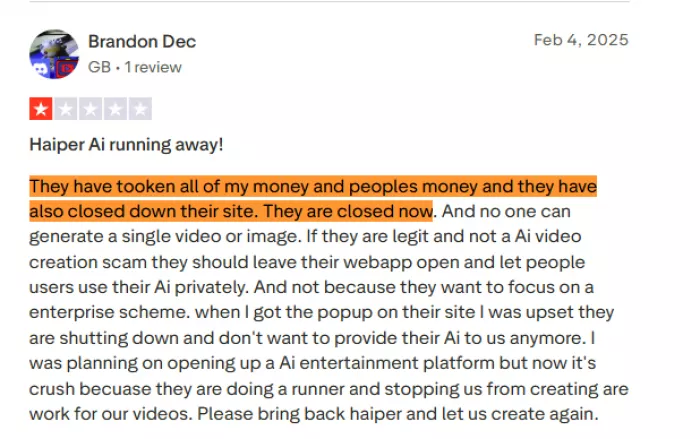
"They have taken all of my money and peoples money and they have also closed down their site. If they are legit and not a Ai video creation scam they should leave their webapp open and let people users use their Ai privately. I was planning on opening up a Ai entertainment platform but now it's crushed because they are doing a runner."
— User response to shutdown announcement, Trustpilot
The content filtering controversy
One particularly contentious issue was Haiper's content moderation system. Multiple users reported that the platform would flag and block perfectly innocent prompts while still consuming their paid credits. The system appeared to have no appeal process, and users were held financially responsible when the AI itself generated policy-violating content from ambiguous prompts.
As one reviewer explained: "They are trying to hold you responsible for any image or video that is filtered when the image or video is not bad, meaning if you post a prompt of something cool and the AI misunderstands your prompt and makes something illegal, you pay for it." This created a situation where users were penalized for the AI's own misinterpretations, with no recourse or credit refunds.
The Diamond Credits Debacle
In late 2024, Haiper introduced a "diamond credits" system that fundamentally changed the economics for existing subscribers. Users who had paid for unlimited generation suddenly found themselves needing to purchase additional credits to access quality features or faster processing. Many described this as a bait-and-switch tactic that degraded the value of their existing subscriptions while creating new paywalls.
This change alienated the paying user base just months before the platform shut down, suggesting the company was desperately trying to improve unit economics even as it was already planning an exit.
The shutdown: what actually happened and why
While the February 2025 shutdown surprised users, the warning signs were visible for months to anyone watching closely. The shutdown wasn't a sudden failure but the culmination of fundamental business model problems that became untenable.
The economics of AI video generation
Running an AI video generation service at consumer prices requires solving an extremely difficult cost equation. Each generation consumes significant GPU compute resources far more than text or image generation. A single 4-second video clip could cost $0.30-0.50 in compute alone at cloud pricing, yet Haiper was offering 10 daily free generations plus unlimited paid generations at $8-24/month.
The math simply doesn't work at small to medium scale. To achieve acceptable unit economics, you need either massive scale (millions of paying users amortizing infrastructure costs), or you need to charge closer to actual costs (putting paid tiers at $50-100+/month). Haiper had neither sufficient scale nor pricing power to sustain operations.
Compare this to successful AI companies like Anthropic or OpenAI, which either charge meaningfully higher prices (Claude Pro at $20/month for text, which costs far less to generate than video) or operate at venture-subsidized losses while building toward massive scale. Haiper's $13.8 million in funding was insufficient to reach the scale needed for video generation economics to work.
The aggregator platform threat
As one industry observer noted on Threads: "The R&D cost of building a model and offering it through an app requires deep pockets; aggregator apps offer a choice of image and video models for a fixed price, which makes charging the same price for a single-model app much less attractive to customers."
This dynamic proved devastating. Platforms like Pollo AI, ImagineArt, and others began offering access to multiple AI video models (including competitors to Haiper) for comparable or lower subscription costs. Why pay $24/month for Haiper alone when you could get Haiper plus Runway plus Kling plus Pika for $30/month from an aggregator?
Single-model platforms need strong differentiation to justify standalone subscriptions. Haiper's differentiation was primarily price and simplicity, but these advantages evaporated against aggregators who achieved better pricing through volume and offered superior capabilities by mixing models.
The Microsoft acquisition
In early 2025, Haiper's founders and key engineering staff joined Microsoft AI. This wasn't technically an acquisition, no public announcement of Microsoft purchasing the company appeared. Rather, it resembled an "acquihire" where Microsoft wanted the team's expertise in video generation models more than the business itself.
For Microsoft, this made strategic sense. Paying a few million to absorb a talented team with demonstrated video generation capabilities is cheaper than building similar capabilities from scratch. The team's DeepMind pedigree and successful deployment of a working video model made them valuable assets.
For Haiper users, the transition was brutal. Projects disappeared overnight. Paid subscriptions with months remaining became worthless. No data export option was provided, no transition period, no refunds. The company's final communication was essentially a 404 error page.
The Technology Survives, The Service Doesn't
In June 2025, Haiper's core video generation models were sold to NetMind.AI, a decentralized AI compute platform. NetMind plans to integrate these models into B2B solutions, potentially making the technology available through enterprise APIs.
This represents the actual value proposition that worked: Haiper built legitimate technology that had market value in enterprise contexts. What failed was the attempt to monetize that technology through a consumer subscription service at unsustainable pricing.
Honest assessment: what Haiper got right and wrong
Despite its ultimate failure, Haiper's story offers valuable lessons for both creators evaluating AI tools and entrepreneurs building in this space. The platform succeeded and failed in instructive ways.
| What Worked | What Failed |
| Genuinely free tier with usable capabilities and no mandatory watermarks | Non‑existent customer support; billing and technical issues went unanswered |
| Fast generation times (~1.5 minutes average), practical for iteration | Aggressive content filtering blocked innocent prompts while still charging credits |
| Physics‑aware training, more realistic natural phenomena (water, wind, light) | 4‑second maximum video length, far behind 10–20 second competitors |
| Simple, clean interface with minimal learning curve | Human/animal motion often disturbing: artifacts, merging, morphing |
| Competitive pricing, undercut premium rivals by 50–75% when operational | Temporal consistency collapsed after ~2 seconds, degrading quality mid‑clip |
| Text‑to‑video handled simple prompts (landscapes, basic scenes) reasonably well | “Diamond credits” system devalued existing subs and added new paywalls |
| Template library helped non‑creative users start without prompt skills | Prompt adherence inconsistent; complex requests ignored key elements |
| Business model never reached sustainable unit economics, leading to shutdown | |
| Shutdown offered no data export, refunds, or transition period for prepaid users |
The fundamental miscalculation
Haiper's core strategic error was attempting to compete on price in a category where unit economics don't support competitive pricing at small to medium scale. The team built legitimate technology but wrapped it in an unsustainable business model.
AI video generation in 2024-2025 remained economically viable only at one of two extremes: either massive scale with moderate pricing (think YouTube Shorts), or premium pricing with focused features (think professional editing tools). The middle ground Haiper occupied consumer-friendly pricing without consumer-scale usage was structurally unprofitable.
The founders' DeepMind backgrounds gave them technical sophistication but may have contributed to overconfidence about achieving the scale needed to make consumer economics work. DeepMind operates at Google scale with effectively unlimited resources. A startup with $13.8 million faces entirely different constraints.
What creators should learn from Haiper's failure
For content creators and businesses evaluating AI tools, Haiper's shutdown offers several practical lessons about dependency risk and vendor selection.
Subscription risk assessment
Annual subscriptions to AI services now carry meaningful risk. Haiper users who purchased yearly plans in late 2024 lost months of prepaid access with no recunds. Before committing to annual payments for any AI service, consider: does this company have demonstrated path to profitability? Have they maintained stable pricing for at least 12 months? Do they provide data export capabilities?
Monthly commitments carry lower risk but often cost 20-40% more over a year. That premium is essentially insurance against service shutdown. For critical workflows, the insurance is worth paying.
Platform dependency
Any work stored exclusively in a cloud platform is at risk. Haiper users who built content libraries in the platform without downloading exports lost everything. Best practices now include: download and store all generated content locally, maintain independent backups of source materials and prompts, avoid building critical workflows around tools without data portability.
The aggregator platforms (Pollo AI, ImagineArt, etc.) offer one form of risk mitigation; they provide access to multiple models, so if one shuts down, you still have alternatives. This redundancy costs more per individual model but provides business continuity insurance.
Warning signs to watch
Several indicators preceded Haiper's shutdown that, in retrospect, signaled financial distress. Watch for these patterns in any AI service: introducing new currency systems (like diamond credits) that effectively raise prices; degrading existing subscription benefits without communication; completely unresponsive customer support; frequent generation failures with no service credits; and significant pricing changes within 6-12 months of launch.
Any service exhibiting multiple warning signs is likely facing unsustainable economics. Reduce dependency immediately and identify alternatives before a shutdown forces emergency migration.
The current landscape: where to go after Haiper
For former Haiper users seeking alternatives, the landscape has evolved significantly since the shutdown. Several platforms have emerged or improved to fill the gap, each with different trade-offs in pricing, quality, and feature sets.
Direct replacements
Runway Gen-3 (now Gen-4) offers the closest all-around replacement if you prioritize control and refinement capabilities. At $12-95/month depending on tier, it's more expensive than Haiper but provides significantly more advanced editing tools, longer video generation (up to 10 seconds), and higher success rates. The platform has proven stable business model longevity, having operated since 2018.
Luma Dream Machine excels for realistic motion and camera-like results, particularly when animating concept frames into cinematic shots. The free plan includes 8 videos with watermarks; paid tiers start around $10/month. Generation quality for natural motion often surpasses what Haiper achieved, though prompt adherence can be inconsistent.
Aggregator alternatives
Pollo AI and ImagineArt both offer multi-model access at $15-30/month, providing Kling, Hailuo, PixVerse, and other generators in single subscriptions. This reduces platform risk if one model shuts down or degrades, you have immediate alternatives without switching services. The interfaces aren't as refined as dedicated platforms, but the redundancy and model variety provide significant value.
Premium options for professional use
Sora by OpenAI leads in pure generation quality for cinematic content, though access remains limited and expensive. Videos up to 20 seconds with exceptional temporal consistency and realistic physics, but at $100+/month for reliable access, it targets professional rather than casual creator budgets.
For businesses that need guarantees and support, these premium tiers make sense. For content creators who absorbed Haiper's shutdown costs, the lesson is clear: free and cheap AI video comes with serious continuity risk. Mid-tier services ($20-40/month) from established providers offer better risk-reward balance.
Conclusion: the real cost of "free" AI video
Haiper AI's rise and fall encapsulates a crucial truth about the current AI landscape: impressive technology doesn't guarantee sustainable business models, and consumer-friendly pricing often masks unsustainable economics that eventually fail.
The platform delivered genuine value while it operated. Its fast generation speeds, reasonable output quality for simple prompts, and accessible interface served thousands of creators well. The technology was real, real enough that Microsoft absorbed the team and NetMind acquired the models. What wasn't real was the idea that this technology could be offered at Haiper's pricing sustainably.
For users, the lesson is uncomfortable but necessary: in AI services, price signals sustainability. Tools priced well below apparent compute costs are likely operating on venture capital subsidies that will eventually end. When they end, they often end abruptly 404 errors with no transition period, no refunds, no data export.
The future of AI video generation almost certainly includes some combination of higher prices from sustainable providers and limited free tiers from larger platforms cross-subsidizing new capabilities. The Haiper model generous free access and cheap unlimited paid access from small dedicated companies appears economically unworkable at current technology costs.
As AI capabilities advance and compute becomes cheaper, these economics may shift. Until then, creators should treat any AI service priced at apparent loss as having meaningful shutdown risk, plan accordingly with backups and alternative workflows, and recognize that paying more for established providers is often paying for business continuity insurance.
Haiper proved that small, talented teams can build impressive AI capabilities. It also proved that impressive capabilities aren't enough business model matters, unit economics matter, and no amount of technical sophistication can overcome fundamental market mismatches.
Final Takeaway
The question for any AI tool isn't "is the technology impressive?" but rather "can this company sustainably provide this service at this price?" Haiper's technology was impressive. Its sustainability was not. Future tool selection should weight business viability as heavily as technical capability.


Comments