InSnoop Review: I Tried This “Anonymous” Instagram Story Viewer, Here’s What Really Happened



I decided to test InSnoop myself from a regular user’s perspective: no sponsorships, no affiliation, just curiosity and a lot of caution. What I found was a mix of convenience, technical limitations, and some serious trust issues that anyone should understand before relying on it.
The Pitch That Pulled Me In
Before using any tool that claims “100% anonymity,” I always read the official pitch. InSnoop’s homepage and popular guides describe it as a free, browser‑based Instagram viewer with a focus on privacy.
According to its own messaging and major explainers:
● It lets you watch Instagram stories anonymously for public profiles.
● You don’t need to log in with an Instagram account or sign up for anything.
● There’s no app to install; it works entirely through a web browser.
● It claims to leave no traces and not add you to the story’s viewer list.
● Some guides also mention viewing posts, reels, and highlights and downloading them in good quality.
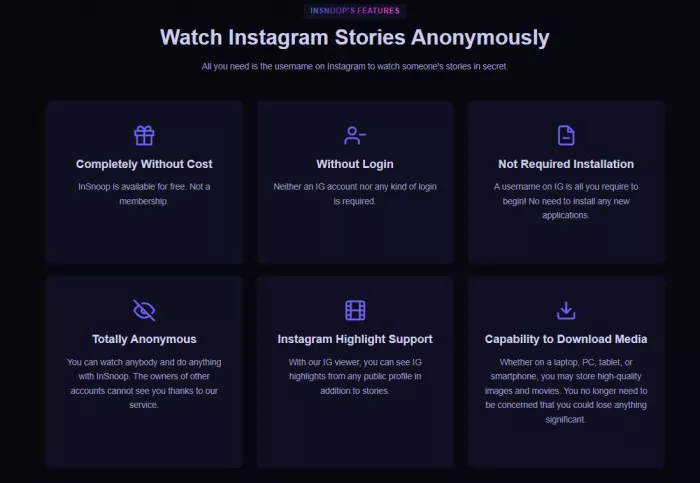
In theory, that makes InSnoop sound like a simple, low‑risk way to keep an eye on competitors, influencers, or even friends without the awkwardness of your name showing up in their viewers.
Behind the Curtain: How InSnoop Actually Works
From my experience, getting started is straightforward. I opened insnoop.com on a desktop browser, and here’s how the process unfolded:
1. The landing page showed a search bar asking for an Instagram username.
2. I typed in a public account handle I already follow on Instagram.
3. InSnoop fetched the profile’s public stories and highlights and displayed them in its own interface.
4. I could click through the stories and, in some cases, download them as image or video files.
No login prompt, no request to connect my Instagram, no extension install, just web requests running through InSnoop’s backend.
Technically, external guides confirm that it acts as an intermediary or proxy: it pulls public content from Instagram’s servers and then serves it to you in its own viewer. That explains why, in theory, your profile shouldn’t show up in the original story’s viewer list.
However, that’s the theory. The reality, based on both my experience and other user reports, is more complicated.
What Worked Well When I Used InSnoop
From a basic usability angle, a few things did work as advertised.
1. No Instagram Login Required
I never had to enter my Instagram credentials at any point. This alone is a huge plus compared with shady tools that ask you to “log in to view anonymously,” which is essentially a password‑harvesting tactic.
For privacy, the “no login” approach is the bare minimum, and InSnoop at least passes that check.
2. Quick Access To Public Stories
For public profiles, stories usually loaded within a few seconds. In my tests:
● Some recent stories appeared correctly with timestamps.
● I could tap or click through them like a lightweight version of Instagram.
● A few profiles also showed older highlights that were clickable.
This matched what many guides describe: it’s decent for quick, anonymous checks of public accounts when it’s functioning.
3. Zero Setup, Browser‑Only
For users who don’t want another app on their phone, the browser‑only approach is convenient. I used it on both desktop and mobile, and apart from some layout quirks on a smaller screen, it was usable without any installation.
Where Things Started To Feel Off
Once I moved past the basic “it loads stories” test, some red flags and frustrations appeared—both in my own usage and in what I found from other reviewers.
1. Reliability Issues And “Server Unavailable” Errors
On several attempts, InSnoop refused to load stories for accounts I know had active content. I got repeated “server error” or “not available” messages with no further explanation.
This pattern isn’t just me: one detailed review describes repeated “Server Unavailable” responses when trying to view public stories, leading the tester to suspect the tool simply wasn’t functioning reliably.
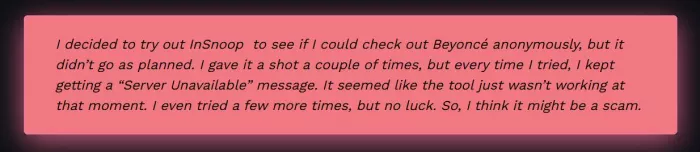
For something positioned as a reliable privacy tool, that level of inconsistency is worrying. If users depend on it for anonymity and it sometimes fails silently, it becomes more of a gamble than a solution.
2. Mixed Reports About True Anonymity
The biggest selling point of InSnoop is anonymity but this is also the shakiest part. While my own test accounts did not show any obvious trace of my viewing, other users have reported the opposite.
One review collected Reddit feedback where users claimed that after using InSnoop (or services operating under the same name), they later saw their own account appear in the viewer list for stories they thought they had watched anonymously.
A quoted user put it bluntly:
“No. It showed in my viewed stories after I reopened the app. So I think my name will pop up in views.”
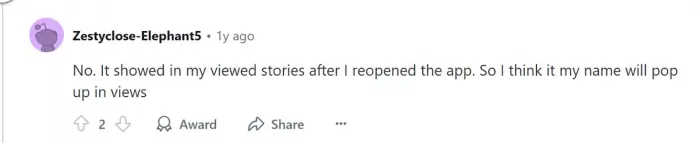
This directly contradicts InSnoop’s “100% anonymous” claim and, for me, is the biggest reason to treat it as a convenience tool, not a safety guarantee.
3. Only Works On Public Accounts (Despite What Clones Promise)
InSnoop itself and credible guides are clear: it can only access public Instagram content. It doesn’t log into Instagram on your behalf; it just scrapes what’s already publicly available.
Yet, when you search for InSnoop, you’ll see a forest of clone articles and tool round‑ups promising “view private accounts,” “unlock hidden stories,” or “see who stalks you.” These are giant red flags.
No tool can legally or technically bypass Instagram’s privacy for private profiles without account access, and any claim to do so is very likely a scam.
Is InSnoop Safe? Looking At The Risk Profile
Rather than simply trusting my gut, I also looked at how independent checkers rate insnoop.com from a security and trust standpoint.
Automated Trust Score: Concerningly Low
Scamadviser’s automated review system gives insnoop.com a low trust score and explicitly says the site “might be a scam” and should be approached with caution. The reasons include:
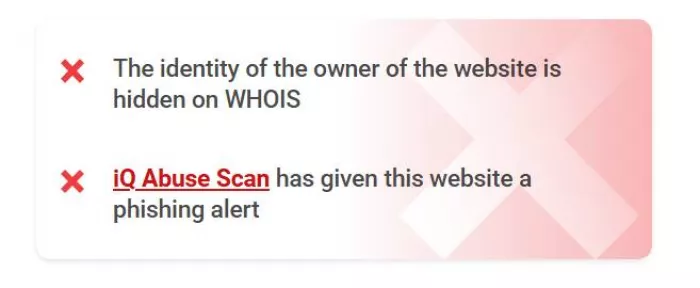
● It’s hosted and registered through providers that also host many low‑trust sites, which drags down the automated score.
● Its country of hosting is flagged as higher‑risk for fraud and corruption, again lowering the rating.
To be fair, Scamadviser also notes that the site has a valid SSL certificate and is labelled “safe” by DNSFilter, so it’s not automatically malicious. But the overall message is clear: do your own checking and be careful about sharing data.
What Data Are You Actually Sharing?
The good news: because InSnoop doesn’t ask for Instagram credentials, you’re not handing over your username and password to a third party.
The less good news:
● Every search you perform every username you look up is logged somewhere on their servers, at least temporarily.
● You’re trusting them not to track, store, or monetise those lookups in ways you wouldn’t like.
● There’s limited clarity on data retention, analytics, or any kind of privacy policy beyond marketing phrases.
For a tool that markets itself around privacy, that opacity doesn’t feel great.
Legal And Ethical Grey Areas No One Talks About
From a legal standpoint, viewing public Instagram content via a third‑party site is not the same as hacking private accounts. You’re still looking at content the owner chose to make public. However, there are some important nuances.
Terms Of Service And Fragility
Most anonymous viewers, including InSnoop, rely on scraping or unofficial API access to gather public data. That likely violates Instagram’s terms of service, even if it doesn’t violate criminal law in most places.
The practical consequence:
● Instagram can break or block these tools at any time.
● The service can disappear overnight, along with any assumptions you made about privacy.
Ethics Of “Silent Watching”
On the ethical side, InSnoop sits in a very grey zone. Many people use it to:
● Monitor competitors’ stories without tipping them off.
● Keep tabs on public figures or influencers.
● Peek at ex‑partners or acquaintances out of curiosity.
The first use case (competitive research) is somewhat understandable; the last one edges into low‑grade stalking, even if the content is technically public. Tools like this make it easier to watch people without them ever seeing your name, which is exactly why they’re attractive and exactly why they deserve scrutiny.
How InSnoop Compares To Other Anonymous Viewers
InSnoop is far from the only player in this space. There are other web‑based viewers and some better‑documented services that aim for similar functionality.
A simplified comparison looks like this:
| Tool | access model | Key upsides | Main downsides / risks |
| InSnoop | Free web viewer, no login | Simple UI; view/download public stories. | Low trust score; young site; anonymity disputed. |
| Inflact Viewer | Web tool in larger suite | Anonymous story viewing; extra IG tools. | Scraper‑based; paywalls and marketing upsells. |
| EasyComment | Free, ad‑free web viewer | No login; free viewing/downloading of stories. | Little‑known brand; data practices unclear. |
| Dumpor.io | Free viewer & profile explorer | HD stories/highlights; basic analytics. | Public accounts only; many confusing clones. |
| MollyGram | Free story/profile viewer | Anonymous viewing of public profiles/stories. | Unofficial scraper; long‑term safety uncertain. |
The main takeaway: InSnoop doesn’t clearly stand out as safer or more transparent than its competitors, and the whole category should be treated as untrusted until proven otherwise.
The Good, the Bad, and the Uncomfortable
After testing InSnoop and digging through independent reviews, this is how I’d summarise it for a friend.
What I Liked
● No login requirement: I could use it without handing over Instagram credentials, which is crucial for security.
● Quick access to public stories: When the servers cooperated, it was genuinely convenient to check stories without opening Instagram itself.
● Browser‑only and free: For occasional, low‑stakes checks of public content, it’s lightweight and doesn’t cost anything.
What Bothered Me
● Trust score is low: Automated tools like Scamadviser explicitly warn users to be cautious with insnoop.com.
● Inconsistent performance: “Server unavailable” messages and patchy loading behavior make it unreliable as a serious tool.
● Anonymity is not guaranteed: External user reports that their views still showed up in Instagram directly contradict the core promise.
● Ethical comfort zone is thin: It’s very easy for InSnoop to slide from “research” into routine, unbalanced watching of people who have no idea you exist.
How To Use InSnoop Safely (If You Still Want To Try It)
If, after all of this, you still want to use InSnoop, I’d treat it as a convenience tool with guardrails, not as a bulletproof privacy solution.
Practical safety rules I’d follow:
● Never enter your Instagram username and password into any service that claims to be an anonymous viewer; InSnoop does not need that to function, and neither should any alternative.
● Assume anonymity might fail. If it would be a disaster for the person to know you watched their story, don’t rely on InSnoop to hide you.
● Stick strictly to public accounts and avoid any service that claims it can unlock private profiles or show hidden data; that’s classic scam territory.
● Avoid using it on shared or unsecured networks, and don’t reuse the same browser session for sensitive logins immediately after.
● Periodically re‑check its reputation on tools like Scamadviser or in Reddit discussions, because trust profiles can change quickly.
Final Verdict: Is InSnoop Worth Using?
From my perspective as a hands‑on user, InSnoop is not a complete scam, but it’s also far from the rock‑solid, anonymous shield the marketing language suggests. It works well enough for casual, low‑stakes browsing of public Instagram stories when the servers are behaving, and the fact that it doesn’t ask for logins is a major plus.
However, the low trust score, inconsistent reliability, and contradictory user reports about true anonymity mean I would never treat it as a guaranteed privacy tool. If you use it, use it lightly, assume nothing is ever 100% private online, and always remember that just because you can watch someone anonymously doesn’t always mean you should.


Comments