PressVibePulse.com Review: Is This Quick-Read Info Hub Worth Bookmarking?



PressVibePulse.com presents itself as a fast, friendly knowledge hub, where everyday readers can grab bite‑sized explanations on tech, travel, health, finance, lifestyle, fashion, and business without wading through dense jargon. On the surface, it looks like yet another general‑topic blog, but a closer, 360‑degree look reveals both its strengths as a quick‑read companion and its limitations as a serious information resource.
First impressions: a “snackable info” hub
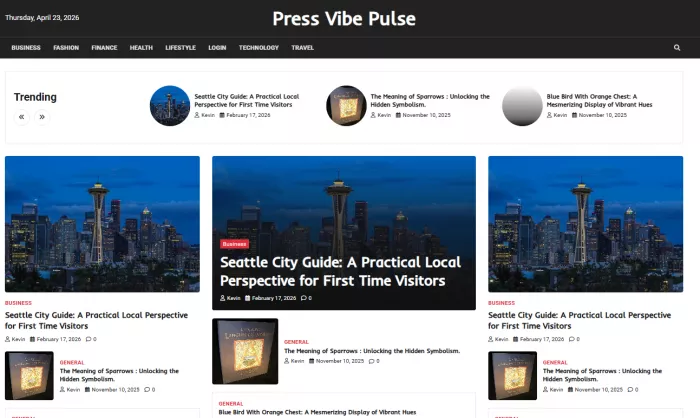
Landing on PressVibePulse.com feels like opening a digital magazine that has stripped away most of the clutter you see on ad‑heavy portals. The homepage puts its category navigation front and center, with sections like Technology, Travel, Health, Finance, Lifestyle, Fashion, and Business clearly accessible from the top menu. Articles are presented in a familiar card layout with headlines and snippets, inviting you to click into short explainer‑style posts rather than long essays.
The overall tone of the site becomes obvious within a few clicks: it is built for casual readers who want a simple, 3–5 minute overview of a topic, not for professionals hunting for deeply sourced research. That design choice shapes almost everything: the content style, the UX, and even how the site seems to target search queries.
How PressVibePulse.com organizes its content
PressVibePulse runs on a wide‑net content strategy, spreading its articles across multiple high‑demand categories instead of focusing on a single niche. From a reader’s perspective, this means you can jump from a basic tech explainer to a travel listicle or a lifestyle tip without leaving the site’s overall aesthetic and tone. From a reviewer’s perspective, it also means content depth and expertise vary significantly depending on the topic.
Here is a simplified view of how its main categories tend to behave:
| Category | Typical article style | Depth of coverage | Best suited for |
| Technology | Short explainers, trend overviews, basic guides | Medium at best | Beginners learning concepts or buzzwords |
| Travel | Idea lists, quick tips, destination overviews | Shallow–medium | Casual travelers in early planning stages |
| Health | General wellness tips, basic health info | Shallow | Readers seeking quick awareness, not medical advice |
| Finance | Simple budgeting, saving, and money tips | Shallow–medium | New earners or beginners to personal finance |
| Lifestyle | Everyday life hacks, habits, routines | Medium | General readers wanting light, approachable content |
| Fashion | Trend summaries, styling ideas | Shallow–medium | Style beginners, casual interest readers |
| Business | High‑level business concepts, market overviews | Medium | Students or early‑stage professionals |
Across categories, the pattern is similar: PressVibePulse prioritizes accessibility and variety over depth and specialization. That’s not inherently a flaw, but it sets clear expectations about how you should (and should not) use the site.
Deep dive into article style and readability
Most PressVibePulse articles fall in the 400–800 word range, which aligns with “quick read” content that can be consumed in under five minutes. Instead of complex sentences or academic structures, posts lean on short paragraphs, simple vocabulary, and direct explanations that aim to keep bounce rates low and reading flow smooth. Headings and subheadings are used to break content into digestible sections, and you’ll also see lists and bullets, though they rarely dominate entire pages.
For a casual user, this makes the site very approachable. You can skim headlines, read just one or two sections, and still walk away with a basic grasp of the topic. For more advanced users, the simplicity starts to feel like a ceiling: the articles usually don’t link to primary research, official documents, or in‑depth resources that would allow you to go further.
In terms of tone, articles are written in a neutral, informative style that resembles a generalist explainer rather than an opinion piece or expert commentary. The upside is that it feels unbiased; the downside is that many posts can blur into each other, lacking a distinct voice that sets the site apart from other generic content platforms.
Content quality: accuracy, depth, and reliability
Because PressVibePulse covers sensitive areas like health and finance alongside lighter topics, the question of trust and depth becomes critical. On surface topics like lifestyle habits, travel ideas, or fashion trends the site’s short, fact‑light style is usually enough to give you inspiration or a basic overview. However, where health tips or money advice are concerned, the lack of prominent citations and expert authorship is a noticeable gap.
Broadly, articles tend to be:
● Factually generic: Information reads like it has been compiled from common knowledge rather than from named expert sources.
● Lightly sourced: Explicit links to external authorities (like government health sites or financial regulators) are limited or absent in many posts.
● Moderately practical: You do get simple, actionable tips, but they rarely go into nuances, edge cases, or long‑term strategy.
This makes the content safe enough for basic orientation, but not robust enough for important decisions. Health and finance pieces, in particular, should be treated as starting points, not final answers. Readers looking for step‑by‑step, data‑driven guidance will likely need to pair PressVibePulse with more specialized resources.
User experience and design: smooth for skimmers
PressVibePulse’s user experience is tailored to people who like to browse quickly rather than commit to long reads. Page layouts are clean, with a focus on readable fonts, adequate spacing, and a standard blog structure that most users will instantly recognize. Ads, where present, are generally light and do not overwhelm the central content, which is a relief compared to many cluttered content farms.
Navigation is straightforward. The top menu and category pages make it easy to hop between topics, and article pages tend to suggest other related posts that keep you inside the site’s ecosystem. On mobile, the streamlined layout and shorter content blocks work in its favor, allowing readers to scroll quickly without getting lost.
Here’s how the UX elements roughly stack up:
| UX Element | Experience on PressVibePulse |
| Navigation | Simple top‑menu categories, intuitive browsing flow |
| Layout & Design | Clean, blog‑style layout, emphasis on readability |
| Ads & Distractions | Light ad usage, generally not intrusive |
| Mobile Experience | Fast to scan, scroll‑friendly for short reads |
For a user who mostly wants a frictionless reading experience, this is a strong point in the site’s favor. It feels designed for scrolling on a phone while commuting or taking a break, rather than for deep, desk‑bound research sessions.
Under the hood: SEO, structure, and intent
The visible structure strongly suggests a deliberate search‑driven strategy. Many articles are framed around straightforward, intent‑rich queries titles that resemble “What is…”, “How to…”, or “Benefits of…” the kind of phrasing that aligns closely with common search behavior. Content is then written in a way that satisfies basic informational intent without getting too technical.
The articles’ internal structure also follows familiar SEO‑oriented best practices: clear H1 titles, subheadings that mirror long‑tail variations of the main topic, and short, scanning‑friendly paragraphs. Internal linking between related posts further supports both discoverability and SEO, nudging readers to move from one explainer to another in the same category.
However, when you look at E‑E‑A‑T (Experience, Expertise, Authoritativeness, Trustworthiness), especially for YMYL (Your Money or Your Life) topics like health and finance, some gaps appear.
Those gaps typically include:
● Limited author visibility: Articles do not strongly foreground expert authorship or credentials for sensitive topics.
● Sparse citations: Health or finance pieces seldom prominently link to recognized institutions or primary sources.
● Generalist breadth: The wide topic range makes it harder to project deep expertise in any single category.
This doesn’t mean the site is unsafe, but it does mean readers and search engines may treat it more as a lightweight informational companion rather than an authority to quote or fully rely on.
Safety, privacy, and monetization
From a basic user safety standpoint, PressVibePulse is relatively low‑risk to browse. The site uses HTTPS, which is now standard but still essential for protecting data in transit. It also does not aggressively demand personal information for access, so you can read most content without any form of registration.
Monetization appears to be driven primarily by advertising and possibly some affiliate‑style recommendations, though the ads are described as light and not overwhelming. There are no paywalls or subscription prompts that interrupt the reading experience, which keeps it accessible for a global audience that may be unwilling or unable to pay.
As always, however, monetization and content neutrality should be kept in mind: when reading product‑related articles (for example, in tech, fashion, or finance), it’s wise to cross‑check any recommendations and not assume full editorial independence. That’s not a PressVibePulse‑only issue, but a general rule for modern content sites.
Who actually benefits from PressVibePulse?
If we strip away the marketing language and look at the real reader experience, PressVibePulse is best understood as a starting point and a companion, not a destination for deep dives. It suits people who need to get up to speed quickly, or who simply want light, accessible content during short windows of time.
Typical readers who might find value include:
● Beginners or curious readers who want a quick grounding in topics like basic tech concepts, simple money habits, or lifestyle ideas before exploring more serious material.
● Students who need initial orientation on a topic before they move on to academic or highly specialized sources.
● Busy professionals who want a 3‑minute article that explains a buzzword or trend they’ve heard about without forcing them to read jargon‑heavy reports.
On the other hand, readers who might find the site underwhelming include experts, advanced learners, and anyone who needs fully sourced, deeply detailed content for health or financial decisions. For them, PressVibePulse works more as a light overview or a refresher than as a core research tool.
Comparative context: where it sits among similar sites
In the broad landscape of “quick info” sites, PressVibePulse sits somewhere between personal blogs and large content portals in terms of polish and scope. It doesn’t feel as ad‑saturated or chaotic as some low‑quality content farms, but it also doesn’t carry the heavy editorial or expert weight of specialized magazines, government portals, or academic‑grade blogs.
If you compare it to classic reference sites, PressVibePulse often trades depth and formal citations for speed and simplicity. Against small niche blogs authored by experts, it usually wins in topic variety and navigational ease but loses in hands‑on insight and firsthand experience. In other words, it’s a generalist: safe enough for surface reading, too light to be your only source.
Scorecard of PressVibePulse: a 360° breakdown
Based on its visible structure, content style, and user experience, you can roughly think of PressVibePulse’s strengths and weaknesses along these axes:
| Dimension | Score (out of 10) | Rationale |
| Content Quality | 6.5 | Clear and readable, but often generic and light on depth/sourcing |
| Trust & Sources | 5 | Adequate for casual reading, weak on citations for health/finance |
| UX & Design | 8 | Clean layout, easy navigation, low distraction level |
| SEO & Structure | 7 | Search‑friendly structure and topical organization |
| Overall Usefulness | 7 | Handy as a quick‑info hub, limited as an expert resource |
These numbers are interpretive rather than official, but they summarize what most users are likely to feel after browsing the site for a while: it is convenient, approachable, and useful in short bursts, yet not designed to be the definitive authority on the topics it covers.
Final verdict: how to use PressVibePulse wisely
PressVibePulse.com is best treated as a friendly, fast‑reading companion for everyday learning: the place you visit when you want a simple overview, a light explanation, or a bit of inspiration across popular topics. It does a good job of keeping content accessible, the design uncluttered, and the reading experience smooth, especially on mobile.
However, it is not a replacement for expert‑driven resources, especially in domains where accuracy, nuance, and evidence‑backed advice are critical, such as health and finance. Use it to break the ice with a topic, understand the basics, or pick up a quick tip, then move on to authoritative sites, books, or professional guidance if your decisions carry real‑world stakes. In that role an introductory, low‑friction knowledge hub PressVibePulse makes sense and can fit comfortably into a modern reader’s daily information diet.


Comments