Thesindi.com Review: How Good Is This All‑Rounder Content Platform, Really?



Thesindi.com is one of those websites that doesn’t shout for attention but quietly positions itself as the friend you call when you don’t understand a term in your bank statement, a health buzzword, or a trending tech concept. It lives somewhere between a casual blog and an online handbook: approachable, uncomplicated, and absolutely geared towards people who want explanations, not academic lectures.
What Thesindi.com is really trying to be
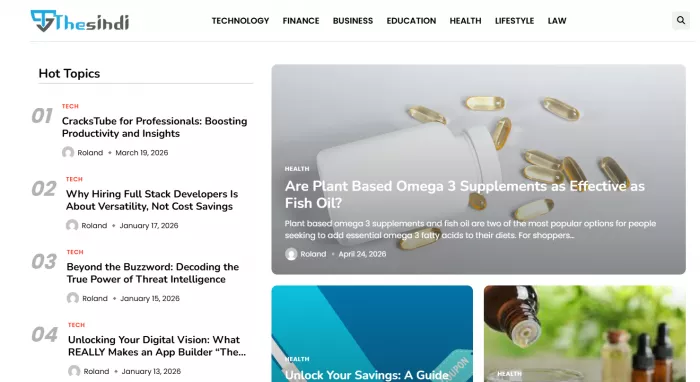
At first glance, Thesindi.com looks like a familiar WordPress magazine layout: logo on top, categories across the header, articles tiled across the homepage. But spend more than a few minutes wandering through its pages and a clear intent emerges—it wants to be a “first‑stop explainer” for almost everything that touches everyday life.
You are not asked to sign up, log in, or pay; you simply land, click, read and leave a little clearer than you arrived. The site trades in 5–10 minute reads written in very simple English, with each article trying to answer one central question: what is this, why should you care, and what do you do next?
A site that refuses to pick a single niche
If you were hoping for a laser‑focused niche blog, Thesindi.com makes the opposite argument. It deliberately stretches itself across a wide spectrum of categories: Finance, Business, Health, Lifestyle, Travel, Education, Tech, Real Estate, Automotive, Sports, Social Media and more, including some oddly titled sections that feel like experiments in categorization.
In one session, you can move from an explainer on loans to a piece about wellness habits and then into a travel safety article, without ever feeling like you’ve left the site’s core personality. That personality is simple: “Let’s strip this topic down to something you can understand over a cup of tea.”
Categories It Covers
Thesindi.com spreads its content across many everyday categories, including finance, business, health, lifestyle, fashion, education, technology, travel, sports, automotive, real estate, social media, and general topics. This broad structure makes the site feel more like a multi-topic information hub than a niche publication.
1. Finance and Business
The finance and business section appears focused on practical topics such as loans, savings, taxes, basic investment ideas, and financial schemes. It is useful for beginners who want simple explanations, but it should be treated as introductory reading rather than serious financial advice.
2. Health and Wellness
The health content uses simple, non-technical language for general wellness and basic health topics. It may help casual readers understand broad ideas, but without strong sourcing or expert attribution, it should not be used as medical guidance.
3. Lifestyle and Fashion
Lifestyle and fashion are natural fits for the site’s casual style. These sections cover everyday routines, habits, style tips, and consumer-interest topics in an easy-to-read way, making them useful for quick, practical browsing.
4. Technology
The technology section seems built for non-technical readers. It explains tools, platforms, and digital trends in plain language, but it does not appear to offer deep product analysis or expert-level technical reporting.
5. Education
Education content focuses on student-friendly advice and simple learning-related guidance. It works best for readers looking for quick explanations rather than academic or research-backed insight.
6. Travel
The travel section appears to offer basic tips, safety advice, and introductory destination-style content. It is practical, but likely more functional than highly original or experience-driven.
7. Other General Categories
Social media, sports, automotive, real estate, and general topics show how wide the site’s coverage is. This gives readers variety, but it also makes the site’s identity feel broad and less specialized.
Category landscape at a glance
| Section | How it behaves on Thesindi.com |
| Finance & Business | Walk‑throughs of loans, savings, small‑business basics, and money “how‑tos” for beginners. |
| Health & Wellness | General health tips, routines and basic explanations with a decidedly non‑technical tone. |
| Lifestyle & Travel | Everyday improvements, travel suggestions, safety notes and lifestyle adjustments. |
| Technology | Human‑readable takes on tools, apps and emerging tech ideas. |
| Education | Study strategies, exam tips and academic life guidance. |
| Miscellaneous | Real estate, sports, automotive, social media and other “whatever you’re curious about” themes. |
The upside : you can treat the site as a Swiss army knife for general questions.
The downside: if you want truly deep sector expertise, this is not the final destination.
How the content feels when you actually read it
The reading experience appears to be one of Thesindi.com’s strongest practical advantages. The site articles are beginner-friendly, easy to skim, and written in very simple English with short paragraphs and predictable article flow.
That is more important than it sounds. Many information sites fail ordinary readers not because the topic is hard, but because the presentation is heavy. Thesindi.com avoids that by flattening complexity into digestible chunks, often using subheads and familiar structures like what-it-is, why-it-matters, benefits, steps, and conclusion.
The result is content that feels accessible even when it is not especially original. This is the site’s real editorial bargain: it may not produce category-defining analysis, but it does lower the barrier to understanding.
Editorial voice: clear, human, but not highly distinctive
The site’s tone is generally conversational and plainspoken. It appears to write as if the reader is new to the topic, which keeps the material approachable and avoids the arrogance that often creeps into information content.
At the same time, that friendliness does not always translate into a sharply differentiated voice. Thesindi.com often reads like a competent explainer platform rather than a publication with a memorable editorial personality, which is an important distinction if long-term brand loyalty is the goal.
In other words, the content is usually readable before it is remarkable.
Design and user experience
Visually, Thesindi.com seems to follow a straightforward WordPress magazine or blog template with familiar category navigation, article cards, archive structures, and standard page elements. Reviews suggest the design is functional, not premium, and that is actually consistent with the platform’s role as a utility-first information site.
Readers are not being asked to learn a new interface. The design gets out of the way and lets the article structure do most of the work. On mobile, the short-paragraph approach and conventional layout likely improve usability because it reduces friction and keeps scanning easy.
Ads appear to be part of the experience, but the site is not widely described as excessively intrusive. That matters for trust, because a free informational site can tolerate monetization, but once ad clutter overwhelms readability, usefulness drops sharply.
Navigation and discoverability
Because the site covers many categories, navigation becomes crucial. Thesindi.com uses visible category links and archive paths that make it fairly easy to jump across topics without confusion.
This basic discoverability suits casual browsing. A user who arrives through search can still explore adjacent categories without feeling trapped in a single article silo, which helps the site function as a general-interest content hub rather than a one-hit landing page.
Experience summary
| UX element | What you actually get |
| Navigation | Straightforward category and archive navigation; easy to hop between topics. |
| Readability | Short paragraphs, simple fonts, clear headings—especially kind to new readers. |
| Speed & weight | Light, reasonably fast pages thanks to a simple setup. |
| Distractions | Regular ad placements, but no aggressive pop‑ups or full‑screen interruptions. |
| Extras | No login, no tools, no community features; the site’s “product” is purely its content. |
SEO DNA: the engine under the hood
Thesindi.com appears to be heavily shaped by search behavior. The content style, article structures, and topic selection strongly suggest an SEO-led strategy built around long-tail queries, beginner intent, and broad topic coverage.
That is not automatically a criticism. Search-first publishing can still be genuinely useful when the content clearly answers a reader’s question. But it does influence how the platform feels: topics are often practical, article framing is query-shaped, and the editorial mission can seem secondary to discoverability.
The site therefore belongs to a familiar class of modern web publishers: not spammy by default, not deeply journalistic either, but purpose-built to sit in the space where information demand and organic search traffic meet.
Trust, ownership and transparency
This is the area where a user-first review has to slow down. Available analysis indicates that Thesindi.com has standard legal pages such as privacy, disclaimer, terms, and DMCA-type documents, which gives it a baseline legitimacy as an operating website.
However, ownership transparency appears limited. WHOIS information is privacy-protected, and there is not a prominently detailed editorial masthead that clearly explains who runs the site, how content is reviewed, or what expertise sits behind specific categories.
This does not make the site illegitimate, but it does place a ceiling on trust. A user can reasonably browse it for orientation, but topics with higher stakes such as health, finance, or legal issues should be verified through stronger primary or expert-backed sources.
Is Thesindi.com credible?
The most accurate answer is: credible enough for entry-level orientation, not credible enough for final reliance. There are no major red flags in the available reviews suggesting outright malicious intent, and the site appears to function as a normal content publisher rather than a deceptive front.
Still, credibility is not only about avoiding scams. It is also about sourcing, author transparency, editorial discipline, and evidence quality. On those measures, Thesindi.com seems adequate for general reading but not especially strong.
Monetization model
The business model appears straightforward: free content supported through display advertising, with potential additional revenue from affiliate links and sponsored or guest-post style publishing. This is a common monetization structure for broad-topic informational sites, especially those designed around organic traffic.
That model explains much about the site’s behavior. It favors scalable topic coverage, steady publishing, and practical search-oriented article formats over expensive editorial investigation or highly specialized reporting.
Where the site genuinely works well
The strongest argument in favor of Thesindi.com is that it respects reader effort. It does not make ordinary questions feel complicated, and it does not bury basic explanations under heavy formatting, dense jargon, or needless editorial theatrics.
A few strengths stand out:
● It is easy to read, especially for beginners.
● It covers a wide range of practical topics in one place.
● It appears functional on mobile and keeps article structure simple.
● It can be a helpful first-stop resource when the reader only needs orientation.
Those strengths may sound modest, but on the modern web, usability itself is a competitive advantage.
Where it falls short
Its limitations are the mirror image of its strengths. Because the site optimizes for accessibility and breadth, it often sacrifices depth, originality, and authority.
The main weaknesses are hard to ignore:
● Articles are often useful at a basic level but may not go far enough for informed decision-making.
● Source attribution and expert validation appear limited.
● The brand voice is readable but not especially distinctive.
● The multi-category spread can make the site feel more search-led than editorially curated.
This does not make the platform poor. It simply defines its ceiling.
Visual scorecard
| Area | Assessment | Why it lands there |
| Readability | 8.5/10 | Very simple language, short sections, easy scanning for beginners. |
| Content depth | 5.5/10 | Useful for basics, but not strong enough for expert or high-stakes decisions. |
| Category breadth | 8/10 | Covers many everyday topics across finance, health, lifestyle, travel, tech and more. |
| Trust and transparency | 5/10 | Standard policy pages exist, but ownership and editorial sourcing remain limited. |
| Design and usability | 7/10 | Functional, familiar, and low-friction rather than polished or distinctive. |
| Originality | 5/10 | Clear and usable, but not obviously built on unique reporting or expert perspective. |
A simple visual framework
The easiest way to understand Thesindi.com is to place it on three sliding scales shaped by the available reviews.
| Scale | Where Thesindi.com sits | Interpretation |
| Readability | High | It is designed to reduce confusion fast. |
| Depth | Low to medium | It introduces topics more than it exhausts them. |
| Authority | Moderate at best | It looks legitimate, but not strongly expert-led. |
If visualized as a radar chart, readability would likely be the longest spoke, breadth would be strong, and authority plus depth would trail behind.
Who should use it
Thesindi.com makes the most sense for readers who want to understand the shape of a topic before diving deeper. Students, early-career professionals, casual readers, and users who dislike overly technical language are the clearest fit.
It is less suitable for readers who need rigorous sourcing, specialist insight, or high-confidence recommendations in areas with real consequences. In those situations, the site works best as a stepping stone, not a destination.
Final verdict
Thesindi.com is best understood as a quiet generalist: a broad, beginner-friendly content platform that values accessibility over authority and convenience over specialization. Its strongest quality is not that it knows the most, but that it explains enough for an average reader to keep moving.
That makes it useful, but with boundaries. For light research, quick orientation, and easy-to-read introductions, the site does its job reasonably well. For finance, health, legal, or other high-stakes subjects, it should be treated as a starting point that helps frame the question rather than answer it completely.
Bottom Line : Thesindi.com is a readable, practical, low-friction explainer site that works best for beginners and casual browsers, but it does not yet have the transparency, sourcing discipline, or editorial distinction needed to rank as a high-authority destination.


Comments