Totally Science in 2026: How a “Science” Website Turned Into a Full Gaming Arcade



Anyone visiting Totally Science for the first time in 2026 will notice something strange. The name suggests science education, yet the homepage presents a massive wall of unblocked games. There are racing titles, shooters, clickers, pixel adventures, and even full WebGL simulators. What you do not see is a single science experiment, lesson module, STEM quiz, or learning resource.
This mismatch is not an accident. It is the entire strategy that allowed the site to grow. In this review, we examine how Totally Science transformed from an academic sounding domain into a multi mirror gaming network, why the content has nothing to do with science, and whether users should trust or even rely on the platform at all.
The Disappearance of Science Content
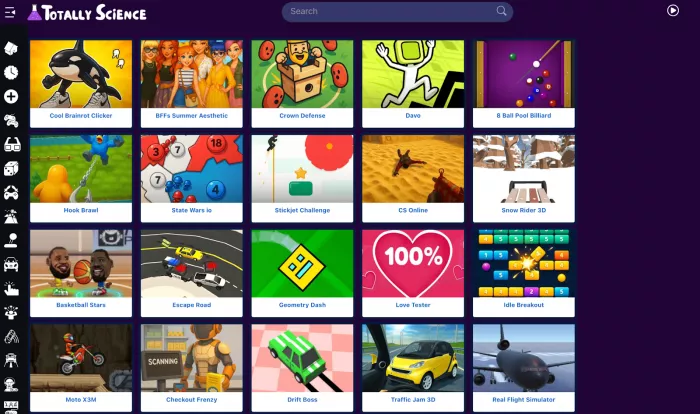
The most important question is simple. If the site is called Totally Science, where is the science content. Students searching for science games, physics lessons, or educational simulations do not find any. Instead, they see titles like FNF, Drift Hunters, Five Nights at Freddy’s, Minecraft Classic, Snow Rider 3D, Stickjet Challenge, and Capybara Clicker.
The current site structure includes:
● game categories for racing, action, pixel, sniper, car, simulator, and sports
● a long home feed filled entirely with unblocked games
● promotional writing about unblocked gaming culture rather than science
There is no trace of any science curriculum or STEM educational plan. The brand name appears to have been a convenient doorway, not a mission statement.
Why a Science Name Leads to an Arcade Platform
Unblocked gaming sites often rely on academic sounding names to survive school filtering systems. Filters typically flag words such as “games” or “arcade,” but neutral or educational names like science, math, or study are much harder for automated filters to block without affecting classroom websites.
Totally Science seems to have followed this pattern. The name creates a sense of legitimacy when students search for work arounds. The school network sees a harmless word associated with learning, but the content is an entertainment hub. The strategy is simple. The label looks intellectual. The reality is purely recreational.
What You See After Visiting the Site
Once you scroll through the homepage, the pattern becomes clear. Every visible part of the interface highlights entertainment. Game thumbnails dominate the page and new titles are added frequently. Categories like “girls,” “drift,” “driving,” “multiplayer,” “sniper,” and “simulator” replace any mention of science, chemistry, biology, astronomy, or math.
The promotional text on the site attempts to explain why unblocked games are useful at school or work, but none of the explanations link to science. The FAQ sections focus on Chromebooks, privacy, and ad comments, not anything educational. Even the About page reinforces the gaming identity.
To show the shift, here is a clarity table.
Identity Shift Table
| Area of the Site | Expected Content Based on Name | Actual Content Observed |
| Homepage | Science themed learning platform | Gaming thumbnails and arcade categories |
| Blog section | STEM articles or science news | Casino guides and random SEO filler |
| Educational promise | Experiments or simulations | None provided |
| Navigation | Science topics | Game genres and unblocked game instructions |
The mismatch is total.
The Blog Section Tells a Different Story Entirely
The blog reveals even more about the site's intentions. Instead of scientific topics, users find articles about casinos, slot games, betting, esports in the Gulf region, travel budgeting, shirt numbers of athletes, and random gambling advice. There is no thematic connection to science or dating or learning.
This shows that the website is not curated with a structured editorial intent. It is filled with SEO driven content designed to attract traffic for entirely unrelated industries. Websites that cluster casino articles with unblocked games usually do so for revenue, not for educational impact.
Why the Site Functions This Way
Based on common patterns in unblocked game networks, the likely explanation is straightforward.
1. The domain began with a science sounding name to slip through school filters.
2. The site grew as an unblocked game hub and began earning revenue through ads.
3. To expand reach, identical or mirror sites were created under similar names.
4. The blog became a repository for paid posts from casino marketers and unrelated advertisers.
5. The educational identity was abandoned completely because the gaming traffic produced better earnings.
This interpretation is supported by the content itself. The platform behaves like a traffic farm, not like a learning tool.
Platform Evaluation Table
| Category | Rating | Reason |
| Educational authenticity | 1 out of 5 | No science content despite the name |
| Transparency | 2 out of 5 | Identity appears misleading |
| Entertainment quality | 4 out of 5 | Large library of working unblocked games |
| Safety | 2 out of 5 | Ad quality is unpredictable and the blog attracts questionable industries |
| User experience | 3 out of 5 | Simple interface but heavy advertising |
These ratings reflect the site as it operates today, not the story implied by the name.
What Users Should Understand Before Using It
Totally Science is not a science platform. It is a gaming archive that uses a misleading name to remain accessible on restricted networks. Students who want quick entertainment will find it functional and convenient. Parents and educators who assume the platform is educational will be misled by the branding.
The presence of casino articles and gambling SEO posts indicates that the site participates in a broader traffic and monetization system that has nothing to do with science or learning. Users should be aware that the website’s priorities are aligned with traffic and advertising revenue rather than educational value or content integrity.
Conclusion
Totally Science operates today as a gaming hub with no scientific material. The identity feels designed to appear harmless to school filters while functioning as an entertainment portal. The blog reveals a completely different revenue strategy that includes casino marketing and SEO filler, confirming that education is not part of the platform’s mission.
Users can enjoy free unblocked games on the site, but they should not expect any learning outcomes or structured educational support. Parents and teachers should treat the site as a gaming platform rather than a STEM resource and understand that the branding does not reflect the actual purpose of the website.


Comments