Unlucid AI Review 2026: Features, Pricing, User Feedback, and the Real Truth Behind the “Uncensored” AI Platform

Ranjit Sharma

Javaughn Johnathan Porter
Javaughn Johnathan Porter
What Unlucid AI actually is
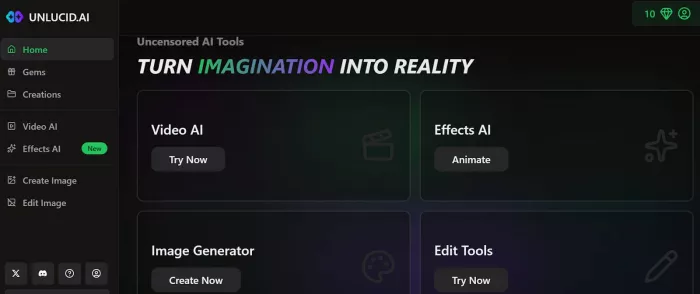
On its own site, Unlucid describes itself as “uncensored AI tools” for creating, editing, and animating videos and images. The homepage and about page position it around four main buckets: Video AI, Effects AI, Image Generator, and Edit Tools. The official tutorials page says the suite expanded on April 25, 2025 with 17 video effects, 5 image styles, and 4 editing modes.
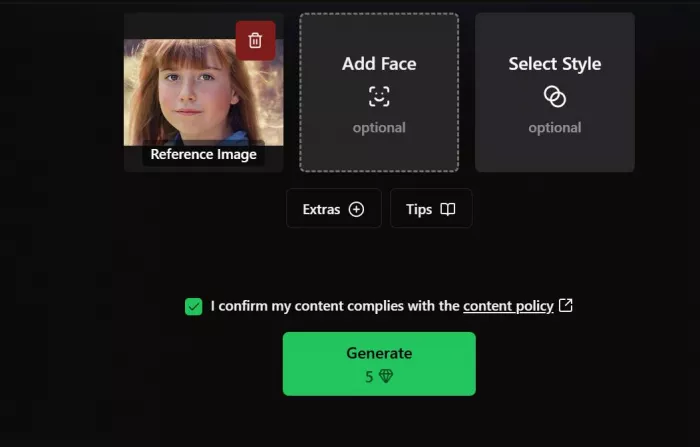
The more revealing source is the Terms of Service. There, Unlucid says it is a browser-based generative AI platform that lets users create and edit images, including both sexually explicit and non-sexually explicit content, through AI-powered tools. The terms also define Facial Reference Technology, which lets users upload a face so the system can generate synthetic images resembling that person, subject to consent requirements.
So in practical terms, Unlucid is best understood as a consumer-grade visual generation playground with three main workflows:
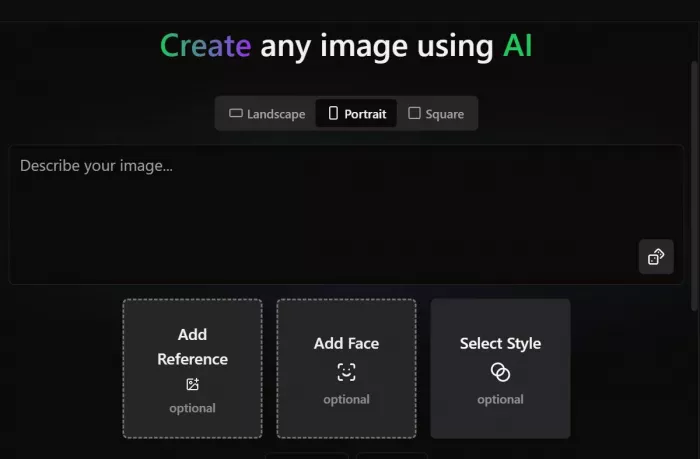
1. Text-to-image creation
2. Image editing/manipulation
3. Image-to-short-video effects and animation
Practical example: how a creator could use Unlucid AI
Imagine a small content creator wants to make a short, eye-catching Instagram Reel without learning advanced video software.
Goal- Create a fun animated social post from a single portrait photo.
Step 1: Upload the starting image
The creator uploads a clear selfie or portrait image into Unlucid’s video or effects section.
Step 2: Choose a motion effect
Instead of building an animation manually, the creator selects one of Unlucid’s preset effects, such as a dance-style animation, zoom effect, or reveal effect.
Step 3: Spend gems to generate the clip
Unlucid processes the uploaded image and applies the chosen motion template. The creator spends gems for the output.
Step 4: Review the first version
The first result may be good enough for casual posting, but if the motion feels awkward or too exaggerated, the creator can try another preset effect.
Step 5: Download and publish
Once a usable version is generated, the creator downloads the clip and posts it to Instagram Reels, TikTok, or YouTube Shorts.
Core features and real use cases
The clearest feature set, combining official pages and current reviews, looks like this:
| Feature area | What evidence shows | Realistic use case |
| Image generation | Text prompts generate images in multiple styles | Concept art, memes, social graphics |
| Image editing | Remove objects, change colors, swap outfits, cleanup | Fast edits without Photoshop |
| Image-to-video effects | Preset motion and effect templates | TikTok/Reels style short clips |
| Face reference workflows | Terms explicitly define facial reference tech | Personalized stylization, with consent |
| Daily free gem loop | Official gem page offers free daily claims | Trial use, occasional casual generation |
| Affiliate program | 30% commission, recurring commissions, crypto payouts | Growth via affiliate acquisition |
All of that is supported by the official site and policy pages.
The likely real-world use cases are narrower than the marketing implies. Based on official positioning plus available public feedback, Unlucid seems strongest for:
● short meme-style or novelty video clips
● social content experiments
● quick image remixes
● adult-oriented or otherwise less-filtered creative experimentation
It looks weaker for:
● brand-safe enterprise use
● high-fidelity filmmaking
● long narrative video
● high-trust client work involving privacy-sensitive assets
Pricing, gem economics, and usage limits
Using the official bundle math, the effective pricing signal looks like this:
| Bundle | Price | Approx image cost | Approx edit cost | Approx video cost |
| 120 gems | $8.99 | $0.07 | $0.15 | $0.75 |
| 450 gems | $29.99 | $0.07 | $0.13 | $0.67 |
| 1250 gems | $59.99 | $0.05 | $0.10 | $0.48 |
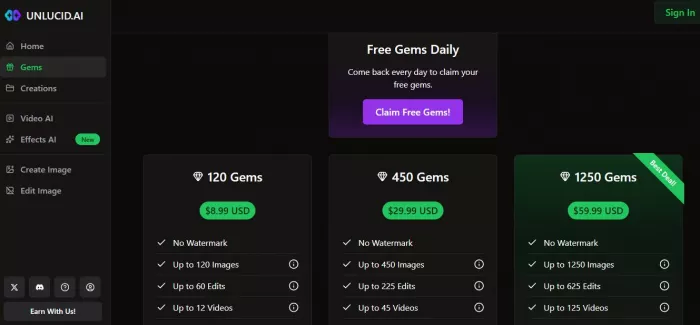
These are derived from Unlucid’s own bundle claims.
Review analysis: Trustpilot, G2, Capterra, Reddit, and public trust signals
This is one of the biggest issues in the investigation: public review coverage is thin.
I could not verify an active public Trustpilot review page for Unlucid AI itself, nor a public Capterra listing during this research. What I did find on G2 was an alternatives page, which confirms G2 recognizes a product entity called Unlucid AI, but I did not surface a meaningful public review corpus there.
The most concrete public user discussion I found was a Reddit thread in r/AIToolTesting. The takeaways from that thread were:
● daily free gems exist, but are limited
● output quality is “decent” rather than standout
● success rate is not fully reliable
● it is usable for quick short-form content
● it gets expensive when volume rises
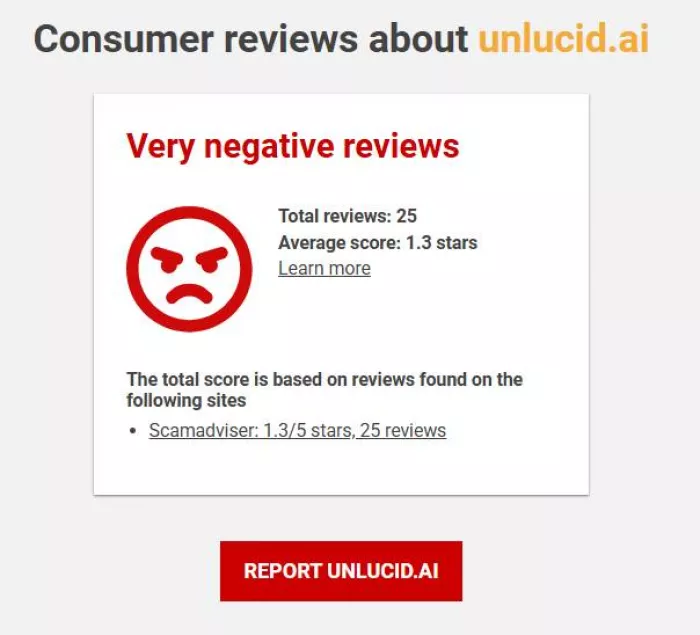
A separate trust signal comes from Scamadviser, which shows 25 reviews averaging 1.3/5 and labels the sentiment “very negative,” while also noting that its own site-level trust score is automated and should not be treated as definitive proof of fraud. This is not the same as a software review platform, but it is still a negative public signal worth noting.
Evidence-weighted review summary
| Source | What surfaced | Reliability for product quality |
| Small but useful firsthand discussion | Medium | |
| G2 | Alternatives footprint, no robust review dataset surfaced | Low |
| Trustpilot | No verified product review page surfaced in research | Low |
| Capterra | No verified listing surfaced in research | Low |
| Scamadviser | 25 reviews, 1.3/5 average, very negative | Low to medium, but more trust-risk than product-quality signal |
Because the review sample is so thin, any strong claim like “users love it” or “users hate it” would be overstating the evidence. The real conclusion is narrower: public proof of satisfaction is weak, while public trust concerns are more visible than public praise.
Strengths reported by users and reviewers
The strengths that showed up repeatedly were fairly consistent:
1. Fast, beginner-friendly workflow
The official site explicitly markets simplicity, and third-party reviews echo that. This is probably the platform’s strongest advantage.
2. Daily free entry point
The gem page promises free gems daily, and Reddit users independently mentioned daily free gems. That lowers the barrier to testing.
3. Fewer content restrictions than many mainstream tools
Unlucid openly brands itself as “uncensored,” and its terms confirm it supports both sexually explicit and non-sexually explicit content, while setting explicit consent and anti-minor rules.
4. Good fit for quick short-form experiments
The Reddit and review coverage that exists points toward “quick clips,” memes, transitions, and casual social posts rather than polished ad production.
Weaknesses and risk factors
The weaknesses are sharper, and better evidenced:
1. Thin trust and company transparency signals
The official site exposes product pages, privacy policy, terms, tutorials, and affiliate pages, but not much company depth is visible on the public-facing marketing surface. Scamadviser also flags hidden WHOIS identities and negative reviews. That does not prove bad intent, but it does weaken trust.
2. Weak review-platform footprint
For a product claiming serious usage, the lack of strong public Trustpilot, G2, or Capterra review depth is a credibility problem. G2’s visible surface is mostly the alternatives page.
3. Video value looks poor at scale
Official pricing plus Reddit feedback point the same way: the economics are okay for occasional use, but heavy video usage gets pricey fast.
4. Quality appears inconsistent
Third-party reviews repeatedly describe the output as mixed and less polished than stronger competitors. Even relatively positive comments describe it as good for quick fun rather than high-end output.
5. Policy and consent burden on face uploads
The terms are explicit that users must have written consent for other people’s faces and must keep consent records available on request. The platform also says it logs attempted uploads involving minors for up to six years. That is legally cautious on paper, but it also signals that face-based workflows carry real compliance risk.
Comparison with similar tools
For practical buying decisions, Unlucid is better compared with mainstream image/video generators than with generic G2 “Emerging AI” neighbors.
The table below uses official pricing pages where possible and focuses on workflow fit, not just headline features.
| Tool | Best fit | Pricing signal | Strength vs Unlucid | Weakness vs Unlucid |
| Unlucid AI | Casual visual experimentation, uncensored workflows | Pay-as-you-go gems, no-watermark bundles | Lower entry friction, flexible spend | Weaker trust and less polished output |
| Runway | Professional video creation | Free tier, then $12/$28/$76 with credits | Much stronger production stack and broader model access | Higher learning and cost for casual users |
| Pika | Consumer-friendly AI video creation | $8/$28/$76 yearly-billed plans with explicit credit costs | More explicit video-credit economics and broader branded video tooling | Less “uncensored” positioning |
| SeaArt | Large-volume image creation and model ecosystem | Dual token system, broad image/video/model ecosystem | Bigger creation ecosystem and persistent credits | More complex token logic |
Final verdict
Reality beats hype, but only partly.
Unlucid AI appears to be a real, popular, lightweight creative tool with a strong hook: fast, browser-based, less-filtered image and short-video generation. For casual creators, curiosity-driven users, and short social experiments, that may be enough.
But the investigation does not support a stronger claim that Unlucid is a top-tier, trusted, professional creative platform. The weak public review footprint, highly negative Scamadviser review pool, limited transparency signals, and recurring comments about inconsistent quality and rising video cost all pull it back down.
So the most honest conclusion is:
● For hobby use and fast experimentation: worth testing.
● For sensitive client work, brand-safe teams, or high-volume video production: look elsewhere first.
I also made two simple graphs from the official pricing and public-review discovery data:
Unlucid cost per output graph
Public review signal graph


Comments