What to Use Instead of Mailchimp When Your List Starts Growing


MailerLite
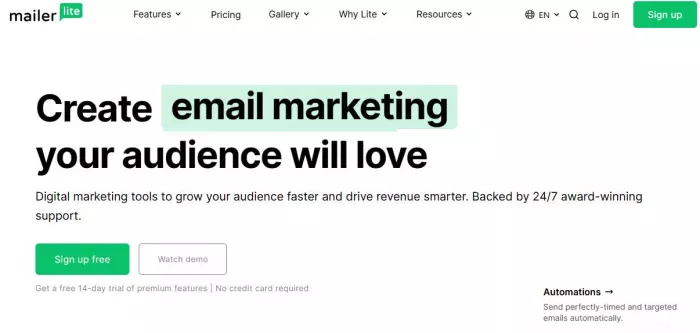
MailerLite positions itself as the simplest way to run email marketing without cost friction. It is built for small businesses, creators, and teams that want predictable pricing without constantly unlocking new tiers. (MailerLite)
Where it clearly pulls ahead of Mailchimp is cost control. At around $9 per month for 500 subscribers and roughly $39 to $50 at 5,000 subscribers, it stays significantly cheaper. Even at 10,000 subscribers, pricing usually lands in the $70 to $100 range, depending on features. The logic is straightforward: you pay based on subscribers, not on how many emails you send.
Automation is functional but not deep. You can build workflows, triggers, and sequences, but once you try to layer complex branching or behavioral logic, the limits become visible. Deliverability has remained consistently strong based on independent testing and user reviews, which is one of the reasons it is widely recommended for newsletters.
The interface is one of its biggest advantages. It avoids the clutter that Mailchimp has gradually accumulated, especially after adding multiple product layers.
Where it wins over Mailchimp
1. Much lower cost at every subscriber tier
2. Cleaner interface with less friction
3. Strong deliverability for newsletters
Where it falls short
1. Automation depth is limited
2. Fewer advanced integrations
3. Reporting is simpler and less granular
Brevo (Sendinblue)
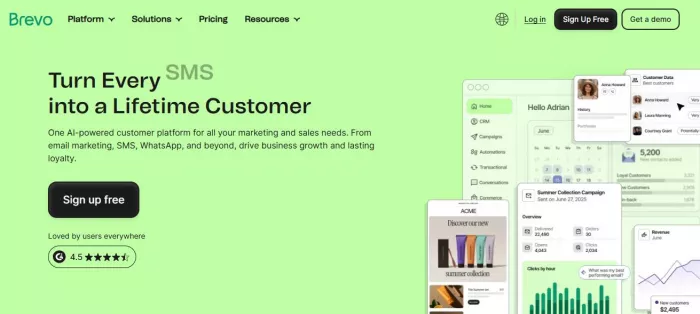
Brevo operates on a fundamentally different pricing model. Instead of charging for subscribers, it charges based on email volume. This changes how you think about scale entirely. (Brevo)
It is built for businesses that send transactional emails alongside marketing campaigns. If you run order confirmations, OTPs, or system emails, Brevo becomes more efficient than Mailchimp quickly.
Pricing starts around $25 per month, and you can send a fixed number of emails rather than paying for list size. For example, you can manage 10,000 contacts but only pay if you actually send to them frequently. This is a major cost advantage for low-frequency senders.
Automation is solid, with workflow builders that are more flexible than MailerLite but not as deep as enterprise tools. Deliverability is strong, especially for transactional use cases, because of its infrastructure focus.
The tradeoff shows in usability. The interface is not as intuitive as MailerLite or Kit, and it feels closer to a system tool than a marketing tool.
Where it wins over Mailchimp
1. Email volume pricing can be cheaper at scale
2. Strong transactional email support
3. Better value for low send frequency
Where it falls short
1. Interface feels less intuitive
2. Learning curve is higher
3. Design tools are less polished
GetResponse
GetResponse sits closer to Mailchimp in terms of feature ambition. It tries to combine email marketing with automation, landing pages, and even webinars. (GetResponse)
It is built for users who want more than just campaigns. If you are running funnels, lead magnets, and automated sequences, this is where it starts to make sense.
Pricing begins around $19 per month for 1,000 subscribers, but the cost rises quickly as you move into automation-heavy tiers. At 5,000 subscribers, you are typically looking at $50 to $70, and at 10,000 subscribers, it can cross $90 depending on features.

Automation is one of its strongest areas. You get visual workflows with branching logic, scoring, and behavior tracking. This is where it can outperform Mailchimp if you actually use those features.
The downside is complexity. The interface is not beginner-friendly, and many users report friction when navigating between tools.
Where it wins over Mailchimp
1. Stronger automation workflows
2. Built-in funnel and landing page tools
3. More flexibility for advanced campaigns
Where it falls short
1. Pricing increases quickly with features
2. Interface complexity
3. Overkill for simple email use cases
Moosend
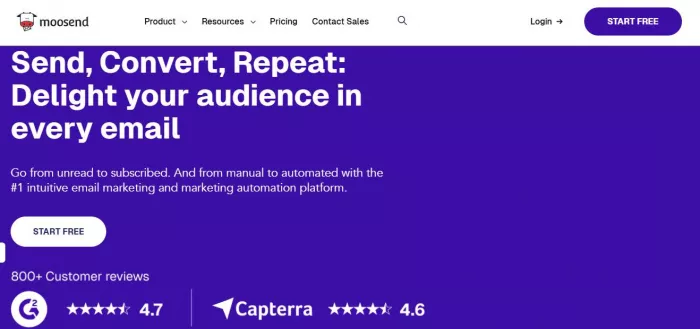
Moosend is often overlooked, but it competes directly on pricing and simplicity. It is built for small businesses that want automation without enterprise complexity. (Moosend)
Pricing starts at around $9 per month, and even at 5,000 subscribers it typically stays under $40. At 10,000 subscribers, it remains relatively predictable compared to Mailchimp’s tier jumps.
Automation is surprisingly capable for the price. You can build workflows, triggers, and segmentation rules without needing advanced setup. Deliverability is solid, though not as widely benchmarked as larger platforms.
The main limitation is ecosystem depth. Integrations and third-party support are not as extensive, which can become a bottleneck as you scale.
Where it wins over Mailchimp
1. Lower and more predictable pricing
2. Good automation for the price
3. Lightweight and easy to manage
Where it falls short
1. Smaller integration ecosystem
2. Less brand trust compared to larger tools
3. Limited advanced features
Kit (ConvertKit)
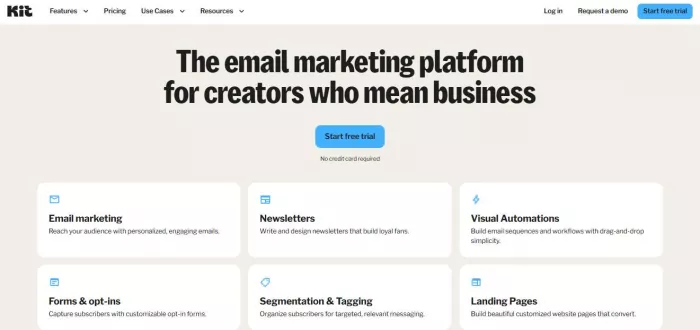
Kit is built specifically for creators. It focuses on newsletters, audience segmentation, and monetization rather than traditional campaign marketing. (Kit)
It works best for writers, YouTubers, and solo operators who care more about audience relationships than complex automation trees.
Pricing starts free for basic usage, with paid plans from around $15 per month. At 5,000 subscribers, you are typically paying $70 to $80, and at 10,000 subscribers, it crosses $100.
The pricing is higher than MailerLite or Moosend, but the tradeoff is simplicity and creator-focused features like tagging, sequences, and digital product sales.
Automation is intentionally simplified. It supports sequences and basic logic but avoids complexity, which is both a strength and a limitation.
Where it wins over Mailchimp
1. Built specifically for creators
2. Strong tagging and segmentation model
3. Clean writing-focused interface
Where it falls short
1. Expensive at scale
2. Limited design customization
3. Not ideal for traditional marketing teams
Constant Contact
Constant Contact targets traditional small businesses, especially those running local campaigns, events, and promotions. (Constant Contact)
It starts at around $12 per month and scales steadily with subscriber count. At 5,000 subscribers, it typically ranges between $80 to $100, and at 10,000 subscribers, it can exceed $150 depending on features.
The platform focuses more on usability than depth. Campaign creation is straightforward, and templates are designed for quick deployment rather than customization.
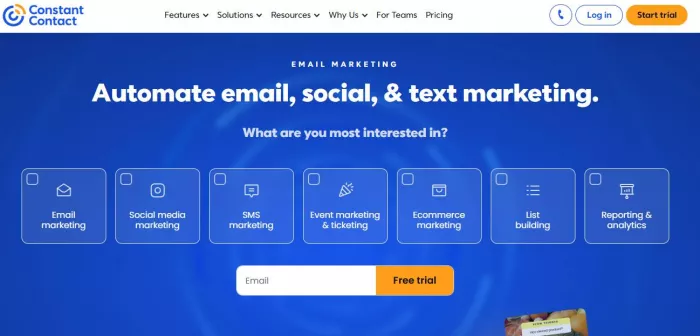
Automation is basic. You get autoresponders and simple sequences, but nothing close to advanced workflow builders.
The biggest concern is value. Compared to newer tools, it feels expensive for what it offers.
Where it wins over Mailchimp
1. Easy onboarding for beginners
2. Strong event and local business features
3. Reliable support
Where it falls short
1. Expensive for its feature set
2. Limited automation
3. Outdated interface in parts
Snapshot comparison
| Tool | Starting Price | Pricing Model | Free Plan | Best Use Case | Rating (G2 / Capterra / Trustpilot) |
| MailerLite | Free, paid from $9/month | Subscriber-based | Yes | Low-cost scaling | G2 ~4.6, Capterra ~4.7, Trustpilot ~4.2 |
| Brevo | Free, paid from $25/month | Email volume-based | Yes | Transactional + marketing mix | G2 ~4.5, Capterra ~4.6, Trustpilot ~4.0 |
| GetResponse | From $19/month | Subscriber-based | Limited free | Automation-heavy users | G2 ~4.3, Capterra ~4.2, Trustpilot ~3.5 |
| Moosend | From $9/month | Subscriber-based | No permanent free | Budget automation | G2 ~4.7, Capterra ~4.6, Trustpilot ~4.2 |
| Kit (ConvertKit) | Free, paid from $15/month | Subscriber-based | Yes | Creators and newsletters | G2 ~4.4, Capterra ~4.6, Trustpilot ~3.9 |
| Constant Contact | From $12/month | Subscriber-based | Trial only | Small businesses, events | G2 ~4.0, Capterra ~4.3, Trustpilot ~1.8 |
Conclusion
● MailerLite is the strongest low-cost replacement for Mailchimp if your focus is straightforward email marketing with predictable pricing.
● Kit is the best choice for creators who prioritize audience relationships over campaign complexity, even though it becomes expensive at scale.
● GetResponse stands out for automation-heavy use cases where workflows actually matter.
● Brevo is the most efficient option when email volume is lower or when transactional emails are part of your system.
If the goal is to replace Mailchimp with something that feels familiar but less restrictive, MailerLite is the closest match in terms of structure, usability, and cost balance.


Comments