Apple's Future AirPods Could Get Cameras — Is This the Next Step for Wearable AI?



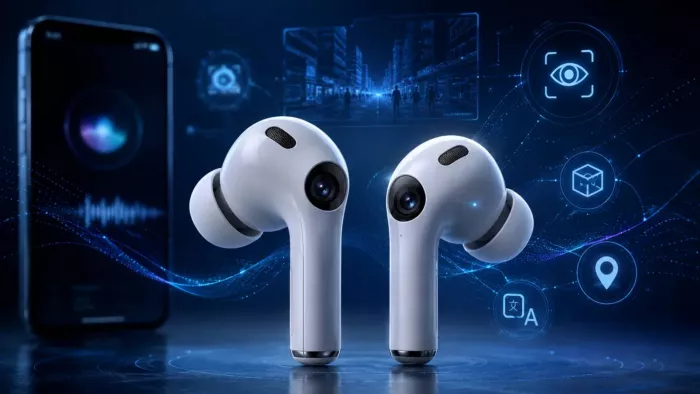
The world's most popular earbuds are about to gain a new superpower: the ability to see.
Imagine pointing your ears at a restaurant menu and having Siri read it, translate it, and suggest what to order — all without lifting your phone. That is the promise quietly taking shape inside Apple's labs, where engineers are reportedly putting the finishing touches on what could become one of the company's most ambitious products in years: AirPods with built-in cameras.
According to Bloomberg's Mark Gurman — the most reliably plugged-in Apple reporter in the business — Apple has reached the late stages of development for camera-equipped AirPods, with prototypes now featuring a near-final design and capabilities. The project has entered advanced testing, and the earbuds are being positioned as Apple's first wearable device designed specifically for the artificial intelligence era.
Not the Cameras You're Thinking Of
Before you picture yourself snapping selfies with your earbuds, it's worth understanding what these cameras are actually for. They are expected to be low-resolution or infrared sensors — not meant for photography or videography, but for giving Apple's AI a live, continuous view of the world around the wearer.
The idea is elegantly simple: let Siri see the same scene you're seeing, then reason over that image the way it already reasons over typed or spoken prompts. Facing a shelf of ingredients at the supermarket? Ask what you should cook for dinner. Walking through an unfamiliar neighborhood? Get turn-by-turn directions that reference actual landmarks you can see. The device could also surface reminders triggered by what the camera detects — a contextual awareness that no amount of voice commands alone can replicate.
Apple has also explored using the cameras to power an upgraded version of VoiceOver, the accessibility feature that describes visual content for users who are blind or have low vision. A camera embedded in something already worn in the ear could be transformative for accessibility in ways that holding up a phone simply cannot match.
Part of a Bigger AI Wearable Push
The camera-equipped AirPods don't exist in isolation. They are reportedly the opening move in a broader three-product strategy that Apple CEO Tim Cook is personally championing as the company's "next big thing."
Alongside the AirPods, Apple is developing smart glasses — codenamed N50 — that will carry more advanced cameras capable of capturing photos and video, while also feeding visual data into Siri and Apple Intelligence. The glasses are described as a direct rival to Meta's Ray-Ban smart glasses, featuring cameras, microphones, speakers, and Siri integration, but with Apple's signature emphasis on build quality and premium materials.
Completing the trio is an AI pendant — a small, clip-on or necklace-style device with its own onboard camera — that offers another hands-free way to keep computer vision running without requiring users to hold up their phone. At an all-hands meeting earlier this year, Cook told employees the company was "extremely excited" about these new product categories.
All three devices are designed to work together, each leveraging computer vision to interpret the user's surroundings and feed contextual awareness into Siri and Apple Intelligence. The camera-equipped AirPods, being the simplest and most familiar of the three, are expected to arrive first.
Why AirPods Make Sense as Apple's First AI Wearable
There's a strategic logic to leading with AirPods that goes beyond hardware. Smart glasses — even well-made ones — ask something of the wearer: they ask you to look different. AirPods don't. They are already one of the most widely worn accessories on the planet, universally accepted in offices, on trains, in coffee shops, and on running paths. Nobody looks twice at someone wearing AirPods. That social invisibility is a product advantage that no new wearable form factor can buy overnight.
Apple doesn't need to convince anyone that camera-equipped AirPods deserve to exist. AirPods are already a compelling product. The cameras would simply add a new layer of value to something people already wear for hours every day — making them a far lower-friction entry point into the age of wearable AI than a new pair of glasses or a novel clip-on pin.
The Competitive Pressure Is Real
Apple's urgency here is no accident. Meta has been quietly building a head start in the AI wearables space with its Ray-Ban smart glasses, which allow wearers to ask questions about their surroundings, take hands-free photos and videos, and interact with Meta AI in real time. The Ray-Bans have found genuine consumer traction in a market that has historically been unkind to wearables, and they've put pressure on Apple to respond.
Apple's answer appears to be a three-pronged strategy that bets on integration — a connected ecosystem of earbuds, glasses, and a pendant, all talking to the same upgraded Siri and Apple Intelligence backend — rather than a single hero device. That approach plays to Apple's greatest strength: making products work better together than any of them work alone.
The key variable, however, lies not in the hardware but in the software. Apple's rebuilt Siri — the large language model-powered version that the company has been promising — needs to actually deliver on the contextual, intelligent, conversational experience that camera-equipped wearables demand. Without a Siri that can genuinely reason about what it sees, the cameras are a solution in search of a problem.
A New Era for the Humble Earbud
What Apple is quietly proposing is a fundamental rethinking of what earbuds are for. Since their introduction, AirPods have been audio devices — excellent ones, with smart features bolted on. Camera integration would turn them into something different: a sensory extension of the user, an always-present AI companion that can hear what you hear and now see what you see.
That is a significant leap. And it raises questions that go beyond product specs: questions about privacy, about what it means to have a camera running continuously near your face, and about who controls the data that camera generates. Apple has historically staked its reputation on privacy, and how it handles those concerns will be as important as any technical spec.
But if it gets it right — if the cameras are subtle, the AI is genuinely useful, and the privacy model is trustworthy — camera-equipped AirPods could quietly become one of the most consequential devices Apple has ever shipped. Not because of what they look like, but because of what they allow you to see.


Comments