How to Grow Your Fitness Instagram: 12 Proven Tips That Actually Work



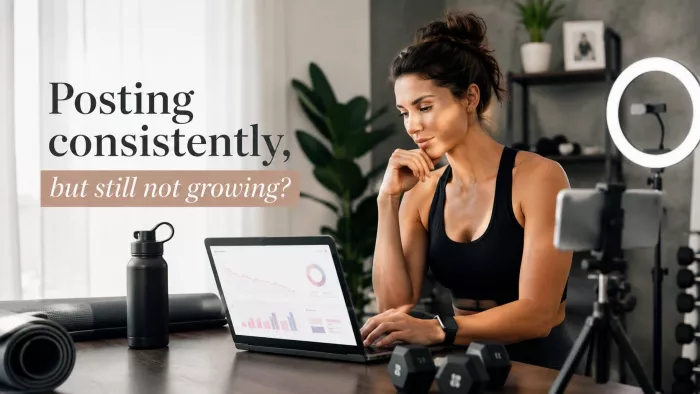
You've been posting consistently for months. Workouts on Monday, progress photos on Wednesday, a motivational quote on Sunday. You're showing up. You're putting in the work. And your follower count? Basically the same as it was three months ago.
It's one of the most frustrating places to be as a fitness creator. Not a beginner who just started, but not growing either. Just... stuck.
Here's the thing: the problem usually isn't effort. Its direction.
The fitness creators who grow steadily aren't necessarily more talented, more shredded, or posting more often. They've figured out something that the stuck creators haven't. Instagram doesn't reward volume. It rewards value. Specifically, content people want to save, share with a friend, and return to.
This article is for you if you've been consistent but aren't seeing results. Not generic growth hacks, not "post at 6pm for maximum reach" advice. Just the actual principles that separate fitness accounts that grow from the ones that flatline. Here's how to apply them to your content right now.
Why Growing a Fitness Instagram Feels Harder Than Ever
Before we get into what works, let's be honest about why it's harder than it used to be.
More Competition Than Ever
When fitness Instagram was less crowded, showing up with decent content and a consistent posting schedule was enough to stand out. That window has closed. There are now millions of fitness accounts posting high-quality workout videos, transformation content, and nutrition advice. The supply of fitness content has exploded. Audience attention hasn't.
Higher Content Standards
Audiences have become genuinely selective. A shaky gym selfie with a generic caption used to be fine. Now, even creators with relatively small followings are producing clean edits, thoughtful captions, and content with a clear point of view. The floor has risen. What was "good enough" two years ago is now invisible.
Audience Attention Is Limited
Your potential followers aren't spending their evenings searching for fitness accounts to follow. They're passively scrolling, watching Reels, saving posts they find useful. For your content to break through, it has to earn attention in the first two seconds, deliver something genuinely useful, and make someone feel like following you is worth their while.
Why Consistency Alone Isn't Enough
Consistency is necessary but not sufficient. Posting the wrong content consistently just means consistently being ignored. Posting regularly matters less than posting the right things regularly. That distinction matters a lot.
The good news is that growth is absolutely still happening for fitness creators. Every week, accounts go from 500 followers to 50,000, from 5,000 to 500,000. It's not luck. It's a combination of the principles below.
12 Proven Tips That Actually Work
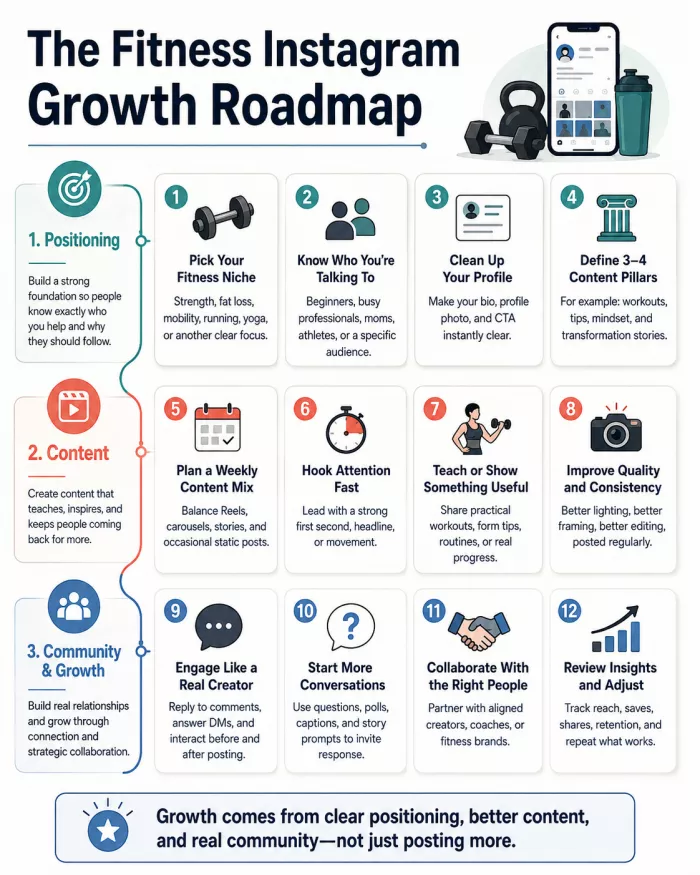
1. Choose a Specific Fitness Niche
If your account is for "anyone interested in fitness," it's really for no one. That sounds harsh, but it's one of the most common reasons fitness accounts stall. Vague positioning means vague content, which attracts a vague audience the algorithm has no idea who to show your posts to.
Think about the difference between "fitness creator" and "fitness for busy moms over 35" or "strength training for complete beginners" or "running your first half marathon." The narrower the focus, the clearer the message. And the clearer the message, the faster people self-identify as your audience and hit follow.
This doesn't mean you can never post anything outside your lane. It means your account has a gravitational center that everything orbits around. A strength training creator can absolutely post about sleep and recovery, because those things support strength training. The niche is the lens, not a cage.
Common mistake: Thinking a narrow niche limits growth. In reality, it accelerates it. A smaller, more engaged audience that genuinely cares about your topic grows faster and converts better than a large, scattered one.
2. Create Content Around Problems, Not Exercises
Here's a simple test: look at your last 10 posts. How many of them are titled after an exercise or a body part. "3 shoulder exercises," "full body workout," "leg day"? Now ask yourself: who is searching for those things? Probably people who already know what they're doing.
The accounts that grow fastest are solving problems people are Googling at midnight:
"Why do I get shin splints every time I start running again?"
"How do I stop losing weight and then gaining it all back?"
"What should I actually eat before a morning workout?"
"Why do my knees hurt when I squat?"
These are better content, full stop. They speak to someone's actual frustration. When you create content about a real problem someone has, they feel like you made it for them. That feeling is what drives saves and shares.
A creator called Stephanie Buttermore built a massive following by talking openly about her struggle with food restriction and her decision to go "all in" on eating intuitively. It wasn't a workout video. It was a problem her audience had and didn't know how to talk about. The content spread because it was real and useful, not because it was optimized.
Common mistake: Posting content about what you know, rather than what your audience is struggling with. Great content is always audience-first.
3. Make Reels Your Discovery Engine
Reels are still the primary way new people find your account on Instagram. Stories are for your existing audience. The feed is where they decide whether to follow after they've already discovered you. Reels are how they discover you at all.
The fitness content that performs best as Reels tends to have a few things in common: it hooks immediately (the first frame or caption matters enormously), it delivers the payoff fast, and it gives people a reason to share it with someone else. "Send this to your friend who never leaves the couch" is a format for a reason. It works.
You don't need high production value. You need a clear point. A creator who explains one common squat mistake in 30 seconds, with text overlays and decent lighting, will outperform a polished 3-minute workout video with generic music almost every time. Clarity beats production.
What tends to perform well: myth-busting, quick tutorials with visual demonstrations, transformation content that shows the journey honestly, and anything that prompts the viewer to tag someone or save it for later.
Common mistake: Treating Reels as a place to post full workouts. Reels are the trailer, not the movie. Get people curious enough to follow, then deliver the full value.
4. Show Your Own Fitness Journey
People follow people, not programs. If your account looks like a collection of fitness tips with no humans behind it, there's no emotional reason to follow you specifically over anyone else posting similar content.
Your journey, including the messy parts, is what makes your account yours. The week you couldn't train because of an injury. The time you gained the weight back and had to figure out why. These aren't distractions from your fitness content. They are your fitness content.
This doesn't mean you need to overshare or turn your account into a therapy session. It means being honest and specific. "I've been struggling with motivation lately and here's what's actually helped" will always outperform "5 tips to stay motivated" because one of those posts comes from a person and one comes from a template.
Common mistake: Waiting until you've achieved your goals to start sharing. Your audience wants to grow with you, not just admire you after you've arrived.
5. Build a Recognizable Content Style
When someone sees your post while scrolling, they should be able to recognize it as yours before they even read your name. That recognition is built through visual consistency: your color palette, font choices, how you frame your videos, your editing style.
This isn't about being aesthetic for aesthetics' sake. It's about building a brand memory. The more consistently people recognize your content, the more familiar you feel, and familiarity builds trust faster than almost anything else.
You don't need to hire a designer. Pick two or three fonts and stick to them. Decide on a thumbnail style for your Reels and use it consistently. Film with similar lighting every time. Small decisions made consistently become a signature.
Common mistake: Reinventing the visual style with every post. Inconsistency signals a lack of direction to both the algorithm and the audience.
6. Write Captions That Add Value
Captions have not died. For the right type of content, particularly educational posts and personal stories, a strong caption can dramatically increase saves and comments.
The mistake most creators make is using captions as a place to dump hashtags or write something generic like "legs today." A caption is an opportunity to extend the value of the post, add context, tell the story behind it, or invite a response.
Some of the most-saved fitness posts on Instagram are simple workout videos paired with captions that explain the why: why this exercise, why this rep range, what the person posting it personally got wrong when they first started. That layered context is what separates a post someone scrolls past from one they come back to.
Try ending your captions with a genuine question. Not "thoughts?" but something specific: "Which part of this did you think was backwards? Because I definitely did when I first heard it." Specific questions get specific answers, and comments tell the algorithm your content is worth showing more people.
Common mistake: Spending all the time on the visual and writing the caption in 30 seconds. The caption is where the relationship gets built.
7. Turn Frequently Asked Questions Into Content
Your DMs and comment section are a goldmine of content ideas. Every time someone asks you the same question twice, that's a post waiting to happen. Every time someone shares a struggle that sounds familiar, that's a post waiting to happen.
"What do I eat before a morning workout if I'm not hungry?" "Is it bad that I only go to the gym twice a week?" "How long before I actually see results?" These aren't interruptions to your content calendar. They are the content calendar.
FAQ-based content works for two reasons: it's exactly what people are searching for, and it makes the person who asked feel seen, which builds the kind of loyalty that turns followers into fans.
A good habit: keep a running note on your phone of every question someone asks you that you haven't answered publicly yet. You'll never run out of content ideas.
Common mistake: Answering the question once in DMs and moving on. Every good question deserves a public answer.
8. Create Content Series Instead of Random Posts
Recurring content formats are one of the most underrated growth tools on Instagram. When your audience knows that every Tuesday you post a "beginner mistake of the week," or every Friday you share a real client transformation story, they have a reason to come back specifically for that content.
Series create anticipation, which creates habit. Habit creates loyalty. Loyalty creates growth.
This also makes your life easier. Instead of reinventing the wheel with every post, you have containers to fill. The format stays the same; only the content changes.
Some examples that work well for fitness creators: "one rep PR of the week," "nutrition myth Monday," "real talk Friday" (personal reflections on training), or a beginner series that walks through a specific goal step by step.
Common mistake: Starting a series and abandoning it after three episodes. If you're going to commit to a format, commit to it for at least 8–12 rounds before evaluating whether it's working.
9. Focus on Helping Before Selling
There's a pattern that kills fitness accounts faster than almost anything: starting to promote products or services before the audience trusts you. If someone lands on your page and the first thing they see is a discount code for a supplement or a pitch for your coaching program, they leave.
Trust is built through generosity. Give your best advice for free, consistently, over time. The audience that's been following you for six months and getting real value from your content is the audience that will pay for your program and refer their friends.
The rough rule that most successful creator-turned-entrepreneurs follow is 80/20: 80% value, 20% promotion. When the value is genuinely good, the 20% doesn't feel like selling. It feels like a natural next step.
Common mistake: Monetizing too early, or treating every post as a soft sell. People can feel it, and it erodes trust faster than it builds revenue.
10. Engage Like a Creator, Not a Broadcaster
Broadcasting means posting content and waiting for the audience to respond. Engaging means showing up in comments, responding thoughtfully, and being present in the communities where your potential audience already exists.
When someone leaves a genuine comment on your post, a one-word reply is a missed opportunity. A real answer, sometimes three or four sentences that extend the conversation, signals that there's a real person here who cares. That's rare, and people notice it.
Go further: engage with content from accounts in your niche. Leave comments that add something rather than just "great post!" This gets your name in front of audiences who are already interested in fitness, without spending a dollar on promotion.
Common mistake: Going dark after posting. The hour after you post is often the highest-value time to be active and responsive. The algorithm pays attention to early engagement velocity.
11. Study Your Best-Performing Posts
Your analytics are one of the most honest feedback mechanisms you have, and most creators ignore them. Every 4–6 weeks, look at your top 5 performing posts from that period and ask: what did these have in common?
Was it the format (Reel vs. carousel vs. single image)? The topic? The caption style? The time of day? The hook in the first line? Usually there's a pattern, and that pattern is your audience telling you exactly what they want more of.
The goal isn't to chase what performed well and replicate it mindlessly. It's to understand why it worked and use that insight to make better creative decisions going forward.
Common mistake: Creating content based entirely on what you feel like posting rather than what the data tells you your audience responds to. Both matter. Neither should dominate.
12. Stay Consistent Long Enough for Results
Most fitness accounts that quit do so right before they would have started seeing results. This is not motivational filler. It's one of the most common failure patterns.
Consistent, quality content for 90 days is roughly when most accounts start to see compounding momentum. By six months, the accounts that are still posting thoughtfully and engaging regularly are usually seeing meaningful growth. But the majority quit at week four because the numbers feel too small.
The accounts that grow aren't smarter. They're more patient. They've internalized that growth on social media is nonlinear: long flat stretches interrupted by sudden jumps. You can't see the jump coming. You just have to stay consistent long enough to reach it.
Realistic expectations: three to six months of consistent, strategic posting before you'll have enough data to evaluate what's working. That's not failure. That's how it works.
Common mistake: Treating low early numbers as evidence that the strategy is wrong. Low early numbers are evidence that you've been at it for a short time.
What Successful Fitness Accounts Have in Common
When you look across fitness accounts that have built real, loyal audiences, not just follower counts but actual communities, a few patterns emerge consistently.
Trust. They've built it slowly, by being honest and specific. About their wins and their failures, the things they used to believe that turned out to be wrong, the ongoing struggles they haven't resolved yet. Trust is the foundation everything else is built on.
Clarity. You know exactly who they're for and what they stand for within 30 seconds of landing on their profile. There's no ambiguity about the audience, the topic, or the point of view.
Consistency. In posting frequency, yes, but also in voice, visual style, and message. The experience of following them feels coherent over time.
Education. They make their followers more capable, not just more inspired. Inspiration fades. Capability compounds. The creators who teach their audience something useful create followers who stick around and refer others.
Personality. There is a real person here with real opinions, real preferences, and a real story. That's what makes one fitness account worth following over the thousands of others.
Common Mistakes That Slow Growth
Copying other creators. Taking inspiration is fine. Replicating formats is fine. Copying content and voice wholesale is both ethically wrong and strategically bad. Your audience will find the original and wonder why they're following the copy.
Posting without a clear audience. If you don't know who you're talking to, your content will be too vague to resonate with anyone specifically. Clarity about audience is upstream of everything else.
Chasing every trend. Trends are worth participating in when they're relevant to your content. When they're not, they dilute your brand. Every random trend video you post is a post that didn't serve your actual audience.
Ignoring engagement. If you're getting comments and not responding, you're leaving relationship capital on the table. Engagement is a two-way signal. Ignoring it tells the algorithm, and your audience, that you're not present.
Giving up too soon. The timeline for meaningful growth is longer than most new creators expect. If you evaluate success at month two, you'll almost always conclude it's not working. Give it six months of consistent, thoughtful effort before drawing conclusions.
A Simple Weekly Content Plan for Fitness Creators
You don't need to post every day. A realistic, sustainable content mix looks something like this:
2x Educational Posts — Tips, how-tos, myth-busting, or FAQ answers that genuinely help your specific audience. These drive saves, which the algorithm values highly.
1x Personal Story — Something real from your own journey. A setback, a breakthrough, a behind-the-scenes moment. This is what builds trust and keeps people connected to you as a person.
1x Workout Content — An actual workout, exercise demo, or training clip. Keep it relevant to your niche and format it for quick consumption.
1x Community Post — Something that invites conversation. A question, a poll, a "does this happen to anyone else?" post. These build the sense of community that makes people want to stay.
1x Promotional Content (optional, when relevant) — A soft mention of a product you actually use, a link to your coaching, an affiliate recommendation with honest context. Earn the right to this through the other five posts.
These don't all need to be separate formats. A Reel can be educational. A Story can be personal. The categories are about intent, not medium.
Conclusion
The fitness creators who figure this out didn't discover a hack. They didn't crack an algorithm or stumble onto a viral format. They got clear on who they wanted to help, started creating content that actually helped those people, and kept going long enough for the math to work in their favor.
Your account doesn't need to be for everyone. It needs to be the most useful, honest source of support for the specific people you want to serve. Get that right. Stay patient. The numbers follow.


Comments