
If every check for AI-generated content feels stressful and you don't know what to do with a high AI score, don't worry too much. AI detector results aren't always accurate, and a high percentage doesn't automatically mean your text is AI-generated. We'll explain why this happens and show you practical ways to reduce your detection score.
The Problems With AI Detection
AI detection isn't an entirely accurate way to verify the author of a text. An AI detector looks for linguistic and statistical patterns associated with generated content. Based on these markers, it calculates only a probability. It doesn't have access to the writing process itself, so its conclusion may be incorrect.
False positives are one of the main concerns. Completely human-written content may receive a high AI score, while AI-generated or heavily AI-assisted text can sometimes pass an AI checker as human. The same text may also receive very different scores across detectors because each tool can rely on different models, training data, detection methods, and thresholds. An AI-generated text detector can also be biased toward some human writing and classify it incorrectly. For example:
- Technical content. Manuals, documentation, and technical articles rely on precise terminology and consistent structures that can appear predictable.
- Academic writing. Formal vocabulary, standardized structures, and strict conventions can overlap with characteristics associated with generated text.
- Text from non-native English speakers. Research has found that some detectors disproportionately flag non-native English writing. Simpler vocabulary and more predictable word choices can contribute to false positives.
- Business and professional writing. Reports, formal emails, product descriptions, and other professional texts often follow templates and maintain a consistent tone.
- Short text. A small sample provides an AI text detector with less information to analyze, which can make the result less reliable.
Steps to Reduce Your AI Detection Score
Here are six practical steps you can take to improve your AI detector results and make your text more human.
Step 1: Analyze the AI Detector Results
Start with the detector results and find out which parts of the text cause the most concern. Use an AI checker that provides sentence- or paragraph-level analysis rather than only one percentage for the entire document. Mark the passages with the highest AI probability. These are the sections you should focus on first instead of guessing and making random changes throughout the text.
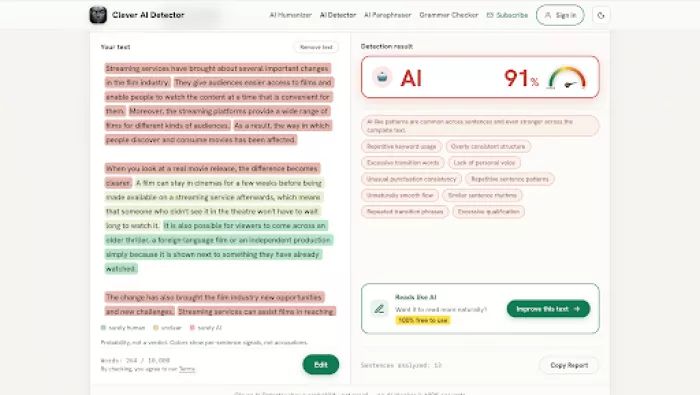
We ran our sample text about the film industry through an AI detector. As you see, it received a high overall AI probability of 91%. However, if you look at the sentence-level analysis, there are still parts of the text that are identified as human-written. We will leave these parts unchanged and concentrate on the parts that are entirely marked as AI-generated.
Step 2: Restructure Sentences and Paragraphs
Now look at the overall structure of the flagged sections. AI-generated drafts sometimes maintain a very consistent rhythm, with sentences of similar length and paragraphs built in nearly identical ways. Mix short sentences with longer ones. Vary paragraph length where it makes sense, and avoid using exactly the same structure for every paragraph. You can also combine closely related sentences or split a long sentence when this makes the point clearer.
Pay attention to how information appears within each paragraph as well. If every paragraph starts with a statement, follows with an explanation, and ends with an example, change the structure where another order works better.
Let's apply this to our example. We took the first paragraph that was fully highlighted by the detector:
Original: Streaming services have brought about several important changes in the film industry. They give audiences easier access to films and enable people to watch the content at a time that is convenient for them. Moreover, the streaming platforms provide a wide range of films for different kinds of audiences. As a result, the way in which people discover and consume movies has been affected.
We restructured the paragraph by combining related ideas and changing how the information is organized:
Restructured: Streaming services have brought about several important changes in the film industry, especially in how audiences access and watch movies. They enable people to choose from a wide range of films and watch the content at a time that is convenient for them. Moreover, these options are available to different kinds of audiences. As a result, the way in which people discover and consume movies has been affected.
Step 3: Paraphrase Sentences
Next, review individual sentences that still sound repetitive or formulaic. Don't simply replace several words with synonyms. This may change the vocabulary while leaving the same sentence structure intact.
Rewrite the sentence itself. Change how it starts, move information to a different position, or split and combine ideas where appropriate. Look for repeated words, similar sentence openings, and overused transitions such as “Additionally,” “Moreover,” or “Furthermore.”
If you struggle to find another way to express the same point, an online text paraphraser will help you. It can rewrite sentences quickly and effectively without distorting their original meaning. Some tools also let you choose a writing style that fits your text, which can save you a lot of time.
We decided to rewrite the text we got in Step 2 using a paraphraser. Here is the result:
Paraphrased: Streaming services have caused some big changes in the movie industry, especially in how people get and watch films. They let people pick from many movies and watch them whenever it's easy for them. What appears on the home page can also put a film in front of someone who might never have searched for it. Sometimes that is enough to change what they watch next.
Step 4: Humanize Larger Parts of the Text
If the AI text detector highlights a large portion of your document, editing every sentence manually can become time-consuming. You may also find that some passages still sound mechanical even after you restructure and paraphrase them.
The best solution in this situation is to humanize AI content. To help you with this, online humanizers will come in handy. They vary sentence structures, remove repetitive wording, and improve the overall flow. At the same time they will keep your original idea.
In the first check, the last two paragraphs were flagged as fully AI. So, we decided to humanize them both together rather than rewrite each sentence individually.
Original: The change has also brought the film industry new opportunities and new challenges. Streaming services can assist films in reaching wider audiences and give filmmakers more distribution choices. On the other hand, studios have to decide if a movie is better off being released in cinemas, as a streaming film, or as a mix of both.
Today audiences have much less predictable choices than in the past. A person could go to the cinema on a Friday for a large action film and then watch a quiet drama at home the following evening. While the type of film shown on screen has changed, the way people decide which films are worth two hours of their time has also changed.
Humanized: The change has also created new possibilities as well as challenges for the film industry. The streaming services can help movies reach more people and offer more options for filmmakers, but it also means that studios have to make decisions about whether a film should be presented in a cinema, a streaming service, or both.
Audience choices have changed as well. Someone might go to the cinema on Friday to see a major action release and then watch a smaller drama at home the next evening. Instead of depending only on cinema schedules, viewers can choose between theatrical releases and large streaming libraries based on what they want to watch and where they want to watch it.
Step 5: Add Specific Details and Original Input
Structure and wording are only part of the problem. Generic content also makes a text appear more predictable, so look for broad statements that lack useful details.
Add concrete examples, research, statistics, test results, observations, technical details, or your own relevant experience where appropriate. Instead of making a general claim, explain exactly what happened, why it matters, or what you found. Only add information you can support. Don't invent personal experiences or facts simply to influence a detector result.
We took the humanized paragraph from Step 4 and added specific detail to this part.
With specific detail: The change has also created new possibilities as well as challenges for the film industry. The streaming services can help movies reach more people and offer more options for filmmakers, but it also means that studios have to make decisions about whether a film should be presented in a cinema, a streaming service, or both. For example, Glass Onion: A Knives Out Mystery had a limited theatrical release before becoming available on Netflix.
Step 6: Check Your Text Again
Once you are done editing, check for AI detection again and compare the new results with the original ones. Pay attention to the passages that were previously flagged and check whether they still have a high AI probability score.
It’s better to test the text with several detectors rather than relying on just one. Various tools may detect different patterns and provide different assessments for the same text. Remember that even an instrument that’s marketed as the best AI detector isn’t authoritative. By running your text through multiple detectors, you simply cover a wider range of possibilities and gain a more complete picture of how your text is scored.
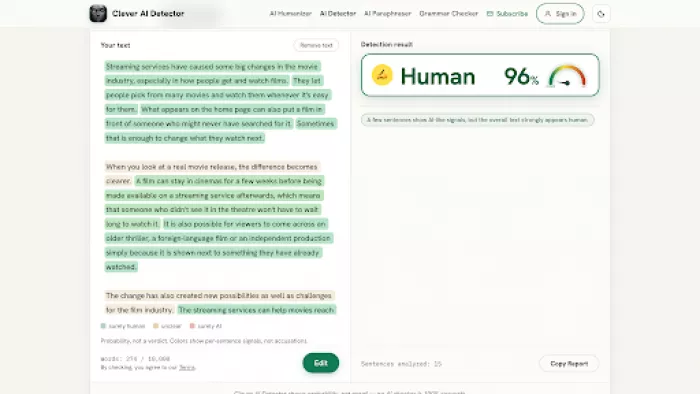
Here is our result after editing. The score improved, and sentences that were previously detected as AI are no longer flagged.
What Not to Do When Trying to Lower Your AI Detection Score
It's a common myth that some tricks can reliably lower an AI score. In reality, they often make little or no meaningful difference and may only reduce the quality and readability of your text.
- Don't just swap words for synonyms. The sentence structure and writing rhythm may remain unchanged.
- Don't add deliberate mistakes. Typos and grammar errors reduce text quality without making it more original.
- Don't use invisible characters or extra spaces. Many detectors can normalize text before analyzing it.
- Don't translate the text back and forth. This can distort the meaning while leaving predictable structures intact.
- Don't rewrite only for the score. Focus on clearer structure, natural wording, and original details instead.
Conclusion
AI detectors don't always provide accurate results, and their scores only estimate the probability that a text may be AI-generated. So, don't treat every result as definitive. Instead, use flagged passages as an indication of where you can improve your text: adjust the structure, add original details, paraphrase repetitive sentences, and humanize sections that still sound mechanical. Finally, check for AI again with several detectors to get a broader view of the results.
Frequently Asked Questions
What patterns do AI detectors look for?
Most AI detectors pay attention to predictable word choices, repeated sentence structures, little variation in sentence length, formulaic transitions and phrases, repetitive wording, generic language, and unusually consistent writing rhythm. Some detection systems may also look for text watermarks or hidden statistical patterns embedded in AI-generated content.
Why do different AI detectors give different results?
Each detector can use different training data, models, detection methods, signals, and classification thresholds. As a result, the same text may receive a low AI probability from one tool and a much higher score from another.
Can human-written text be detected as AI?
Yes. False positives can occur when an AI detector identifies patterns in human writing that resemble generated content. This can be particularly relevant to highly structured, technical, academic, or non-native English writing.
What should you avoid to lower an AI score?
Avoid simple synonym swapping, deliberate typos, invisible characters, extra spaces, and translation tricks. They don't reliably address the patterns detectors analyze, but they can reduce the quality of your text.


Comments