
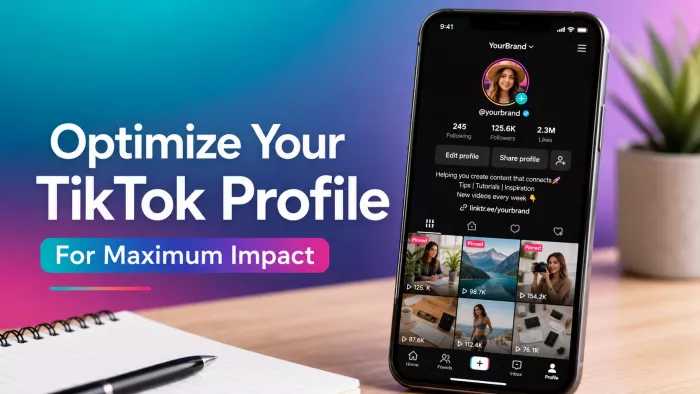
A TikTok profile is usually the second screen, opened after a video creates curiosity. The visitor arrives because a clip solved a problem, demonstrated a product, challenged an assumption, or introduced someone worth following.
The profile must continue that experience. If the video promises practical advice but the bio is vague, the grid is disorganized, and the link leads elsewhere, the momentum disappears. Optimization means turning one viewing moment into a reason to follow, explore, enquire, or buy.
The Profile Is a Handoff
Optimization guides often separate the profile into fields, but visitors experience it as one connected surface and ask four questions in rapid succession.
| Visitor Question | Profile Element That Must Answer It |
| Who is this? | Image, display name, username |
| Is this relevant to me? | Bio, category, visible topics |
| Can this account deliver? | Videos, demonstrations, results, covers |
| What should I do next? | Follow reason, link, booking or product route |
The answers must agree. A viewer arriving from “Three Lighting Mistakes Ruining Your Product Photos” should immediately find a profile about product photography, more examples of that expertise, and a sensible next step such as a lighting guide or portfolio. A bio that says “creative soul sharing my journey” forces the visitor to reconstruct the account’s purpose. That break in continuity is where many accounts lose attention.
Define the Conversion Before the Profile
“Maximum impact” does not always mean the largest follower count. A local consultant may benefit more from five qualified enquiries than from 5,000 viewers outside the service area, while a retailer may care more about product-page visits than follows.
Define the profile around one visitor and one decision:
A person who arrives after watching a practical TikTok growth video should understand that the account provides clear, actionable strategies for improving content performance and take the next step by following the profile or downloading the linked content planner.
For example: A restaurant owner who arrives after watching a menu-marketing breakdown should understand that the account teaches TikTok strategy for local food businesses and download the monthly planning template.
This statement determines the display name, the proof shown near the top of the grid, and the link destination.
Profiles weaken when they try to convert every possible visitor. A freelance editor who speaks to YouTubers, wedding filmmakers, property agents, podcasters, ecommerce brands, and musicians in the same bio has not created a broad opportunity. They have removed the cues that help any one group feel understood.
Design the First Screen for Recognition
Visitors judge the photograph, name, handle, bio, link, and first row of videos as one decision layer.
Use an Image That Survives Reduction
A profile image is a small recognition device, not a portrait gallery. Distant full-body photographs, thin logo lettering, detailed backgrounds, and low contrast often disappear when reduced to the size shown beside a video or comment.
For a creator-led account, use a face that remains identifiable at a glance. A business should use the simplest recognizable version of its logo or product mark rather than compressing a complete brand lockup into a circle.
Judge the image at actual profile size. If it works only when enlarged, it is not doing its job.
Give the Display Name a Category
TikTok distinguishes between the display name and the @username. The display name can contain up to 30 characters and can be changed once every seven days, making it the more flexible place to combine identity with a useful category.
Compare “Maya Kapoor” with “Maya | Budget Travel.” The second version keeps the identity while helping a visitor categorize the account. For a company, “Northline Renovation” is more informative than “Northline Group.”
Do not turn the name into a keyword string. “Coach | Mentor | Growth | Business” is neither memorable nor precise. One category that matches the visible content is enough.
Treat the Username as Infrastructure
The username forms part of the profile link, can be changed only once every 30 days, and changes to it also change the profile URL. TikTok permits letters, numbers, underscores, and periods, although a period cannot sit at the end.
Choose a handle that is easy to hear, type, and repeat. Avoid unexplained numbers, several separators, temporary campaign phrases, or spellings that require correction. Consistency across platforms helps, but clarity matters more than forcing an awkward identical handle everywhere.
Write a Bio That Makes a Choice
A bio cannot communicate every credential, service, product, interest, and personality trait. Trying to include everything usually produces vague language.
A useful TikTok bio makes a choice. It selects the clearest audience, strongest editorial promise, and most relevant route.
Use this structure: Category + Audience Situation + Editorial Promise + Route
The audience situation is more useful than a broad demographic. It describes the condition that makes the account relevant.
A weak version might read: Marketing expert helping businesses grow.
A stronger version would be:
TikTok content systems for local service businesses
Real profile audits and weekly campaign breakdowns
Download the planning sheet
The stronger version identifies the platform, business context, content format, next action, and editorial standard.
For a creator:
Budget city breaks for full-time workers
Real transport costs, hotel comparisons and two-day itineraries
Start with the weekend guides
For an ecommerce brand:
Refillable cleaning concentrates for small homes
Product demos, dilution guides and honest use tests
Shop the starter set
These bios leave out many things on purpose. They do not list every topic, repeat the username, or add unsupported claims such as “best” and “leading.” The missing information gives the included information enough definition to work.
The bio must also match the content visible now. If an account has shifted from general fitness motivation to post-pregnancy strength training, keeping the old positioning because it still sounds acceptable creates the wrong expectation.
Choose the Account Type for the Work

Account type affects how the profile can be managed, promoted, and linked, so it should not be chosen merely to look more professional.
TikTok currently offers Personal, Business, and Organization Accounts. Personal Accounts suit most creators and public figures. Business Accounts are intended for brands promoting products or services and may include Business Suite tools, analytics, Promote, and website linking. Organization Accounts support structured access, but availability and features vary.
The key trade-off for many publishers is music: Business Accounts use the Commercial Music Library rather than TikTok’s general music library. Choose according to the operating model, and avoid repeated switching merely to chase a feature.
Engineer the Grid for New Visitors
The profile grid should not be treated as an archive organized only by publication date. It is the evidence layer of the profile.
The first visible posts should explain what the account repeatedly covers, how strong the information or product is, and where to begin. Build the grid around four content roles.
1. Entry Posts : Entry posts give a new visitor an obvious starting point. Examples include “Start Here: Lighting for Product Photos,” “How Our Refill System Works,” or “The First Budget Every Freelancer Needs.” These videos should remain useful after the publication date has passed.
An entry post does not need to introduce the creator’s complete background. Its job is to help an unfamiliar viewer enter the subject without needing to understand earlier videos.
A career coach, for example, could create “Start Here: Moving From Specialist to Manager.” The video would immediately establish the audience, problem, and level of advice offered by the account.
2. Proof Posts : Proof posts demonstrate the account’s ability to deliver. A designer can show a packaging redesign from brief to print file. A tutor can correct a real speaking mistake and explain the rule. A retailer can show how a product performs after several weeks rather than filming only an unboxing.
Proof becomes stronger when viewers can inspect the process instead of hearing a claim.
A consultant saying “I help businesses increase conversions” provides a promise. A consultant showing the original landing page, explaining three specific problems, presenting the revised version, and discussing the outcome provides evidence.
3. Depth Posts : Depth posts cover comparisons, limitations, exceptions, or connected parts of a system. A skincare brand might publish separate videos on ingredients, patch testing, routine order, and common sources of irritation.
This content prevents the account from feeling like a collection of repeated beginner tips. It also gives interested visitors somewhere to go after the first useful video.
For a photography account, depth may include difficult lighting conditions, material-specific reflections, editing limitations, equipment comparisons, and client workflow. These topics demonstrate that the creator understands the subject beyond one viral technique.
4. Route Posts : Route posts explain what happens after interest forms. They can show how to select a service, what a consultation includes, which product fits a need, or how to use the resource linked in the bio.
“What happens during a 30-minute portfolio review” is more useful than “Book now” because it reduces uncertainty before asking for commitment.
A product company could create “Which Starter Kit Should You Choose?” rather than publishing a generic sales video. The post still supports conversion, but it earns the action by helping the buyer make a decision.
Make Covers and Playlists Navigational
A video cover previews the post on the profile and helps visitors identify what to open. Use wording that remains meaningful after the posting moment. “Three Bio Mistakes” and “Starter Kit Guide” work as labels; “Big News” and “You Need This” depend on missing context.
Cover text should describe the video’s practical subject rather than repeat the opening hook word for word. A spoken hook may create curiosity in the feed, but the profile visitor needs navigation.
For example, a video might begin with: Your restaurant menu may be costing you orders.
Its profile cover could read: Menu Conversion Audit
The first version earns attention in the feed. The second helps a visitor understand where the video fits within the account.
Visual consistency can help viewers recognize a series, but rigid templates sometimes damage navigation. If every cover uses the same face, color block, and vague two-word hook, the grid may look polished while hiding the difference between posts.
Where Creator Playlists are available, they can group public videos into sequences shown at the top of the videos tab. TikTok notes that playlists are not available to every account or in every location.
Use them for genuine routes such as “Start Here,” “Beginner Editing,” “Product Tests,” or “Client Questions.” A playlist containing two unrelated videos adds another label without improving discovery.
Build Search Positioning From the Profile Outward
TikTok search optimization does not begin with a caption. It begins with a stable subject that the entire profile supports.
An account positioned around “phone photography for jewellery sellers” should reinforce that subject across the display name, bio, spoken wording, on-screen text, captions, covers, and related posts. The exact phrase does not need to appear everywhere. The subject needs to remain recognizable.
Select one primary category, two or three supporting topics, and a clear audience condition:
● Primary category: Phone product photography.
● Supporting topics: Lighting, composition, editing, and inexpensive equipment.
● Audience condition: Small sellers photographing products without a studio.
This structure gives the account enough range without allowing every adjacent topic to enter the content plan.
A jewellery photography account might reasonably cover reflective surfaces, background materials, camera positioning, editing, and affordable lights. General smartphone news or unrelated social media advice may attract views, but it weakens the profile’s search and audience identity.
TikTok’s Creator Search Insights shows topics people search for, highlights potential content gaps, and provides search analytics for posts. Its “Searches by followers” filter requires more than 1,000 followers.
Use this data to improve language, not to replace positioning. Look for clearer phrasing around subjects the account already intends to own.
A creator may describe a topic internally as “visual merchandising content,” while viewers search for “how to photograph clothes for Instagram.” Search information can reveal that language difference without forcing the account to chase an unrelated trend.
Make the Link Complete the Journey
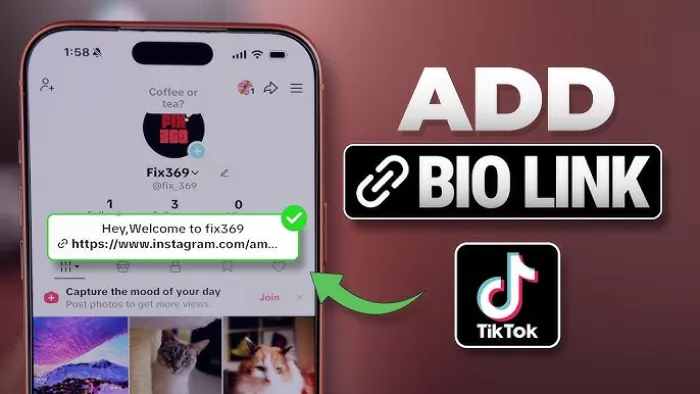
A profile link must complete the action promised in the bio. TikTok currently allows website links for accounts with at least 1,000 followers or Registered Business Accounts. Users may also connect supported social accounts such as Instagram, YouTube, or Lemon8, with availability varying by region.
A viewer who watches a video about choosing a wedding photography package should reach a page explaining packages and availability, not a homepage dominated by unrelated news. Someone promised a free content planner should see the planner immediately without opening a menu or scrolling past several offers.
| Weak CTA | Clearer CTA |
| Link below | Download the 30-day content planner |
| Learn more | See packages and current availability |
| Shop now | Shop the refill starter set |
| Check it out | Watch the complete editing workshop |
A multi-link page is useful when visitors genuinely need several routes. During a launch, booking period, or product promotion, one direct destination usually creates a cleaner path.
The destination page should also preserve the same language used in the TikTok profile. If the bio promises “weekend itineraries for full-time workers,” the linked page should use that phrase or a close equivalent. A sudden change in terminology makes the visitor question whether they reached the correct place.
Increase Evidence Density
Follower totals may influence first impressions, but they are weak substitutes for visible evidence. A smaller account can appear highly credible when the first screen contains precise positioning, useful demonstrations, consistent expertise, and a clear commercial or editorial standard.
Evidence density describes how much proof a visitor can find without extensive searching: a process-led result, a product test covering limitations, a concrete client answer, a relevant qualification, or several videos approaching one subject from different angles.
Consider two service profiles.
The first profile claims to be an “expert growth strategist,” but its visible posts contain motivational statements, broad trend commentary, and personal updates. The second profile names a narrower speciality and shows three audits, two client questions, a process explanation, and a video about unsuitable clients.
The second account may have fewer followers, but it gives the visitor more material from which to judge the service.
Evidence should also include limitations where they matter. A product demonstration that explains who should not buy the product can create more trust than a video that presents every feature as universally suitable.
Verification can confirm identity, but it should not be imitated. TikTok states that a genuine verified badge appears next to the account name in search and on the profile. A check mark placed elsewhere, including in the bio, does not represent verification, and TikTok does not charge for verification. Trust is strongest when it is distributed across the profile rather than compressed into a line of claims.
Diagnose the Profile With Analytics
Analytics should answer a diagnostic question, not merely report that views moved up or down.
TikTok Studio provides account sections for overview, content, viewers, and followers, along with post-level analytics covering performance, audience information, and engagement. Creator tools also report figures such as total views, net followers, and individual-post insights.
Use metric relationships to locate the weak point:
● High video views with low profile visits suggest that the post creates a complete viewing moment but gives little reason to investigate the account. The video may need a clearer series connection, recognizable creator identity, or reference to related content.
● High profile visits with low follow growth suggest that the video created curiosity but the profile failed to establish consistent future value. Review the bio, first visible posts, topic boundaries, and whether recent videos support the same promise.
● Healthy follow growth with weak link activity may mean viewers value the content but do not understand the external offer. The call to action or destination may be too broad, premature, or unrelated to the posts producing profile visits.
● Frequent enquiries with poor fit usually point to missing qualification information. The profile may need to state the audience, location, service level, starting price, or scope more clearly.
● One strong search post with little related viewing suggests that the profile has not built a route around the subject. Add connected posts, clearer covers, and a playlist where available.
Record a baseline before changing anything, then alter one significant layer at a time. A new bio, link, grid strategy, account type, and visual identity launched together may look decisive, but it prevents useful diagnosis.
Two Profile Rebuilds
Creator: From Interests to a Viewing System
Before
Maya
Travel | Lifestyle | Food
Sharing good vibes and adventures
Latest vlog below
This version lists broad categories without explaining why someone should return. Travel, food, and lifestyle may all appear in the videos, but the visitor is left to identify the connection.
After
Display name: Maya | Weekend Travel
Bio: Two-day city guides for full-time workers
Real budgets, public transport and hotel comparisons
Start with the weekend itineraries
The grid should support that promise with entry guides, destination breakdowns, budgeting advice, and linked itineraries. The profile becomes a resource rather than a diary of interests.
Business: From Brand Language to Buying Clarity
Before
Premium natural care for modern living
Quality, wellness and sustainability
Shop our collection
This wording does not identify the product, customer problem, or evidence. Nearly any skincare, food, home, or wellness company could use the same lines.
After
Display name: Nera | Sensitive Skin Care
Bio: Fragrance-free cleansers and moisturizers
Ingredient explainers and routine guides for reactive skin
Shop the three-step starter routine
The grid should show textures, ingredients, routine order, customer questions, and a starter-routine guide. The profile replaces abstract values with evidence.
Mistakes That Look Like Optimization
● Adding more keywords can reduce recognition when the profile stops reading like one identity. The display name should not become a compressed list of every service and adjacent topic.
● A uniform grid can damage navigation when covers prioritize brand colors over readable subjects. Consistency should help visitors find content, not make every post interchangeable.
● Sending everyone to a multi-link page can lower intent when one destination is clearly more relevant. Additional choice is useful only when the visitor understands why each option exists.
● Copying a successful creator’s bio structure can preserve the form while losing the strategy. The audience situation, evidence, and route must come from the account’s own offer.
● Changing the username without planning for old links can disrupt previously shared profile URLs. The handle should change only when the identity benefit outweighs the cost.
● Using a Business Account only to look official can create an unnecessary music limitation. Account type should match the commercial purpose and operating needs.
● Rewriting the bio while leaving contradictory videos at the top solves only the smallest part of the problem. Visitors trust the evidence they see more than the promise they read.
Protect the Asset
A recognizable profile with a valuable audience, publishing history, and commercial links should be treated as an account asset.
TikTok’s Security Checkup supports phone and email verification, two-step verification, trusted-device management, security-activity review, and passkeys.
Use a unique password, remove old devices, and avoid informally sharing one login across a business team.
Security is especially important during staff changes, agency transitions, or rebranding work, when several people may temporarily need access. Document who controls the recovery email, phone number, advertising accounts, connected stores, and external link tools before access problems occur.
Final Reflection
A TikTok profile reaches maximum impact when it continues the promise of the video that brought the visitor there.
The strongest profiles do not try to look complete by filling every field with more information. They make a smaller number of decisions visible: who the account serves, what it repeatedly delivers, why the visitor should believe it, and where the visitor should go next.
Recognition comes from the image and naming system. Relevance comes from a bio that chooses a real audience situation. Evidence comes from a grid built around entry, proof, depth, and route content. Action comes from a link that completes the same journey. A video can create attention by itself. A profile converts that attention only when every visible part tells the same story.


Comments