
Money almost never moves for nothing. Somewhere between a fan tapping “pay” and a creator seeing the cash, at least one party takes a slice so a promise of “no transaction fees” is worth reading closely rather than at face value.
In nearly every case the phrase means one specific fee has disappeared, not all of them. The distinction that follows is the whole point of this article, so it is worth getting straight before the list. What counts as fee-free depends entirely on which fee is being talked about.
The two fees nobody separates
There are two very different cuts stacked on most creator payments, and lumping them together is how “fee-free” marketing gets away with the claim. The simplest way to see them is to follow a single payment on its way to a creator.
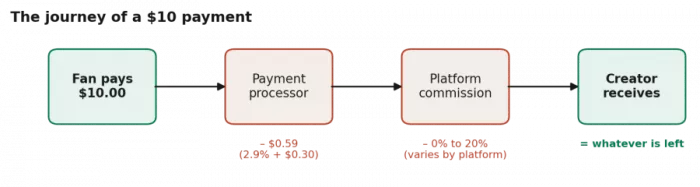
The first is the platform commission the percentage a service like Patreon, OnlyFans, or a course marketplace keeps for hosting the work and connecting a creator to an audience. This is the fee that swings wildly, from roughly 8–12% on Patreon to about 20% on OnlyFans, and it is the one most “zero-fee” platforms are actually removing.
The second is the payment-processing fee the roughly 2.9% plus 30 cents that Stripe or PayPal charges to move a card payment at all. This one is close to unavoidable. It applies whether or not the platform takes a commission, because someone has to run the card. When an article says “keep 100%,” it almost always means 100% after processing, not before.
The two fees, side by side
| Metric | Platform commission | Payment processing |
| What it pays for | Hosting, audience, built-in tools | Moving the card payment |
| Typical range | 0% – 20% and up | ~2.9% + $0.30 |
| Who charges it | The creator platform | Stripe, PayPal, card networks |
| Can it be avoided? | Often, yes | Rarely the cost of taking cards |
Keep that split in mind. Every method below removes or sidesteps the platform commission. None of them, short of cash in hand, escapes the processing fee.
The third fee, once the money is earned
There is a quieter cost that most “fee-free” coverage ignores entirely: the price of getting money off a platform and into an actual bank account. Fee-free at the point of sale is not the same as fee-free by the time the money is spendable.
It shows up in a few forms. Some platforms set a minimum payout threshold, so small balances sit stranded until they grow large enough to withdraw. Others charge a flat fee per withdrawal or transfer. And for creators paid in a currency other than their own, the sharpest cut is often the exchange rate banks and platforms quietly widen the spread, and a poor conversion can cost more than the platform commission ever did.
A creator can keep 90% of a sale and still lose a real chunk on the way home. So the honest test of any earning method is not just the headline fee, but what actually lands in the account at the end of the month.
1. Sell digital products through a zero-commission storefront
Digital products templates, presets, ebooks, stock footage, courses are the cleanest place to dodge platform commission, because a file costs nothing to deliver again once it is made. Tools built for this, such as Gumroad’s paid Creator plan or a plain Stripe checkout on a creator’s own site, take no percentage of the sale.
The trade sits in plain sight, though. A marketplace that charges commission is also a place buyers browse; a bare checkout link is not. Removing the middleman removes the middleman’s shopfront, so getting people to the page becomes entirely the creator’s job.
For anyone already sending their own traffic from a newsletter, a channel, a following that is pure upside. For someone relying on being discovered, the commission was partly buying an audience, and cutting it means finding that audience some other way.
A few of the common zero- or low-commission routes:
Where 0%-commission digital sales actually happen
| Tool / approach | Platform cut | The trade |
| Own Stripe or PayPal checkout | 0% | Full control, but the page is yours to build and drive |
| Gumroad, Creator plan | 0% | Paid monthly; the free plan takes about 10% |
| Payhip, paid tier | 0% | The free tier keeps around 5% |
| Podia or self-hosted (Ghost) | Flat monthly | 0% per sale once the subscription is paid |
2. Swap the percentage cut for a flat monthly fee
The most overlooked move is structural rather than about any single brand: trade a per-sale percentage for a fixed monthly cost. All-in-one tools like Kajabi, or a self-hosted publishing setup like Ghost, charge a flat fee and then take nothing from each transaction.
Whether that is a good deal is a maths question, not a marketing one. A flat fee is dead weight at low volume and a bargain at high volume there is a crossover point where the monthly cost drops below what the commission would have taken.
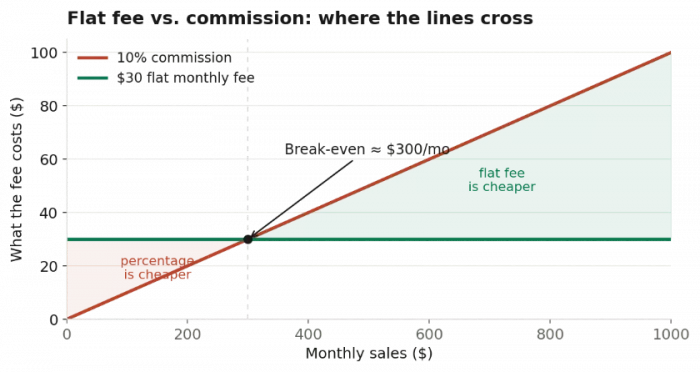
A $30/month tool only beats a 10% cut once monthly sales pass about $300.
Below that line the percentage model wins; above it, the flat fee does. The honest way to frame this is to name the line rather than crown a winner, because the right answer changes as a creator grows what is wasteful at the start becomes a saving later.
Two questions settle the switch better than any sales pitch:
• Is monthly volume high and steady enough to clear the break-even every month, not just in a good one?
• Does the flat-fee tool replace things already being paid for email, hosting, a checkout or is it a fresh cost stacked on top?
3. Tips and donations on a true 0% tip jar
Tipping is the rare stream where zero platform commission is both real and common. Ko-fi, for instance, takes 0% on tips on its free plan, leaving only the processing fee. A handful of similar tools quietly keep around 5%, which is worth checking before assuming.
Tips get underrated because each one is small, but small and near-frictionless is a strong pairing. There is no product to make, nothing to ship, and almost nothing skimmed off the top which makes tip income some of the highest-margin money in the whole list, closer to pure profit than almost any sale.
Tips tend to land best in a few specific moments:
• Right after something free and useful lands a guide, a track, a genuinely helpful answer while goodwill is at its peak.
• At milestones a following feels part of: a launch, an anniversary, a goal being hit.
• Wherever the ask is specific and low-stakes “buy me a coffee” converts far better than a vague “support me.”
The ceiling is real, of course. Tips rarely grow into a primary income on their own. They work best as a low-effort layer sitting underneath everything else, catching goodwill that would otherwise go uncollected.
4. Memberships and community on owned ground
Recurring revenue is the sturdiest kind, and it does not have to arrive with a per-member cut. Instead of a platform skimming every monthly payment, memberships can run through a flat-fee tool or a self-hosted community, and the commission stays with the creator.
What replaces the fee is work. Owning the membership means owning the churn, the tech headaches, the failed-payment emails, and the support requests a commission-charging platform would otherwise absorb. The percentage saved is, in effect, the wage for taking all that on.
In practice, “owning it” means picking up a to-do list the platform used to hide:
• Churn every cancelled member is one to win back or replace, with nothing nudging them to stay.
• Failed payments, expired cards and declined charges turn into emails to send, not a problem solved in the background.
• Support the login issues, access problems, and refund requests all arrive at the creator’s door.
So this is a stream that rewards scale and a tolerance for admin. A large, stable membership repays the effort many times over; a small or fiddly one may not be worth the hours the platform would have handled quietly in the background.
5. Brand sponsorships paid by invoice
The oldest creator income stream is also the one that never involved a transaction fee to begin with. When a brand pays a creator to make something, the money moves from the brand’s account to the creator’s usually by invoice and bank transfer with no marketplace sitting in between taking a percentage.
There is a reason most monetization lists skip this: it does not run through an app, so it is easy to forget it counts. But a direct deal is about as fee-free as creator income gets. The “cost” is simply a different kind of negotiation, contracts, chasing late payment, and doing the work to be worth sponsoring at all.
That different kind of cost is worth naming plainly:
• Finding and pitching the right brands or being visible enough that they pitch first.
• Agreeing scope, usage rights, and price, which is the part that decides whether a deal is worth the effort.
• Invoicing and following up, including the awkward chase when a payment runs late.
Influencer marketplaces do exist, and they do take a cut for the matchmaking. The point is that they are optional. A sponsorship arranged directly skips that fee entirely.
6. Affiliate and referral income
Affiliate income flips the fee model on its head. Rather than a creator paying a cut on money coming in, the merchant pays the creator a commission on sales sent out so there is no transaction fee on the creator at all. The money lands as a payout, not a sale that needs processing.
That inversion is exactly why affiliate pairs so neatly with everything else here. It layers on top of existing content without competing for the same checkout, and it carries no platform commission because the creator was never the one taking payment in the first place.
Rates vary enormously by what is being recommended, which matters far more than any fee:
Typical affiliate commission, by product type
| What is recommended | Typical creator commission |
| Big marketplaces (e.g. Amazon) | ~1–4% of the sale |
| Physical goods and retail | ~5–10% |
| Online courses and digital products | ~30–50% |
| Software and subscriptions | ~20–40%, often recurring |
The catch lives in the rate, not the fee. Affiliate percentages are set by the merchant and can be thin, and the income depends wholly on an audience trusting a recommendation. It is fee-free, but it is not effort-free.
7. Merch and physical products at 0% commission
Physical goods look like the hardest place to avoid fees, yet several print-on-demand and storefront tools now charge 0% platform commission. Fourthwall among them passing along only the payment processing and the cost of the product itself.
The thing to watch here is not the fee but the margin. “0% platform commission” still leaves the base manufacturing cost, so a shirt that costs a set amount to print sets a floor no fee structure can lower. On physical products, the number that decides profit is the gap between production cost and price, not the platform’s cut.
Even at 0% commission, three costs still come out of every sale:
• The base product cost printing the shirt, making the mug a floor no platform can remove.
• Payment processing, the same ~2.9% + $0.30 that applies everywhere else.
• Shipping, whenever it is not passed to the buyer easy to forget, and quick to erase a thin margin.
Handled well, merch turns audience affection into tangible income with no commission attached. Handled carelessly, thin margins do quietly what a platform fee would have done anyway.
The catch: how “free” platforms actually make money
No platform runs on goodwill. A service advertising 0% commission is earning somewhere else, and knowing where the difference is between a genuine bargain and a shell game. The revenue usually reappears in one of a few familiar places:
• A monthly subscription stands in for the commission which, as covered above, only works out cheaper past a certain sales volume.
• The payment processing itself is marked up, so the “0%” headline quietly hides a slightly fatter cut on the card fee.
• Paid add-ons, premium tiers, or limits baked into the free plan nudge a growing creator toward a bill sooner or later.
• The real price is the audience: some free tools own the relationship, the data, or the discovery, which can cost far more over time than any percentage would have.
The useful habit is to ask, of any 0% platform, a single blunt question: if not a commission, then how? A tool that can answer it honestly is usually fine. One that cannot is charging somewhere that has not been found yet.
Keeping the most: stack, don’t chase
Hunting for one perfect fee-free platform is the wrong goal. The creators who keep the largest share of their income tend to run three to five streams at once, each matched to the lowest-friction tool for that specific job rather than forcing everything through a single service that is mediocre at most of them.It is part of the broader shift toward creators building systems around their audience, with several revenue paths working alongside the same body of content.
A worked example makes the logic concrete. A modest creator might run tips through a 0% jar, sell a course through their own checkout, take one direct sponsorship a month, and scatter affiliate links through older posts. Not one of those four carries a platform commission; the only unavoidable cut is the card processing, and the sponsorship dodges even that.
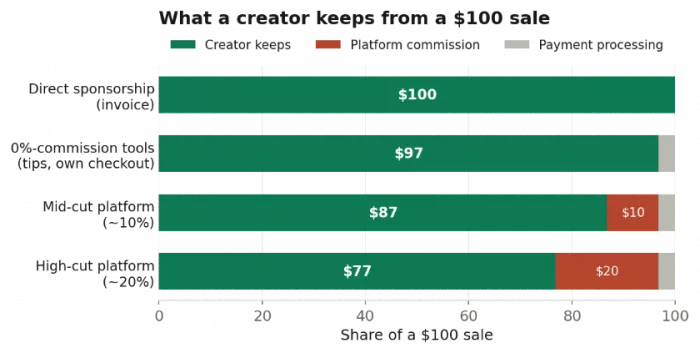
The same $100 lands very differently depending on the model the green is what stays.
A rough map of how the models compare:
The seven streams at a glance
| Income stream | Typical platform cut | Best suited to |
| Digital products, own checkout | 0% + processing | Creators with their own traffic |
| Flat-fee all-in-one | $/month, 0% per sale | Higher, steady sales volume |
| Tips | 0% on some tools | Low-effort supplementary income |
| Memberships, owned | 0% + your own admin | Large, stable communities |
| Sponsorships | 0%, paid direct | Any creator brands want to reach |
| Affiliate | 0%, merchant pays | Audiences that act on advice |
| Merch, 0% tools | 0% + product cost | Engaged fans mind the margin |
One caution outlasts any table: these numbers move. Platforms revise pricing often, free tiers pick up new limits, and a 0% plan today can carry a fee next quarter. Treat any specific percentage as a “check it today” figure, not a permanent fact.
Final Perspective
Chasing “zero fees” is the wrong target. Money moves at a cost, and the honest goal is keeping the largest share of each dollar with the least friction which usually means cutting the platform commission where it is fat, accepting the processing fee where it is unavoidable, watching the payout costs on the way to the bank, and refusing to pay for discovery a creator can generate without help.
| One worthwhile exercise: add up what went to platform commissions last month across every stream. If a single figure in that list looks large, that is the stream to move first and probably the only fee worth the effort of escaping. |


Comments