SEO for Personal Brands: How to Get Found on Google Without a Big Budget



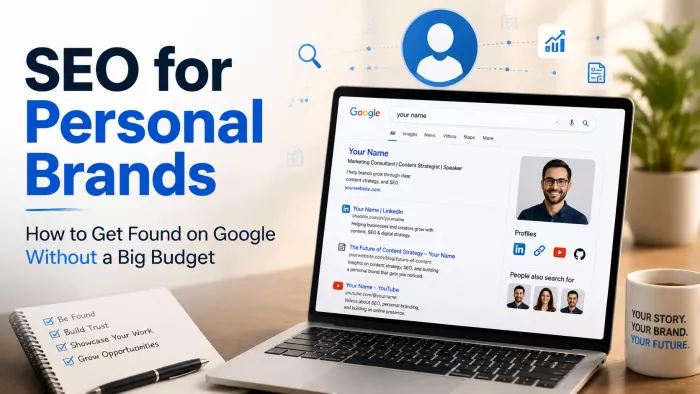
A recruiter once told me she passed on a candidate before the interview. Not because of his resume, but because she searched his name, found nothing, and assumed he wasn't serious about his field.
That stuck with me. One evening I typed my own name into the search bar to see what a stranger would see.
The results were thin. An old profile I'd forgotten about sat at the top, next to a person I'd never met who happened to share my name.
Here's the uncomfortable part. Before someone reads your pitch, opens your portfolio, books a call, or replies to your email, they run a quick search. What loads in those few seconds shapes the decision more than anything you say afterward.
So ask what I asked that night. When your name loads, what comes up first? Is it current, or three roles out of date? Does it show your work, or somebody else's? For a lot of skilled people, the honest answer is "nothing much," and that empty space quietly costs them chances they never hear about.
Personal Brand SEO is how you take back control of that moment. It's the work of shaping what search engines understand about you, so the right people find the right information when they look.
This is the system I use, laid out step by step, with a free tool for every stage. No agency retainer. No ad spend. By the end you'll know how to build a search presence that tells one clear story about who you are and why you're worth trusting.
What Personal Brand SEO Actually Is
Search engines rank web pages. Most people know that. Fewer realize that Google also builds a profile of people, stitching scattered clues into a picture of who you are.
Every time your name shows up with the same photo and the same title, linking back to your work, Google grows more confident it has you figured out. Those clues come from far more than your website:
- LinkedIn and other professional profiles
- Podcasts and interviews you show up in
- Bylines on articles you've written
- Mentions in news and industry press
- Profiles on GitHub, Behance, Medium, and YouTube
The takeaway: Google builds a picture of you, not only of your website. Personal Brand SEO is the practice of feeding that picture clear, credible signals so you appear when people search your name or the work you do.
What Shows Up When You Google Your Name
Before changing anything, you need to see what I saw that night: your current search reality.
Open an incognito window so your own history doesn't skew things, then search your full name. Screenshot the first page. This is your starting line.
Most people land in one of these situations:
| What you see | What it signals |
|---|---|
| Nothing about you | You look inactive or brand new, even with years of experience |
| Outdated results | Your best work is invisible, and old roles define you |
| A stranger's page | Someone who shares your name owns your search space |
I was in the second and third camps at once. My fix started with accepting that Google wasn't hiding me on purpose. It had nothing better to show. Everything below is about giving it something better.
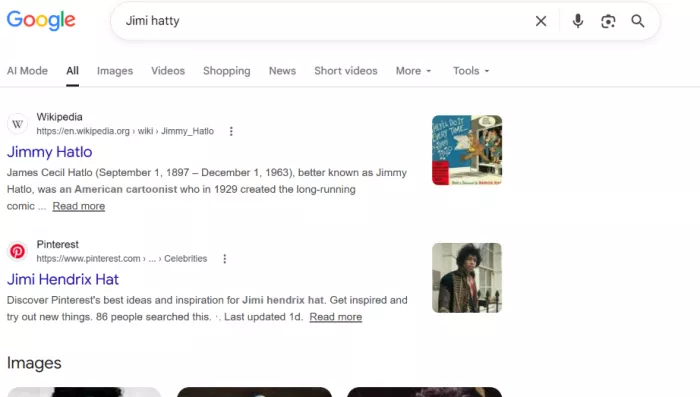
One habit to start now: glance at the image results and the "People also search for" box. They reveal who Google currently ties to your name, which matters more than most people expect.
Why This Matters More Than Before
That blank or messy results page isn't cosmetic. It changes outcomes.
Trust starts with a search. A hiring manager, a prospective client, an event organizer, a first date: each one reaches for the same search bar before committing.
Two shifts make this more pressing than it was five years ago.
First, verification moved to the front of every decision. People check you out before the first conversation, not after it.
Second, AI changed how discovery works. Search engines now answer questions outright and cite a handful of sources, which means your name gets pulled into an answer or left out of one. I'll come back to how you influence that in Step 7 below.
Who feels this most:
- Freelancers up against clients who vet before replying
- Founders raising from investors who background-check by habit
- Coaches and consultants whose product is trust itself
- Job seekers hoping the interview is half-won before they arrive
A strong search presence turns a cold name into a credible one.
How Google Understands People
To improve those signals, it helps to know what Google is reading in the first place.
Search engines assemble your reputation from a few core signals. I think of them as questions Google is quietly trying to answer:
- Identity: Is this the same person everywhere? Your name and photo are the anchors.
- Expertise: What does this person actually know? Your content answers that.
- Authority: Who vouches for them? Links and mentions from respected places carry weight.
- Consistency: Does the story hold up across sites? A bio that shifts around weakens the signal.
- Trust: Is this real and safe? A real photo, verified profiles, a reachable email, and a complete bio all help.
That last group is what Google's guidelines call E-E-A-T: experience, expertise, authoritativeness, and trust. You don't need to memorize the acronym. You need to make each part obvious.
There's a deeper idea here, and it drives the next few steps. Google doesn't only index your name as text. It tries to treat you as an entity: a distinct, real person it can connect to your work and your field. Once it's confident enough, you may earn a Knowledge Panel, the info box that appears beside results for recognized people.
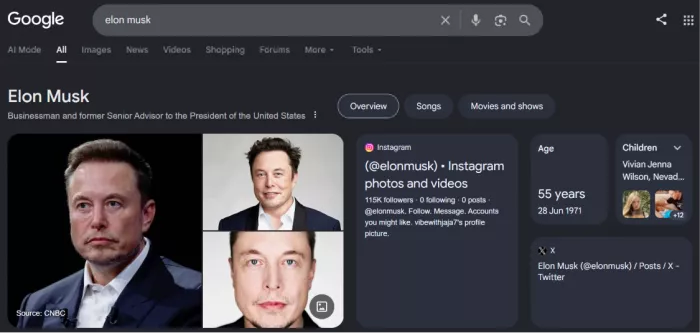
Turning yourself from stray text into a recognized entity is the quiet goal behind everything that follows.
Step 1: Get Specific About What You Want to Be Known For
Signals only work if they point somewhere specific. So the first move happens before any profile or tool.
Google rewards clarity. A vague label gives it nothing to attach you to. A sharp one tells it exactly which searches you belong in.
Answer two questions honestly:
- What do I want to be known for?
- Who am I trying to reach?
Then tighten your positioning. Watch what specificity does:
| Vague | Specific |
|---|---|
| Entrepreneur | AI consultant for healthcare startups |
| Designer | UX designer for SaaS products |
| Marketer | Email marketer for DTC brands |
| Coach | Career coach for mid-career engineers |
The right column does more than read better to a human. It gives Google a lane. Search "UX designer for SaaS" and the specific version has a real shot. The vague one competes with millions.
Pick your lane before optimizing anything. The rest of this guide assumes you have one.
Step 2: Make Your Name Consistent Everywhere
With a lane chosen, the next job is making every profile tell the identical story. Remember the consistency signal from the section above? This is where you earn it.
Google cross-references your profiles. When details match, confidence climbs. When they clash, the picture blurs. Lock these down on every platform:
- The same name, spelled and formatted identically
- The same professional headshot, one photo used everywhere
- The same handle or username wherever you can claim it
- The same one-line headline built around your niche
- The same link pointing to your central hub
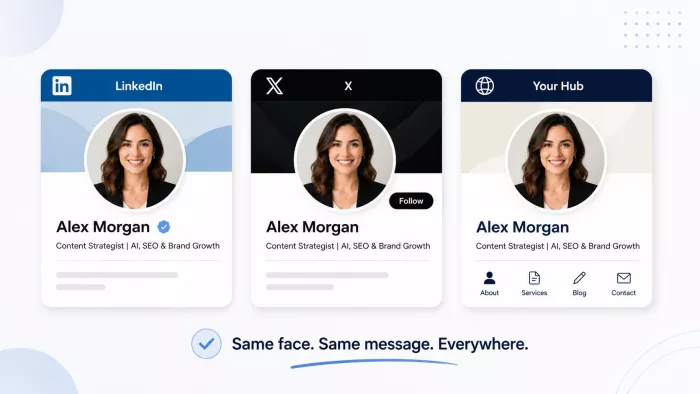
Small mismatches add up. "Mike Chen" on one site and "Michael Chen" on another can read as two different people. The same face and the same words, everywhere: that's the whole game.
Step 3: Build Your Digital Home, and Make Google Recognize It
Every profile you just aligned needs to point somewhere. That somewhere is your digital home.
Picture the problem from your audience's side. Your work is scattered: a portfolio in one place, a newsletter in another, social profiles all over, a talk sitting on YouTube. Anyone who wants the full picture has to hunt for it, and most won't bother.
A central hub fixes that. One page that gathers your work, your links, your achievements, and a way to reach you. It becomes the destination in every bio and the page you actually want ranking for your name.
This is where a link-in-bio platform earns its keep. A tool like TieUp lets you build that hub in minutes, pulling your portfolio, social profiles, products, and contact details onto a single link you control. Its persona pages for creators, founders, coaches, and other roles show the format in action.
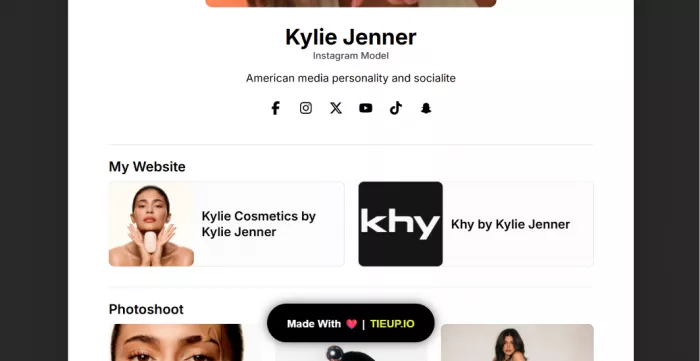
A good-looking hub isn't enough on its own. To help Google treat you as the entity we discussed above, your home has to speak Google's language underneath the design. Two things matter most.
Person schema. This is structured data, a small snippet of code that tells search engines "this page is about a person named X, who does Y." Plenty of site and hub builders add it for you. Check whether yours does with Google's free Rich Results Test.
The sameAs property. Inside that schema, sameAs lists every profile that belongs to you: LinkedIn, GitHub, YouTube, your socials. It's the thread that tells Google all those accounts are one person. This single property does more for entity recognition than almost anything else on the page.
Set your hub up this way and you get two wins at once. People get one clean place to understand you, and Google gets the structured proof it needs to connect the dots.
Step 4: Publish Content That Proves You Know Your Stuff
A hub tells people where to look. Content gives them a reason to trust what they find.
Google's guidelines reward first-hand experience, the first "E" in the E-E-A-T from the section above. Generic advice ranks poorly because everyone already has it. Your specific experience is the part nobody can copy.
Skip the "10 quick tips" posts. Write the things only you can write:
- Lessons from a project that went sideways, and what you'd change
- A case study with real numbers and the decisions behind them
- An opinion piece that stakes out a clear position in your field
- A framework or checklist you've sharpened through repetition
Each piece pulls double duty. It shows expertise to a reader, and it hands Google another page tying your name to your topic. Two or three strong pieces beat twenty forgettable ones.
Where should it live? Your own site or hub first, so you own it. Republishing selectively on Medium or LinkedIn stretches your reach, which leads straight into the next step.
Step 5: Get Mentioned Beyond Your Own Site
Everything so far sits on property you control. The authority Google trusts most comes from other people talking about you.
When a respected site mentions your name or links to your work, Google counts it as a vote. Enough votes from credible sources and your search presence strengthens across the board.
Ways to earn them without a PR budget:
- Guest posts on industry blogs that take contributors
- Podcast appearances, since small shows count and stack up over time
- Journalist requests answered through free platforms like Connectively or Featured
- Speaker pages from meetups, webinars, and conferences
- Real contributions in communities where your audience already hangs out
Each credible mention makes your name a little more familiar to a reader and to the algorithm. Start with one podcast or one guest post this month, then build the habit.
Step 6: Build Topical Authority With Content Clusters
Individual posts and mentions are dots. Topical authority is what you get when you connect them.
Google looks at whether your body of work circles one clear theme. Cover a subject from several angles and it starts treating you as a name to trust on it.
The simplest way to build this is a content cluster: one core theme surrounded by supporting pieces that link back to it. Say your theme is personal branding. Your cluster might include:
- A guide to writing a standout LinkedIn profile
- A walkthrough of building a portfolio that converts
- A piece on networking for people who hate networking
- Notes on the creator economy and where it's heading
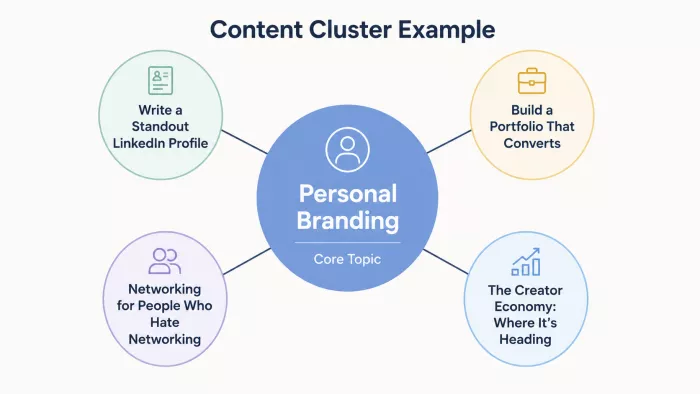
Each supporting article links to the others and back to your hub. Over time Google connects your name to the whole theme instead of one stray post. Depth beats scatter.
Step 7: Show Up in AI Answers, Not Just Blue Links
I promised earlier to come back to AI, so here we are. This is the biggest change to getting found since I started doing this work.
Search now often hands people an answer before it hands them links. Google's AI Overviews summarize the web at the top of the page. Tools like ChatGPT, Perplexity, Gemini, and Claude answer questions directly and cite a few sources. Your name either lands in those answers or it doesn't.
The good news: the work that gets you into AI answers overlaps heavily with everything above. These systems pull from sources they read as clear and credible. A few moves tilt the odds your way:
- Stay consistent across the web. AI models lean on entities they can identify with confidence, so the sameAs and schema setup from Step 3 pays off here directly.
- Write plain, quotable statements. Open a section with a direct answer in a sentence or two. Models lift clean, self-contained explanations far more easily than rambling ones.
- Earn mentions on sources AI trusts. The third-party coverage from Step 5 is exactly what these models retrieve and quote.
- Keep your facts current and unambiguous. Make your role and your one-line story easy to state and hard to misread.
Test it yourself. Ask Perplexity or Google "who is [your name]," read what comes back, and note the gaps. That answer is becoming the new first impression, so shape it on purpose.
Step 8: Monitor and Protect Your Reputation
Building your presence is half the work. Watching it is the other half.
You can't manage what you never look at. Once your name gains ground, a light routine keeps you in control and catches trouble early.
A quick monthly check:
- Search your name in an incognito window and scan the first page
- Look through the image results for anything off-brand
- Read the AI answer for "who is [your name]" and confirm it's accurate
- Skim any mentions of your name from the past month
Two free tools handle most of this. Google Alerts emails you whenever your name turns up somewhere new. Google Search Console, once you have a site or hub, shows which searches bring people to you and flags technical issues.
Then the harder question: what if something negative or outdated ranks for your name?
You have honest options. Publishing strong, current content and profiles pushes old results down over time, since Google favors relevance and freshness. If something is genuinely false or breaks a platform's rules, you can request removal through the host or through Google. For results that are unflattering but true, the durable fix is usually creating better material worth ranking rather than attacking the existing page. Reputation work is slow, and consistency is what wins it.
The Free Toolkit
I promised a system with no agency retainer, so here's every tool this guide leans on and what it costs:
| Tool | Use | Cost |
|---|---|---|
| Google Search (incognito) | Audit what people see | Free |
| Google Alerts | Track new mentions of your name | Free |
| Google Search Console | See your search traffic and issues | Free |
| Rich Results Test | Check your Person schema | Free |
| Perplexity / AI Overview | Test your AI answer | Free |
| TieUp | Build your hub and links | Free tier |
| Canva | Make simple visuals and diagrams | Free tier |
The scarce resource here is consistency, not cash.
Common Mistakes to Avoid
A few patterns quietly undo personal brand SEO. I've been guilty of some of them:
- Using different versions of your name across platforms
- Leaning on LinkedIn alone as your whole presence
- Skipping a professional photo, or having none at all
- Publishing nothing that shows how you think
- Buying followers or backlinks, which Google can detect and penalize
- Stuffing keywords into your bio until it reads like a robot wrote it
- Letting old profiles rot with stale titles and dead links
The common thread: each one sends Google a confusing or low-trust signal. Clean up the signals and the rankings follow.
Your 30-Day Plan
Reading this is easy. Doing it is what moves your name. Here's how I'd spend the first month starting from scratch:
| Week | Focus | What to do |
|---|---|---|
| Week 1 | Identity | Audit your name in incognito and screenshot it; lock in your specific positioning; choose one headshot and one headline |
| Week 2 | Profiles | Update every profile with the same photo, headline, hub link, and bio; build or refine your hub; check your schema with the Rich Results Test |
| Week 3 | Content | Publish one experience-based piece; add sameAs links to your profiles; sketch a content cluster outline |
| Week 4 | Authority | Pitch one guest post or podcast; set up Google Alerts and Search Console; test your AI answer and note the gaps |
Don't attempt all four weeks in one sitting. Open an incognito tab, search your name, and take that first screenshot. Seeing your real starting point is the thing that turned this from a someday idea into a system for me. Your first improvement is one search away.
Conclusion
Remember the recruiter from the opening, the one who passed on a candidate she never met? She wasn't being unfair. She was doing what we all do now, letting a quick search tell her who someone is.
That's the lesson sitting under every step above. Your online presence answers a question about you before you ever get the chance to. The steps in this guide are how you make sure that answer is accurate and fully yours.
Months after my own first search, the results finally matched the person I am. My hub ranked first, with my writing and my talks right behind it. The stranger who shared my name had slipped down the page.
None of it took money.
It took showing up in the same place, with the same story, until Google and the people reading believed it. That consistency is the whole secret, and it's yours the moment you choose to build it.


Comments