
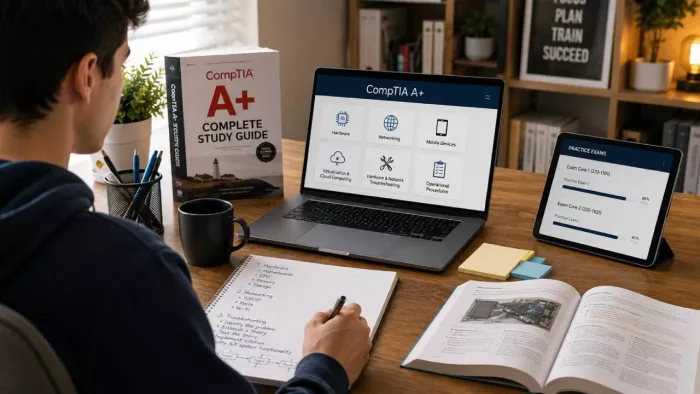
Most people who fail the A+ do not fail because they were short on study material. They fail because they had too much of it. Somewhere in the first two weeks they bookmarked four video courses, bought two books, joined three Discord servers, and downloaded a stack of question dumps, and then they spent the next month feeling busy without actually getting closer to a passing score.
I taught A+ prep classes for years, and this was the pattern I saw again and again. The strong candidates were rarely the ones with the biggest resource pile. They were the ones who picked a small set of tools, learned how each one worked, and stayed with them long enough to see progress. So this guide does the opposite of a mega-list. It gives you one resource per job, five jobs total, and tells you how to run them together.
What Actually Belongs In An A+ Study Stack
A study stack is the smallest set of resources that covers every job the exam asks of you. Not the best of everything. The minimum that leaves no gap. For CompTIA A+, that comes out to five roles:
- A video course for watching a concept explained for the first time.
- A book, for the depth and the reference you go back to.
- A question bank for volume practice and for finding your weak domains.
- A performance-based question (PBQ) simulator, for the hands-on tasks the hardest.
- A community, for the questions no book answers at 11 pm the night before.
Each role does something the others cannot. A video course teaches you the concept. A question bank tells you whether the concept stuck. Skip one role, and you end up with a blind spot that shows up on test day, usually in the part of the exam you were most confident about. Fill each role once, and you have everything you need, with nothing competing for your time.
For context on what you are actually preparing for: the A+ is two exams, Core 1 (220-1201) and Core 2 (220-1202), and you have to pass both. Each one is a maximum of 90 questions in 90 minutes. Core 1 passes at 675 on a 900-point scale; Core 2 passes at 700 on that same 900-point scale. Keep those two numbers straight, because a lot of older study material still quotes a single cut score for the whole certification, and that has not been accurate for a while.
Why Five Resources Beat Fifteen
The short version: every extra resource you add past the fifth one costs you time and gives you almost nothing back.
Here is what the failure actually looks like. You watch a topic explained by one instructor, then you watch a second instructor explain the same topic because the first one felt a little fast, and then you read the book chapter on it, too. Three passes on one concept, and you have not answered a single question about it yet. Meanwhile, the domains you find boring, printer troubleshooting, operational procedures, and safety, get a quick skim because you keep gravitating toward the material that already makes sense. The exam does not care what you find interesting. It weighs every domain the same way, whether you enjoyed it or not.
The other failure mode is question hoarding. People collect thousands of practice questions from six sources and treat a high raw count as progress. It is not. Two hundred questions that you review carefully, where you read the explanation for every miss and go back to the source material, will move your score more than two thousand questions you click through on autopilot. Volume without review is just typing practice.
One resource per role fixes both problems. You watch the concept once, you read it once for depth, and then you spend the bulk of your hours on questions and hands-on tasks, which is where the score actually comes from. The pass mark is high, especially on Core 2, so your time has to go where it counts.
The Explainer You Watch: One Video Course
Pick one video course and treat it as your first pass through every objective. The job of the course is to get a concept into your head in plain language before you go deep. That is it. It is not where you will get most of your practice, and you should not expect it to be.
The default free choice most candidates land on is Professor Messer, whose full A+ 220-1201 and 220-1202 video courses are free on his site and cover the current objectives end-to-end. If you prefer a more structured paid path with a workbook feel, Mike Meyers and the Total Seminars courses are the usual alternative, and they show up on sale often enough that you rarely need to pay full price. Either one works. What matters is that you do not watch both. Choose the teaching style you can sit through for hours, watch each objective once, take rough notes, and move on to questions. Rewatching a video you already understood feels productive and teaches you nothing new.
The Explainer You Read: One Book
The book is your depth and your reference, not your primary teacher. A good video course gets you to seventy percent understanding fast. The book gets you the rest, and it gives you something to search when a practice question hits a detail the video glossed over.
The standard here is the Mike Meyers CompTIA A+ Certification All-in-One Exam Guide, updated for the current 220-1201 and 220-1202 objectives. It is thick, it is thorough, and you are not meant to read it cover to cover like a novel. Use it in two ways. First, read the chapter for a domain after you have watched the matching videos, so the depth lands on top of a concept you already half know. Second, keep it open while you do questions, and when you miss one, look up the topic and read the surrounding pages, not just the one fact. That second habit is where the book earns its place. Skip the book entirely, and you will find the exam asks about edges that videos tend to skim.
The Question Bank That Keeps You Honest
This is the resource you will spend the most hours in, and it is the one that tells you the truth about where you stand. A question bank is a large, categorized set of practice questions you can filter and repeat. Its real value is not the questions themselves. It is the feedback: a good bank shows you, domain by domain, where you are strong and where you are guessing, so you stop wasting time on material you already own.
Look for three things in a bank. It should be aligned to the current V15 objectives, not a recycled version from the last exam cycle. It should let you filter by domain, so you can drill into the two heaviest Core 2 areas, Operating Systems and Security, which sit at 28 percent each. And it should give you a per-domain score after each test instead of a single number, because a single number hides exactly the weak spot you need to find.
One platform built around that kind of feedback is Crucial Exams, which keeps its question bank mapped to the current exam objectives. On the Core 2 side, it runs a large customizable bank with a Study Mode that shows explanations one question at a time and a Test Mode that scores you immediately and breaks results down by domain. If you want a CompTIA A+ Core 2 practice test that filters to just the objectives you are weak in, that domain breakdown is the point: each round of 220-1202 practice questions tells you where to spend the next study block instead of leaving you to guess. There is a free tier with a limited set of CompTIA A+ 1202 practice questions before a paid membership opens the full library, so you can see whether the format fits before you pay.
Whatever bank you choose, the discipline is the same. Do not chase a bigger question count. Review every miss, read the explanation, and go back to your book or course for anything you got wrong twice. The bank is a diagnostic tool. Treat it like one.
Hands-On Practice For The PBQs
Performance-based questions are the tasks that ask you to do something rather than pick an answer. Drag the right settings into place, configure an interface, and walk a simulated ticket to resolution. They usually sit at the front of the exam; they carry more weight than a single multiple-choice item, and they are the part that candidates most often waste time on because they have never seen the interface before.
A PBQ simulator is a practice built specifically for those tasks, in an environment that mirrors the real exam interface. This is a separate job from your question bank, even if some banks include a few PBQs, because the skill is different. You are practicing the mechanics of the task, not just recalling. Boson ExSim is the paid option people mention most for realistic simulations. Several question-bank platforms now include drag-and-drop PBQ exercises as part of their sets, so check whether the bank you already picked covers this before you buy a second tool. The goal is simple: walk into the exam having already done a handful of these, so the format costs you no time and no panic on the day.
The People Who Answer at 11 pm: A Community
The fifth resource is other people. No book covers everything, and when you hit a topic that will not click, or you need to know whether your practice scores mean you are ready, a community gives you answers from people who took the same exam last month.
The main one is r/CompTIA, the subreddit where candidates post study plans, pass and fail write-ups, and honest reviews of every resource on this list. It is also where you will find the recurring "master list" threads that rank study materials, which are worth a read precisely because they are written by candidates, not vendors. Beyond Reddit, there are active Discord study servers and local or workplace study groups. Use the community for three things: sanity-checking your plan, getting unstuck on a specific concept, and calibrating readiness. One warning. CompTIA does not publish official pass rates, so any pass-rate percentage you see quoted in a thread is a community estimate, not a documented figure. Treat it as a rough signal, not a fact.
How To Run The Five Without Burning Out
Owning the five resources is not a plan. Sequencing them is. Here is the order that works, described in three phases rather than a rigid day-by-day calendar, because everyone starts from a different baseline.
Phase one is learning. Go domain by domain. Watch the video for a domain, read the matching book chapter, then do a short, untimed set of questions in Study Mode with explanations on. You are not testing yourself yet. You are confirming the concept landed. Work through Core 1 this way first, then Core 2, or run them in parallel if you have the time.
Phase two is drilling. Now the question bank does most of the work. Do domain-filtered sets, review every miss against your book, and retake the domains where you score lowest. This is also where you fit in your PBQ practice; a few sessions are usually enough to remove the surprise. Keep going until your domain scores stop having a weak outlier.
Phase three is rehearsal. Switch to full-length timed tests in Test Mode, no explanations, the whole 90-question format under the clock. You are training pace and stamina as much as recall, because 90 questions in 90 minutes is tighter than it sounds once PBQs eat into your time. When your timed scores clear the cut line comfortably and consistently, not once, book the exam. If you are only clearing it on a good day, you are not there yet.
Community runs through all three phases. Ask questions when you are stuck, and post your own write-up when you pass, because the next person is reading it.
What To Leave Out Of Your Stack
Part of keeping a stack small is knowing what to say no to. A few things you can skip.
Skip brain dumps and any site selling the real exam questions. They are against CompTIA policy, they can get your certification revoked, and they teach you to recognize leaked items instead of understanding the material, which falls apart the moment the question is reworded.
Skip the second and third video courses. If your first instructor is not working for you, switching once is fine. Collecting four is not studying; it is procrastinating with good production values.
Skip the giant question and count it as a goal. A bank advertising fifty thousand questions is not five times better than one with a well-maintained ten thousand. Alignment to the current objectives and the quality of the explanations matter far more than the raw number.
Skip paid boot camps if you are self-studying on a budget. They can work, but nothing in a boot camp is unavailable in the five-resource stack for a fraction of the price. The A+ is a certification that people routinely pass through self-study, and the payoff is real: IT support roles that often list a high school diploma plus certifications as the entry path, at a median wage of around 61,550 dollars a year for computer support specialists. You do not need to spend boot-camp money to get there.
FAQ
Do I really need a book and a video course?
For many people, one or the other is enough. If you learn well from video and you review carefully, a strong course plus a question bank can carry you. The reason to keep both is coverage. Video gets you to a fast, broad understanding, and the book fills in the detailed edges that questions love to test. If your budget and time allow both, it is the safer path, especially for Core 2 with its higher cut score. If you have to choose one, keep the resource that matches how you actually learn and lean harder on your question bank to find the gaps.
Is a question bank enough on its own?
No. A bank is excellent at showing you which topics you have not learned and at drilling recall, but it teaches pattern recognition, not concepts. If you only do questions, you end up memorizing that answer C is correct without understanding why, and a reworded version of the same question on exam day catches you out. Pair the bank with a course or book so that every miss sends you back to material that explains the concept, then return to the bank to confirm it stuck.
What is the cheapest stack that still works?
You can get very close to free. Professor Messer's video course is free and covers the full current objectives. A question bank with a free tier gives you practice and domain feedback at no cost, and r/CompTIA is free forever. That covers three of the five roles. The two worth paying for, if you can, are a book for depth and a paid tool that gives you realistic PBQ practice and a large, well-explained question set. Even then, you are looking at the cost of a book and one membership, not hundreds of dollars.
Key Takeaways
- The failure mode for most A+ candidates is too many resources, not too few. Pick one per role and stay with it.
- The five roles are a video course, a book, a question bank, a PBQ simulator, and a community. Each covers a gap the others cannot.
- Core 1 (220-1201) passes at 675 out of 900, and Core 2 (220-1202) passes at 700 out of 900. You must pass both, each with a maximum of 90 questions in 90 minutes.
- A question bank earns its place through per-domain feedback, not raw question count. Review every miss instead of chasing volume.
- Practice PBQs before test day so the format costs you no time, and switch to full-length timed tests only in the final rehearsal phase.
- Skip brain dumps, extra video courses, and boot camps you do not need. The five-resource stack is enough.


Comments