Valant (Valant IO): A Comprehensive Look — Features, Pricing, Reviews & What You Should Know



Introduction
In the world of behavioral health therapy, psychiatry, counseling managing patient records, scheduling appointments, billing insurance, and documenting treatment is a constant operational challenge. Many clinics and practitioners turn to digital solutions: electronic health records (EHRs) designed for behavioral and mental health workflows. Valant is one of the most widely known among them.
But how good is Valant in practice? Does it really simplify work, improve efficiency, and suit both small solo practices and large clinics? Or is it an overbuilt, costly, and sometimes frustrating system?
This article explores Valant in depth what it promises, what users say, where it shines, where it falters, and when it might (or might not) be right for you.
What Is Valant — Overview
Valant bills itself as a behavioral‑health‑specific EMR / practice‑management software, designed for psychiatry clinics, therapists, psychologists, counselors, group practices in short, mental/behavioral health providers.
Key components of Valant include:
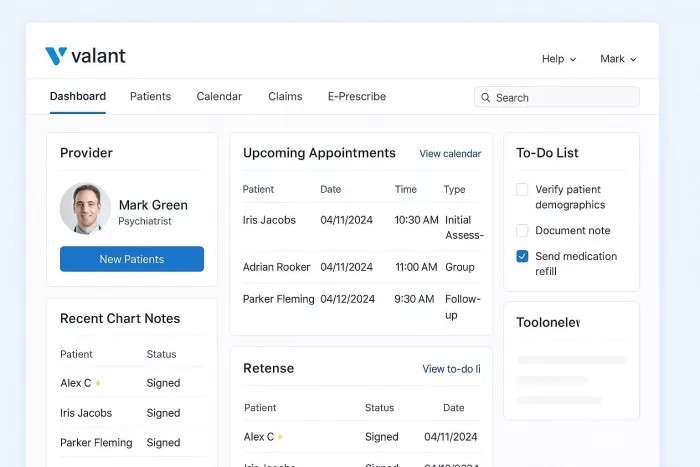
- Clinical documentation — structured note templates, intake/assessment automation, group‑therapy notes, e‑prescribing, treatment planning. (Valant)
- Scheduling & practice management — calendars for appointments, recurring sessions, group‑therapy scheduling, color‑coded scheduling for clarity.
- Billing & insurance claims management — integrated billing, support for insurance claim processing, auto‑generated superbills, charge capture, payment tracking.
- Patient‑facing functions — portal for patients/clients to book appointments, pay bills online, do intake questionnaires, manage communications.
- Telehealth / remote care support — for virtual therapy or psychiatry sessions, useful especially in contexts where remote mental‑health care is needed. (Forbes)
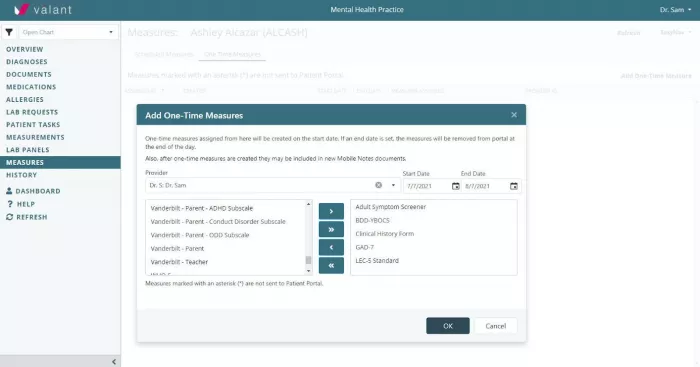
- Reporting & analytics / outcome tracking — tools for generating reports, tracking patient outcomes over time, supporting evidence‑based care and compliance.
In short: Valant aims to combine clinical care, administrative work, billing & revenue management, and patient interaction in a single unified platform all specifically tailored for behavioral health.
Pricing & Cost Structure — What You Should Know
One of the common criticisms (and sources of uncertainty) about Valant is its pricing model.
- Valant does not publish a simple fixed-per-feature price list publicly. Instead, prospective buyers must fill a lead form and speak with a sales representative for a customized quote which depends on factors like number of providers, size of practice, features needed, and insurance/billing setup.
- According to a third‑party review, for small practices, the price may start around US $150 per user per month.
- For larger organizations with many users (e.g. 100 providers), the monthly cost may scale significantly possibly reaching around US $12,000/month.
- Implementation costs (data migration, setup, training) can also be substantial: for small-to-medium practices roughly US $5,000–$20,000, and for larger/customized deployments possibly US $20,000–$50,000, depending on complexity.
- Many reviewers consider Valant expensive, particularly for solo practitioners or small practices.
- There are also reports that certain “extra” features or services e.g. certain telehealth licenses, integrated services, billing clearinghouse fees may carry additional costs beyond base subscription.
In short: Valant appears often cost‑effective for mid‑sized to larger clinics with many clients/providers, where automation and integrated billing can pay off. But for solo therapists or small practices, the cost especially given opaque pricing may be a major downside.
Strengths & What Works Well
Despite criticisms, many users and reviewers do praise Valant especially when the practice is large or requires integrated functions. Key advantages include:
Comprehensive, Mental‑Health Focused EHR
Because Valant is built specifically for behavioral/mental health, its templates, intake/assessment workflows, outcome measures, and note structures often align better with therapy/psychiatry than generic medical‑EHR software.
Unified Workflow: From Intake to Billing to Follow‑Up
Valant covers almost all aspects of practice management and clinical care. Scheduling, documentation, billing/claims, patient portal, telehealth all in one place. For busy clinics, that integration can save significant time and reduce overhead.
Automation & Time Savings
Structured note templates, auto‑populating past data, auto‑generated billing/claims, integrated e‑prescribing these reduce repetitive administrative load. For many clinics, that efficiency is a major benefit.
Support for Modern Mental‑Health Needs Telehealth, Patient Portal, E‑Payments
In contexts where remote therapy is common, or patients expect convenience (online booking, online payments), Valant has many of the features that meet those demands.
Scalability from Solo to Multi‑Clinician Practices
Because the license model is per-user and infrastructure is cloud-based, Valant claims to support small solo practices up to large group practices or agencies making it versatile if your practice grows.
Some users summarised their positive experience:
“Clinical templates make it very easy for me to document. Billing is tightly integrated. Good streamlining with the meds.”
“Valant is incredibly easy and intuitive to use. It was designed for behavioral health care providers specifically.”
Weaknesses, Complaints & What Users Dislike
No software is perfect and Valant’s user feedback is decidedly mixed. Some recurring pain points emerge clearly:
High Cost, Especially for Small or Solo Practices
As described earlier cost is often prohibitive for solo practitioners or small clinics. The lack of transparent pricing makes it hard to evaluate ROI before committing.
Steep Learning Curve & Complexity for Day‑to‑Day Use
Some users find Valant’s interface clunky or outdated; performing even “simple” tasks can require navigating multiple menus. For smaller practices without dedicated administrative staff, that can be burdensome.
One review summarized:
“The system is one of the least intuitive EHRs I've ever seen.”
Technical Issues, Glitches, Slow Performance, Unreliable Telehealth
Some users report frequent crashes, lag or downtime after updates, and unreliability of integrated video/telehealth features sometimes causing cancellations or forcing fallback to other platforms.
From a user on a therapy‑practitioner forum:
“Patients often have difficulty logging on to the portal … the video feature only works about two‑thirds of the time … the whole platform just crashed … So stressful.” (G2)
Customer Support & Responsiveness Issues
Poor or slow customer support is a recurrent complaint. Some users mention long wait times for tickets, no live phone support, and unresolved issues even after extended delays.
In one forum comment:
“It is the worst EHR I have ever worked with.” (Reddit)
The Cost Benefit Ratio is Mixed for Smaller Practices
Many reviewers feel that certain “bells and whistles” (billing clearinghouse, integrated e‑prescribing, telehealth modules, extra services) are expensive — sometimes making the total cost unjustifiable for low-volume practices.
Reviews & Real‑World Feedback - What Practitioners Say
Beyond formal reviews, real-world users in forums and communities share varied experiences. Here’s a snapshot of both praise and frustration.
Positive & Mixed Feedback
- Some practitioners say they recommended Valant to their group practices because it helps them “be more lucrative and minimize staff hours.”
- Others find that documentation which often takes up much clinician time becomes much faster, especially for standard sessions: structured note forms can reduce post-session paperwork dramatically.
- For medium or large practices especially those dealing with many clients, insurance billing, group therapy, or integrated telehealth Valant’s all-in-one design and automation can offer real efficiency gains.
Negative & Critical Feedback
- From an online forum (for therapists):
“I have been a Valant user for years. Valant EHR does not resolve user tickets and does not return phone calls… It is the worst EHR I have ever worked with.”
2. Another user described a painful transition:
“The last 4 weeks have been truly the hardest.” They complained about difficulty navigating telehealth sessions, lost data during migration, missing credit card records, and frustrated clients.
3. And from a business‑owner’s perspective:
“The system has literally set our business back by a year. Since we migrated off of it, billing has passed through insurance reliably, where it would be hung up and contested with Valant.”
These reviews highlight an important reality: for some, Valant is a powerful tool; for others, it’s a source of frustration, inefficiency, and even financial loss.
Comparison: Valant vs Other EHR / Practice‑Management Tools
To understand where Valant stands, it's useful to see how it compares to alternatives. While there are many EHR systems, a few comparisons stand out in user discussions and industry reviews.
| Comparison Factor | Valant | Simpler / Lower‑Cost Alternatives (e.g. smaller EHRs / basic tools) |
| Feature breadth | Very broad — documentation, billing, scheduling, patient portal, telehealth, group therapy, e‑prescribing, outcome tracking. | Narrower — may cover appointment scheduling and basic notes, but often lack integrated billing, insurance claims handling, telehealth, or deep outcome tracking. |
| Scalability (solo → large) | High — designed to support small to large group practices. | Good for solo/small practices, but may struggle with multi-provider workflows or insurance billing demands. |
| Cost | High, especially for small volume; opaque pricing; implementation fees. | Lower cost, simpler pricing (flat rate or per user), sometimes more affordable for solo/small practices. |
| Ease-of-use & Learning Curve | Steep for some — interface can feel clunky, customization and navigation heavy. | Often simpler and more intuitive, easier to onboard staff, especially for limited use-case. |
| Support & Reliability | Mixed — some report long support wait times, bugs, downtime; telehealth glitches. | While simpler, may offer better responsiveness or fewer bugs, especially with a smaller user base. |
| Overall Value (for large/ busy practices) | Potentially high — can streamline operations, reduce admin overhead, integrate billing and care. | Good for basic workflows; may require additional tools or manual work for billing/insurance/complex care. |
One published comparison between Valant and a competitor noted: Valant EHR might cost around US $200 per user/month, while the alternative may offer a lower fixed rate (e.g. US $49/month flat for unlimited users).
That stark difference illustrates why many smaller practices hesitate before committing to Valant.
When Valant Makes Sense And When to Be Cautious
When Valant May Be Worth It
- You run a mid‑sized to large behavioral‑health practice with multiple clinicians, administrative staff, and consistent patient volume.
- You need integrated billing + insurance claims + outcome tracking especially if you deal with insurance, Medicare/Medicaid, or need to document progress and compliance.
- You offer group therapy, telehealth, e‑prescribing or remote care, or want a unified system where scheduling, patient portal, documentation, billing all live together.
- You value automation, structured notes, reporting, and want to reduce admin overhead, so clinicians can focus more on care than paperwork.
When to Reconsider or Proceed Cautiously
- You are a solo therapist or small practice with low patient volume the cost-benefit balance may not justify Valant’s price and complexity.
- You want a lightweight, easy-to-use system with minimal training, for simple scheduling or note-keeping only.
- You are worried about customer support, stability, or you lack dedicated admin staff frequent crashes, slow support, and a steep learning curve can be frustrating.
- You don’t need advanced features (insurance billing, group therapy, outcomes reporting) simpler or cheaper EHR/management solutions might suffice.
Final Thoughts
In a world where mental‑health care is often overburdened, time‑pressed, and administratively complex, having the right digital tools can make a real difference for both clinicians and clients. Valant aims high: to offer a comprehensive, unified EHR tailored for behavioral health. When it works well, it can reduce paperwork, prevent billing headaches, offer telehealth, track outcomes, and bring order to what might otherwise be chaotic workflows.
But the journey to “works well” isn’t always smooth. Cost, complexity, bugs, and support issues these are real obstacles.
If you or your practice are considering Valant: treat it with the same care as a major business investment. Demo it, ask detailed questions, examine sample workflows, simulate intake-to-billing flows, and only commit if you’re confident it fits your volume, staff, and long-term plans. For small practices especially run the numbers carefully before signing up.
For many, a lighter or niche EHR may be more cost-effective and easier to manage.
Above all: choose technology but choose wisely.


Comments