Droven.io Review: An Active AI Content Platform With Clear Strengths and Real Transparency Gaps




Droven.io presents itself as a trusted source for AI information, tools, guides, and future technology insights, and on the surface that positioning makes sense for the kind of site it is trying to be. It is an active AI and technology content platform, but it is also a hybrid operation that blends editorial publishing, guest posting, and AI/IT service positioning into one brand.
That mix is exactly what makes Droven.io worth a critical review. The site is not obviously misleading, and it is not a dead or neglected domain. At the same time, it does not yet have the kind of author transparency, editorial depth, or trust infrastructure that would make it feel like a top-tier authority in the AI content space.
In other words, Droven.io is best understood as a site with genuine activity and useful topical coverage, but also with a business model and editorial structure that deserve a closer look before treating it as a high-trust reference.
At a glance
| Factor | Snapshot |
| Type | AI and tech content platform with guest post and service elements |
| Main topics | AI tools, automation, generative AI, digital transformation, future of work |
| Publishing model | Editorial content plus guest submissions |
| Audience | Readers looking for AI/tech insights, plus contributors seeking exposure |
| Best described as | A hybrid AI knowledge site, not a deeply specialized research publication |
What Droven.io is trying to be
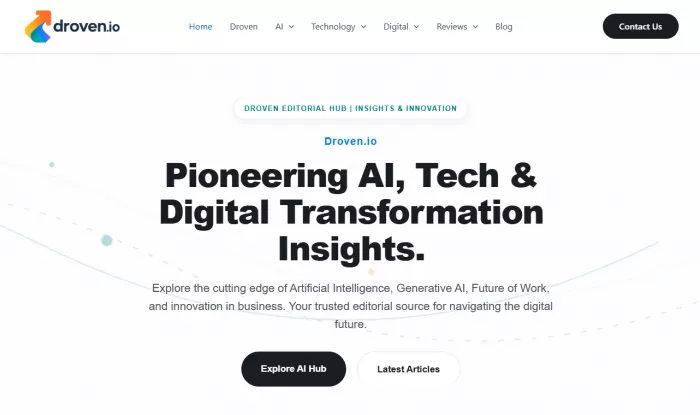
Droven.io appears to be trying to occupy three roles at once: a general AI information hub, a business-facing AI and automation platform, and a publication that can host outside contributors. That combination is not unusual in the digital publishing world, but it does shape the reading experience. A site with this structure usually prioritizes reach, topical breadth, and search visibility as much as it prioritizes deep expertise.
The upside is obvious. The site covers a wide mix of AI-related subjects, which makes it easy for casual readers to find accessible entry points into the topic. The downside is equally important: broad coverage often comes at the cost of sharper editorial identity, stronger expert voice, and more visible proof of subject-matter authority.
A balanced way to describe Droven.io is that it behaves like a modern AI content brand trying to build trust while also building traffic. That is not inherently bad. It simply means readers should judge the site by both what it publishes and how it publishes it.
Content quality and writing style
The writing style on Droven.io is generally structured, readable, and easy to scan. Headings, section breaks, and straightforward phrasing make the site approachable, especially for readers who want quick overviews rather than highly technical explanations.
That readability is a strength. Many AI sites overwhelm readers with jargon or overcomplicated language, but Droven.io seems designed to keep things simple and accessible. For casual users, that can be a positive because it reduces friction and makes the content feel easy to consume.
The limitation is depth. Based on the public material available, the site does not appear to lean heavily on original research, case studies, or expert-led technical analysis. That means the writing may be useful as an introduction or overview, but less convincing when you need evidence-rich, expert-grade commentary.
Where the content feels strong
Droven.io’s strongest content quality signal is its organization.
● The site covers a wide range of AI and technology themes, including generative AI, automation, digital transformation, and business use cases.
● The structure appears built for easy browsing, with categories that help readers move across topics without getting lost.
● The editorial tone is more informational than aggressively promotional, which helps the site feel more neutral than many SEO-heavy blogs.
That combination makes the platform comfortable to read. It is the kind of site that can be useful for someone scanning the AI landscape and looking for quick context before doing deeper research elsewhere.
Where the depth feels limited
The main weakness is that the content does not visibly show enough proof of expertise.
| Area | Strength | Limitation |
| Topic coverage | Broad AI and tech coverage | Breadth is stronger than specialization |
| Writing clarity | Easy to read and follow | Simplicity can flatten nuance |
| Original analysis | Some editorial framing | Limited visible research or unique data |
| Technical authority | Covers relevant themes | Few visible expert markers or author credentials |
This matters because AI content is crowded. Readers do not just want summaries anymore; they want perspective, proof, and interpretation. Droven.io seems to understand the topical demand, but it has not yet clearly demonstrated the kind of layered expertise that makes a publication feel authoritative rather than merely active.
Author transparency and editorial trust
This is one of the most important areas to examine.
Droven.io does mention that guest contributions can be published with proper author credits, and its terms indicate that submissions may be accepted, edited, or rejected at the site’s discretion. That suggests some editorial process exists. However, the public-facing material does not strongly surface individual author bios, editorial leadership, or a visible team page that would help readers evaluate who is behind the content.
That gap matters more than it may seem. A website can publish decent content and still feel less trustworthy if readers cannot tell who wrote it, what their background is, or how the editorial process works. For a site that describes itself as trusted AI information, stronger author transparency would significantly improve credibility.
The result is a trust profile that is functional but incomplete. The site is not devoid of contact information or publishing rules, but it also does not provide the kind of detailed author and editorial structure that experienced readers often expect from a serious knowledge platform.
Publishing consistency and freshness
Droven.io does seem active. Publicly visible content from 2026 suggests regular publication activity, and the site shows signs of ongoing category updates rather than a static or abandoned blog.
That kind of consistency is a positive signal. It tells readers that the site is not just a placeholder domain or an old project with no maintenance. It is being used, updated, and positioned as an ongoing publication.
But consistency alone does not equal reliability. A site can publish regularly and still vary in quality from article to article, especially when guest submissions are part of the model. So the fact that Droven.io is active is reassuring, but it should not be mistaken for proof of editorial rigor.
Guest posting and monetization signals
The guest-post angle is important because it affects how the platform should be read.
Droven.io openly invites contributors and says submissions should be original, reviewed by the editorial team, and accompanied by proper author credits. Its terms also show that guest contributions may be accepted and that published content can remain live indefinitely. That is a normal publishing arrangement in one sense, but it also points to a broader SEO and backlink-driven model.
That model is not automatically a problem. Many sites monetize through contributor content and link placements. The issue is transparency. When a platform blends editorial content with guest-post opportunities, readers should know that the site is not operating as a purely independent editorial newsroom.
In practice, that means Droven.io should be judged as a hybrid platform: part editorial hub, part marketing channel, part AI service brand. That is a perfectly workable business model, but it is not the same thing as an expert publication built primarily around original reporting or deep research.
Trust and reliability
On balance, Droven.io looks more legitimate than suspicious, but it still carries enough opacity to deserve caution. It has contact information, terms, guest-post guidelines, and a clearly stated content theme, which are all positive signs. At the same time, it does not visibly provide enough background on ownership, editorial leadership, or company structure to fully settle trust concerns.
A simple way to summarize reliability is this: the site seems usable, active, and real, but not yet fully transparent. For a reader browsing AI content casually, that may be enough. For anyone evaluating whether to rely on it as a primary authority, it is not quite enough yet.
| Trust factor | Assessment |
| Contact details | Present, but limited to email-based communication |
| Terms and policies | Present and publicly accessible |
| Author visibility | Weak |
| Editorial process | Exists, but not deeply explained |
| Company transparency | Limited |
| Overall reliability | Moderate, with noticeable transparency gaps |
Where it fits in the AI content landscape
Droven.io is not the kind of site you read for groundbreaking AI research or dense technical commentary. It is better viewed as a mid-tier informational platform with broad appeal, useful categories, and a commercial layer that is hard to ignore.
That makes it potentially useful in several ways:
● For general readers who want a simple overview of AI topics.
● For marketers and publishers who understand the guest-post model.
● For people looking for a broad AI and automation content hub rather than a specialist publication.
It is less compelling for readers who expect visible expert authorship, strong citations, and a more transparent editorial identity. In that sense, the site sits in the middle: useful, but not authoritative enough to be treated as a final word.
Personal Rating Scorecard
| Category | Rating / 10 | Personal take |
| Content quality | 7.0 | Clear and readable, but not highly original or deeply technical. |
| Depth of expertise | 5.5 | Covers relevant topics, but expert signals are limited. |
| Author transparency | 4.5 | Weak visibility of authors, editors, and team structure. |
| Publishing consistency | 7.5 | Appears active and regularly updated in 2026. |
| Trust & transparency | 5.0 | Legit-looking, but still fairly opaque. |
| Reliability | 6.0 | Usable and active, but not yet strong enough to call fully authoritative. |
| Practical usefulness | 7.0 | Good for broad AI browsing, guest posts, and quick overviews. |
| Overall editorial value | 6.0 | Useful, but best treated as a mid-tier AI content platform. |
Final Take
Droven.io is a real, active AI content platform with broad topical coverage, readable writing, and a clear effort to position itself around future-facing technology. Those are genuine strengths. It also has a practical publishing structure and enough consistency to suggest it is an ongoing operation rather than a superficial placeholder.
But it is not a fully transparent or deeply authoritative publication yet. The lack of visible author profiles, limited company disclosure, and guest-post-driven monetization model all make it feel more like a growing hybrid media-and-services brand than a mature expert resource.
A balanced takeaway is : Droven.io is credible enough to read, broad enough to be useful, and active enough to deserve attention, but still too opaque to be considered a top-tier trust source. For general AI browsing, it can be worthwhile. For serious research or high-trust citation, it still needs to prove more.


Comments