GoMyFinance.com Review: Helpful Finance Guide or Limited Authority Site?



GoMyFinance.com presents itself as a finance education website for readers who want simple explanations around money, investing, credit, tools, and financial decisions. The site is active and easy to browse, but finance content needs a higher trust standard than ordinary blog content.
This review looks at how GoMyFinance.com actually performs across its homepage, categories, writing quality, author profile, About page, Contact page, publishing activity, EEAT signals, strengths, limitations, and overall reliability.
The Short Verdict
GoMyFinance.com is useful as a beginner-friendly finance reading site, especially for readers who want quick explanations of personal finance and investing topics. It is not a bank, broker, lender, tax firm, or registered financial adviser, and its own disclaimer makes that clear.
The site works best as a starting point. It can help readers understand a topic before they verify important details through official sources, banks, regulators, tax professionals, or licensed advisers. Its biggest weakness is not readability. It is the limited proof of expertise behind serious financial topics.
| Area | Quick Assessment |
| Main sections | Personal Finance, For Investors, Calculators & Tools |
| Strongest area | Simple explanations for beginners |
| Weakest area | Limited author credentials and expert review |
| Trust level | Suitable for general reading, not final financial decisions |
What GoMyFinance.com Is
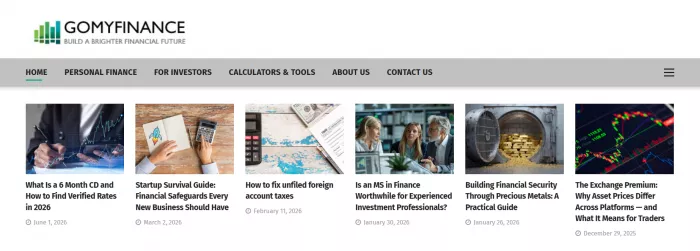
GoMyFinance.com is a finance content website built around educational articles, guides, and tool-related resources. It covers everyday money topics such as saving, credit, debt, loans, CDs, investing, business finance, and financial calculators.
The site’s main navigation is built around three visible pillars: Personal Finance, For Investors, and Calculators & Tools. The homepage also shows broader topic areas such as Banking, Credit & Debt, Budgeting & Saving, Business Finance, Investments, Stocks, Real Estate, Calculators, and Tools.
That structure is clear and useful. A new visitor can quickly understand what the website is trying to cover. The issue is that GoMyFinance covers several high-impact areas at once. When a site discusses loans, taxes, investing, credit, and trading, readers need more than simple explanations. They also need clear sourcing, update dates, author expertise, and review transparency.
Homepage: Clean but Broad
The homepage gives GoMyFinance.com a neat finance-blog layout. It shows recent articles, category sections, top stories, and finance-focused navigation. The visible topics include 6-month CDs, startup financial safeguards, foreign account taxes, investment degrees, precious metals, exchange price differences, no-credit-check loans, bad-credit loans, dividend stocks, and futures trading.
That makes the site look active, which is a positive sign. Finance content can become outdated quickly, so a site with recent posts feels more useful than an abandoned blog. The homepage also does a good job of showing visitors that this is a finance-focused website rather than a random content farm.
The weaker point is focus. The site moves from beginner borrowing advice to tax correction, investment education, startup finance, trading, and precious metals. A broad finance website can work, but only when the editorial process is strong enough to support that range. GoMyFinance has the structure, but the authority behind it is not fully visible.
| Homepage Area | What Works | What Feels Weak |
| Navigation | Simple menu with clear finance sections | “For Investors” and “Investments” could be more consistent |
| Recent posts | Shows signs of activity and regular publishing | Topic range feels very wide |
| Category layout | Easy to browse by finance theme | Some topics feel loosely grouped |
| Trust elements | About, Contact, disclaimer, and bylines are present | Editorial policy and expert review are not clearly shown |
The homepage creates a good first impression, but it does not fully answer the trust question.
What the Site Covers
Personal Finance
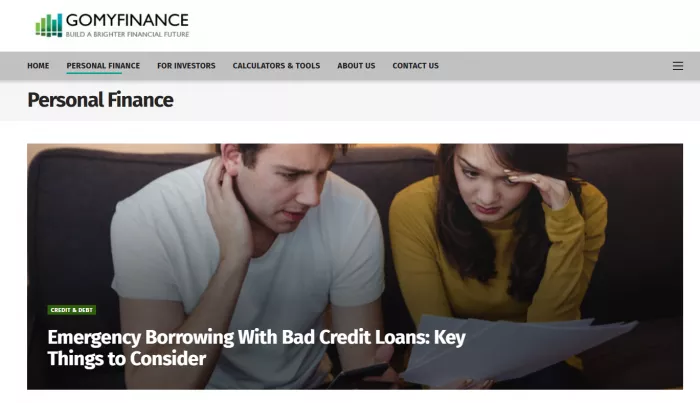
The Personal Finance section is the most practical part of GoMyFinance. It covers credit, debt, saving, borrowing, emergency expenses, payday loans, bad-credit loans, student money mistakes, and general financial safety.
This section has real value for beginners. A reader who wants a plain-language explanation of credit, borrowing risks, savings, or basic debt topics can use it as an entry point. The writing is usually simple enough for someone who does not already understand finance terms.
The risk is that many topics in this section can affect real financial behavior. Articles about payday loans, no-credit-check loans, and bad-credit borrowing need careful warnings because these products can be expensive and risky. GoMyFinance would be more useful if these articles included stronger references to official consumer finance sources and clearer risk comparisons.
For Investors
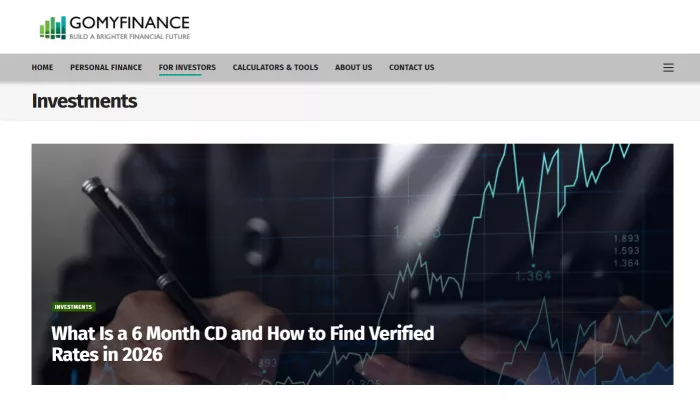
The For Investors section gives GoMyFinance a broader finance identity. It includes topics around CDs, dividend stocks, futures trading, precious metals, crypto exchanges, investment education, and market-style explainers.
This content is useful for readers who want to understand investment concepts at a basic level. It helps the site move beyond budgeting and saving into wealth-building topics. That said, this section also requires the highest level of trust.
Investment content should clearly separate education from advice. A reader should not treat a general article about dividend stocks, precious metals, futures, or crypto exchanges as a reason to invest. GoMyFinance does include a disclaimer, but stronger article-level risk framing, source lists, update dates, and expert review would make this section much more reliable.
Calculators & Tools
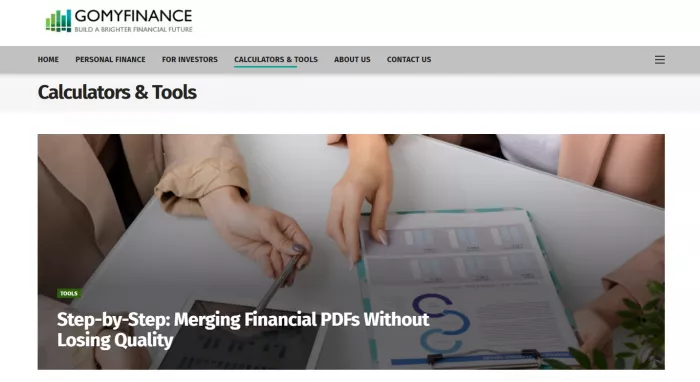
The Calculators & Tools section has strong potential, but it does not fully deliver on the expectation created by its name. A reader may expect working tools for budgeting, debt payoff, loan comparison, retirement planning, savings goals, interest, or CD returns.
The section currently feels more like a collection of tool-related articles than a full interactive calculator hub. It includes topics around financial calculators, essential tools, budgeting apps, retirement calculator guides, finance software, PDF tools, and regulation-ready finance tools.
That content can still be useful, but the section would be much stronger with real calculators built into the site. A debt payoff calculator, savings goal calculator, CD return calculator, loan comparison calculator, and emergency fund calculator would make the category more practical and more aligned with user intent.
Category Reality Check
GoMyFinance has the right category pillars for a finance education site. The problem is that the execution is uneven. Personal Finance feels the most useful, For Investors needs stronger trust signals, and Calculators & Tools needs more hands-on functionality.
| Category | Best Use | Main Limitation |
| Personal Finance | Basic learning around credit, debt, saving, and borrowing | High-risk loan topics need stronger warnings and sourcing |
| For Investors | Introductory investment education and topic discovery | Not enough visible expertise for real investment decisions |
| Calculators & Tools | Guides around finance tools and calculator concepts | More article-based than interactive |
This does not make the site poor. It means readers should understand what each section is best suited for.
Writing Quality: How good is it?
The writing on GoMyFinance is mostly clear, simple, and easy to follow. Articles usually use headings, short explanations, examples, and FAQ-style sections. That makes the site approachable for readers who want basic finance information without technical language.
The strongest writing appears in topics that need simple explanation, such as CDs, financial calculators, bad-credit loans, and general money habits. These articles can help a reader understand the basic idea before researching further.
The limitation is depth. Some articles explain the topic but do not always add enough original analysis, real-world comparison, official references, or expert-backed interpretation. For general finance reading, that is acceptable. For topics involving taxes, loans, investing, trading, credit, and retirement, readers should expect stronger evidence.
There are also small polish issues. Some parts of the site show unfinished elements such as “No Result” or “No Content Available.” These do not make the site illegitimate, but they make the publishing process feel less controlled.
Author Profile and Expertise
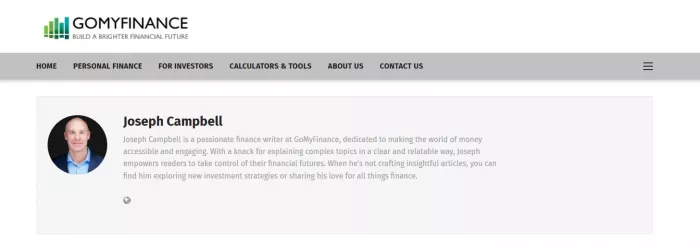
GoMyFinance has a visible author profile for Joseph Campbell, which is better than fully anonymous publishing. The author archive shows multiple posts under the same name, and the profile describes him as a finance writer who explains money topics in accessible language.
The issue is that the profile does not prove strong financial expertise. It does not clearly mention finance degrees, certifications, licenses, professional experience, tax knowledge, investment background, or links to independent professional profiles.
For a basic explainer website, a finance writer may be enough. But GoMyFinance covers serious topics such as taxes, loans, credit, investing, retirement, and trading. For those areas, readers should be able to see whether the content has been reviewed by a qualified professional.
A stronger author setup would include finance credentials, professional background, reviewer names, article review dates, and a clear editorial policy. Without those details, the author profile is a basic trust signal, not a strong expertise signal.
About Page: Clear But Thin
The About page explains that GoMyFinance wants to make finance easier to understand for beginners and experienced readers. It also describes the site’s focus areas, including personal finance, investing, financial literacy, calculators, tools, and financial news.
This page helps explain the site’s purpose. It shows that GoMyFinance is trying to be a broad finance education resource rather than a single-topic blog.
However, the About page does not go far enough for a finance website. It does not clearly explain who owns the site, who writes the articles, how content is reviewed, what sources are used, how often articles are updated, or how corrections are handled. For a finance site, these details matter because the content can influence money decisions.
Contact Page and Transparency
The Contact page is one of the better trust signals on the site. It lists an email address, phone number, business hours, live chat mention, and a physical address in Sugar Land, Texas. Many low-quality finance sites provide much less than that.
Still, the page has small consistency issues. The Contact page lists one email address, while the footer shows another. That may simply mean the site uses multiple inboxes, but it looks less polished. The live chat mention is also not fully supported by visible proof on the page.
The Contact page supports legitimacy, but the site would feel stronger with consistent contact details, clearer company ownership, a dedicated editorial contact, and a simple correction request process.
Publishing Activity
GoMyFinance appears active. The homepage and author archive show posts across 2025 and 2026, and the site has multiple pages of published content.
That matters because finance information changes quickly. CD rates, loan terms, tax requirements, credit guidance, and investment conditions can shift over time. A finance site needs fresh content to remain useful.
The caution is that publishing activity is not the same as authority. A site can publish often and still lack expert review. GoMyFinance would be stronger if high-impact articles showed “last reviewed” dates, update notes, and reviewer names.
EEAT Breakdown
GoMyFinance has some EEAT signals, but they are uneven. It has active content, author pages, About and Contact pages, and a disclaimer. These are useful baseline trust elements.
The weaker area is expertise. The site does not clearly show professional finance credentials, expert reviewers, detailed sourcing standards, or a transparent editorial process.
| EEAT Area | Assessment |
| Experience | The site explains practical topics, but shows limited first-hand testing, original research, or real calculator use. |
| Expertise | A named author exists, but credentials and expert review are not clearly proven. |
| Authoritativeness | The site has many finance posts, but limited evidence of outside authority or recognized contributors. |
| Trustworthiness | Contact details, disclaimer, bylines, and About page help. Generic bios, limited review transparency, and polish issues reduce trust. |
The EEAT picture is mixed. GoMyFinance looks legitimate as a finance content website, but not strong enough to be treated as a high-authority financial source.
What GoMyFinance Does Well
GoMyFinance is useful because it makes basic finance topics easier to approach. It does not bury readers under technical language, and its category structure helps visitors browse common money questions quickly.
Its strongest qualities are:
● Clear sections for personal finance, investing, and tools.
● Beginner-friendly explanations across common finance topics.
● Visible publishing activity across recent years.
● Basic trust pages, including About, Contact, author profile, and disclaimer.
● Practical topic coverage around credit, debt, loans, CDs, saving, and financial tools.
These strengths make the site useful for learning the basics.
Where the Site Falls Short
The site’s main weaknesses are not about access or readability. They are about trust depth.
GoMyFinance covers topics where incorrect or incomplete information can affect real financial decisions. Because of that, it needs stronger author credentials, clearer review standards, better sourcing, and cleaner site maintenance.
The biggest limitations are:
● Author credentials are not strong enough for high-impact finance topics.
● Expert review is not clearly visible on tax, loan, credit, investment, or trading content.
● The tools section feels more like guides than actual calculators.
● Some unfinished theme elements reduce polish.
● Contact details are not fully consistent.
● The About page does not explain sourcing, ownership, corrections, or editorial process.
These problems do not mean the site is fake. They mean it should be used with limits.
Is GoMyFinance.com Trustworthy?
GoMyFinance.com looks legitimate as a finance blog or educational website. It has active articles, visible categories, an author page, About and Contact pages, a disclaimer, and multiple finance sections.
However, it is not strong enough to use as a final authority for serious financial decisions. The site does not show enough verified expertise, professional review, or detailed sourcing for high-impact financial topics.
The safest use is as a first-read resource. Readers can use it to understand a topic, then verify important details through official sources, banks, regulators, tax professionals, or licensed advisers.
Who Should Check It Out?
GoMyFinance is worth checking out for readers who want simple finance explanations. It may help beginners understand credit, saving, debt, CDs, loans, investing basics, and financial tools.
It can also help readers who want a quick overview before moving to official or expert sources. Content researchers may also find it useful as an example of how a broad finance site organizes personal finance, investing, and tool-related content.
Who Should Avoid Relying on It?
GoMyFinance should not be the only source for readers making serious financial decisions. Investors, borrowers, taxpayers, retirement planners, and people dealing with debt or credit problems should verify information elsewhere.
This is especially important for payday loans, no-credit-check loans, tax filings, investment products, retirement planning, credit repair, and trading decisions. These areas need official guidance or professional advice.
My Personal Rating
| Area | Rating | Short Take |
| Website Structure | 4.0/5 | Clean layout with clear main sections. |
| Content Usefulness | 3.7/5 | Helpful for basic finance learning, but not deep advice. |
| Writing Quality | 3.6/5 | Easy to read, though sometimes broad and SEO-led. |
| Author Transparency | 2.8/5 | Author profile exists, but credentials are limited. |
| Trust and EEAT | 3.0/5 | Basic trust signals are present, but expert review is weak. |
| Tools Section | 2.9/5 | More tool guides than real interactive calculators. |
| Overall Rating | 3.4/5 | Good starting point, not a final source for money decisions. |
The Verdict
GoMyFinance.com is a real and active finance education website with clear categories, beginner-friendly writing, and useful topic coverage. Its Personal Finance section is the strongest because it deals with everyday money issues such as credit, debt, loans, saving, and borrowing basics.
The site’s biggest weakness is authority. It has basic legitimacy signals, but it does not yet show enough author expertise, expert review, sourcing transparency, or editorial process for high-stakes finance content.
The fair verdict is simple: GoMyFinance.com is useful for learning the basics, but readers should not rely on it alone for important financial choices. It works best as a starting point, not as the final word on money decisions.


Comments