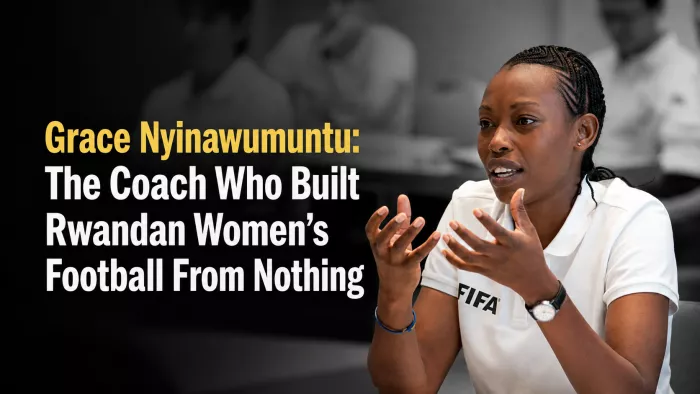
Grace Nyinawumuntu: The Coach Who Built Rwandan Women's Football From Nothing

Ranjit Sharma
In early 2012, Rwanda did not have a senior women's national football team. FIFA had no ranking for one, because there was nothing to rank.
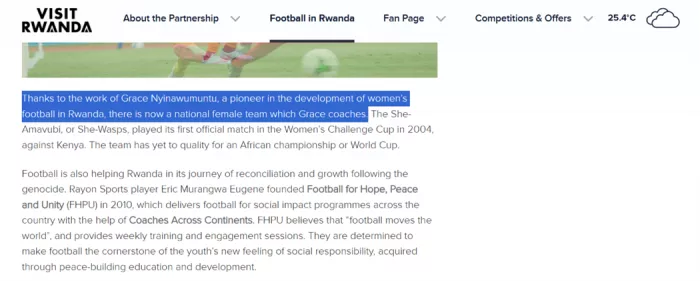
Two years later a Rwandan side walked out in Kigali and beat Kenya 1-0. Alice Niyoyita scored in the 29th minute. The squad had a nickname before it had a history: She-Amavubi, the She-Wasps.
The person who assembled that team had already refereed men's matches in a country where no woman had ever held a senior whistle. Her name is Marie Grace Nyinawumuntu.
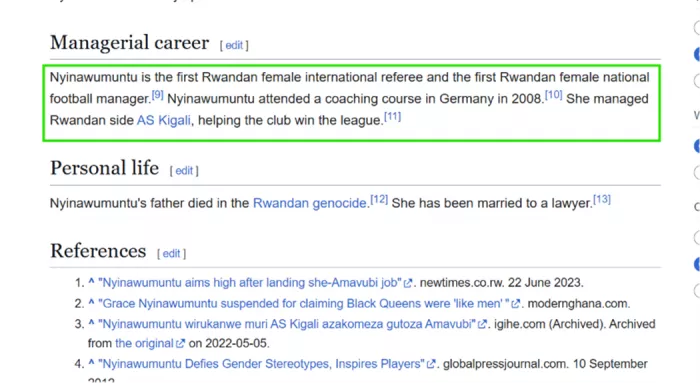
Her public record is thin to the point of being misleading. Wikipedia gives her a stub of around fourteen sentences. Wikiquote gives her exactly one quotation, and it is the worst thing she ever said in public. Search her name and the first page is dominated by a single bad night in September 2023, reported almost entirely by outlets in another country.
Everything below was pulled back together from Rwandan match reports, federation statements, academy announcements, a court outcome and a scattering of interviews spread across twelve years. The gap between what she did and what is written down is the actual story here, and the closing section returns to why that gap matters far beyond football.
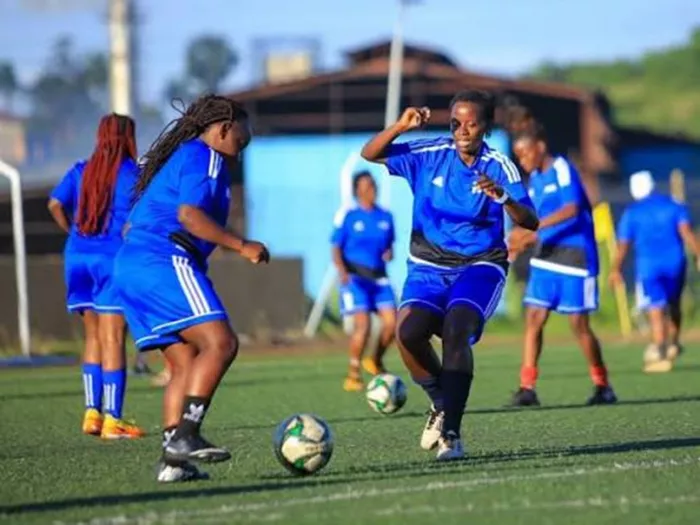
The pitch was empty before she arrived
Rwanda's neighbours had a head start measured in decades. Nigeria had been winning continental titles since the 1990s. Kenya, Uganda, Ethiopia and Tanzania all fielded women's sides while Rwanda fielded none.
Part of the reason sits in the country's recent history, and part of it sits in ordinary institutional neglect. There was no domestic pipeline worth the name and no coaching pathway for women, which meant there was no budget line that would have paid for either.
A 2014 assessment of the situation was blunt about the constraints facing the region: limited access to education for girls, poverty among women in the wider society, weak legal protection for female players, and a structural inequality that made all three harder to fix. Talented players who did emerge tended to leave for Zambia or elsewhere, because staying meant playing for nothing.
Against that backdrop, the federation FERWAFA decided in 2012 to assemble a senior women's team ahead of the 2014 African Women's Championship qualifiers. They needed someone to build it. They gave the job to the coach of the AS Kigali women's club.
Understanding why they picked her means going back about thirty years.
A childhood spent outnumbered
Nyinawumuntu was born in December, with sources splitting between 1981 and 1982. Wikidata records her birthplace as Kayonza District in Rwanda's Eastern Province. She grew up playing sport with her male cousins, which in practical terms meant she learned the game in the only environment available to a girl who wanted to play it.
Her father was killed in the Rwandan genocide.
She attended Lycée de Kigali, one of the country's better-known secondary schools, then took a bachelor's degree in physical education and sport. She has since added postgraduate qualifications; her own social media profiles cite a master's in project management, while other records list an MBA. The distinction matters less than the pattern, which is that she kept qualifying herself long after she had a job.
As a player she was a central defender for the City of Kigali side. Contemporary write-ups say her performances there earned a national call-up, and she was part of the first assembled national women's group around 2009, though that early squad never entered a major competition.
The whistle came first
Before she coached anything, she officiated.
In 2004 she became the first woman in Rwanda to referee at senior level. She went on to officiate men's matches and later became the country's first female international referee. This is the part of her CV that tends to get compressed into a single line, and it deserves more space, because refereeing men's football in Rwanda in 2004 was a different proposition from coaching a women's club in 2014.
A referee has no squad, no bench and no institutional cover. She is alone with a decision and twenty-two people who disagree with it.
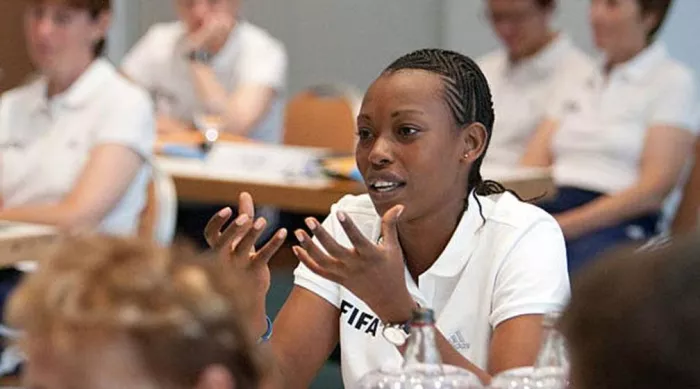
Two things follow from those years. The first is credibility: by the time FERWAFA needed a national women's coach, she was already a known quantity to the federation. The second is a technical grounding in the laws of the game that most coaches acquire second-hand, if at all. She is now a CAF instructor, which means she trains other coaches across the confederation.
Germany, 2008, and a licence nobody in Rwanda had
In 2008 she travelled to Germany for a coaching course and came back with a Level B licence.
That certificate made her Rwanda's first female professional football coach. Reporting on the exact year varies, and the variation is worth flagging rather than smoothing over:
• Several Rwandan and East African outlets date the milestone to 2008, tied directly to the German licence.
• The English Wikipedia entry on the Rwanda women's national team puts it at 2009.
• Ghanaian coverage in 2023 repeatedly said 2014, which appears to conflate her professional debut with her first senior national team appointment.
• Her Wikipedia biography confirms only that the German course took place in 2008.
The 2014 figure spread widely because it was carried in wire copy during a news cycle, which is a useful illustration of how a thin public record calcifies around whichever version happened to travel furthest.
The AS Kigali years, and a run almost nobody outside Rwanda knows about
Between 2009 and 2016 she managed AS Kigali Women, the City of Kigali-sponsored side. Under her the club won the domestic league every single season.
The exact count differs by source. Africa Top Sports reported eight consecutive titles from 2009 to 2016. KT Press put the figure at nine. A 2015 New Times match report catches her mid-run, publicly targeting a sixth straight championship while simultaneously holding the national team job.
Either number would be remarkable. Eight or nine consecutive national titles is the kind of run that gets a men's coach a continental job and a documentary.
The AS Kigali record, as reported:
| Detail | What the sources say |
|---|---|
| Period in charge | 2009 to 2016 |
| Consecutive league titles | Eight (Africa Top Sports) or nine (KT Press) |
| Nickname earned by the side | The invincibles |
| How the spell ended | Relieved of duties in 2016 |
| Concurrent role | Head coach of the senior national team from January 2014 |
She was, in other words, doing two demanding jobs at once for two of those years. The next section covers what the second job actually involved.
Thirty-six players, eight clubs, one deadline
The She-Amavubi were not inherited. They were convened.
Speaking in early 2014, Nyinawumuntu described selecting a provisional group of 36 players drawn from eight domestic clubs, and calling in coaches from other women's teams to help her assess them. She was candid at the time that the structures did not exist yet and would have to be built as they went. She was equally candid that the team was limited by resources.
The debut came against Kenya in Kigali in 2014, in the first qualification round of that year's African Women's Championship. Rwanda won 1-0 through Niyoyita's goal, the moment this article opened with.
What followed was harder. In June 2014 Rwanda lost 8-0 to Nigeria in Kaduna, a scoreline that still stands as the team's heaviest defeat. At the 2016 CECAFA women's championship the side went out at the group stage after a 3-2 loss to Ethiopia, having pulled two goals back through Dorothee Mukeshimana and Gloria Sifa Nibagwire. She told reporters afterwards that the tournament had been a lesson.
Her first spell lasted roughly two years.
2016 and 2017: the part that gets reported badly
In 2016 she was relieved of her duties at AS Kigali.
In 2017 she was suspended as head coach of the same club after players made sexual harassment allegations against her. She took AS Kigali to court for wrongful dismissal and won. The club was ordered to pay her damages reported at around 47,000 US dollars, roughly 44,000 euros at the time.
This sequence is worth stating carefully, because most of the coverage that reaches international readers compresses it into a single clause about a previous suspension and stops there. The outcome of the legal process was in her favour. Any account that mentions the allegations without mentioning the judgment is giving readers half a document.
She returned to national duty in 2021, and that is where the story picks up again.
Paris comes to Kigali
In December 2019 the Rwandan government signed a sponsorship deal with Paris Saint-Germain through its Visit Rwanda tourism brand. The agreement ran for three years initially and was extended in May 2023. One component was a PSG Academy in Rwanda.
In April 2021, after a three-day selection workshop run by PSG Academy's head of coaching Benjamin Houri, Nyinawumuntu was named technical director of the new academy. She beat four other candidates for the role. All four were men.
The PSG Academy Rwanda launch team:
| Role | Name |
|---|---|
| Technical Director | Marie Grace Nyinawumuntu |
| General Manager | Theonas Ndanguza |
| Coach | Hamida Murekatete |
| Coach | Alain Mbabazi |
| Coach | David Rumanzi |
| Coach | Nonde Mohamed |
The academy's results under her supervision are the least-covered achievement in her entire career. Its under-11 and under-13 sides won three titles at PSG's global academy tournament, an annual event held at the Parc des Princes that gathers the French club's academies from around the world.
A Rwandan coach taking junior teams from Kigali to Paris and beating academies from wealthier federations is a straightforwardly good story. It received a fraction of the coverage that a single post-match quote would receive two years later.
The U-20 job, and a second chance at the senior team
In July 2021 she was appointed head coach of Rwanda's first-ever under-20 women's national team, ahead of qualifying for the 2022 FIFA U-20 Women's World Cup in Costa Rica. She was assisted by Consolée Mukashema and Théogenie Mukamusonera, with Claude Maniraguha on goalkeepers. Rwanda advanced to the second round after South Sudan withdrew, then faced Ethiopia.
In June 2023 FERWAFA brought her back to the senior side.
Her stated target was the qualifying campaign for the Paris 2024 Olympic Games, starting against Uganda with the first leg on 12 July and the return in Huye. A 25-player provisional squad entered camp on 28 June, with AS Kigali and Rayon Sports supplying the largest contingents. Mukamusonera, then coaching AS Kigali Women, came in as her assistant again.
She told Times Sport at the appointment that coaching Rwanda was an honour and that building a competitive side would require the right group of players around her. In a federation statement she was more direct, saying she does not accept responsibilities she will not fight for.
September 2023: the sentence that ended the spell
On 20 September 2023, Rwanda hosted Ghana at Kigali Pele Stadium in the first leg of a 2024 Women's Africa Cup of Nations qualifier. Nora Hauptle's Black Queens won 7-0. Evelyn Badu and Anastasia Achiaa each scored twice, with further goals from Doris Boaduwaa and Priscilla Adubea. Ghana went through 12-0 on aggregate after the second leg in Accra on 26 September.
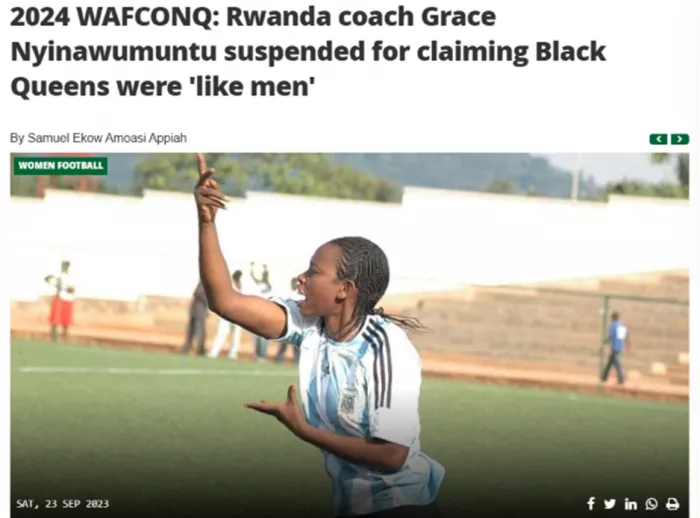
Speaking after the first leg, Nyinawumuntu said her players had been frightened on the pitch, and attributed that to her belief that some of the Ghanaian players had male hormones and resembled men.
FERWAFA suspended her within days. The federation's statement said the suspension would run until further notice, cited her choice of language, and said the remarks breached the rules and values of Rwandan football. It reminded members to avoid comments lacking factual basis or professionalism.
The remark was indefensible. It also travelled, in a way nothing else she has ever done travelled. Dozens of outlets across Ghana and beyond ran it within seventy-two hours. Almost none of them mentioned the academy titles at the Parc des Princes or the eight or nine consecutive league championships. Almost none mentioned that the national team she was being suspended from was one she had personally assembled from nothing nine years earlier.
That imbalance is measurable, and the next section measures it.
What the record actually says
Here is her career condensed, with the disputed points marked rather than resolved.
| Year | Event | Confidence |
|---|---|---|
| 1981 or 1982 | Born, December, Kayonza District | Disputed year |
| 2004 | First woman to referee at senior level in Rwanda | Well sourced |
| 2008 | Level B coaching licence obtained in Germany | Well sourced |
| 2008, 2009 or 2014 | Becomes Rwanda's first female professional coach | Disputed |
| 2009 to 2016 | Manages AS Kigali Women, eight or nine straight titles | Count disputed |
| January 2014 | Named first head coach of the She-Amavubi | Well sourced |
| 2014 | National team debut, Rwanda 1-0 Kenya, Kigali | Well sourced |
| 2016 | Relieved of duties at AS Kigali | Well sourced |
| 2017 | Suspended after player allegations; wins wrongful dismissal case | Well sourced |
| April 2021 | Appointed Technical Director, PSG Academy Rwanda | Well sourced |
| July 2021 | Appointed head coach, Rwanda U-20 women | Well sourced |
| June 2023 | Returns as senior national team head coach | Well sourced |
| September 2023 | Suspended by FERWAFA after post-match remarks | Well sourced |
Four of those thirteen entries carry a factual dispute. For a national team head coach in the FIFA era, that is an unusually high error rate, and it exists because the primary sources were never consolidated anywhere.
Where the story stands now
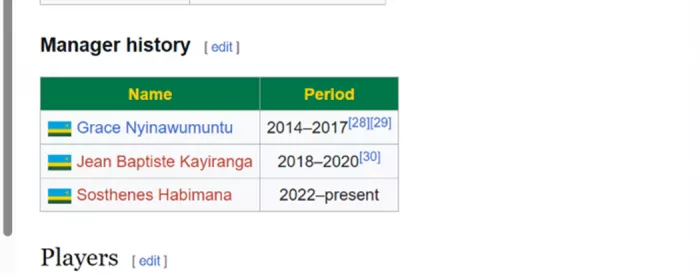
The She-Amavubi have moved on. Sosthenes Habimana is the current head coach. Gloria Nibagwire, one of the scorers from that 2016 CECAFA defeat, captains the side.
The team's trajectory since Nyinawumuntu built it is not a straight line upward.
| Metric | Figure |
|---|---|
| First official international | Rwanda 1-0 Kenya, Kigali, 2014 |
| Highest FIFA ranking reached | 105th, December 2017 |
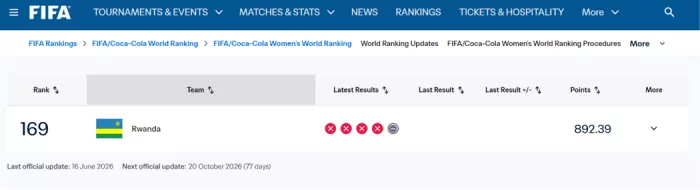
| FIFA ranking as of 11 December 2025 | 169th |
| Biggest recorded win | Rwanda 2-0 Djibouti, Njeru, 5 June 2022 |
| Biggest recorded defeat | Nigeria 8-0 Rwanda, Kaduna, 7 June 2014 |
The peak of 105th came in December 2017, roughly a year after her first spell ended. The ranking has since fallen to the team's lowest recorded position. Read that however you like; the point is that a programme which did not exist in 2012 has now had a peak and a decline, which is what having a programme looks like.
The lesson buried in a fourteen-sentence stub
Return to where this started.
A woman refereed men's matches in 2004, qualified abroad in 2008, won a league eight or nine times running, convened a national team out of eight club sides, took Rwandan children to the Parc des Princes and won there, then said one wrong thing in a press scrum after a 7-0 defeat.
Search her name today and the last item is the loudest. Her Wikiquote page contains that sentence and nothing else. Her Wikidata entry lists her occupation and her school without a single reference attached. Her Wikipedia article runs to fourteen sentences, four of which are about her personal life.
This happens to people whose achievements occur outside the attention of large media markets. Rwandan sport is covered by a handful of domestic outlets with limited archives. When international press does arrive, it arrives for a controversy, writes one paragraph of background from whatever it can find, files, and leaves. The background paragraph then becomes the record.
The practical defence is unglamorous: own a page you control, keep it current, and make it the thing that ranks. A single link that holds a verified career timeline, primary source citations, media contacts and your own account of contested events does work that no third-party wiki stub will do for you. Coaches, athletes, founders and anyone whose reputation is searchable before it is met all face the same asymmetry, which is why TIEUP.IO exists as a place to consolidate that identity rather than leave it scattered across other people's platforms.
Nyinawumuntu built a national team before she had a budget for it. Building a public record is a smaller task than that, and it has to be done by the person who owns the record.
A note on why I wrote this
I went looking for Grace Nyinawumuntu after reading a one-line entry that quoted her worst public moment and told me nothing else. It took several hours across Rwandan sports archives, a federation site, a French club's academy announcements and a Ghanaian news cycle to assemble what you have just read, and I still cannot tell you with certainty what year she was born.
That bothered me more than the controversy did.
The 2023 remark was wrong and the suspension was warranted. Both facts appear above without softening. What sits alongside them is a body of work that took fifteen years, produced a national team and a domestic dynasty, and sent a group of Rwandan children to win at the Parc des Princes, and which currently occupies less space online than seventy-two hours of bad headlines.
If you are reading this and you have built something that nobody has written down, that is the part worth acting on today.


Comments