Grubby AI Review: I Tested the Humanizer to See What It Really Fixes



Grubby AI is built for one job: rewriting AI-generated text so it sounds more human and becomes harder for AI detectors to flag. I tested it with AI-written content, checked the rewritten version across multiple detectors, and looked closely at whether the output was actually usable or just “changed.”
The short answer is that Grubby AI can improve the surface of AI writing, but it is not a guaranteed detector-bypass tool. Some checkers responded better after humanization, while others still found the text suspicious. The output also needed manual editing before I would call it publish-ready.
My Testing Setup
I used a short AI-generated paragraph written in a clean informational style. I chose this type of content because it reflects how most people would use Grubby AI in real life: essays, blog sections, emails, discussion posts, product descriptions, and quick web copy.
The original text was grammatically correct, but it had the usual AI-writing pattern. The sentences were balanced, the tone was too polished, and the paragraph felt predictable. It was not unreadable, but it did not feel fully natural either.
I tested the content in three stages:
● First, I checked the original AI-written sample in multiple AI detectors.
● Then, I ran the same sample through Grubby AI’s humanizer.
● Finally, I tested the humanized version again and compared the result with the reading quality.
I did not judge Grubby AI only by detector scores. A humanizer can make a detector score look better while making the writing worse. So I looked at both sides: detection performance and actual readability.
| Test Area | What I Checked |
| AI detector response | Whether the humanized text was still flagged |
| Sentence flow | Whether the rewrite sounded natural |
| Meaning accuracy | Whether the original point stayed the same |
| Editing effort | How much cleanup the output needed |
| Practical value | Whether the tool saved time or created extra work |
This made the testing more useful than simply asking whether Grubby AI “works.” The better question is where it works, where it struggles, and how much users should trust the final result.
First Impression of Grubby AI
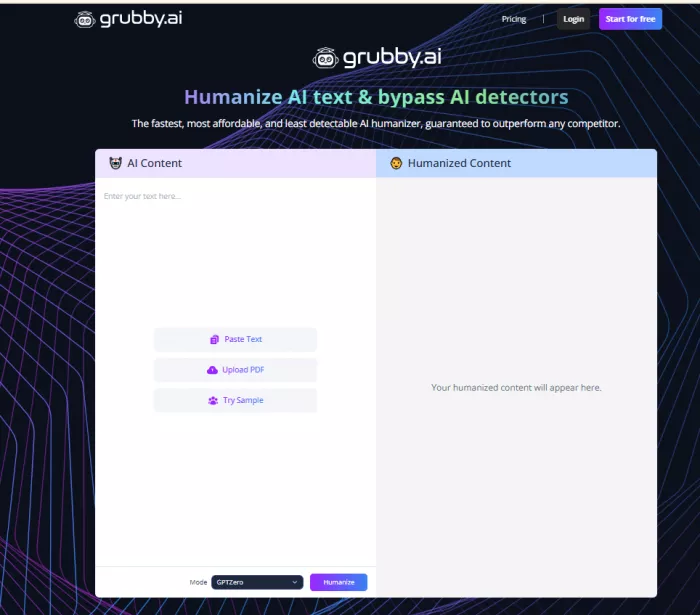
Grubby AI is easy to understand. You paste your AI-generated text into the tool, run the humanizer, and get a rewritten version back. There is no complicated setup or long workflow.
That simplicity is one of its strengths. The tool does not try to be a full writing platform. It does not ask you to build outlines, choose complex templates, or manage documents. It focuses on rewriting.
But that also means its limits are clear. Grubby AI does not add research, verify facts, improve weak arguments, or make generic writing more useful. It only changes the language. If the original draft is thin, the humanized version will still be thin.
In my test, Grubby AI did make the paragraph sound less mechanical. The rewritten version had more variation in rhythm and fewer obvious AI-style transitions. But it also introduced a few lines that felt slightly over-reworked. That is where human editing still mattered.
1. Originality.ai Result
Originality.ai was the toughest detector in my test. The original AI-generated sample was flagged strongly, which was expected. After I ran the text through Grubby AI, the result improved only slightly.
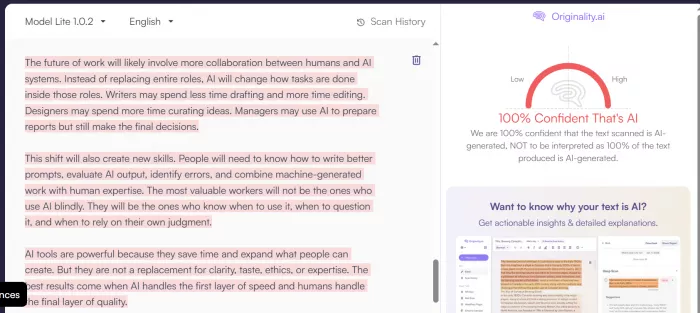
The rewritten version looked different from the original, but Originality.ai still treated it as suspicious. This suggests that Grubby AI changed surface wording, but not enough of the deeper structure for this detector.
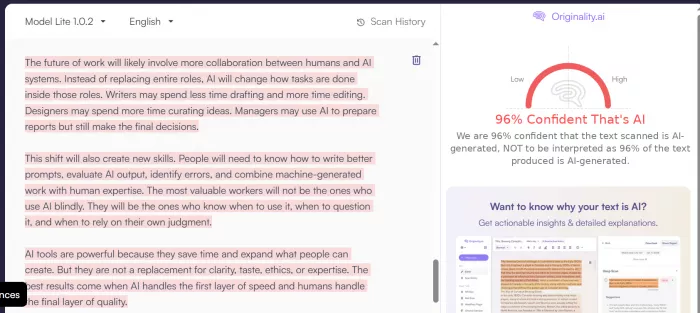
That matters because Originality.ai is commonly used by publishers, editors, and SEO teams. If a tool cannot reliably pass stricter detectors, users should not treat it as a complete detection solution.
| Originality.ai Test | My Finding |
| Original AI sample | Strongly flagged as AI-written |
| After Grubby AI | Still looked suspicious to the detector |
| Quality note | Wording changed, but structure remained too controlled |
| My verdict | Weakest result in the test |
My takeaway from Originality.ai was clear: Grubby AI may make the text less robotic to a human reader, but that does not mean every detector will accept it as human-written.
2. GPTZero Result
GPTZero showed a more balanced result. The original AI sample was flagged as AI-generated, but the Grubby AI version moved closer to a mixed or human-assisted result.
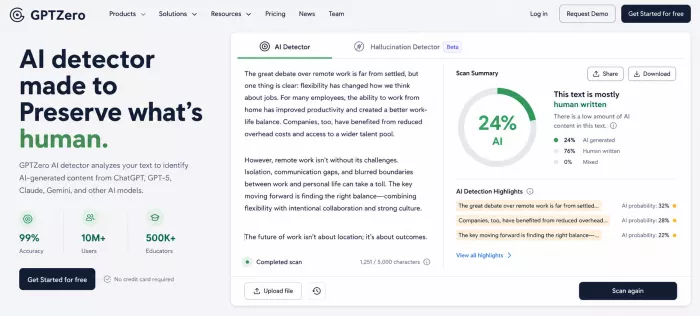
This was a better outcome than Originality.ai, but it was not a perfect pass. GPTZero seemed to respond positively to some of the rewritten sentence variety, but it still picked up parts of the text that felt too AI-shaped.
This matched my reading experience. The humanized version sounded better in some places, but not completely natural throughout. Some phrases felt changed for detection rather than clarity.
| GPTZero Test | My Finding |
| Original AI sample | Flagged as likely AI |
| After Grubby AI | Improved, but not fully clean |
| Quality note | Better sentence rhythm, but uneven phrasing |
| My verdict | Partial improvement |
GPTZero was where Grubby AI felt useful, but not fully reliable. It showed that the tool can reduce AI signals, but users still need to check the final text carefully.
3. Copyleaks Result
Copyleaks landed somewhere in the middle. The Grubby AI version performed better than the original AI sample, but it did not feel like a fully clean result.
This detector seemed to notice that some parts of the text were still too structured. The rewrite changed enough wording to improve the result, but the paragraph still carried a controlled AI-style flow.
From a writing perspective, this was also where I noticed the biggest trade-off. The text sounded less robotic, but a few sentences became less direct. That is not a small issue. A humanizer should not make readers work harder just to make a detector less suspicious.
| Copyleaks Test | My Finding |
| Original AI sample | AI content detected |
| After Grubby AI | Improved, but not fully convincing |
| Quality note | Some phrases needed cleanup |
| My verdict | Useful, but still needs editing |
Copyleaks confirmed the main pattern. Grubby AI can improve detection results, but it does not remove the need for manual review.
Detector Performance Summary
The test did not produce one simple answer. Grubby AI worked better on some detectors than others.
| Detector | Result After Humanization | Review Note |
| Originality.ai | Still suspicious | Toughest result |
| GPTZero | Improved but mixed | Helpful, not perfect |
| Copyleaks | Moderate improvement | Better, but still cautious |
This is the most important finding. Grubby AI can reduce AI-detection signals, especially on tools that respond strongly to surface-level rewriting. But stricter detectors may still identify the text as AI-assisted.
That means the tool is useful, but not guaranteed.
Reading the Output Closely
After the detector tests, I focused on the writing itself. This part is important because a lower AI score does not automatically mean better content.
The Grubby AI version was more varied than the original. It did not follow the same smooth AI rhythm, and some sentences felt more natural. The tool did reduce the overly polished tone that often makes AI writing easy to spot.
But the rewrite also had problems. A few sentences sounded slightly forced. Some wording felt less direct than the original. In places, it seemed like the tool was trying hard to avoid AI patterns instead of simply making the sentence better.
That is the biggest weakness of Grubby AI. It changes the writing, but it does not always improve the writing.
Before and After Quality
The original AI paragraph was clean but flat. It made sense, but it felt predictable. The Grubby AI version had more movement and a more natural rhythm, but it still needed editing.
| Quality Area | Original AI Text | Grubby AI Output |
| Tone | Polished and robotic | More natural but uneven |
| Sentence flow | Predictable | More varied |
| Clarity | Clear but generic | Mostly clear, with a few awkward lines |
| Meaning | Easy to follow | Mostly preserved |
| Editing required | Yes | Still yes |
This is where users should keep expectations realistic. Grubby AI can help improve the surface of AI writing, but it does not create a polished final draft by itself.
Pricing and Value
Grubby AI offers a very limited free allowance. Its pricing page lists 150 free words per month, which is enough to test a short sample but not enough for serious use. The paid plans are based on monthly word limits, with options for light, regular, and heavy users.
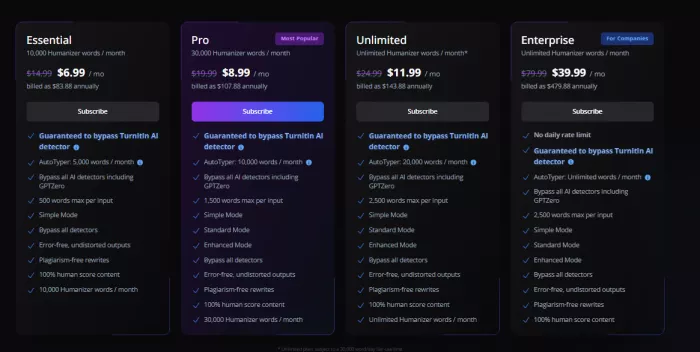
The value depends on how much time the tool saves. If the output only needs a light edit, the paid plan may make sense. If every rewrite needs heavy cleanup, the tool becomes less useful.
Before paying, I would test Grubby AI with your own real content. Do not test it with a random paragraph. Use the kind of text you actually plan to humanize.
What Real Users Say
Public feedback for Grubby AI is mixed. Some users say it saves time, improves AI-written drafts, and helps with detector results.
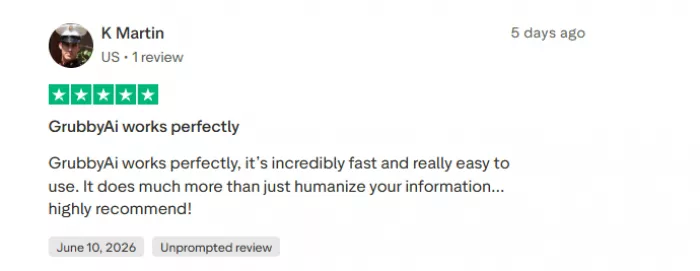
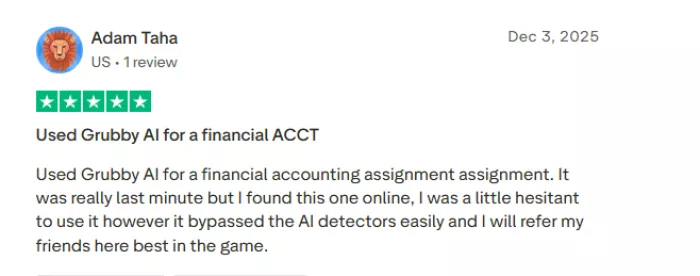
Others complain that the text still gets flagged, the rewrites can sound awkward, or support and billing are frustrating.
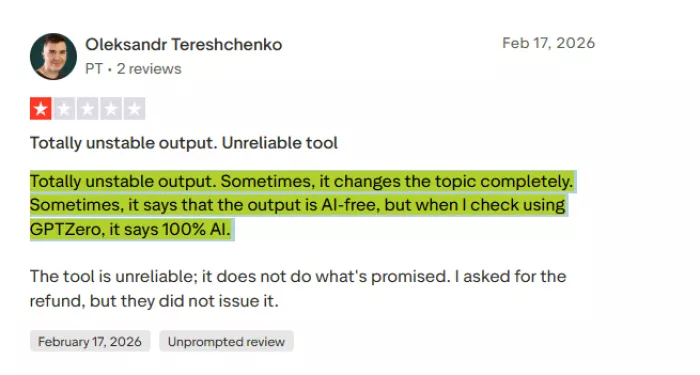
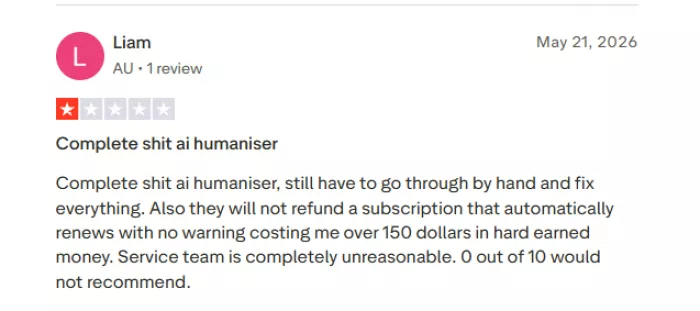
That mixed pattern matches my test. Grubby AI can produce useful results, but it is not consistent enough to trust blindly.
The positive reviews make sense because the tool is quick and simple. The negative reviews also make sense because the output is not always strong, and the detector results can vary.
For a humanizer tool, that split matters. Users are often buying confidence, not just rewriting. If the confidence is inconsistent, the tool should be used carefully.
Best Use Cases
Grubby AI is most useful when the draft already has a clear point and only needs a more natural tone. It works better as a final rewriting layer than a full writing solution.
It is best for:
● short AI-written paragraphs
● emails that sound too formal
● blog sections that feel robotic
● simple essay drafts that need tone cleanup
● product descriptions that need more natural wording
● testing how humanized text behaves across detectors
The tool is less useful when the draft needs research, stronger logic, original examples, or better structure.
Where It Falls Short
Grubby AI does not fix weak content. If the original paragraph has no real insight, the rewrite will still have no real insight. If the facts are wrong, Grubby AI will not correct them. If the article lacks structure, the humanizer will not rebuild it.
That is why the tool should not be used as a shortcut for publish-ready writing. It can make AI text sound less mechanical, but it cannot replace expertise, editing, or fact-checking.
It also should not be treated as a guaranteed detector bypass. My test showed clear improvement on some detectors, but not all of them.
Students, Bloggers and Marketers
For students, Grubby AI may help rephrase notes or clean up AI-assisted drafts, but using it to hide AI-written assignments can violate academic rules. The safer use case is tone improvement, not misconduct.
For bloggers, it can help reduce robotic AI phrasing in short sections. But it will not make an article helpful by itself. SEO content still needs accurate information, original value, and clear structure.
For marketers, Grubby AI can be useful for quick copy cleanup. AI-generated outreach emails, captions, and landing page sections often sound too polished. The tool can make them feel more natural, but the final copy still needs brand editing.
Pros and Cons
| Pros | Cons |
| Simple and fast to use | Free plan is very limited |
| Improves detector results on some tools | Does not bypass every detector |
| Makes AI text less robotic | Output can still sound awkward |
| Useful for short drafts and quick cleanup | Does not add research or depth |
| Helps with sentence variation | Final text still needs editing |
| Easy workflow for casual users | Not reliable enough for blind use |
Final Personal Scorecard
| Category | Score | Review Note |
| Ease of Use | 8/10 | Simple paste-and-humanize workflow. |
| Humanization Quality | 7/10 | Makes AI text less robotic, but still needs editing. |
| Detector Performance | 6.5/10 | Improves some scores, but does not pass every checker. |
| Readability | 6.5/10 | Better flow in places, with a few awkward lines. |
| Pricing Value | 6/10 | Free plan is limited; paid plans suit regular users. |
| Trust Factor | 5.5/10 | Public feedback is mixed. |
Overall Score: 6.7/10
Grubby AI is useful for quick AI text cleanup, but it is not a guaranteed AI detector bypass tool. It works best for short drafts, emails, and casual rewriting where the final output will still be reviewed by a human.
Final Verdict
Grubby AI is a useful AI humanizer, but it is not a guaranteed solution. In my test, it made AI-written text sound less robotic and improved results on some detectors. However, GPTZero and Copyleaks showed only partial improvement, while Originality.ai still treated the output as suspicious.
The rewritten text was more natural than the original AI draft, but it still needed manual editing. Some lines improved, while others felt slightly awkward or less direct.
Grubby AI works best for short drafts, emails, casual rewriting, and blog sections where the goal is to reduce robotic AI tone. It should not be trusted blindly for academic work, professional publishing, or content where accuracy and originality matter.


Comments