
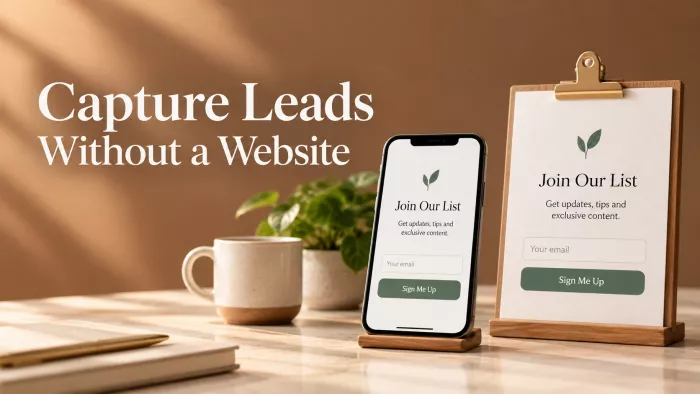
THE SHORT VERSION A website is one place to collect contacts, not the reason to collect them. With a strong offer, a hosted form or link page, and somewhere to store what comes in, a real email list can grow from Instagram, a market stall, or a podcast with no homepage involved. The trick is treating capture as a chain, and never leaving a link weak. |
The premise is usually backwards
Most guides on collecting leads open with the same instruction: first, build a website. For a lot of people, that order is upside down. The site is plumbing. It is one surface where contacts can be caught, not the thing that catches them.
Meanwhile, plenty of people already have an audience and no site at all. A coach with an engaged Instagram. A baker with a WhatsApp group of regulars. A freelancer whose best work comes from a LinkedIn following. What they are missing is not a homepage. It is a way to turn that attention into a list they actually control.
This guide lays out that system from start to finish: the offer that earns an email, the tools that hold the form, the channels that feed it, and the follow-up that keeps it warm.
Why skipping the website can be a strength
Going without a site removes the two things that stall most people before they start: cost and setup time. A capture page built inside a form tool can be live the same afternoon. No hosting bill, no theme to wrangle, nothing to keep patched.
There is a quieter benefit as well. With no site to hide behind, attention lands on the parts that genuinely decide success the offer, and the place where people already gather. That is usually where the real work is anyway.
The deeper reason to bother comes down to a single distinction worth sitting with.
| Followers are rented. An email address, given with permission, is owned. |
A follower count lives on someone else's server, shaped by someone else's algorithm and terms. Reach can be throttled overnight with no warning. An email list behaves differently: it is a direct line that no feed change can quietly switch off. Collecting emails is how a rented following slowly turns into an audience that belongs to the person who built it. A focused lead-generation bio link can make that shift happen before a full website is even part of the setup.
The anatomy of lead capture
Every capture setup, whether it is a scrappy Google Form or a paid funnel, runs on the same five parts. Naming them upfront makes the rest of this guide easier to read, because each tactic later is just a different way of filling one slot.
Traffic → Offer → Capture → Storage → Follow-up
• Traffic is the flow of attention to the people already watching, listening, or walking past a stall.
• Offer is the reason someone hands over an address instead of scrolling on.
• Capture is the mechanism that records the contact: a form, a lead-ad, a keyword reply in the DMs.
• Storage is where those contacts land and stay organised, rather than scattering across screenshots and inboxes.
• Follow-up is what happens next, and it is the part most people forget to plan.
A weak link anywhere breaks the chain. Strong traffic pointed at a dull offer collects nothing. A brilliant offer with no follow-up collects addresses that go cold within a week. The point of the framework is simple: when results are thin, the fix is almost always one specific link, not the whole machine.
The offer comes first

The most common mistake is shopping for tools before deciding what to give people. Tools are easy to swap. The offer is the hard, valuable part, and it is where the thinking belongs.
An email address carries an invisible price. It costs a moment of attention plus the low-grade dread of one more sender in an already crowded inbox. People pay it only when the thing on the other side is clearly worth more than that. This is the whole game a fair trade, tilted slightly in the reader's favour.
| Lead magnet | Suits | Why it earns the email |
| Checklist or template | Practical, task-focused audiences | Saves real time on something they were going to do anyway |
| Mini-course by email | Skills, coaching, education | Delivers value across days, so the list warms up on its own |
| Discount or first-order perk | Products, local shops, makers | Turns a browser into a buyer with a concrete nudge |
| Free audit or teardown | High-ticket services, consultants | Shows expertise directly and starts a real conversation |
| Waitlist or early access | Launches, drops, communities | Trades on curiosity and the fear of missing the good stuff |
A quick test cuts through the guesswork: would anyone pay even a small amount for this thing? A genuinely useful pricing template passes. A vague “sign up for updates” almost never does, because nobody wakes up wanting more updates. The stronger the standalone value, the less persuading the form has to do.
WATCH OUT “Subscribe to my newsletter” is not an offer, it is a request for a favour. Give the first issue a name and a promise (“The 5-email teardown of what actually converts”), and the same list grows several times faster. |
The website-free toolkit
The tools split cleanly into four categories. Reading them as a system, rather than a shopping list, makes the choice obvious: pick one link surface, one place to store contacts, and stop there until it is working.
| Category | Examples | Best for | Holds your list? |
| Link-in-bio / micro pages | Carrd, Beacons, Linktree | A tidy home for a bio link | Only if it captures, not just redirects |
| Form & survey builders | Tally, Typeform, Google Forms | Fast, flexible sign-up forms | Yes export or connect onward |
| Email platforms + pages | Kit, MailerLite, Beehiiv | Capture and follow-up in one | Yes this is the home base |
| Native platform lead forms | Meta Lead Ads, LinkedIn | Paid capture, no click-away | Yes, but export regularly |
There is one trap worth flagging. A plain Linktree that only bounces visitors to other apps collects nothing on its own; it is a signpost, not a net. The version that matters has an actual email field wired to a list. Same product, very different outcome. A stronger link-in-bio landing page keeps the main action clear instead of making visitors choose between too many competing buttons.
For most people starting out, the cleanest setup is an email platform (which doubles as both the hosted form and the follow-up engine) plus a link-in-bio page pointing at it. Two tools, both free to begin, and the whole chain from the previous section is covered.
PRO TIP Choose the email platform first, then let it host the sign-up page. Starting with a separate form builder often means migrating contacts later extra work a beginner does not need. |
A playbook for each channel
The offer and the tool stay the same across platforms. What changes is how the invitation gets made, because each channel has its own grain. Working with that grain instead of forcing a generic “link in bio” everywhere is what lifts conversion.
Instagram and TikTok
The bio link is the obvious route, but the higher-converting move is comment-to-DM: a post invites people to comment a keyword, and an automation replies privately with the offer link. It feels personal, it keeps the action inside the app, and it sidesteps the “links kill reach” problem.
Native lead-gen forms pull a person's details in with a single tap, which removes almost all friction. Outside of ads, a LinkedIn newsletter or a strong call to action at the end of a post does steady, unglamorous work over time.
YouTube
Description links get clicked far less than creators hope, so the spoken ask matters more. A clear verbal prompt (“the free checklist is linked below”) paired with a pinned comment and an end screen tends to outperform a buried URL every time.
Newsletters and long-form platforms
On Substack, Beehiiv, or Medium, the subscribe button is the capture publishing on these is list-building by default. The catch is portability: exporting subscribers on a regular schedule keeps the list owned rather than locked in.
Podcasts
Audio has no clickable link, so a memorable spoken destination does the heavy lifting. A short, easy-to-spell URL or a single keyword (“text HOOK to sign up”) repeated a couple of times per episode converts far better than a long address nobody can remember.
Let the capture run while you sleep
Manual capture caps out fast. Automation is what lets a single post keep collecting contacts for weeks after it is published, with no one at the keyboard.
• Comment-to-DM tools such as ManyChat watch for a keyword, then send the offer link privately and instantly the workhorse of Instagram capture in 2026.
• Keyword and auto-reply triggers turn a routine caption into a repeatable funnel: one setup, endless runs.
• QR codes bridge the physical world to the digital one, carrying someone from a flyer, a product tag, or a market table straight to a sign-up form.
A working flow reads simply: someone comments the keyword, the tool detects it, a DM goes out with the link, and the address lands in the email platform tagged by source. Once that loop is built once, it runs on its own the closest thing lead capture has to passive income.
Offline and hybrid capture
This is the part most digital guides skip, which is exactly why it is worth including. A great deal of real audience-building still happens face to face, and those moments convert unusually well because trust is already in the room.
• Events, workshops, and pop-ups put warm, interested people in one place a printed QR code on the table turns that interest into a list before they leave.
• Business cards and flyers earn their keep when they carry a keyword or short link, not just a phone number that gets lost in a wallet.
• WhatsApp Business and Telegram work as both capture and nurture: a broadcast channel is, in effect, a list that people opt into and read at near-total open rates.
The hybrid version is the strongest of all to meet people offline, then move the relationship somewhere it can be nurtured at scale. The market stall builds the trust; the email list keeps it alive between visits.
Where the leads actually go
Capturing contacts is only half the job. The other half is making sure they land somewhere usable, because a lead sitting unnoticed in a DM thread is, for practical purposes, a lead lost.
The failure mode is predictable. Emails end up spread across screenshots, comment sections, a notes app, and three different inboxes. When it comes time to actually send something, there is no single list to send it to just fragments nobody can reach.
The fix is to centralise from day one. An email platform is the natural home; a lightweight CRM works for service businesses; even a spreadsheet connected by an automation tool like Zapier or Make is a fine place to start. What matters is that every source funnels into one destination, and that contacts get tagged by where they came from as they arrive. That tag is what makes later segmenting possible talking to the podcast crowd differently from the market-stall regulars.
PRO TIP Tag on entry, not later. Adding a source label the moment a contact is captured costs nothing; reconstructing it across a thousand names months on is close to impossible. |
The trust and consent layer
Collecting emails comes with real rules, and they are worth understanding in plain terms rather than fearing. In most regions, some form of clear consent is required the person has to knowingly agree to hear from the sender, and has to be able to leave easily.
Two ideas cover most of it. Double opt-in means a new subscriber confirms via a quick email before joining, which keeps the list clean and the sending reputation healthy. Frameworks like GDPR in Europe and CAN-SPAM in the US come down to a few sensible habits: be honest about what people signed up for, include a real way to unsubscribe, and never buy or scrape addresses.
It helps to see consent as more than a legal box. Transparency tends to lift conversion, not lower it. When the offer is specific and the promise is clear what will arrive, how often, and how to stop more people sign up, not fewer, because the exchange feels fair.
| Trust is not a compliance cost. It is a conversion lever most people never pull. |
From capture to conversion
A captured email does nothing on its own. Value only appears when a relationship follows, and the first few days after sign-up are where that relationship is won or quietly lost.
A simple welcome sequence handles it. The first email delivers exactly what was promised, on time, with no hoops. The next one or two build a little familiarity, a useful idea, a short story, a reason to keep opening. Only after that does a soft offer make sense, once some goodwill exists to spend.
The reframe worth holding onto: capture is the opening line of a conversation, not the finish line of a campaign. Lists treated as relationships stay engaged. Lists that only ever receive sales pitches decay into dead weight, and no amount of clever capture fixes a list nobody wants to open.
Measuring what matters

A handful of numbers reveal whether the whole chain is healthy, and which link needs attention. Watching these is far more useful than watching raw follower counts, which flatter the ego and predict very little.
| Metric | What it tells you |
| Conversion rate | Share of visitors who actually sign up the health of the offer and the form |
| Cost per lead | What each new contact costs, in money or effort matters most with paid traffic |
| List growth rate | Whether the audience is compounding or stalling month to month |
| Open and click rate | Whether the list is warm and paying attention, or drifting off |
| Lead quality | Whether the people joining are the ones who eventually buy |
One trade-off deserves special attention, because it catches almost everyone. Shortening a form dropping from five fields to just an email reliably increases sign-ups. It can also lower the quality of who signs up, since a frictionless door lets in the merely curious alongside the genuinely interested.
There is no universal right answer. A high-volume newsletter wants the friction low; a consultant selling a premium service may want an extra qualifying question precisely to filter. Testing one variable at a time the headline, the field count, the button wording is how the right balance gets found rather than guessed.
The mistakes that quietly cost the most
• Chasing tools before the offer. Weeks disappear comparing form builders while the actual reason to sign up stays vague. The offer is the bottleneck almost every time.
• Collecting with no plan to follow up. Addresses gathered and then ignored go cold fast, and a cold list is harder to revive than a small warm one is to grow.
• Ignoring consent. Skipping permission risks the sending reputation and the trust of the exact people the list is meant to serve.
• Betting everything on one platform. An audience that lives entirely inside a single app is one rule change away from vanishing. Extracting emails is the insurance policy.
When a website actually earns its place
It would be dishonest to pretend a site never matters. The no-website approach is a superb way to start and to validate but there are clear signals that it is time to graduate.
A website starts pulling its weight once search traffic becomes worth owning, once funnels grow complex enough to need custom pages, or once credibility with larger clients depends on having a proper home online. At real scale, the control and flexibility of a site outrun what hosted pages can offer.
The honest framing is this: going without a website is a brilliant beginning, not a permanent ceiling. The endgame is still to own the platform outright. Capturing emails first simply means that by the time the site arrives, there is already an audience waiting to visit it.
ConclusionA homepage was never the point. The point is a fair offer, a place to capture, somewhere to store what comes in, and a genuine follow-up of the same chain whether it runs through a link in a bio or a stall at a weekend market. Every tool in this guide is just a way to fill one of those slots. The most valuable move is also the smallest: pick one offer worth signing up for, wire it to one email platform, and point one channel at it this week. A list of even a hundred owned contacts is worth more than ten thousand followers on rented land and it starts the day the first email lands, not the day a website goes live. |


Comments