The Story of Unoaku Anyadike: From National Pageant Winner to Corporate Strategy

Sakshi Purna

Unoaku Anyadike entered Nigeria’s national consciousness under the bright lights of a beauty-pageant stage. In October 2015, the psychology student representing Anambra State was crowned Most Beautiful Girl in Nigeria. The title took her from university life to Miss World in China, Miss Universe in the Philippines and two years of public appearances.
The crown, however, is only the opening chapter of her adult life. Anyadike later moved into banking, brand campaigns, partnerships and professional leadership. Her journey is not about rejecting pageantry, but refusing to remain confined by it. The stage gave her visibility; the career that followed required long-term discipline, institutional trust and repeated delivery.
| Career stage | Key development |
| Education | Studied Psychology at the University of Ibadan and initially planned a career connected to child development. |
| National pageantry | Won Most Beautiful Girl in Nigeria 2015 while representing Anambra State. |
| International stage | Represented Nigeria at Miss World 2015 and Miss Universe 2016. |
| Advocacy | Used her reign to promote endometriosis awareness and medical assessment for severe menstrual pain. |
| Corporate career | Built experience at Guaranty Trust Bank across communications, brand projects, campaigns and partnerships. |
| Industry leadership | Elected ACAMB Treasurer for the 2026–2028 term. |
Before the Crown

Unoaku Temitope Anyadike was born on 16 September 1994 and grew up in Ilé-Ifẹ̀, Osun State. Her father was from Anambra State, while her mother was Yoruba and from Ilé-Ifẹ̀. That background later became part of her public identity when she represented Anambra at MBGN while speaking warmly about the South-Western city where she had been raised.
Education was central in her household. In an interview after her MBGN victory, she said her father taught Literature in English at Obafemi Awolowo University and her mother owned a school in Ilé-Ifẹ̀. She described herself as the youngest of five daughters and credited her older sisters, including one with modelling experience, for encouraging her pageant ambitions.
Anyadike attended Queen’s College in Yaba, Lagos, before studying Psychology at the University of Ibadan. By the time she won MBGN, she was in her final year and discussing postgraduate study in child and developmental psychology. Her official Miss World profile also noted three years of work with the Ace5 Initiative, which supported children from disadvantaged homes.
This background prevents her biography from becoming a simple account of gowns and competitions. Psychology, education and children’s welfare were already part of how she imagined her future. Pageantry enlarged her platform, but it did not create her first serious ambitions.
Learning the Pageant Craft
The MBGN win can look sudden when reduced to a coronation photograph. Anyadike’s own account shows a gradual progression. She entered a secondary-school competition called Miss Scrupple and finished as second runner-up. At the University of Ibadan, she competed in Miss U.I. and became first runner-up. She also participated in the 2014 MBGN process before returning the following year.
Those earlier results gave her a useful ladder: second runner-up, first runner-up and finally national winner. More importantly, they exposed her repeatedly to judging, public speaking, presentation and the pressure of comparison. By 2015, she already understood that confidence on stage had to be supported by preparation.
She described that preparation without drama. She read, prayed, exercised, watched what she ate and studied how to carry herself. She also credited the humility and self-belief encouraged by her family. Her persistence is one of the least discussed parts of her story. The national title arrived only after she had experienced smaller competitions, missed the main crown and returned better prepared.
The National Breakthrough
On 24 October 2015, the MBGN final took place at the Calabar International Convention Centre in Cross River State. Anyadike, then 21, competed as Miss Anambra. She reached the final five and won the MBGN World title ahead of contestants representing Ebonyi, Abuja, Bauchi and Edo.
The victory brought national attention, but the role demanded more than looking composed during a televised final. MBGN World became Nigeria’s representative to Miss World. Anyadike had to move quickly from student routines into interviews, fittings, travel preparation, official appearances and advocacy work while completing her degree.
Her response to the result captured both confidence and surprise. She said she had imagined reaching that point, yet still described hearing her name as an experience that was difficult to explain. That balance suited a role in which a contestant had to believe she could win without acting as though the result was guaranteed.
The scale of representation also changed. Earlier pageants had assessed her as an individual contestant. MBGN made her the face of an organisation and, internationally, a country. Her communication, conduct and preparation became part of the image Nigeria presented to a global audience.
Representing Nigeria
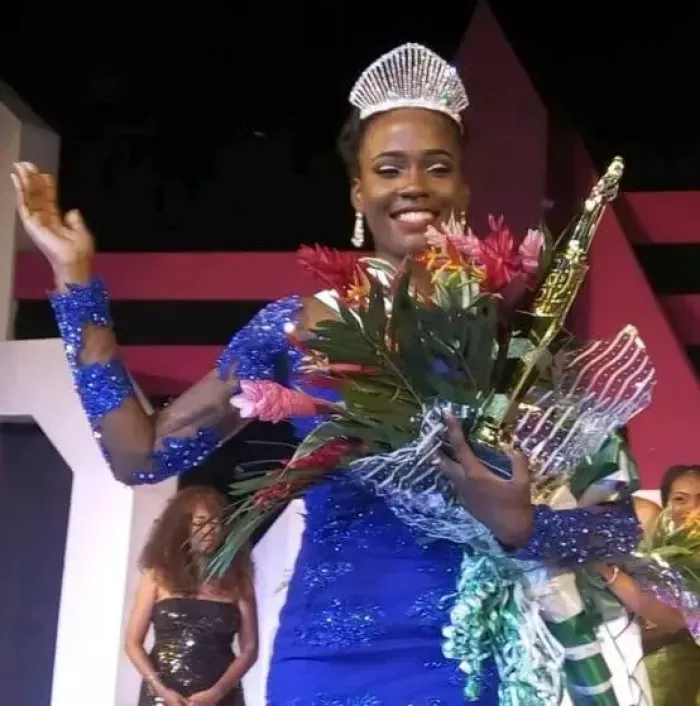
Anyadike represented Nigeria at Miss World 2015 in Sanya, China. Her official profile listed her at 183 centimetres tall, speaking English and Yoruba, and completing a Psychology degree at the University of Ibadan. It also highlighted her ambition to work in child developmental psychology and her volunteer experience with children.
She did not place among the final winners, but the value of the experience cannot be measured only through the result. Miss World placed her inside an international production involving contestants from different cultures, extensive media attention and formal competition categories. It required her to explain Nigerian identity while every other delegate was presenting her own country.
Anyadike later represented Nigeria at the 2016 Miss Universe competition, whose activities and final were held in the Philippines in January 2017. She arrived in Manila as a 22-year-old psychology graduate completing Nigeria’s National Youth Service at the Federal Inland Revenue Service. The competition gathered 86 contestants and concluded at the Mall of Asia Arena.
She again finished outside the final placement group, yet later called Miss World and Miss Universe high points of her reign. The Philippines experience stood out particularly strongly. She credited MBGN with giving her the chance to travel, build relationships and represent Nigeria in spaces she would not otherwise have entered.
International pageantry also developed a practical set of abilities. Representing a country involves message discipline, protocol, schedule management and composure under constant observation. These skills could not replace corporate training, but they would later prove relevant to communications, events and partnership work.
Advocacy With Purpose
Anyadike chose endometriosis awareness as a central cause during her reign. The issue was connected to her experience of severe menstrual pain and the concern that she might have the condition. In her 2015 interview, however, she explained that a medical check-up found her symptoms were not caused by endometriosis. That distinction matters because some later profiles have written about her as though a diagnosis had been publicly confirmed.
Her response was to focus on awareness rather than make herself the centre of the campaign. She wanted girls, including secondary-school students, to understand that extreme menstrual pain should not automatically be dismissed and that medical assessment matters. She discussed returning to Queen’s College and visiting other schools to speak with students. Media coverage immediately after her win also reported her intention to devote her reign to the subject.
The campaign was more useful than a broad promise to empower women because it had a defined audience and practical message. It also fitted a wider pattern in her interests. Across interviews, she repeatedly returned to young people, education, counselling and early intervention. Her public causes were strongest when they focused on information that could help someone act before a problem became more serious.
Beyond the Pageant Stage
Anyadike’s MBGN tenure lasted about two years, longer than the usual annual reign. In August 2017, The Sun described her as the only MBGN winner at that time to have held the crown for two years. She handed the title to Ugochi Ihezue during the pageant’s 30th-anniversary edition in September.
The end of a pageant reign can create an identity problem. A winner has spent months being introduced through a title, then suddenly becomes a former queen while public attention moves to her successor. Anyadike did not attempt to preserve the same level of celebrity through constant entertainment work. She began moving into formal employment.
She completed national service at the Federal Inland Revenue Service and said in a 2017 interview that she was working there after NYSC. Third-party employment records place her FIRS period before her banking career, although their exact job titles should be treated as provisional rather than official.
This transition changed the nature of her work. Pageantry centred on individual visibility. Institutional employment required her to contribute to a team and represent an employer rather than herself. Her public profile became quieter, but that did not mean her ambitions had reduced. They had moved into an environment where progress was measured through responsibility and delivery.
Building a Banking Career
Anyadike joined Guaranty Trust Bank in 2018, according to public employment records. They describe an executive-trainee position followed by experience in communications, external affairs and corporate social responsibility, then work in brand-extension marketing and projects. Her current professional profile identifies her with GTBank and describes her focus as brand campaigns and global partnerships.
The progression matters more than any single title. An executive-trainee route suggests entry through a structured corporate process rather than a role built around her celebrity. Communications and external affairs require an understanding of reputation, audiences and stakeholder expectations. Corporate social responsibility adds community engagement and project coordination.
Brand and project work is often misunderstood because audiences see only the finished campaign. Behind it sit budgets, suppliers, schedules, approvals, events and senior stakeholders. Partnership work adds negotiation and the need to align two organisations around a shared objective. Anyadike’s LinkedIn profile points to programme management, large-scale event planning, C-suite administration and strategy execution, suggesting a role built as much around organisation as public presentation.
There is continuity between this work and her earlier public life, but the connection should not be exaggerated. Pageantry gave her experience in representation, media and events. It did not give her technical banking knowledge or guarantee promotion. She still had to enter a formal system, learn its expectations and build a record over several years.
The shift also changed where she stood in relation to a brand. During MBGN, she was the visible representative. In banking communications, she increasingly worked behind institutional campaigns and partnerships. The setting changed, yet the core questions of message, audience, image and execution remained.
Returning to Business School
Anyadike’s early plans included postgraduate education, although her career moved away from child psychology. Her professional profile now lists Imperial College Business School and describes her as an MBA candidate, with the study period shown as 2025 to 2026. The programme reconnects her biography with the academic ambition she discussed during her pageant year, now directed towards corporate leadership.
This change does not make her Psychology degree irrelevant. Brand work depends on understanding behaviour, motivation, attention and group dynamics. Partnerships depend on trust, while leadership requires an awareness of how people respond to expectations and change.
The MBA adds formal business training to years of practical experience. It can strengthen knowledge of finance, strategy, leadership and organisational decision-making. Public information available in July 2026 still describes her as a candidate, so the qualification should be presented as ongoing unless she confirms that it has been completed.
An Industry Leadership Role
A clear marker of Anyadike’s professional standing arrived in January 2026, when she was elected Treasurer of the Association of Corporate Communication and Marketing Professionals in Banks, known as ACAMB, for the 2026–2028 term. The new council included representatives from the Bank of Industry, FirstBank, Wema Bank, UBA, Polaris Bank, Jaiz Bank, Parallex Bank and Zenith Bank.
The appointment matters because it reflects recognition from a specialised professional community. ACAMB brings together people responsible for how banks communicate, market themselves and manage institutional reputation. Her pageant past may be widely known, but it was not the qualification being assessed when members chose their executive officers.
As Treasurer, Anyadike holds a role associated with trust, governance and the administration of the organisation’s affairs. It would be inaccurate to present the position as making her one of Nigeria’s most senior banking executives. It does, however, support the description of a growing corporate leader whose peers have entrusted her with responsibility beyond her employer.
The appointment also marks a shift from private career progression to professional-community leadership. The crown introduced her to a broad national audience. ACAMB represents credibility among a smaller audience that directly understands the demands of her work.
Skills That Crossed Over
A beauty title does not provide corporate expertise, but Anyadike’s pageant years offered several experiences that could be carried into her later work:
● Public representation became institutional representation. Speaking on behalf of Nigeria required care around conduct and messaging, while corporate communications demands similar discipline on behalf of an employer.
● Complex pageant schedules built familiarity with events. International competitions involve rehearsals, travel, appearances and strict timelines, experience that can support large brand activations.
● Advocacy required a clear message and audience. Her endometriosis work became meaningful when it focused on what schoolgirls should understand and why medical checks mattered.
● Competition developed comfort with scrutiny. Corporate projects are assessed by managers, partners and audiences rather than judges, but feedback still has to be handled without losing composure.
These links explain the flow of her career without claiming that one field automatically led to the other. The transferable skills were useful, but her corporate credibility depended on what she did after entering the workplace.
Public Life and Privacy
Anyadike remained connected to fashion through selected shoots and appearances, but entertainment did not become the centre of her professional life. Her visibility gradually became more controlled, with occasional public milestones replacing the constant attention of her reign.
In December 2022, Nigerian lifestyle publications covered her traditional and white-wedding celebrations under the hashtag #UnAdulterated. Much of the coverage focused on her bridal fashion. Beyond the celebrations, she has kept her marriage and wider family life away from detailed public discussion.
That privacy should be respected. There is no reliable public basis for estimating her wealth, salary or private family arrangements. The absence of constant celebrity coverage should not be treated as evidence that she withdrew from public life. Her available professional record points instead to a deliberate shift towards work, education and industry participation.
Beyond the Crown
Unoaku Anyadike first became widely recognised through pageantry, but the years that followed gave her public story greater depth. After representing Nigeria at Miss World and Miss Universe, she moved into structured corporate work, building experience in communications, brand campaigns, partnerships and project execution.
Her election as Treasurer of ACAMB reflects the professional trust she has developed within Nigeria’s banking communications community. It also shows how her identity has expanded beyond the title that originally introduced her to the public.
The crown gave Anyadike visibility, international exposure and a national platform. Her later career required a different kind of progress, built through workplace experience, continued education and growing professional responsibility. Her story is ultimately not about leaving pageantry behind, but about ensuring that one celebrated achievement did not become the limit of her public identity.


Comments