
You set up your Campsite.bio page a couple of years ago, dropped the link in your Instagram bio, and it quietly did its job. Then something shifted. Maybe your audience grew and the basic click count stopped telling you anything useful. Maybe you started selling a digital product and realized your bio page couldn't take a payment. Or maybe you simply looked at the $7 a month leaving your account and asked whether you were getting your money's worth.
If any of that sounds familiar, you're not alone. The link-in-bio category has changed more in the past eighteen months than in the five years before it. Tools that used to be glorified link lists now run full storefronts, send email campaigns, and even hand you retargeting pixels. Others have doubled down on doing one thing beautifully. Campsite.bio is still a capable tool, but "capable" is a lower bar than it used to be.
This guide breaks down the seven strongest Campsite.bio alternatives for 2026, with real pricing, honest trade-offs, and a clear sense of who each one actually fits. Every price here was checked against the providers' own pages during 2026, though these tools change their plans often, so treat the numbers as a strong starting point rather than gospel. Let's get into it.
What Is Campsite.bio, Exactly?
Campsite.bio is a link-in-bio platform launched in 2018 and run out of the US. The premise is the same one every tool in this category shares: social apps only let you post one clickable link, so you point that link at a single landing page that holds all your other links, and you send followers there.
Where Campsite.bio carved out its niche was performance and clean design. Its pages load fast, the templates look tidy without much effort, and it leans harder on data than most of its simpler rivals. The free plan gives you unlimited links, a set of themes, and basic click tracking, but it stamps Campsite branding across your page and keeps the useful stuff locked away.
The paid tier is where it earns its reputation. For $7 a month, Pro adds proper analytics, link scheduling for timed promotions, tracking pixels for Meta and Google, an email capture widget, a custom domain, and branding removal. A Pro+ plan at $24 a month layers on more link types and deeper reporting, and there are organization plans built for agencies and brand teams who need multiple people editing one page with role-based permissions. That team-collaboration angle is one of Campsite's more distinctive strengths, since most competitors gate multi-user access behind expensive enterprise tiers.
The catch worth naming upfront: Campsite's email capture depends on you already running Mailchimp, Kit, or Klaviyo, because there's no native list storage of its own. And the page can't process a sale directly, so anyone selling products has to route buyers elsewhere.
Why Creators Are Looking Past Campsite.bio in 2026
The reasons people go hunting for a Campsite.bio alternative tend to cluster around the same handful of frustrations.
The free plan feels like a permanent trial. Unlimited links are nice, but the branding, the thin analytics, and the locked features nudge you toward paying almost immediately. Several rivals now offer a more capable free tier with unlimited links, genuine analytics, and media embeds. That makes Campsite's habit of gating the basics behind $7 a month harder to justify.
There's no real way to sell. This is the big one. Campsite.bio is built to route traffic, not to close a transaction. If you want followers to buy a template, book a coaching call, or grab a digital download without leaving the page, you need a tool built around commerce. Campsite simply isn't that.
Email capture is half a feature. Because it relies on an external provider, the email widget only works if you've already set up and are paying for a separate email service. For a creator who wants list-building baked in, that's friction.
You may want more, or less, than it offers. Some creators have outgrown the format and want an all-in-one platform with a store, a media kit, and email marketing under one roof. Others want the opposite: a dead-simple page that loads instantly and costs nothing. Campsite.bio sits in an awkward middle, doing a bit of everything without excelling at the thing you specifically care about.
None of this makes Campsite.bio a bad tool. It makes it a tool that no longer fits everyone, which is exactly why a shortlist of alternatives is worth having.
How This Comparison Was Made
Every tool below was checked against its official pricing page in 2026 and cross-referenced with current reviews, then judged on the factors that actually change what a creator pays and can do: the real cost on both monthly and annual billing, transaction fees on anything you sell, whether a custom domain is included or costs extra, how much you can customize, and whether the page can take a payment at all. Where a tool had recently changed its pricing or repositioned, and a couple had in the past year, the newer information took priority over older write-ups. Pricing in this space moves fast, so treat each figure here as a checkpoint and confirm it on the official site before you commit.
Campsite.bio Alternatives at a Glance
Before the deep dives, here's the quick version. Skim it to spot the two or three worth reading in full. The columns that matter most are what you'll actually pay, whether you can sell, and what the fees do to your take-home.
| Tool | Free plan | Paid from (monthly / annual) | Custom domain | Sell products? | Transaction fees |
| Beacons | Yes | $10/mo · $100/yr | Yes | Yes — full store | 9% Free/Creator; 0% Plus/Max |
| Linktree | Yes | $8/mo · $6/mo yearly | No | Yes — commerce blocks | Plan-dependent |
| Taplink | Yes | $4/mo Pro · $54/yr Business | Yes (Business) | Yes — digital products | No platform fee |
| Bio.link | Yes | $7.49/mo · 50% off annual | Yes (Pro) | No native store | N/A |
| Lnk.bio | Yes | $0.99/mo · $9.99 lifetime | $29.99/yr add-on | Via outbound links | None |
| Stan Store | No (14-day trial) | $29/mo · $300/yr | No | Yes — full storefront | 0% platform fee |
| Carrd | Yes | $9/yr | Yes, from $19/yr plan | Basic payment integrations | None |
Prices here were verified in 2026 against official pricing pages. This category changes its plans frequently, so confirm the live figure on the official site before you sign up.
1. Beacons:
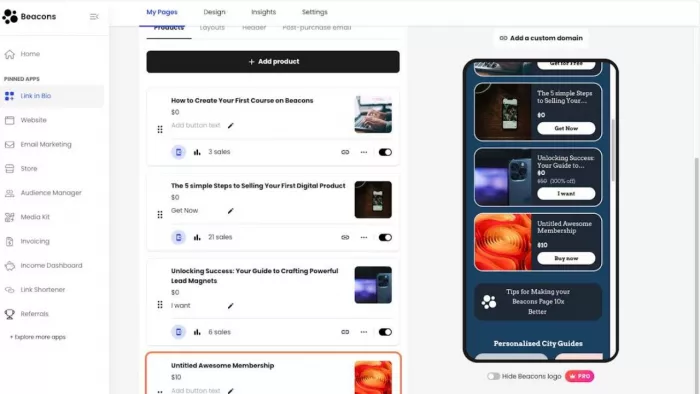
If Campsite.bio left you wanting more, Beacons is the tool that tries to give you everything. It bundles a link-in-bio page, an online store, email marketing, a media kit builder for pitching brands, and an AI assistant it calls Beam, all inside one dashboard. Founded by a team of Stanford graduates and backed by serious venture funding, it's positioned less as a link list and more as an operating system for a creator business. For anyone treating their audience as a customer base rather than a follower count, that ambition lands.
Standout features
- Native online store for digital products, with mobile-first checkout designed to cut cart abandonment
- Built-in email marketing, so list-building and broadcasts live in the same place as your page
- Live API media kits that pull your real stats to streamline brand pitches
- AI setup wizard that can generate a page design from your existing social profiles
Best for: Creators who want to sell, email, and pitch from one platform rather than stitching together several tools.
Pricing: A free plan (with a roughly 9% fee on sales). Creator is $10/month, or $8.33/month billed annually, and still carries the 9% sales fee. Creator Plus is $30/month ($25 annually) and drops the sales fee to 0%. Creator Max is $90/month ($75 annually) with team features. Annual billing works out to roughly two months free.
Pros
- Lets you run the storefront, email list, media kit, and bio page from one dashboard instead of stitching together several creator tools.
- The free tier is genuinely usable for testing an idea before committing to a subscription.
- Particularly strong if your bio link is part of a larger creator-business funnel rather than just a list of destinations.
- The media-kit and brand-deal features make it more useful for creators actively pitching sponsors.
Cons
- The 9% sales cut on the lower tiers can become a noticeable expense surprisingly quickly.
- The dashboard tries to do so much that simple tasks can feel buried under creator-business features.
- The page editor isn't as effortless as simpler link-in-bio builders, especially when you're tweaking a page on mobile.
- Creators who only need links and analytics may end up paying for a lot of functionality they'll never touch.
The math matters here. At roughly $333 in monthly sales, the $30 Creator Plus plan becomes cheaper than paying Beacons' 9% seller fee on the $10 Creator plan, before payment-processing fees. If you're selling consistently above that level, Plus can make financial sense even before you factor in its additional features.
Campsite.bio vs Beacons: Campsite gives you a fast, clean page with marketing pixels and an email-capture widget that pipes into Mailchimp or Kit. Beacons does that and adds what Campsite can't: a native storefront, its own email sending, and a media kit. The cost is Campsite's calm simplicity, traded for a busier interface and a 9% sales cut until you reach the $30 tier. Pick Beacons if you want to sell and email from the page itself; stay closer to Campsite's lane if all you need is links plus tracking.
2. Linktree:
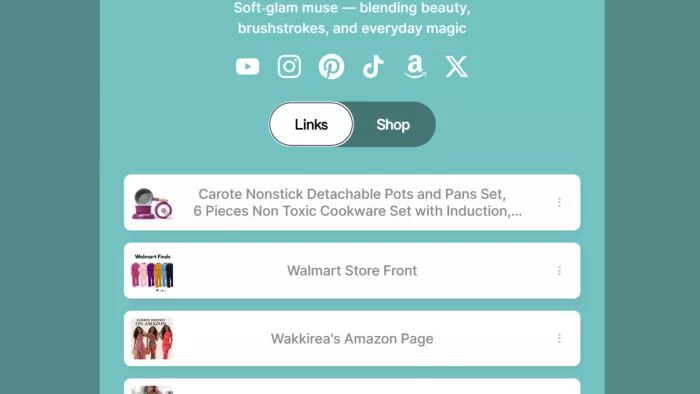
Linktree made the whole "link in bio" idea mainstream, and that head start still counts for something. Its URL is instantly recognizable, its onboarding is the smoothest in the category, and you can have a working page live in under five minutes. It also carries the broadest integration ecosystem of any tool here, connecting to Shopify, Spotify, Mailchimp, Zapier, and dozens more. For a creator who values a familiar, trusted format and doesn't want to think too hard, it remains a safe default.
Standout features
- The fastest, most guided setup of any link-in-bio tool
- The widest catalog of third-party integrations and embeds
- Built-in monetization blocks including a tip jar and Stripe checkout
- Recognizable, trusted link format that first-time visitors don't hesitate over
Best for: People who prioritize brand recognition and a polished, foolproof onboarding over deep features or low cost.
Pricing: A free plan is available. Starter is $8/month ($6/month billed annually), Pro is $15/month ($12/month annually), and Premium is $35/month ($30/month annually). Two things to flag: Linktree raised its Pro price by 67% in November 2025 (from about $9 to $15), and it offers no custom domain on any plan.
- Visitors already understand what a Linktree page is, which removes almost all friction when sharing it with a new audience.
- Setup is exceptionally quick; you can get from signup to a presentable page without learning a new design system.
- Its huge integration ecosystem makes it easy to connect the tools and platforms you're already using.
- A sensible choice for creators who value reliability and familiarity over extensive customization.
Cons
- The 2025 price increase makes the higher tiers harder to justify when cheaper competitors now offer comparable features.
- You're locked into Linktree's domain structure because custom domains aren't available.
- Its familiar appearance can also be its biggest weakness if you're trying to build a distinctive personal brand.
- Selling through Linktree can introduce fees that make the cheaper subscription tiers less attractive for creators generating meaningful sales.
Linktree is the tool you pick when familiarity is the feature. The trade-off is that you'll pay more for less flexibility than several rivals on this list, and if a custom domain matters to you, it's a non-starter.
Campsite.bio vs Linktree: This one is closer than Linktree's fame suggests. Campsite actually out-features it in a few places a data-minded creator cares about: native email capture, Meta and Google pixels, and a custom domain, all at $7/month. Linktree's cheaper tiers don't fully match that, and Linktree has no custom domain at any price. What Linktree gives back is recognition and the widest integration library. If you're leaving Campsite for a "safer" name, go in knowing you'll likely pay more ($15/month for Pro) and give up the custom domain.
3. Taplink:
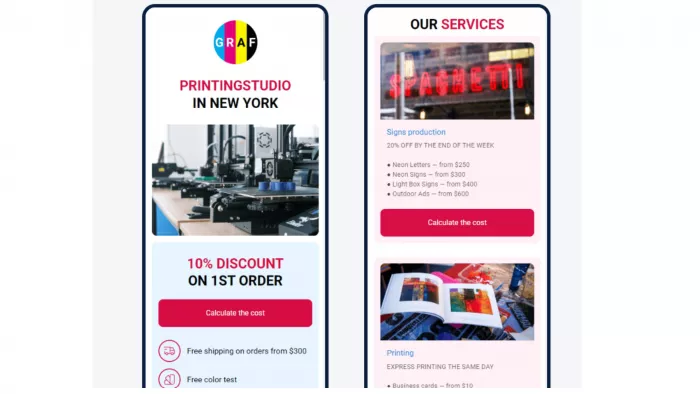
Taplink is the closest thing on this list to a genuine mini landing-page builder, and it does it cheaply. Instead of a plain stack of buttons, you build pages out of blocks: product carousels, booking forms, contact widgets, text sections, and more. The result reads more like a one-page business card than a link list, which suits creators who also run a small service or product business. It's an easy tool to onboard, even for non-technical users, and the pricing undercuts almost everyone.
Standout features
- Block-based editor for structured, landing-page-style layouts
- Booking and contact form widgets built for service businesses
- Product blocks that let you sell digital goods and services on higher tiers
- Solid integration list including Stripe, PayPal, Mailchimp, and Google Analytics
Best for: Creators and small business owners who want form, booking, and product blocks alongside their links without paying premium prices.
Pricing: Basic is free. Pro starts at $4/month, while Business starts at $8/month. Taplink discounts longer billing periods: paying for six months gets 30% off, while paying for 12 months gets 50% off. The current Business annual price is $54/year, equivalent to $4.50/month. Business unlocks digital products, payment acceptance, lead forms, custom domains, and other monetization features.
Pros
- Feels more like a compact landing page than a traditional stack of bio links.
- Forms, bookings, product sections, and other business-focused blocks make it useful beyond social-media traffic.
- The pricing makes it particularly attractive for freelancers and small businesses that don't need a full website.
- You can build a surprisingly functional sales or lead-generation page without paying for a heavyweight website platform.
Cons
- The design system prioritizes functionality over the polished, creator-first feel of platforms such as Beacons.
- Its business-oriented features can make the page feel more like a mini sales page than a personal creator hub.
- Some useful capabilities sit behind higher tiers, so the inexpensive headline price doesn't tell the whole story.
- It has less of an ecosystem around creator monetization, brand deals, and audience growth than the more creator-focused platforms.
If your bio page needs to do actual business things, like take a booking or show a product grid, and you don't want to spend $29 a month to do it, Taplink is one of the most underrated picks here.
Campsite.bio vs Taplink: Campsite is a polished link page with strong analytics; Taplink is a block-based mini landing-page builder that also takes bookings and sells products, for less than Campsite's $7 Pro. If your bio needs structure more than tracking (a booking form, a product grid, a multi-step quiz), Taplink does more for your money. If clean design and marketing pixels are the priority, Campsite still has the edge.
4. Bio.link:
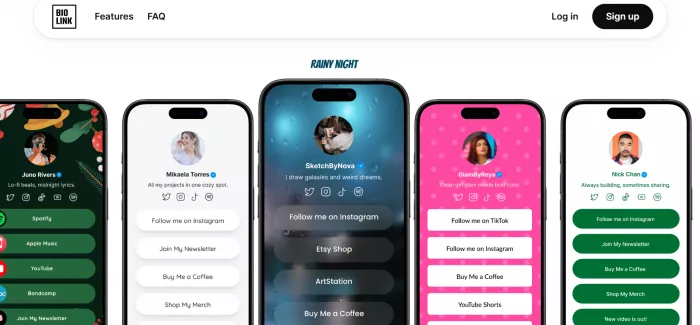
Bio.link has quietly become one of the more interesting tools on this list. Built by the maker of Buy Me a Coffee and now used by more than three million creators and brands, it has moved well past the simple link list it started as. Today it's closer to a lightweight personal site: custom themes, media embeds, real-time analytics, an email list, publishable posts, and a built-in AI assistant trained on your content to greet visitors and answer their questions. For a creator who wants their bio page to actually do something while they're offline, that AI angle is a genuine point of difference.
Standout features
- AI assistant trained on your links, posts, and knowledge base to guide and answer visitors
- Full personal-site kit: 15+ themes, media embeds, SEO, a QR code, and unlimited visitors
- Built-in email list and publishable posts that can alert your subscribers
- Custom domain, branding removal, and unlimited sites on the paid plan
Best for: Creators who want a low-cost, full-featured page with AI and email built in, rather than a bare link list.
Pricing: There's a free tier to start, followed by a single Pro plan at $7.49/month. Bio Link advertises 50% savings with annual billing, so check the current checkout price for the exact annual total before subscribing.
Pros
- Packs an unusually broad set of personal-site features into a relatively inexpensive Pro plan.
- The built-in email list means you can start collecting subscribers without immediately connecting a separate email-marketing service.
- Its AI assistant gives the page a practical interactive element rather than simply adding another decorative AI feature.
- Posts, embeds, SEO tools, analytics, and themes make it capable of functioning as a lightweight personal website.
Cons
- The AI functionality will be unnecessary for creators whose visitors mainly need to click one or two links.
- It doesn't make the same case for direct product sales as Beacons or Stan Store.
- The single paid tier means there isn't much flexibility if you eventually need a more advanced business setup.
- Creators who prefer a minimalist link page may find the extra publishing and AI features more distracting than useful.
Bio.link is no longer the bare-bones option it once was. Where Campsite locks analytics and pixels behind $7 a month, Bio.link hands you a fuller kit (AI, email, posts, custom domain) for roughly half that on annual billing. The trade-off is focus: Campsite leans into marketing pixels and team editing, while Bio.link bets on AI and content. If you want more page for less money, it's an easy tool to recommend now.
5. Lnk.bio:
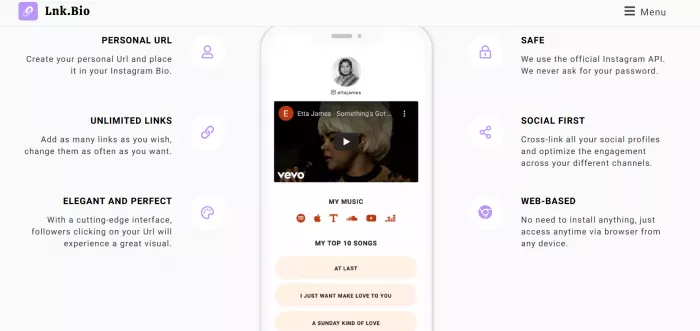
Lnk.bio is the quiet giant of this category, an independent tool used by more than 1.5 million creators across 215 countries, and its pitch is refreshingly different: pay once, use it forever. While nearly every competitor locks you into a monthly subscription, Lnk.bio offers one-time lifetime tiers. It has also kept the same prices since 2016, which in a year where Linktree hiked its plans 67% is a genuine selling point. Beneath the pricing, it's a deep, customizable tool with a huge library of embeds, icons, templates, and fonts.
Standout features
- One-time lifetime pricing tiers, a rarity among major link-in-bio tools
- Deep customization: 577 templates, 3,000+ icons, and tens of thousands of fonts
- 147 embed services covering YouTube, Spotify, TikTok, SoundCloud, Twitch, and more
- Native apps across iOS, Android, Shopify, Chrome, and Firefox
Best for: Creators who want long-term value, price stability, and customization depth without a recurring bill.
Pricing: Free plan with unlimited links. Mini is $0.99/month or $9.99 once for lifetime access, Unique is $24.99 once for lifetime, and agency plans start around $2/month. A custom domain is a separate $29.99/year add-on.
Pros
- The lifetime pricing changes the economics completely: you can stop thinking about another monthly SaaS bill once you've paid for the tier you need.
- Its customization library is much deeper than its low price initially suggests.
- The huge selection of embeds makes it particularly useful for musicians, streamers, video creators, and anyone with content spread across multiple platforms.
- Price stability is a genuine advantage in a category where competitors regularly change their plans.
Cons
- The interface feels more utilitarian than polished, particularly compared with newer creator-focused platforms.
- Its sheer number of customization options can make setup feel more like configuring a website than filling out a bio page.
- A custom domain costs extra, weakening some of the value proposition of the lifetime plans.
- If selling products is the main reason you're leaving Campsite, Lnk.bio doesn't offer the same depth as dedicated creator storefronts.
If the idea of paying $7 a month indefinitely is what pushed you to look for alternatives in the first place, Lnk.bio is the direct answer. Twenty-five dollars once, and you're done.
6. Stan Store:
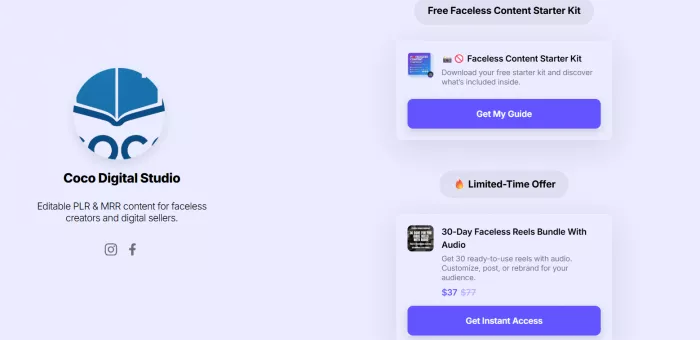
Stan Store is a creator storefront that happens to work as a link in bio. If your primary goal is turning followers into paying customers, whether through digital products, online courses, coaching sessions, or subscriptions, Stan is built specifically for that job. The one-tap mobile checkout is designed to move someone from "follower" to "buyer" in as few steps as possible, and it collects emails along the way. This is the tool for creators who are actively monetizing.
Standout features
- Full storefront for digital products, courses, coaching, and memberships
- 0% transaction fees on every plan, so you keep more of each sale
- Smooth one-tap mobile checkout optimized for social traffic
- Built-in email collection and marketing tools, plus ready-to-use templates
Best for: Creators whose main goal is selling directly from their bio and who already have, or are building, real sales volume.
Pricing: There is no free plan. Creator costs $29/month or $300/year ($25/month equivalent), while Creator Pro costs $99/month or $948/year ($79/month equivalent). Both plans have a 14-day trial, and Stan charges 0% platform transaction fees, although payment processors such as Stripe and PayPal still charge their normal processing fees.
Pros
- Everything is designed around one outcome: turning social-media visitors into customers.
- The checkout experience is built specifically for people arriving from Instagram, TikTok, and similar platforms on their phones.
- 0% platform transaction fees make the subscription easier to justify once sales become consistent.
- Products, courses, coaching, memberships, and email collection can live under the same storefront instead of being spread across different services.
Cons
- The $29/month starting price is difficult to justify if you're still experimenting with your first product.
- Its economics favor creators who already have something to sell; it isn't particularly compelling as a simple link-in-bio replacement.
- You give up some of the visual freedom you'd get from a dedicated page builder.
- Paying for a full storefront when your bio mostly contains social links can mean you're buying infrastructure you don't actually need.
The value equation is simple: if you generate even $500 a month in sales, Stan's zero-fee model can save you more than the subscription costs compared to platforms that skim 9 to 12%. But if you're not selling yet, that $29 monthly floor is a hard bet, and one of the free or cheap tools above will serve you better until you are.
7. Carrd:
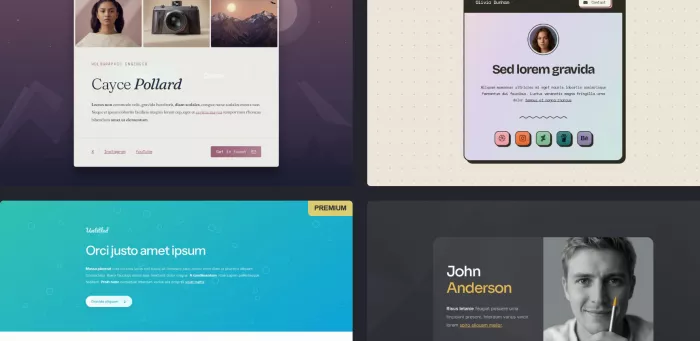
Carrd is the outlier here, and for the right person it's the best pick on the whole list. It's a one-page website builder that doubles as a link-in-bio tool, built and run largely by a single developer, and it gives you near-total design freedom to construct a page element by element. It competes on price and creative control rather than built-in creator features, and on both counts it's hard to beat. If you want a bio page that looks like a custom mini-site rather than a template everyone recognizes, Carrd is how you get there cheaply.
Standout features
- Near-total design control; build pages block by block, exactly how you want
- A genuinely functional free tier good for a clean, branded page
- Custom domain, forms, and analytics bundled into a $19/year plan
- Historically stable pricing, unusually so for this category
Best for: People who want a custom, design-led page or one-page site as cheaply as possible and are comfortable building it themselves.
Pricing: Free for up to three sites (with a Carrd badge and subdomain). Pro Lite is $9/year and removes branding, Pro Standard is $19/year and adds a custom domain, forms, and analytics, and Pro Plus is $49/year. Everything is billed annually, and there's no native store, so no transaction fees.
Pros
- Gives you far more control over the final design than a conventional link-in-bio template system.
- At $19/year, a custom-domain page is dramatically cheaper than maintaining most creator-focused platforms.
- There are no platform transaction fees because Carrd doesn't try to become your storefront.
- It's ideal for creators who want their bio link to feel like a tiny personal website rather than another recognizable link-in-bio page.
Cons
- Carrd's flexibility comes with a cost: you have to make more design decisions yourself.
- There are no built-in creator-business features such as a native storefront, email marketing system, or media-kit workflow.
- The one-page approach can become restrictive once your content or business grows beyond a simple landing page.
- Its value is highest for people comfortable building their own page; less technical users may prefer a more guided editor.
Carrd asks more of you upfront than any tool here, because you're designing rather than filling in a template. But if you enjoy that, or want a page that doesn't look like everyone else's, nineteen dollars a year for a custom-domain site is hard to beat on price.
How the Seven Stack Up in Real Use
Reading feature lists only gets you so far. After weighing these tools against how creators actually use them, a few clear patterns emerge, and they're worth stating plainly.
For pure selling, the honest winners are Stan Store and Beacons, and the choice between them comes down to volume and breadth. Stan is cleaner and charges no transaction fees, which makes it the better deal once you're selling consistently, but its $29 floor punishes anyone still building an audience. Beacons is more forgiving to start with, since it's free to launch and does far more than sell, though its 9% fee on entry tiers quietly eats into margins until you upgrade to the $30 plan. If you sell one or two flagship products, lean Stan. If you want a store plus email plus a media kit under one roof, lean Beacons.
For the lowest long-term cost, Lnk.bio and Carrd win. Lnk.bio's lifetime tiers turn a subscription into a one-time $9.99 or $24.99. That's the most direct answer to Campsite's recurring $7. Carrd goes cheap in a different way, at $19 a year for a custom-domain page you design yourself. Both reward creators who think in years rather than months.
For the most capability per dollar, Bio.link has quietly become a standout. Its repositioning around an AI assistant, plus a built-in email list, media embeds, and a custom domain, packs a lot into a single plan that lands near $3.75/month on annual billing. It's no longer the minimalist option it once was. It's one of the better value-for-features picks here.
Linktree and Taplink split the "familiar versus flexible" vote. Linktree wins on recognition and setup speed and loses on price and the absence of a custom domain. Taplink wins on price and structured, business-style layouts and loses on polish and brand familiarity. Neither is wrong; they just serve different instincts.
One theme runs through all of it. The tools that clearly earn a subscription in 2026 are the ones doing real work: running a store, sending email, generating a media kit. If all you need is links, the bar has risen. Bio.link's free tier, Lnk.bio's one-time plans, and Carrd's cheap annual pricing all cover the basics without a recurring bill, which makes paying monthly for a plain link list harder to justify than it once was.
Which Campsite.bio Alternative Should You Pick?
There's no single winner, only the right tool for what you're trying to do. Here are the four decisions most people leaving Campsite.bio are actually making.
You want to sell digital products, courses, or coaching. Go with Stan Store. Its one-tap checkout and 0% platform fees are built for exactly this, and if you're selling even $500 a month the zero-fee model more than covers the $29 subscription. The one caveat: don't sign up until you're ready to sell, because there's no free tier.
You want an all-in-one creator business: links, store, email, and brand deals in one place. Go with Beacons, and budget for the $30 Creator Plus plan so the 9% sales fee drops to zero. It does the most of anything here; you're paying for that breadth with a steeper learning curve.
You just want to escape Campsite's monthly fee without losing much. Go with Lnk.bio if you'd rather pay once ($9.99–$24.99) and never see another invoice, or Bio.link if you'd prefer a free-to-start page with AI, email, and a custom domain for a few dollars a month. Both do the core job Campsite did, for far less over time.
You want a page that looks unmistakably yours. Go with Carrd at $19 a year for near-total design control and a custom domain, as long as you enjoy building it yourself.
Two honorable mentions round it out: Linktree if brand recognition and a foolproof five-minute setup matter more to you than price, and Taplink if you want structured pages with booking and product blocks on a tight budget.
Every option here has a free plan or a trial except Stan Store, so spin up your top two, drop in your real links, and see which one feels right before you spend a dollar.


Comments