
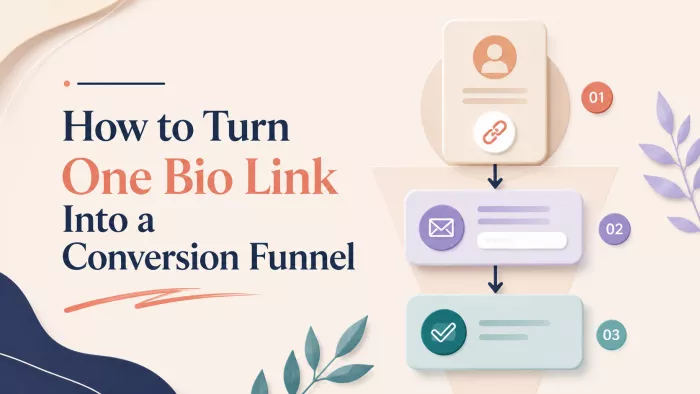
The link in your bio is the highest-intent click you get on social media. Nobody lands on it by accident. They watched your content, opened your profile, and tapped through on purpose. That's a warmer visitor than almost anything paid ads can buy you.
And yet most bio pages treat that visitor like a stranger at a buffet: eight links stacked vertically, no hierarchy, no capture, no tracking. YouTube. Podcast. Merch. "My favorite tools." A Spotify playlist from 2023. The visitor scans for three seconds, taps nothing or taps the wrong thing, and leaves. You just paid for that attention with hours of content, and the page monetizing it did nothing.
Here's the reframe this article is built on: your LInk in Bio is not a menu. It's a one-page funnel with stages, drop-off points, and a number attached to every visitor. By the end of this, you'll know how to rebuild yours as one and how to measure whether the rebuild worked.
Why the "Menu of Links" Fails
Profile-to-bio-link click-through rates typically land somewhere between 15% and 30% depending on niche and how aggressively you point to it in content. That part works fine. The failure happens on the page itself, where most creators convert under 2% of visitors into anything measurable: a lead, a sale, a booked call. The gap between those two numbers is the whole problem, and it has three causes.
Choice paralysis is real and measurable. Hick's Law the finding that decision time increases with the number of options is the reason every serious landing page has one call to action, not eight. A bio page with eight equally weighted links forces the visitor to do the work of deciding what matters. Most won't. They'll tap whatever is first, or nothing.
There's no primary action. Ask yourself what the single most valuable thing a visitor could do on your page is. If your page doesn't visually scream that one thing, you don't have a funnel, you have a directory.
There's no data capture. Every visitor who taps your YouTube link and leaves is gone. You can't email them, retarget them, or message them. You're renting your entire audience from Instagram or TikTok, and your bio page the one property you actually control in that relationship isn't converting renters into owned contacts.
There's a fourth failure that's subtler: a link menu treats all visitors as identical. But bio-link traffic is a blend of three temperatures. Cold visitors found you through one viral post an hour ago. Warm visitors follow you and finally clicked through. Hot visitors came because you said "link in bio for the template" in a specific post. A menu serves all three the same wall of options. A funnel sorts them.
The Five-Stage Bio Link Funnel
Everything below fits on a single page. The stages aren't separate screens, they're layers, ordered by scroll position and visual weight. Here's the full anatomy.
Stage 1: The Hook What They Get, Not Who You Are
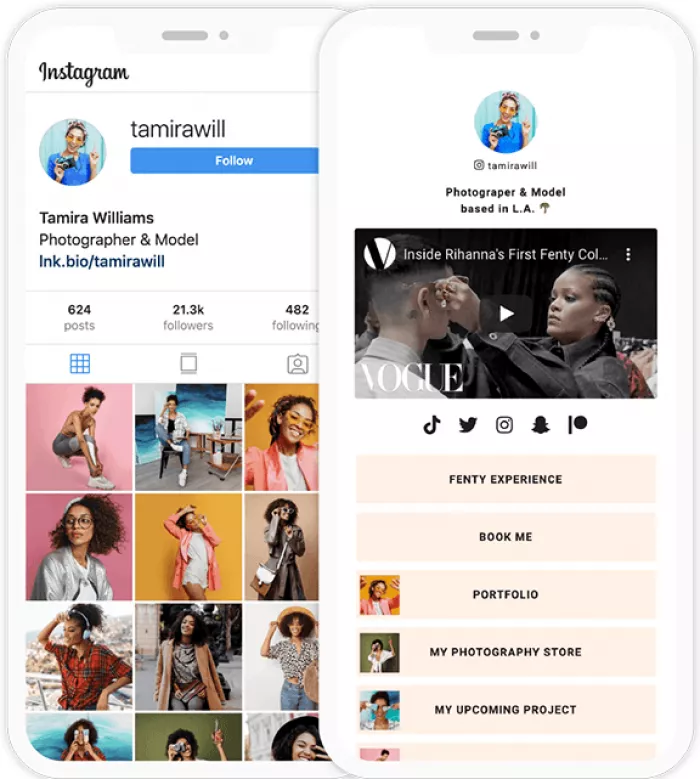
The first thing a visitor sees above the fold should be a one-line value proposition, not your name and job title. They already know who you are; your profile is one tap behind them. What they don't know is what's in it for them on this page.
Compare these two openers:
● "Rahul Sharma | Content Creator | Marketing Tips" this restates the profile they just left and gives the visitor zero reason to keep scrolling.
● "Free 12-page playbook: how I grew a newsletter to 8,000 subscribers with zero ad spend" this makes a specific promise, sets up the primary CTA, and filters for exactly the visitor you want.
Write the hook like a headline, keep it under 15 words, and make it about the outcome the visitor gets. If you can put a number in it, do.
Stage 2: The Primary CTA One Dominant Action
This is the hardest discipline in the whole rebuild: exactly one action gets visual dominance. One button, styled differently from everything else on the page, is bigger, filled color, positioned directly under the hook. Everything else is smaller, quieter, lower.
A useful constraint is the 1:3 rule: one primary CTA, and no more than three secondary links below it. If you currently have eight links, five of them are about to die, and that's fine. Pull your click data first and you'll usually find the bottom five links share less than 10% of total taps anyway. They were noise pretending to be options.
What should the primary CTA be? Whatever moves your actual business number. For a coach it's the discovery call. For a digital product seller it's the flagship product or its free sample. For a newsletter operator it's the subscribe box. Not your latest YouTube video YouTube pays you pennies for that click and tells you nothing about who took it.
Stage 3: The Lead Capture Layer Because You Don't Own Your Followers
Directly under or built into the primary CTA sits the capture mechanism: an email or WhatsApp opt-in traded for a lead magnet. This stage exists for one reason: platform risk. If Instagram suspends your account tomorrow, or the algorithm decides your reach is worth 20% of what it was, your captured list is the only audience that survives.
The lead magnet has to be worth the trade. A generic "join my newsletter" converts miserably typically 1–3% of page visitors. A specific, immediately useful asset ("the exact 7-email launch sequence, copy-paste ready") can pull 8–15% on the same traffic. Specificity does the selling. Three formats consistently outperform the rest:
● The shortcut asset a template, calculator, or swipe file that saves the visitor an hour of work today. Fastest to say yes to, because the value is obvious before they've read a word of it.
● The proof-of-method document a short case study or teardown showing exactly how you got a result they want. This one pre-sells your paid offer while it captures, which is why it's usually the best choice for coaches and service providers.
● The first-module giveaway lesson one of your paid course, free. Highest buyer intent of the three, lowest volume. Use it when you'd rather have 50 serious leads than 500 curious ones.
Whichever you pick, deliver it instantly and automatically. A lead magnet that arrives "within 24 hours" trains your newest, warmest contact to expect slowness from you.
One note that Western marketing blogs almost never mention: if your audience is in India or most of Southeast Asia, a WhatsApp opt-in will crush email. Open rates on WhatsApp broadcasts routinely sit above 90%, against email's 20–35%, and the opt-in friction is lower because nobody has to type an address one tap opens a pre-filled chat. Tools like WhatsApp Business API providers, or even a simple wa.me link with a keyword message, plug straight into a bio page. If your buyers live on WhatsApp, capture them where they already are.
Stage 4: The Qualification Path Secondary Links That Sort Intent
Your three secondary links shouldn't be random destinations. Each one should represent a different intent level, so that the tap itself tells you who the visitor is:
● "Book a 1:1 call" this visitor has money and urgency. Highest intent, highest value, lowest volume.
● "Free resources / templates" this visitor is interested but not ready to spend. They're future customers if you capture and nurture them, which is why this link should route through an opt-in, not to a public Google Drive folder.
● "Shop" or "Courses" mid-intent browsers who want to see what you sell before committing to a conversation.
Structured this way, your bio page stops being a signpost and becomes a sorting machine. Your analytics now show you not just how many people visited, but what proportion of your audience is at each temperature and that ratio should directly shape what content you make next. If 70% of taps go to free resources and 2% to calls, you have an audience-building problem dressed up as a sales problem, and no amount of "buy now" posting will fix it.
Stage 5: The Retargeting Net Pixel the Page Itself
This is the stage almost nobody implements, and it's the cheapest leverage on the entire page. Install a Meta pixel (and Google tag, if you run any search or YouTube ads) on your bio link page itself.
Think about what that audience is: people who deliberately visited your page in the last 30–180 days. Even the ones who tapped nothing and bounced have raised their hand harder than any lookalike audience ever will. When you eventually run ads for a launch, of course, anything a custom audience of "visited my bio page" plus its lookalikes will outperform cold targeting by a wide margin, because every person in it has already chosen to look you up.
The catch: you can only do this on platforms that allow custom code or native pixel integration, and ideally on your own domain. Linktree's free tier won't let you. This single limitation should weigh heavily in your tool choice, which we'll get to.
Match the Funnel to the Traffic Source
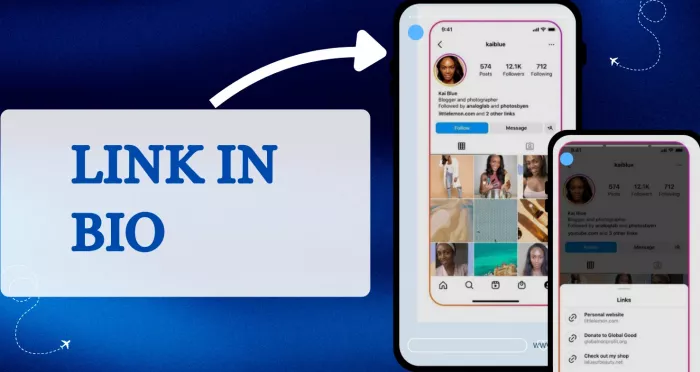
A static bio page is a compromise. The advanced move is treating the page as a rotating hero: the top block changes based on what's driving traffic this week.
The logic is simple. If a post about pricing strategy just went semi-viral, the visitors flooding your bio page for the next 72 hours all want more on pricing. A hook and primary CTA about pricing ("Grab the pricing calculator from the post") will convert several times better than your evergreen offer, because it completes the loop the post opened. When the wave passes, the evergreen block comes back.
Picture it concretely. A fitness creator's reel on "why your deficit isn't working" hits 400K views on a Tuesday. Her evergreen bio page leads with coaching applications, and against this cold wave it converts at maybe 2% into anything. She swaps the hero to "Free: the deficit troubleshooting checklist from the reel" that evening five minutes of work and now 11% of those visitors hand over a contact. Three days later the wave is spent, the hero swaps back, and she's holding a few thousand new leads who joined for exactly the topic her paid program solves. Same viral moment; the only variable was whether the page acknowledged why people were arriving.
The same thinking applies to launches. During a launch window, the bio page shouldn't feature the launch, it should be the launch page. Hook, offer, deadline, buy button. Everything else gets temporarily demoted or removed. A launch is the one time breaking the 1:3 rule down to 1:0 is correct.
Two mechanics make this manageable rather than exhausting:
● Use UTM-tagged deep links in Stories and posts when you can link directly (Stories, pinned comments, DM automations), reserving the bio link for profile taps. This splits your analytics cleanly: you'll know exactly which conversions came from the static bio page versus specific pushes, instead of one blurred number.
● Rotate only the hero block, not the whole page. Your capture layer, qualification links, and pixel stay constant. Swapping one headline and one button takes five minutes on a Sunday and keeps the page synced to your content calendar.
Choosing a Tool by Funnel Capability, Not Feature Count
Every link-in-bio tool comparison lists themes, fonts, and integrations. None of that matters here. The only question is: which stages of the funnel can the tool actually execute? Here's the honest breakdown across the four realistic options.
| Capability | Linktree | Beacons | Stan Store | Self-hosted page |
| Native email capture | Paid plans only | Yes, free | Yes | Yes (any form tool) |
| Custom domain | Paid ($9+/mo) | Paid | No | Yes, you own it |
| Meta pixel / retargeting | Paid plans | Paid | Limited | Full control |
| Embedded checkout | Limited | Yes | Yes (its core strength) | Yes (Stripe/Razorpay) |
| Analytics depth | Basic tap counts | Decent | Sales-focused | Full GA4 + pixel events |
| Platform risk | Their domain, their rules | Same | Same | Zero |
Reading the table honestly: Linktree is fine for Stage 2 and nothing else unless you pay, and even then you're building on their domain. Beacons are the strongest free option for capture. Stan Store is genuinely good if your entire model is selling digital products directly to a creator audience; its checkout is frictionless but you sacrifice domain ownership and flexibility.
Here's the plain take: if you're running a real business, a self-hosted one-page site on your own domain beats every third-party tool, and it isn't close. A single page built on Carrd ($19/year), Framer, or plain HTML gives you every funnel stage with no gatekeeping your pixel, your forms, your checkout, your analytics, on a domain that accrues authority to you. The bio link becomes yourname.com/start instead of linktr.ee/yourname, which also quietly signals you're not an amateur. The only cost is two or three hours of setup once, against a monthly subscription forever and permanent platform dependency.
The third-party tools exist because they're zero-effort. That's a fair trade at the hobby stage. It stops being fair the day your bio link starts making money.
The Metrics That Actually Matter
You can't improve a funnel you're not measuring, and "total clicks" the only number most tools show you measures nothing useful. Track the chain instead:
Profile visits → bio link CTR. How many profile visitors tap the link. Healthy range is 15–30%. If you're under 10%, the problem is upstream: your content isn't creating a reason to visit the page, or your bio copy above the link is dead weight.
Page visitors → primary action rate. Of everyone who lands on the page, how many take the primary CTA. This is the number the entire rebuild exists to move. A link menu converts 1–2%. A properly structured funnel page should reach 8–15%, and hot campaign traffic against a matched hero block can go higher.
Leads → customers, with a timeframe. Of captured contacts, how many buy within 30/60/90 days. This tells you whether your lead magnet attracts buyers or freebie collectors. A 10% capture rate of the wrong people is worth less than 4% of the right ones.
And then the one metric almost nobody calculates: revenue per bio-link visitor. Take 90 days of revenue attributable to the funnel, divide by page visitors in the same window. The first time you run it the number will probably be depressing a few rupees or cents per visitor. That's the point. Once it exists, every change to the page becomes testable against it, and it converts vague "engagement" into a figure you can compare against what a paid click would cost you. When your revenue per visitor exceeds your niche's average CPC, you've built something genuinely valuable: attention that's worth more monetized than it would cost to buy.
The 30-Minute Rebuild
Everything above compresses into one working session. Do it in this order:
1. Pull your click data and audit ruthlessly. Any link earning less than 5% of total taps over the last 60 days gets deleted, no sentiment allowed. You're usually left with two or three survivors.
2. Write the hook line. One sentence, under 15 words, outcome-first, ideally with a number in it. Draft five versions, keep the one you'd actually tap.
3. Set the single primary CTA and style it so it's unmissable the only filled, full-width button on the page, sitting directly under the hook.
4. Wire the capture layer. Attach your lead magnet to a form, or set up the WhatsApp keyword flow if that's where your audience lives. Test it yourself on mobile before publishing.
5. Arrange three qualification links below the primary CTA in descending intent order: call, shop, free resources.
6. Install the pixel or if your current tool won't allow it, put "migrate to own domain" at the top of next week's list, because that limitation is costing you your best future ad audience every single day.
7. Screenshot the finished page and note today's numbers. Baseline visits, primary action rate, captures. Recheck in 30 days.
The Verdict
Strip away the tactics and one idea remains: every follower you have is rented. The platform owns the relationship, sets the rent through algorithmic reach, and can evict you without notice. Your bio link is the single doorway through which rented attention can walk out and become something you own: an email address, a WhatsApp contact, a pixel match, a customer record.
A menu of links leaves that doorway propped open with nobody checking who walks through. A funnel stands at the door with a clipboard. Same traffic, same content, same follower count, completely different business twelve months later. The rebuild takes thirty minutes. The excuse for not doing it took you about ten minutes to read.


Comments