The Psychology of Trust: What Makes People Choose You Online



Let me start with a confession. Last month I bought a course from someone I had never met, in a country I have never visited, after watching about ninety seconds of their content. I did not read the full sales page. I did not check the refund policy line by line. Something in my head had already decided this person was worth my money, and the rest of me was just catching up to a choice my brain made in the background.
That moment is the whole subject of this article.
When someone lands on your profile or reads one of your posts, they cannot shake your hand or sit across from you over coffee. So the brain does what it has always done with strangers. It scans for signals and reaches a verdict fast, often before the reader has consciously taken in a single sentence.
I have spent years watching why some creators and business owners get chosen while equally talented people get scrolled past. The uncomfortable answer is that talent is not the deciding factor. Perceived trust is. This piece walks through the psychology behind that verdict and the signals that move it. Then it shows how to shape your online identity so the verdict lands in your favour. I built the argument one layer at a time, so it helps to read the sections in order.
Why Trust Became The Thing People Actually Buy
Offline, trust had time to grow. A customer met you, saw your shop, asked a neighbour, came back a second time. Reputation traveled slowly through people who already knew you.
Online, that slow process collapses into a few seconds of judgement made by a stranger who will never meet you.
That shift created something I call the trust gap. The trust gap is the distance between what you claim about yourself and what your audience actually believes. Anyone can type “marketing expert” into a bio. The words cost nothing, which is exactly why they persuade no one. The gap only closes when the audience sees evidence that matches the claim: a useful post, a result they can verify, a client who vouches for you, a body of work they can scroll through.
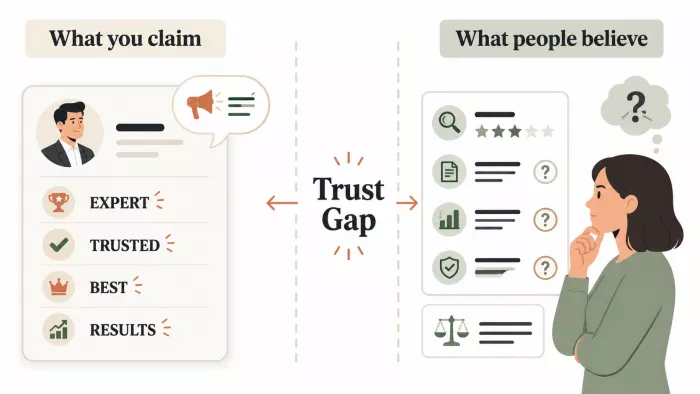
Here is why this matters more than it used to. Two creators can sell the same service, at the same price, with the same skill. The one who closes the trust gap gets the sale. The other one gets a polite “I’ll think about it.” Attention is cheap to buy with a good hook. Trust is the harder currency, and it is the one that turns a viewer into a client.
Which raises the obvious question. How does a stranger decide, so quickly, whether to believe you at all? For that, we have to look at what the brain does in the first fraction of a second.
What Your Brain Decides In The First Tenth Of A Second
In 2006, two Princeton psychologists, Janine Willis and Alexander Todorov, ran an experiment that belongs on every marketer's wall. They showed people photographs of faces for 100 milliseconds, a tenth of a second, then asked them to rate each face on traits like competence and trustworthiness. Afterwards they let other people study the same faces with no time limit at all.
The ratings barely moved. A tenth of a second produced almost the same judgement as unlimited time. Of every trait they tested, trustworthiness was the one people locked onto fastest.
Your visitor forms a trust verdict about your photo and your header before the conscious reading brain has even switched on.
It gets sharper when you move from faces to websites. B.J. Fogg's team at Stanford asked 2,684 people to judge the credibility of real sites, then studied what those people actually commented on. The single most common factor, present in 46.1% of all comments, was not the accuracy of the content or the author's credentials. It was the visual design: the page layout, the typography, the colour scheme, the overall polish. People were judging trustworthiness by how the page looked before they weighed what it said.
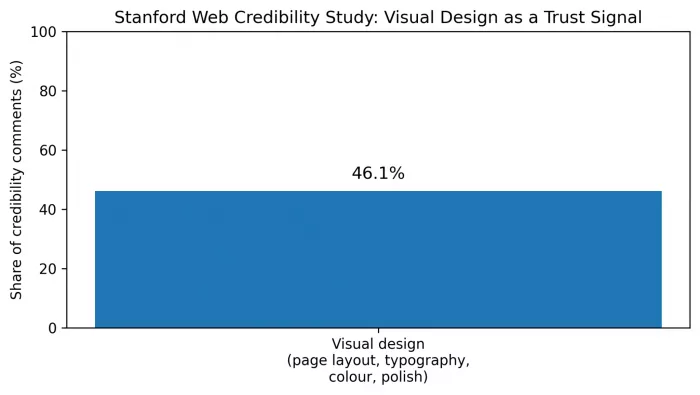
I am not sharing this to celebrate shallow judgement. I am sharing it because your audience runs on the same wiring, and pretending otherwise costs you clients. A cluttered profile with a blurry photo is not a neutral starting point. It is an active signal, and it points the wrong way.
The Brain Trusts What Is Easy To Process
There is a second mechanism sitting right next to first impressions, and psychologists call it processing fluency. In plain terms, the brain reads “easy to understand” as “safe and true,” and reads “confusing” as “risky.”
When your message is clear and your offer is legible in a single glance, you are not only being courteous to the reader. You are handing their brain a small hit of trust every time it processes you without friction. When they have to work to figure out what you even do, that effort registers as doubt.
So a strong online identity answers a few questions before the visitor has to ask them. Who is this person? What do they do, and for whom? Why should I care right now? Miss those, and even a gifted creator reads as “unclear,” which the brain quietly files under “not trusted yet.”
We now have the mechanism. The next section is the part you can act on: the specific signals that push the verdict toward yes.
The Seven Signals That Make People Trust You Online
Everything above happens inside the visitor's head on autopilot. This section is about what you put in front of them. I have grouped it into seven signals. The table below is your map before we walk through each one.
| Signal | What it proves | One way to show it |
|---|---|---|
| Authenticity | You are a real person, not a facade | Share a lesson you learned the hard way |
| Credibility | You can actually do the work | Show your work and the results behind it |
| Social proof | Others already trust you | Feature two specific testimonials |
| Consistency | You are the same person everywhere | Keep your name, photo, bio, and colours aligned |
| Authority | You know more than the reader does | Teach something useful for free |
| Transparency | There is no hidden catch | State pricing and expectations plainly |
| Emotional connection | You care about what they care about | Lead with the outcome they want |
1. Authenticity Beats Polish
Audiences have grown allergic to the flawless corporate voice. What earns attention now is a real person with an actual point of view.
A designer who writes “I redesigned 50 landing pages last year and kept hitting the same three mistakes” sounds more trustworthy than one who writes “I create stunning designs.” The first shows a human who has done the work and noticed patterns. The second could have been written by anyone, about anything.
Show your process. Admit what you got wrong before you got it right. Those small honesties do more for trust than another round of polish ever will.
2. Credibility Means Evidence, Not Adjectives
Claims describe you. Evidence proves you. The brain weighs the second far more heavily than the first.
A portfolio piece, a before-and-after, a screenshot of a real result, a short case study with numbers in it: each one closes the trust gap I described earlier, because the audience no longer has to take your word for anything. They can see it for themselves.
3. Social Proof Is Borrowed Trust
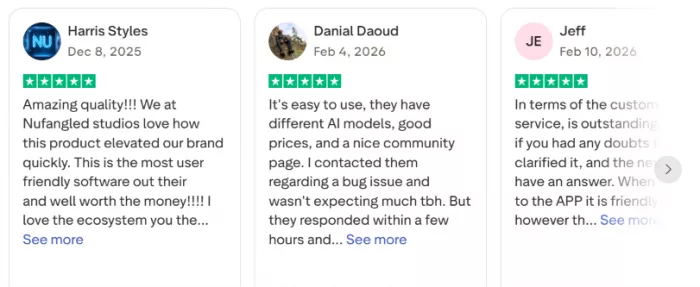
Robert Cialdini named social proof as one of the core levers of persuasion, and the logic is ancient. When we are unsure, we look at what other people are doing and copy them. A testimonial, a review, a recognisable client logo, a story from someone the reader sees themselves in: each one lends you a piece of trust that person already earned.
One warning. A wall of vague five-star quotes reads as noise. Two specific testimonials that name a real problem and a real result will outperform fifty generic ones. The quality of your proof beats the quantity every time.
4. Consistency Makes You Recognisable
Familiarity is comfortable, and comfort reads as safe. When a person meets you on Instagram, later finds your website, then spots you mentioned somewhere else, and the name, the photo, the wording, and the promise all line up, each touch reinforces the last.
When they do not line up, the reverse happens. A different handle here, a different headshot there, and the brain starts wondering which version is the real you. Consistency is not about looking rigid. It is about being instantly recognisable, so recognition has the chance to grow into trust.
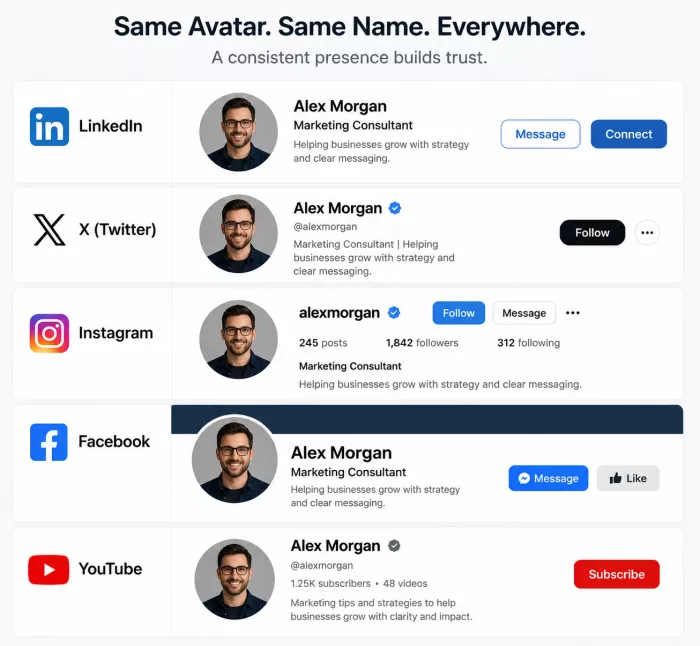
Holding that consistency together across platforms is harder than it sounds, and it is a problem I come back to when we reach your digital identity below.
5. Authority Comes From Teaching
The fastest way to be seen as an authority is to make a stranger smarter for free. A short tutorial, a breakdown of how you solved a problem, an insight your peers keep quiet about, a template you actually use: teaching signals mastery in a way that self-description never can.
Every strong personal brand quietly answers one question in the reader's mind: what can I learn from this person? Answer it well and often, and authority follows on its own.
6. Transparency Removes The Fear
Every online buyer carries a quiet fear of being scammed, overcharged, ignored, or let down. Transparency is how you defuse it before it grows.
Clear pricing, a plain description of what the client gets, an honest timeline, and a simple way to reach you: none of this is glamorous, but all of it lowers the perceived risk of choosing you. Hidden information does the opposite. It makes people assume the worst about whatever you left out.
7. Emotional Connection Closes The Deal
People decide with emotion and justify with logic. That is the order, and it does not flip just because the decision is happening on a screen.
Compare two photographers. One says “I take photos.” The other says “I help families keep the moments they will want to revisit in twenty years.” Same service. The second one reaches something the first cannot, because it speaks to why the work matters instead of what the work is.
Seven signals, one destination. On their own they sit scattered across posts and platforms. The real question is where they add up into a single verdict, and that brings us to the most important surface you own.
Your Digital Identity Is Where Trust Adds Up
Here is the shift I want you to make. You do not have an Instagram presence over here and a separate website over there. You have one digital identity, and every scattered piece is either adding to it or leaking trust out of it.
The trouble is that the pieces live in different places. Your best work sits on one platform, your reviews on another, your shop somewhere else, your contact form buried a few clicks deep. Every extra jump is a moment where the visitor's attention, and their fragile new trust, can slip away.
This is exactly the gap a link-in-bio identity platform is built to close, which is why I use one. Tieup.io, for example, pulls your links, your portfolio, your products, your promo codes, and your social proof onto a single page that lives behind one link. Instead of asking a curious visitor to go hunting across the internet, you hand them one place where every trust signal from the last section sits together.
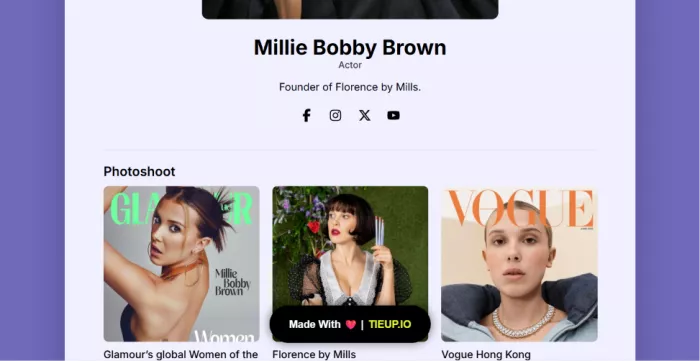
Think of that single page as your trust infrastructure. Here is what a version that actually converts tends to get right.
A Clear Identity At The Top
Within a second of landing, the visitor should know who you are and who you help. “I help fitness coaches grow with short-form video” does the job. “Helping people achieve their dreams” does not, because it could belong to literally anyone.
A Bio That Says Something
Vague bios are trust leaks. Swap “passionate about success” for a specific sentence that names your audience and the outcome you create for them. Specificity, as we saw with the designer example earlier, reads as competence.
Links With A Hierarchy
A page with thirty equal links creates the decision fatigue we will look at in the mistakes section. Put your main offer first and your proof right behind it. Make the contact option impossible to miss. Guide the eye instead of dumping options on it.
One Obvious Next Step
Every visit should have a destination you actually want: book a call, view the portfolio, grab the free resource, buy the product. A profile without a next step is a conversation that ends mid-sentence.
When those four elements sit on one consistent page, the seven signals stop being scattered and start compounding. That is the practical payoff of treating your identity as a single surface instead of a dozen.
To make all of it easy to remember, I boiled the whole thing down to a five-part formula.
The TRUST Framework
I run this checklist before I publish anything with my name on it. Each letter maps to something we have already covered, so it doubles as a quick recap of the article so far.
| Letter | Principle | The question to ask |
|---|---|---|
| T | Transparency | Have I hidden anything a buyer would want to know? |
| R | Reliability | Would someone recognise me across platforms? |
| U | Understanding | Am I talking about their problem or my service? |
| S | Social Proof | Where is my evidence on this page? |
| T | True Identity | Does this sound like a real, specific person? |
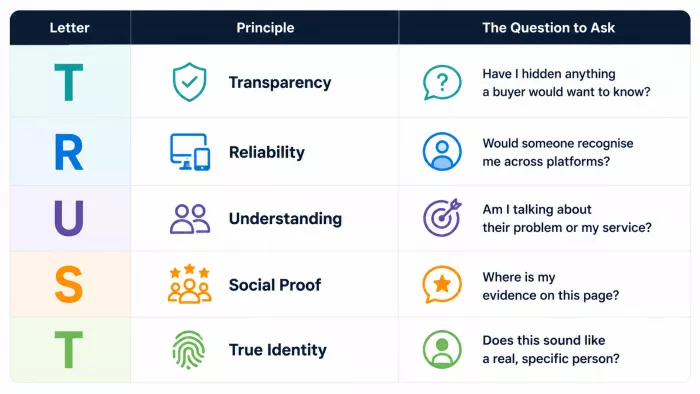
Run anything through those five questions and the weak spots surface fast. I kept the framework small on purpose, because a checklist you can hold in your head is one you will actually use.
Knowing what builds trust is only half the job. The other half is not quietly dismantling it, which people do more often than they realise.
The Mistakes That Quietly Kill Trust
Some trust leaks are loud. Most are silent. They never announce themselves; they just cost you the client you never knew you almost had. Here are the ones I see most.
| Mistake | Why it breaks trust | Quick fix |
|---|---|---|
| Speaking to everyone | Generic messages feel like they belong to no one | Name one specific audience |
| Too many links, no order | Choice overload makes people freeze and leave | Prioritise a single main action |
| Claims with no proof | Assertions without evidence read as bluffing | Put a result beside every claim |
| A scattered identity | Different names and photos confuse the brain | Unify your presence in one place |
| Selling before giving | Pitching too early feels self-serving | Offer value before you ask |
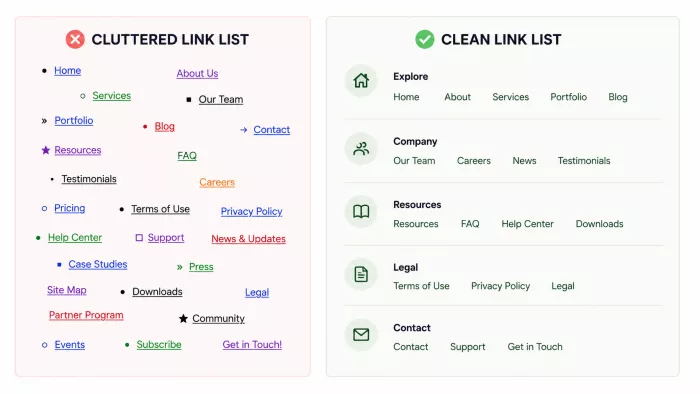
There is a psychological reason these hurt so much, and it has a name: negativity bias. Research on how we weigh good against bad, summarised in the well-known paper titled “Bad Is Stronger Than Good,” shows that a single negative signal lands harder than several positive ones combined. One broken link, one sketchy claim, one mismatched photo, one dead-end page can quietly undo a dozen things you did right.
That is the quiet math of trust. You build it slowly, in small deposits, and one careless signal can wipe out the balance. Which is why the scattered-identity problem is worth solving properly rather than patching over.
What Trust Looks Like As AI Fills The Internet
The ground is shifting under this whole conversation. Content has never been cheaper to make. Anyone can generate a polished post, a slick bio, a confident article, a tidy caption in seconds, and audiences already know it.
That does something interesting to trust. When words are infinite and free, words on their own stop being proof of anything. The signals that survive are the ones that are hard to fake: a real track record, a face that shows up consistently, a body of work with your fingerprints on it, other humans willing to vouch for you.
The creators and businesses who win the next few years will be the ones who lean into the human parts of trust exactly as everyone else automates them away. A recognisable identity, honest evidence, a consistent presence, and a point of view earned from lived experience are getting rarer, which is precisely what makes them worth more.
So the verdict your visitor reaches in a tenth of a second is going to count for more, not less. Your job is to make sure that when they glance at you, every signal they catch is pulling in the same direction.
Now Open Your Own Profile The Way A Stranger Would
Here is the only exercise I ask people to run after reading this. Open your main profile on a device you are not logged into, and give it the tenth of a second we talked about at the start. Do not read it as the person who built it. Read it as someone who has never heard your name and already has four other tabs open.
Then ask two blunt questions. Do I know what this person does within three seconds? Do I see a single reason to believe them?
Most profiles fail one of those, and the owner is always the last to notice, because they read meaning into words that a stranger reads as noise. That gap between how you see yourself and how a first-time visitor sees you is where your next clients are quietly won or lost.
You do not close it by adding more. You close it by making the few signals you already have clearer and easier to find in one place.
Trust is the rare asset that keeps paying you back long after the post that earned it has scrolled out of sight. Go and audit yours today.


Comments