I Checked Out CR Remover to See If It Actually Helps Content Creators

Ranjit Sharma
Copyright problems can disrupt an otherwise normal posting schedule. A YouTube upload gets claimed, a Reel loses its audio, or a creator discovers that repurposed footage is being treated as reused content. CR Remover caught my attention because it presents itself as a simple tool for dealing with several of these problems.
I looked at the service from a creator's perspective: what it actually does to a video, where it could fit into a social publishing workflow, what the paid plans offer, and whether its stronger copyright and monetization claims hold up once you look beyond the homepage. There is a potentially useful processing tool here, but creators need to separate that functionality from promises the service cannot fully control.
Why CR Remover Got My Attention
CR Remover is clearly aimed at people publishing video on YouTube, Facebook, Instagram and similar platforms. Its website talks about Content ID, reused content, muted audio, monetization, movie clips, sports footage and other issues that immediately catch the attention of anyone managing video-heavy social accounts.
The marketing is unusually confident. The Enterprise tier advertises phrases such as "Full Copyright Immunity" and a "0% Risk Guarantee," while other parts of the site claim processed videos can avoid automated detection or be treated as original by social platforms.
For a creator, those promises matter because an account can be much more than a place to post videos. It may drive sponsorships, affiliate sales, newsletter signups, products and traffic through a link-in-bio page. That makes it worth asking what CR Remover is genuinely doing and what remains outside its control.
What CR Remover Actually Is
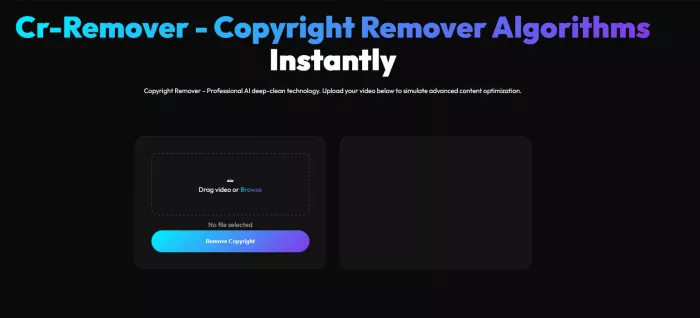
Despite the name, CR Remover does not literally remove copyright ownership from a video. It is better understood as a video-processing utility marketed around copyright-detection avoidance.
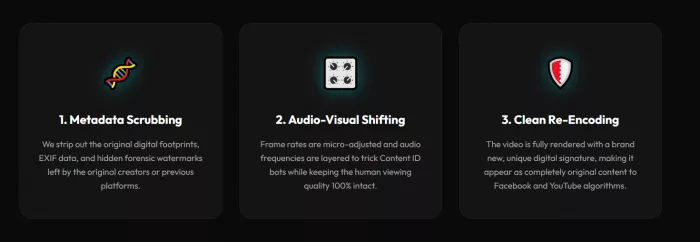
The workflow is straightforward: upload a video, let the service process it and download a newly rendered version. CR Remover says its system removes metadata and digital footprints, alters certain audio and visual characteristics, and then re-encodes the file with a different technical signature. It uses terms including "Metadata Scrubbing," "Audio-Visual Shifting" and "Clean Re-Encoding" to describe the process.
Some of those underlying operations are perfectly understandable. Metadata can be removed, audio can be processed and video can be re-encoded. What is harder to verify independently is whether those operations consistently produce the much bigger outcomes advertised, such as copyright immunity, guaranteed monetization or reliable avoidance of platform detection. That distinction shapes the rest of my view of the service.
Where It Fits in a Creator Workflow
CR Remover isn't really competing with CapCut, Premiere Pro, Final Cut Pro or DaVinci Resolve. Those applications handle the creative work: editing, pacing, captions, color, sound and graphics. CR Remover sits much closer to the final export stage.
| Stage | Typical Creator Workflow |
| Creation | Record original footage, tutorials, commentary, interviews or product content |
| Editing | Cut clips, add captions, music, graphics and narration |
| Export | Render the finished video at the required resolution and aspect ratio |
| Processing | Use a specialist utility such as CR Remover if additional file processing is actually required |
| Publishing | Upload platform-specific versions to YouTube, Instagram or Facebook |
| Conversion | Send viewers toward a bio link, product, affiliate offer, newsletter or brand campaign |
That makes CR Remover a fairly narrow tool. It won't improve a weak hook, make a Reel more entertaining or turn an average video into something people want to share. Its job begins after most of the creative work is already finished.
For high-volume publishers, that narrow role may still be useful. For creators who produce completely original content and already work with properly licensed assets, the need is much less obvious.
Getting Started Is Simple
The service has deliberately kept its interface basic. Instead of presenting dozens of encoding controls, the homepage revolves around uploading, processing and downloading a video. That keeps the technical barrier fairly low.
The free trial is less straightforward. CR Remover's pricing section says users need to join its Telegram group and request access, with uploads limited to 50 MB and a watermark added to the output. Another trial prompt on the same site, however, asks users to join its YouTube channel before continuing.
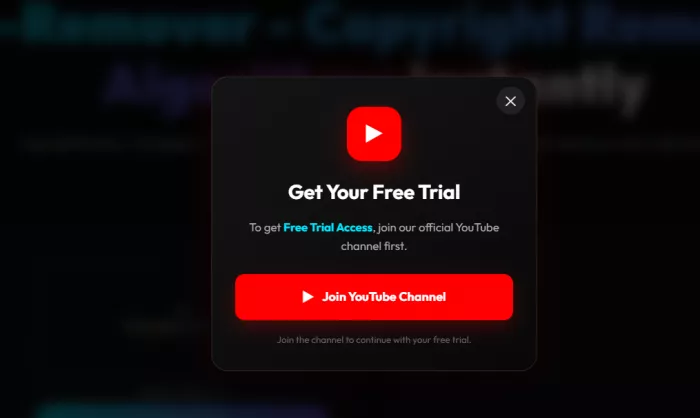
Neither step is especially difficult, but the mixed instructions make the trial feel less polished than a normal account-based signup. I would want the testing process to be clearer before deciding whether the paid workflow is worth using regularly.
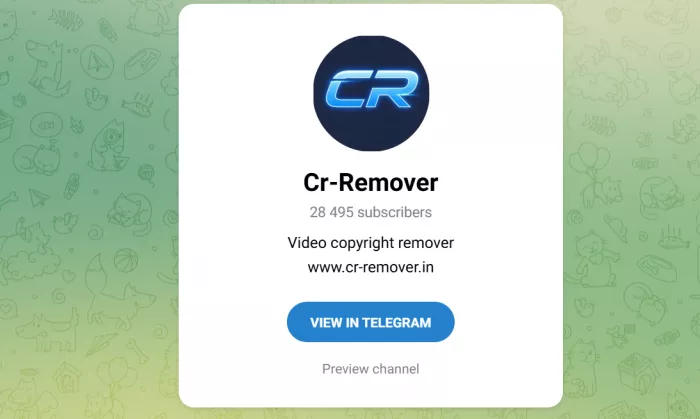
Paid plans increase the video allowance and add higher-resolution output, watermark removal and additional processing features. The interface itself is easy enough to understand; the larger questions concern what happens to the processed file once it reaches a social platform.
What Its Processing Really Means
CR Remover says it first strips metadata and hidden digital information, then makes small adjustments to visual and audio properties before completely rendering the video again. According to the company, the resulting file receives a new digital signature.
From a creator's point of view, there are two very different expectations you could have from this.
If the expectation is simply, "I want another processed and re-encoded version of my own video," the service is easy to understand. And if the expectation becomes, "This means copyrighted footage is now safe to upload and monetize," the situation changes considerably.
YouTube's reused-content rules look at whether a creator has added meaningful original commentary, substantial modification or educational or entertainment value. YouTube explicitly says that making minimal changes to somebody else's material can still violate its monetization policies even when no copyright claim is present. A different file signature therefore isn't the same thing as a different creative work.
Processing Doesn't Remove Ownership
This is the point I think new creators could misunderstand most easily. If I process a scene from a commercial movie through CR Remover, the studio does not stop owning that movie. If I process someone else's song, the underlying music rights don't disappear because the audio file has changed technically.
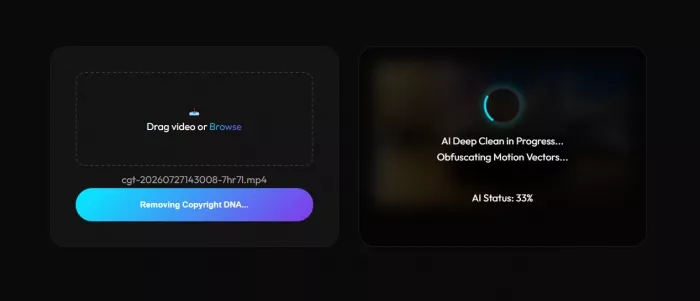
CR Remover's own Terms acknowledge this. They state that users are responsible for ensuring they have the legal right to modify and use uploaded videos. The same Terms say CR Remover accepts no responsibility if processed content results in a copyright strike, suspension or account ban.
That is a much more realistic description of the relationship between the tool and copyright. As a creator, I would therefore judge CR Remover as a processing service rather than treating the phrase "copyright remover" literally.
Content ID Is Only Part of the Problem
A creator can also make the mistake of treating one successful upload as proof that everything worked permanently.
Copyright enforcement does not happen as one single test. An upload could avoid an immediate automated match and still face a later claim, a manual rights-owner complaint or a separate monetization review.
More importantly, YouTube treats reused content separately from copyright. A channel can have no copyright claims and still lose monetization if reviewers cannot see enough original contribution in the videos. YouTube says this assessment can involve the videos themselves as well as titles, descriptions and broader channel context.
That creates several different issues creators should not mix together:
| Issue | What Actually Matters |
| Copyright rights | Whether you own the material or have permission to use it |
| Automated matching | Whether a platform detects protected audio or video |
| Reused content | Whether your version adds meaningful creative value |
| Monetization | Whether the content and channel satisfy revenue policies |
| Distribution | Whether the platform considers the content original and useful enough to recommend |
CR Remover's technical processing is most relevant to automated file recognition. It cannot automatically settle every other row.
Facebook Is Also Prioritizing Originality
The same distinction matters on Facebook. Meta said in March 2026 that Facebook is giving original creators greater reach and monetization opportunities while reducing distribution for unoriginal content. It considers content filmed or produced directly by a creator original, while third-party material needs meaningful new contribution such as fresh information, analysis or substantial improvement.
Meta also specifically says duplicative uploads and low-value edits such as adding borders, captions or changing playback speed can still be considered unoriginal.
This matters because CR Remover markets its processing as a way of making third-party clips appear original to algorithms. Technical alteration and creative originality, however, are not the same thing.
For creators interested in long-term monetization, that difference matters far more than whether the exported file is technically different from the source.
Cross-Posting Your Own Content Is Different
There is another creator scenario that often gets mixed into this discussion: posting your own video across several platforms. If I record and edit an original video, then publish versions to Instagram Reels, Facebook Reels and YouTube Shorts, I don't need to remove my own copyright. I already created the material.
My priorities would instead be maintaining image quality, using the correct dimensions, avoiding other-platform watermarks, checking whether music rights carry across services and adapting captions or hooks for each audience.
CR Remover's re-encoding or metadata tools might have a role if I have a specific technical reason to use them, but I wouldn't add another processing stage simply because I'm cross-posting.
A tool should solve an identifiable problem rather than become an automatic part of the workflow.
Where the Marketing Goes Too Far
This is where I became much more cautious about CR Remover. The website promotes ideas such as full copyright immunity, zero risk and safe monetization of various types of republished material. It also claims its processing can make videos appear original to Facebook and YouTube algorithms.
Its Terms are much less confident. They describe the service as being provided "as is," place responsibility for copyright rights on the user, and state that CR Remover has no liability for strikes, suspensions or account bans.
Those messages don't fit together particularly well. CR Remover can control what its software does to a file. It cannot control every future decision made by YouTube, Meta, a music company, a film studio or another rights holder.
For a creator earning money from an established profile, I would judge the service based on the processing it can directly provide rather than guarantees about what external platforms will do afterward.
Claims vs. Fine Print
The gap becomes easier to see when the sales language and policy pages are placed next to each other.
| What the site promotes | What the policies say | What I would take from it |
|---|---|---|
| Enterprise includes “Full Copyright Immunity” and a “0% Risk Guarantee.” | Users remain responsible for having the right to use their videos, and CR Remover accepts no liability for copyright strikes, suspensions or bans. | I would not treat the marketing language as a guarantee of what YouTube, Meta or a rights holder will do. |
| Starter and Pro Creator advertise one month of access, while Enterprise advertises four months. | The Terms describe a purchased pass as providing 24-hour access. | The actual access period should be confirmed before paying. |
| The site promotes advanced processing designed to bypass automated scanners. | The service is provided “as is,” with the consequences of uploading processed material remaining with the user. | The software can modify a file, but platform outcomes remain outside its control. |
None of this means the processing itself has no use. It means I would evaluate CR Remover on things I can actually observe, such as processing speed, output quality and workflow, rather than treating marketing promises as guaranteed publishing outcomes.
CR Remover Pricing
CR Remover currently has a free plan with a limited time period and three paid plans.
| Plan | Approx. Price | Video Allowance | Resolution |
|---|---|---|---|
| Free | Free | Limited access | Not clearly specified |
| Starter | $5.28 | 20 videos per month | 720p |
| Pro Creator | $9.51 | 50 videos per month | HD |
| Enterprise | $19.03 | 250 videos per month | 4K |
The unusual part isn't the pricing. It is the duration. The homepage advertises one-month access for Starter and Pro Creator and four months for Enterprise. CR Remover's Terms, however, state that purchasing a pass provides 24-hour access, while its Refund Policy also describes the service as a 24-hour pass that expires after 24 hours or once the applicable usage limit is reached.
The Refund Policy also states that all sales are final. I would therefore clarify the actual access period before purchasing, because 24 hours and one month are materially different offers.
What Other Users Say
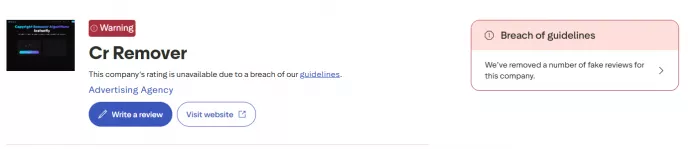
Trustpilot doesn't provide much reassurance at the moment. As of September 3, 2026, CR Remover's overall rating is unavailable because of a breach of Trustpilot's guidelines, and Trustpilot says it has removed a number of fake reviews associated with the company. Of the 134 reviews currently shown, about 50% are one-star and 3% are five-star.
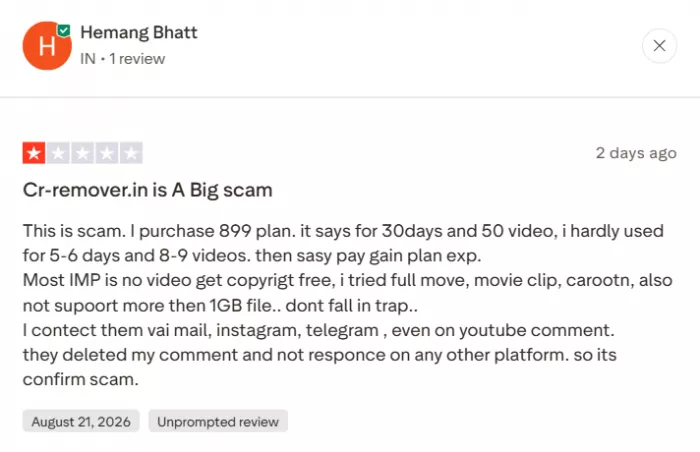
One recent reviewer who said they bought the ₹899 plan claimed that a 30-day, 50-video package expired after several days and fewer than ten processed videos. The same reviewer also complained about results and difficulty receiving support. That is one customer's allegation rather than independently established fact, but it is notable because the plan-duration complaint overlaps with the contradiction already visible in CR Remover's own Terms and pricing page.
Privacy Is Worth Checking
Any creator uploading unpublished footage into an online service should know what happens to those files. CR Remover says it collects phone numbers for account authentication, temporarily stores uploaded videos for processing and records payment transaction metadata. It says banking details and UPI PINs are not stored.
According to its Privacy Policy, uploaded and processed videos are permanently deleted within 24 to 48 hours, and the company says it does not sell, share or claim ownership of users' content. It also mentions third-party payment providers and Telegram APIs among the external services involved in its operation.
Those are useful stated policies, although they shouldn't be confused with an independent security audit. I would be more cautious with unreleased brand campaigns, confidential client footage or material covered by an NDA than with an ordinary social video.
What I Like
There are useful aspects of CR Remover if you separate the processing utility from the bigger copyright promises.
● The workflow is accessible to non-technical creators. Someone publishing at volume does not need to understand metadata structures, codecs or advanced export settings just to run a file through another processing stage.
● Its role in a creator stack is easy to understand. It doesn't try to replace editing, scheduling, analytics or bio-link tools. It is a specialist utility that sits near the end of production.
● It focuses on problems creators genuinely care about. Copyright claims, muted audio and monetization restrictions can have real business consequences. The problem is assuming that one processing tool can solve all of them.
What I Don't Like
My concerns are mostly about expectations rather than interface design.
● The strongest guarantees are difficult to reconcile with the Terms. Marketing "zero risk" while simultaneously disclaiming responsibility for strikes and bans creates a gap creators should notice.
● The plan-duration information needs clarification. A one-month package and a 24-hour pass are not small variations of the same offer, especially when purchases are non-refundable.
● The technical terminology can sound more definitive than the available evidence. Names such as DNA Scrubbing describe CR Remover's own system, but they don't independently establish guaranteed Content ID or monetization outcomes.
Who Might Actually Need It?
CR Remover makes more sense for high-volume publishers or social teams that own or are licensed to use their media and have a specific need for streamlined technical processing.
It makes considerably less sense for a creator who records original videos, edits them normally and uses properly licensed music. That creator is unlikely to need a dedicated "copyright remover" in every publishing workflow.
I would also avoid treating the service as the foundation of a strategy based on movie clips, sports broadcasts, copyrighted music or other third-party media. If a creator's revenue depends on a platform account, the health of that account is worth more than getting an individual clip through an automated check.
What I Would Do Before Paying
Before putting CR Remover into an active creator workflow, I would take a few practical precautions:
● Clarify the access period directly. The current sales page and policy documents give conflicting information, so I would want a clear answer before assuming I have a month or several months of access.
● Test it using content I own. That allows me to judge processing speed, visual quality, synchronization and workflow without turning copyright ownership into part of the test.
● Keep the original master file. Re-encoding can affect quality, and the processed version should not become the only copy of important creator or client footage.
● Judge the service on what it controls. Processing reliability, output quality and usability can be tested. Future decisions made by platforms and copyright owners cannot be guaranteed.
Better Creator Strategies Depend on the Problem
A lot of creator problems get grouped under "copyright" even though they require different solutions. If I need music, I would start with tracks I have the right to use. If I'm turning a podcast into Shorts, I need good editing and repurposing. If I'm building reaction or commentary content, my creative contribution should be obvious. If someone is stealing my original videos, I need rights-management and reporting tools.
For monetization, adding genuine value remains much more defensible than making invisible technical changes. YouTube specifically gives examples such as critical reviews, sports footage accompanied by explanation, reaction videos with commentary and third-party footage that has been substantially edited into a new story. Copyright rules can still apply separately, but these examples show what the platform means by meaningful transformation. That approach also gives creators something much more valuable than a modified file signature: a recognizable point of view.
Final Verdict
CR Remover makes more sense once you stop interpreting its name literally. At its core, it is a specialized video-processing service that cleans metadata, modifies certain audio and visual properties and re-encodes video into a new file. Creators who legitimately need that type of processing may find the straightforward workflow useful.
Where I become cautious is the promise surrounding that process. Copyright ownership doesn't disappear because a file has been technically modified, and YouTube or Facebook can still evaluate whether a creator has actually contributed something original. The conflicting information around plan duration, strict no-refund policy and unusual Trustpilot status are also reasons I would research carefully before paying.
So would I recommend CR Remover to creators? Only as a narrowly defined processing utility for material they own or legitimately have permission to use. I would not rely on it as a shortcut for turning third-party copyrighted clips into guaranteed safe, original or monetizable content.
For creators building businesses around YouTube, Instagram, Facebook or a link-in-bio profile, the account itself is the valuable asset. Clear content rights, meaningful original contribution and a publishing workflow you can sustain offer far more long-term protection than any promise that a technically altered video will become invisible to copyright systems.


Comments