
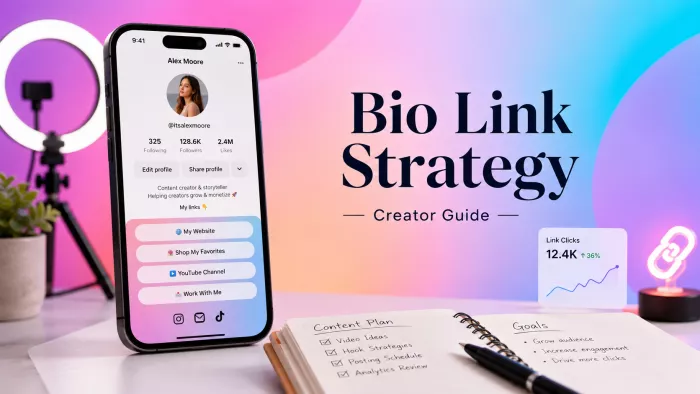
Every TikTok account gets exactly one clickable link. Not one per video, not one per campaign one, sitting under your username, quietly responsible for connecting an unlimited number of views to anything that happens off the app. Most people paste a homepage into that slot the day they qualify and never look at it again.
That's the whole problem, and it's worth sitting with for a second, because the bio link is a strange piece of real estate. It's the highest-friction step in your entire funnel. A viewer has to finish the video, tap through to your profile, then tap a second time to leave TikTok completely. Nobody does that by accident. So the small group of people who click have already told you something valuable: they want more than the video gave them. The only question left is whether what they land on is worth the trip most of them won't take.
The link is a doorway, not a destination
If you take one idea from this guide, take this one. The native website field on your profile is not a strategy. It's plumbing. It's the pipe, not the water. The strategy is entirely in what sits on the other side of the tap, and that's the part almost nobody plans.
The field on your profile isn't the strategy. It's the doorway. What happens after the click decides whether the traffic turns into anything.
The mental shift is small but it changes every decision that follows. Stop asking “what should my link be.” Start asking “someone just finished this specific video and tapped twice to get here, what is the single most useful thing they could do next?” That reframing is the difference between a profile that leaks attention and one that converts it. It also explains why so much generic advice (“just get a Linktree”) misses the point: a tool doesn't answer the question. You still have to decide what the click is for.
Who can actually add a link and the rule nobody agrees on
Before the strategy matters, you need the field to exist. TikTok treats account types differently, and this is where most tutorials are either outdated or quietly wrong.
BIO LINK ACCESS BY ACCOUNT TYPE
| Account type | Clickable link? | The catch |
| Business | Yes no follower minimum, even at zero followers | You're limited to the Commercial Music Library, so trending sounds are off the table |
| Personal / Creator | Widely reported as unlocking at 1,000 followers | The threshold itself is what's disputed see the note below |
The business account is the fast lane. Switch, pick a category, and the website field appears immediately. But that speed carries a real cost for a lot of creators: business accounts lose access to TikTok's full music catalogue and are restricted to cleared commercial tracks. If trending audio is part of how your videos get reach, that trade matters more than the instant link. Weigh it honestly instead of switching on reflex.
CHECK YOUR OWN PROFILE FIRST TikTok has changed the bio-link requirement more than once, so the exact follower threshold for a personal account isn't something to take on faith. Your own account is the reliable test: open Edit Profile and look for the Website field. If it's there, you're eligible; if it isn't, you're not whatever a follower number might suggest. For the official current rule rather than a guess, TikTok's Help Center is where it's confirmed. Platform requirements shift quietly, and what's true this quarter may not hold the next. |
A few mechanical details trip people up constantly, regardless of account type:
● The link lives in the mobile app only. The website field does not appear when you edit your profile on the desktop. People burn a surprising amount of time hunting for it in a browser before realising it was never there.
● The URL needs the full https:// prefix. TikTok won't add it for you, and without it your “link” renders as plain grey text nobody can tap. Always open your profile in incognito or on a second device afterward to confirm it's actually clickable.
● Some domains are blocked outright. Known phishing, crypto-scam, and adult infrastructure get filtered, and a link that trips the filter simply won't save. If a legitimate URL keeps failing, route it through a reputable link tool instead.
If you're not eligible yet
Under the threshold and on a personal account? You still have moves, they're just clumsier. Pin a comment on your best-performing video with the URL written out. Point people to a platform where you do have a live link (“full guide's in my Instagram bio”). And make the bio text itself carry the instruction, since motivated viewers will copy a plain URL if you tell them exactly where it goes. None of this beats a real clickable link, but it keeps the pipeline from going completely dark while you cross the line.
One link, or a link hub?
Here's the debate every creator eventually runs into, usually right after their first viral video. You've got one slot. Do you point it at a single destination, or at a hub page that fans out into ten links? The honest answer is that it depends and the people selling you link tools have an obvious incentive to skip that nuance.
The counterintuitive part: for most conversion goals, a single specific destination beats a multi-link page. When a viewer arrives warm and impatient, a page with ten buttons asks them to make a decision you should have made for them. Every extra choice is a chance to do nothing. A dedicated landing page that matches the video they just watched almost always outperforms the “wall of links” for anything you're actively trying to sell.
But single-link purism falls apart the moment your account does more than one thing. Plenty of creators are, at the same time, selling a product, growing a newsletter, booking calls, and pushing new content. Funnelling all of that into one homepage produces confusion, not momentum. So the real principle isn't “one link good, hub bad.” It's this:
Your bio link needs one primary job per campaign not one job forever.
A hub is fine. What's not fine is treating it like a storage closet for every URL you've ever owned. If you use one, it should behave like a routing layer with a clear hierarchy: the thing you're promoting this week sits at the top, unmissable, and the rest fades into a supporting cast. A good link page still answers “what's the one action” the second it loads. A bad one makes the visitor do triage. A rough way to decide:
● Send to a single destination when you're running a campaign, launching one product, or your account genuinely has a single obvious next step. Focus wins here.
● Use a hub when you truly juggle several offers that different segments of your audience want but design it with one clear priority on top, not ten equal buttons competing for the same tap.
The same principle applies when building a link-in-bio landing page that converts: give the strongest action visual priority and make secondary destinations genuinely secondary. A visitor who already made the effort to leave TikTok should not have to decode the page before deciding where to go.
Picking the destination
The most common mistake in this entire game is linking to a homepage. It feels safe and professional. It also converts terribly, because a homepage is built for people who already know your brand and are willing to browse. TikTok traffic is the opposite: it arrives fast, hot, and context-free, carrying the energy of a fifteen-second video, and a sprawling homepage kills that momentum instantly.
The fix is to think in stages. Your profile is the awareness moment. The click is the intent signal. The destination is where the action either happens or doesn't. Each stage has a job, and the destination's only job is to convert the intent the click already proved so it needs to feel as immediate and specific as the content that sent them. If a video sold a specific thing, the link should land on that specific thing, not the front door of a building they now have to navigate. Destination should track the kind of creator you are and what a “win” actually means for you:
MATCHING THE LINK TO THE GOAL
| If you're a | Send them to | Because |
| Coach / consultant | A booking or application page for one specific call | Your revenue is qualified conversations, not traffic; filter for intent, don't just collect clicks |
| Product seller | The exact product from the video, not the storefront | Warm buyers lose interest fast when made to search a catalogue for what they just saw |
| Writer / educator | A newsletter sign-up with one clear promise | You're capturing an audience you own, off a platform you rent |
| Service pro (barber, tattoo) | A booking page or a single “message to book” step | The next action is concrete and local; cut every click between interest and appointment |
| Broad creator / brand | A tightly ordered hub, top item weighted heavily | Multiple real offers exist, but attention still needs a hierarchy to act on |
Whatever the destination, keep the path short. Attention leaks at every step, and outside the addictive pull of the app itself, patience drops off a cliff. As a working rule, treat anything past three screens between the video and the conversion as a leak you're choosing to accept. Cut fields, turn on autofill, drop the optional questions. Every extra thing you ask for is a reason to close the tab.
The CTA problem: convert without killing your reach
This is the section most creators feel but can't name. You add a blunt “link in bio, go buy it” to a video, and your completion rate drops people bail the moment it turns into a pitch. TikTok's distribution reads that drop-off as a sign the video isn't holding people, and quietly throttles it. So it looks like a cruel choice: convert, or reach. Pick one.
The trade-off is largely an illusion, and the reason is placement. A call to action isn't one thing you either include or don't; it's several tools that belong at different points in the viewer's attention. Get the placement right and you can drive action without the algorithm punishing you for it.
● In-video, spoken and soft. A quick verbal nudge (“there's a full breakdown on my profile”) near a natural moment reads as helpful rather than salesy, and it doesn't sit on screen bleeding watch time the way a hard graphic does.
● In the caption, specific. The caption is where a clear instruction can live without interrupting the video itself. It's a better home for “grab it in my bio” than a mid-video overlay begging people to leave.
● In the bio, doing the closing. By the time someone reaches your profile, the video already did the persuading. The bio and the link finish the job which means the video never has to hard-sell in the first place.
The pattern underneath all three: let the content earn the attention, and let the profile convert it. When you stop asking a fifteen-second video to also be a sales page, the false choice between reach and revenue mostly dissolves.
Your bio is pre-sell space, not a name tag
The bio text and the link are a pair, and the bio does more work than people give it credit for. A good one pre-sells so the link has to do less. By the time someone taps through, they should already know what they're getting and why it's worth it. The destination just delivers on a promise the bio already made.
That means the bio isn't the place for a vague vibe or a stack of emojis. It's a single, concrete line about what you offer and what the person should do about it, written in plain, active language. “I help X do Y free guide below” gives the click a reason. “✨ dreamer · creator · vibes ✨” gives it nothing. Say what the thing is, say what to do, and let the link close the loop. Under the character limit, every word is prime space, so don't spend it on decoration.
Measure it, or you're just guessing
Here's where you separate strategy from superstition. If you're only watching views and likes, you have no idea where your money is actually leaking. The path from impression to conversion is a funnel, and people fall out of it at every stage. The trick is knowing which stage, because each leak has a different fix. A rough shape of it, to read as directional rather than exact:
3–5% Viewers → profile visits Only a small slice of people who see a video ever tap through to the profile at all.
10–20% Profile visits → clicks Of those visitors, a fraction take the second tap and leave the app. Well-optimised profiles push past the high end.
0.5–3% Clicks → conversions And of the clicks, only some complete the action. This stage swings enormously by offer and destination quality.
Treat these as the shape of the thing, not exact targets. Real numbers vary wildly by niche, price point, and how warm your audience is reported conversion rates for TikTok bio traffic tend to run higher than Instagram's, but “your mileage will vary” is the only honest headline. The point isn't the digits; it's that you can finally see where you're losing people. Once you can, diagnosis gets simple, and the fix depends entirely on which stage is bleeding:
READING THE LEAK
| The symptom | What it's telling you | Where to fix it |
| Views but few profile visits | Your content isn't making people curious about you | The video's hook and your reason-to-follow |
| Visits but few clicks | Your profile promise is weak or unclear | Bio copy, and how obviously it names the next step |
| Clicks but few conversions | The destination doesn't deliver on the click | The landing page friction, mismatch, or too many steps |
Two tools make this measurable instead of vibes-based. First, add UTM tags to your bio link so your analytics can tell TikTok traffic apart from everything else, and so you can eventually trace which videos drive clicks. Second, use a branded short link rather than a generic shortener recognisable links reportedly lift click-through meaningfully (industry estimates put it in the tens of percent), because a URL carrying your name reads as trustworthy instead of suspicious. A branded short link with an editable destination is even better: you can change where it points without ever changing the URL people have already seen.
Looking beyond total clicks is equally important. Good link-in-bio analytics should show where visitors came from, which destination they chose and whether that traffic eventually produced the action the page was built for.
Advanced moves
These aren't for your first week. But once the basics run themselves, this is where the extra points come from.
● Rotate the destination to match your content calendar. The link isn't a monument. High-output creators repoint it every week or two so it always matches whatever they're currently pushing. Keeping the URL editable means you swap the target, not the link.
● Use TikTok Shop natively where it fits. For physical products, keeping the purchase inside the app removes an entire off-platform hop. Weigh native checkout against sending people to a page you fully control the right call depends on margins, catalogue, and how much you value owning the customer data.
● Track across platforms with distinct links. If you post the same offer to TikTok, Instagram, and YouTube, give each a separate trackable link to the same destination. Now you can see which platform earns its keep instead of guessing.
● A/B test the destination, not just the video. Same traffic, two landing pages, and let the conversion rate settle the argument. Most creators obsess over the video and never question the page the clicks land on which is often exactly where the money is being lost.
Mistakes that quietly cost you
● Treating the link as set-and-forget. The single most expensive habit. A stale campaign page still sitting in your bio months later is dead traffic you're paying for in attention.
● Dumping everyone on the homepage. It feels professional and it converts like a brochure left in a lobby. Match the destination to the video.
● The fifteen-link graveyard. A hub with a dozen equal buttons isn't a strategy, it's indecision made public. Prioritise ruthlessly or go single-link.
● Forgetting the https:// . A link that isn't actually clickable is worse than no link, because it looks like you tried. Test it from a second device, every time.
● Ignoring the numbers entirely. If you never look at profile-visit rate, click-through, and conversion, you're optimising blind and calling luck a strategy.
Choosing a link-in-bio tool
Choosing a link-in-bio tool should come down to how well it supports real traffic and campaign management, not how polished its templates look. At minimum, it should provide per-link analytics so you can see which destinations attract clicks, let you update destinations without changing the public URL, and load quickly on mobile connections. Those basics matter far more than decorative features because they directly affect what you can measure and how easily you can adapt the page.
It is also worth choosing a tool that supports a branded or custom domain and has a strong reputation for working reliably with TikTok. A recognizable URL can make the page feel more trustworthy, while a tool with domain or platform-compatibility issues can create unnecessary friction. If a service performs well across analytics, editing flexibility, speed, branding, and TikTok compatibility, the specific brand becomes much less important.
Treat the doorway like it's worth somethingStrip away the tactics and one idea carries the whole strategy: your bio link is the doorway between free, unlimited attention and an actual business, and the people who tap it already decided they wanted more. Waste it on a homepage and a stale URL and you leak your warmest traffic. Treat it deliberately and a single link quietly does the work of a sales team. Keep the process simple: confirm your TikTok account can use a clickable bio link and test it, decide the main job that link should perform, and send visitors to a destination that closely matches your content. Let the profile and landing page handle most of the conversion work, then track profile visits, link clicks, and final actions so you can fix the exact stage where people are dropping off. The creators who win here aren't running secret tactics. They just stopped treating one of their most valuable pieces of real estate like an afterthought. That's the whole edge, and it's available to anyone willing to think past “paste the URL and forget it.” |


Comments