Vanity URLs Explained: How They Work, When to Use One and What Breaks

Christine Davis
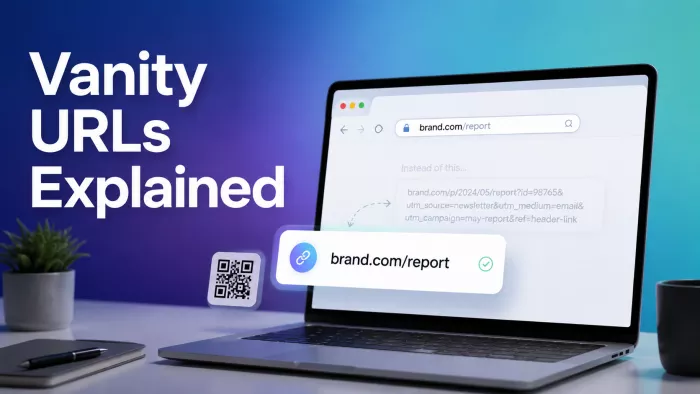
A vanity URL is the easiest thing in marketing to ship and one of the hardest to retire. Someone requests brand.com/spring, a developer adds a redirect rule, and it works. Nobody writes down who owns it. Two years later the campaign is dead, the developer has left, and the rule is still there quietly pointing at a page that is 404s, sitting on a printed brochure somewhere with a five-year shelf life.
That gap between how trivial these links are to create and how long they have to keep working is the whole subject. This piece covers the mechanics DNS, redirect codes, certificates, caching and then the parts most guides skip: what a redirect does to your analytics, how an abandoned one becomes an attack surface, and why the shortest links on the internet depend on the domain policies of countries most marketers have never thought about.
What a vanity URL actually is
A vanity URL is a web address chosen to be read, remembered and typed by a person, standing in for one that was generated by a machine. That's the entire definition. Everything else is implementation.
The default: shop.example.com/c/2847?ref=camp_id=99823&sess=a91f. The vanity version: example.com/spring. Same destination, one of them survives being read aloud on a podcast.
What trips people up is that a vanity URL is not a thing you buy. It's a naming decision that gets implemented using three separate pieces of infrastructure: a domain, a DNS record, and a redirect or rewrite rule each of which can fail independently. It is also none of the following, though the terms get used interchangeably: a link shortener (a service that generates opaque links, usually on someone else's domain), a UTM-tagged link (parameters bolted onto a URL for tracking), a deep link (an address that opens a specific screen inside a mobile app), or a canonical URL (the version you've told search engines to treat as authoritative). A single link can be all of these at once, which is exactly why they get muddled.
Why they exist: shortening broke, and branding fixed it
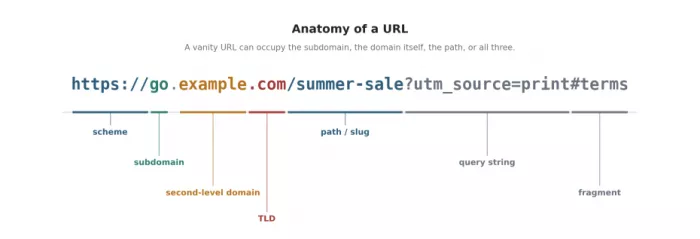
Short links were originally a workaround for a formatting bug. Early email clients wrapped long URLs across lines, and the second half arrived as unclickable text. TinyURL and its successors solved that by trading a long address for a short opaque one.
Then character limits on SMS and social platforms made shortening near-universal, and every major platform built its own wrapper. That created a new property nobody had thought hard about: a link where you cannot see the destination before you click it. Phishing operators noticed immediately. Within a few years, a shortened link in an email had gone from convenient to suspicious, and plenty of corporate mail filters started stripping them on sight.
Branded short domains are the correction. If the domain itself carries a recognisable name, the link becomes self-attesting you can tell who sent it before you click. The industry created the trust problem and then sold the fix, which is a fairly ordinary arc, but it explains why so much of vanity-URL practice is really about signalling legitimacy rather than saving characters.
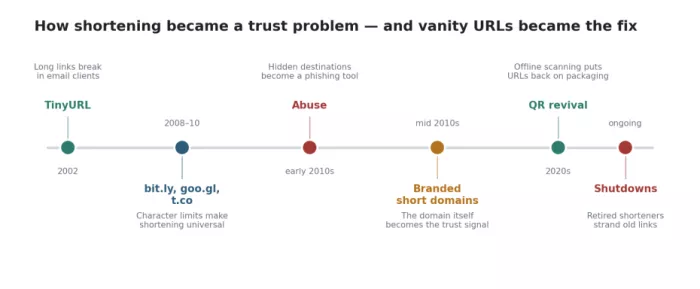
The last stop on that timeline matters more than it looks. QR codes brought URLs back onto physical objects packaging, posters, table tents, museum labels and physical objects have long lives. A URL printed on a wine label needs to resolve for as long as the bottle exists. That's a very different maintenance commitment from a link in a tweet.
The seven kinds and how to choose between them
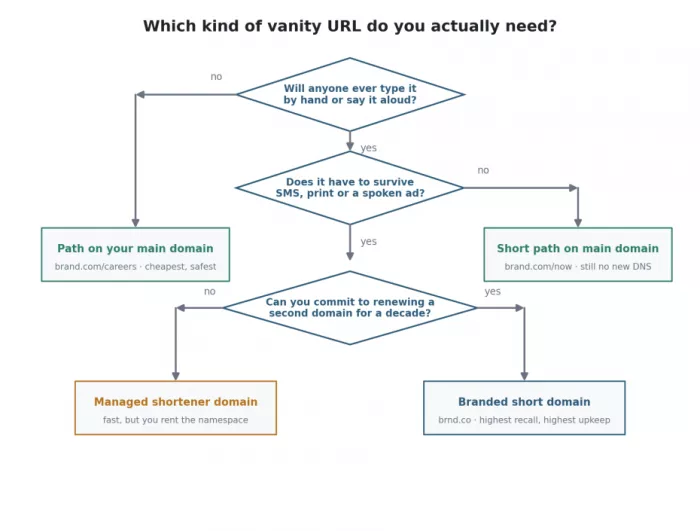
Most guides list types. It's more useful to sort them by the decision you're actually making, which is a trade between how short the link needs to be and how much long-term maintenance you're willing to accept.
| Type | Example | Setup | Best for | The catch |
| Path on primary domain | brand.com/careers | Trivial | Anything that doesn't need to be tiny | None worth mentioning this should be your default |
| Subdomain | shop.brand.com | DNS + certificate | Content on separate platforms or stacks | Treated semi-independently by search engines; needs its own cert |
| Branded short domain | brnd.co/sale | Domain + DNS + cert + tooling | Print, SMS, radio, packaging, QR | A second domain to renew forever; often a foreign ccTLD |
| Standalone campaign domain | trythisthing.com | Full domain setup | Launches with their own identity | Highest recall, worst afterlife; usually abandoned |
| Platform handle | linkedin.com/in/name | Claim it in settings | Profiles, bios, business cards | You rent it. Platforms reclaim, rename and expire handles |
| Internal "go" links | go/payroll | Internal DNS or proxy | Intranets, runbooks, docs people quote in meetings | Breaks off-network unless you plan for it |
| Device-aware link | brnd.co/app | Link platform | One link routing to iOS, Android or web | Adds a decision layer that can misfire on new devices |
The honest summary is that most organisations reach for a branded short domain when a path on their main domain would have done the job at a fraction of the cost. The test below is worth applying before you register anything.
The plumbing
DNS and why your root domain is fussy
A branded short domain points at a redirect service through DNS. For a subdomain, that's usually a CNAME record with an alias saying "ask about this other hostname instead." At the root of a domain (brnd.co with nothing in front of it) you generally can't use a plain CNAME, because the specification doesn't allow a CNAME to coexist with the other records a zone apex must carry. Providers work around this with proprietary record types ALIAS, ANAME, CNAME flattening that resolve the alias on their side and hand back an address record. If your registrar's DNS doesn't offer one, that alone can decide which provider you use.
One operational detail people learn the hard way: lower your TTL a day or two before any cutover. TTL tells resolvers how long to cache an answer, and a comfortable 24-hour TTL becomes 24 hours of stale routing at exactly the moment you need to change something.
Redirect codes, in terms of what they cost you
Status codes are usually explained by definition. It's more useful to think about consequence what the browser caches, what a search engine infers, and how hard the decision is to reverse.
| Code | Means | Search engines infer | Practical consequence |
| 301 | Moved permanently | Move the ranking signals to the new URL | Aggressively cached by browsers. Hard to undo visitors may keep following it long after you change the rule |
| 302 | Found (temporary) | Keep the ranking on the original URL | Safe for genuinely temporary routing; quietly wrong for a permanent vanity link |
| 303 | See other | Rarely relevant | Forces a GET after a form submission; a POST/redirect/GET pattern, not a vanity tool |
| 307 | Temporary, method preserved | Same as 302 | Use when a POST must stay a POST |
| 308 | Permanent, method preserved | Same as 301 | The strict modern counterpart to 301 |
For a vanity URL that's meant to last, a 301 (or 308) is correct. The caching behaviour is the part worth respecting: browsers may hold a 301 for a very long time, so a 301 pointed at the wrong destination and then "fixed" can keep sending returning visitors to the old place. If you're unsure a destination is final, ship a 302 first and promote it later.
Three other methods exist and all of them are worse. A meta refresh tag delays the redirect in the page itself, which is slow, poorly interpreted by crawlers, and disorienting for screen-reader users. A JavaScript redirect fails entirely if the script doesn't run. Frame masking loading the destination inside a hidden frame so the vanity address stays in the bar breaks bookmarking, sharing, analytics and accessibility all at once, and it is still, somehow, sold as a feature by some registrars.
Redirect, rewrite or proxy
There's one question that separates these: does the address in the browser bar change?
• Redirect the server's answers with a status code and a new location. The bar changes. One extra round trip. Simple to reason about, simple to audit.
• Rewrite the server maps the pretty path to the real one internally and serves the content directly. The bar doesn't change. No extra round trip, no split between two addresses, but the logic lives in your server config and is easy to forget about.
• Reverse proxy the server fetches the content from somewhere else entirely and serves it as its own. The bar doesn't change. Powerful for stitching platforms together under one domain; the most operationally demanding of the three, and the easiest to accidentally turn into a duplicate-content problem.
Rewrites are technically better for both speed and SEO. Redirects win in practice because they can be managed by people who don't touch server configuration, which is usually the actual constraint.
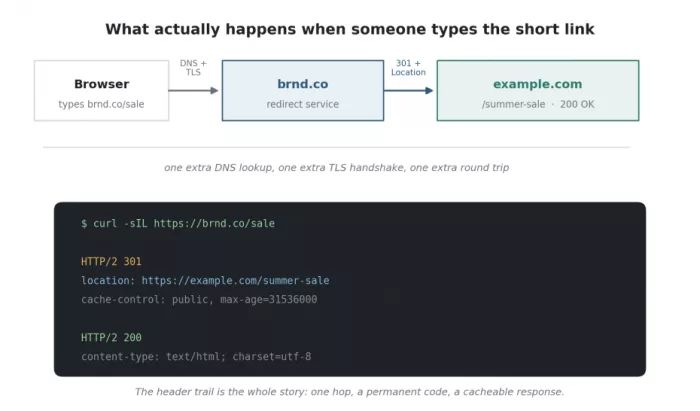
What a hop costs
Every redirect adds a DNS lookup, a TLS handshake and a round trip to a server that has nothing to offer except an instruction to go somewhere else. On a fast desktop connection this is invisible. On a congested mobile network it is not, and it compounds: three hops means three of everything.
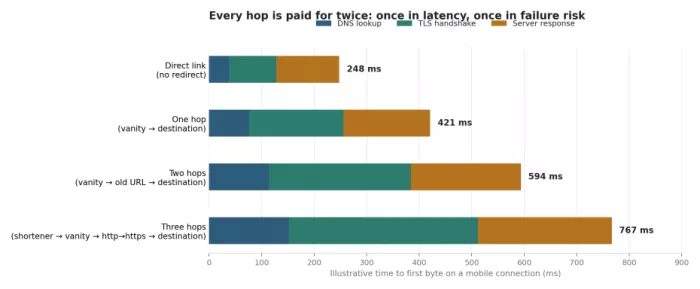
Chains form without anyone deciding to create one. A campaign link points to a page; the page later moves and gets its own redirect; someone adds an http-to-https rule; a shortener gets layered on top for a social post. Nobody added more than one hop, and now there are four. Audit for this specifically a crawler or a scripted check across your redirect table will find chains and loops far faster than anyone will report them.
The QR code is a second link you also have to maintain
A QR code is a vanity URL with a worse failure mode, because the thing carrying it is printed and the thing it points at is not. A static code bakes the URL into the pattern, so repointing it means reprinting. A dynamic code adds a redirect hop that lets you repoint later and hands you one more dependency that can expire or start charging.
Encode the shortest URL you can — density is legibility, and a long one becomes a grid a cheap camera in bad light won't read. Keep the quiet-zone margin designers delete and printers trim. Test the printed code at the size and distance it'll actually be scanned, on a genuinely cheap phone. And govern the redirect behind a dynamic code like any other, because the code on the poster is only as alive as the rule it resolves through.
Certificates, case and the small stuff that breaks things
• Every vanity domain needs its own valid certificate. A short domain with an expired cert produces a full-page browser warning, which is worse than a dead link because it looks like an attack. Automate renewal and monitor expiry separately from the redirect itself.
• Don't redirect through http. A link printed without the scheme will be tried over http first by some clients, adding a hop before the real redirect. HSTS, and a preload entry if you're committed, removes that hop for repeat visitors.
• Domains are case-insensitive; paths often aren't. A slug printed in title case on a poster can 404 on a case-sensitive server. Force lowercase, and accept mixed case with a normalising redirect rather than assuming everyone types carefully.
• Pick a trailing-slash and www convention and enforce it. Both variants resolving independently is a duplicate-content problem you'll never notice until an audit surfaces it.
Search, analytics and the numbers that never match
What passes through, and what doesn't
A permanent redirect passes ranking signals to the destination. A temporary one, by design, doesn't. That single distinction accounts for most of the SEO damage vanity URLs cause, and it's almost always a copy-paste error rather than a decision.
Beyond that: set rel="canonical" on the destination page so search engines know which address is authoritative; keep vanity URLs out of your sitemap, which should only ever list canonical destinations; and don't let a vanity version get indexed instead of the real page, which happens when a rewrite serves identical content at two live addresses. If you run a multi-region site, be especially careful. A vanity layer sitting on top of hreflang annotations is a reliable way to send European visitors to the American page and keep them there.
Measurement and its blind spots
Distinct vanity URLs per placement are the cleanest answer to the oldest question in offline advertising: which billboard worked? One URL per placement not per campaign and one QR code per placement, so the station poster and the magazine spread are distinguishable in your logs.
Two things will make your numbers disagree with each other, and it's better to know why in advance than to argue about it in a meeting:
• Referrer loss. Passing through a redirect can strip or replace the referrer, depending on the referrer policy in play and the schemes involved. Traffic that came from a real source shows up as direct, and your channel attribution quietly understates whatever the vanity link was serving.
• Click counts are not visit counts. Link platforms count requests. Bots, security scanners, email prefetchers and messaging apps generating link previews all make requests. Your analytics counts sessions with a script that ran. A 20–40% gap between the two is unremarkable; a consistent gap that suddenly changes is the signal worth watching.
Server logs are the underrated tool here. They capture requests the JavaScript never saw, and they're the only place you'll find the mistypes the near-miss slugs people actually entered, which tell you whether your URL passes as a spoken word or not.
Links in email are a spam-filter decision
A redirect that behaves perfectly on a landing page can hurt you in an inbox. Filters judge a message by its links, and a link whose visible domain differs from its real destination is exactly the shape of phishing — which is what a redirect through a short domain is at the byte level. A brand-new short domain with no reputation, pointed at by every link in a send, can tip a message into spam without anyone touching the copy.
Warm a domain before routing bulk mail through it, and keep the tracking redirect on a subdomain of your own sending domain so the link aligns with where the mail comes from. Most email platforms already wrap your links in their own redirect, so the recipient's click is often two hops before your vanity layer adds a third.
Privacy
A click-tracking redirect is a data collection point sitting between a person and the thing they asked for. It sees the request, the referrer, the user agent and the IP address, and in many jurisdictions that's regulated processing. If the redirect runs on a third-party domain, it's a third-party collection with all the consent implications that carry. Running it on your own domain is both better for trust and simpler to defend. This is worth a conversation with whoever owns privacy compliance before you wire a tracking layer into every printed asset you own.
The risks nobody budgets for
Open redirects
An open redirect is an endpoint that will forward a visitor to any destination supplied in the URL brand.com/go?url=anything. It's a long-standing vulnerability class, and it's valuable to attackers precisely because the visible domain is yours: a phishing link that starts with a bank's real domain gets clicked. Never redirect to a destination taken from user input without checking it against an allowlist of permitted targets. "We validate that it starts with our domain" is not sufficient; that check has been bypassed with lookalike hostnames more times than anyone can count.
Dangling records and subdomain takeover
This is the failure mode most teams have never heard of and are most likely to be exposed to right now. You point a vanity subdomain at a third-party service. Later the campaign ends and someone cancels the vendor account but nobody removes the DNS record. The vendor releases the hostname. Anyone can now claim it and serve their own content from an address that carries your domain, your certificate, and every scrap of trust attached to both.
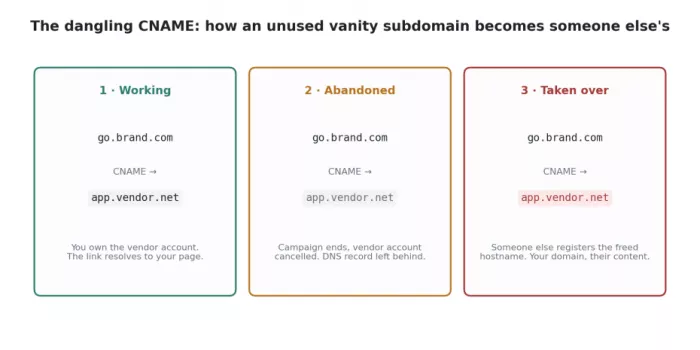
The fix is procedural, not technical: DNS records get removed as part of decommissioning a service, not weeks later. Inventory every CNAME you own and check that each target still resolves to something you control.
Typos, lookalikes and expiry
• Register the obvious mistypes of any short domain you print, and redirect them. Transposed letters, doubled characters, the singular and plural.
• Watch for lookalike registrations using visually similar characters from other scripts. These render almost identically in a browser bar and are a standard phishing technique.
• Put registrar lock and two-factor authentication on the account holding the domain, and treat DNS access as the sensitive credential it is. Control of your DNS is control of your brand's mail, links and certificates.
• Set every vanity domain to auto-renew and put a human calendar reminder on it as well. An expired vanity domain gets picked up by someone else, and every printed asset carrying it becomes an advert for whatever they put there.
Trademark and the fact that a handle is a tenancy
Registering someone else's mark as a domain to profit from it is a recognised abuse with established dispute processes; being on the receiving end is slow and expensive. Defensive registration of the obvious variants is cheaper than a dispute, though it has no natural stopping point, so set a budget rather than trying to be exhaustive.
Platform handles deserve separate thought. A profile URL feels like an asset and isn't it's a tenancy governed by terms that let the platform reclaim, rename or expire it, sometimes to resolve a trademark complaint, sometimes because a policy changed. Claim your handles early on every platform you might ever use, keep the accounts active enough not to be reaped, and never print a platform handle as your primary call to action when you could print a domain you own. (This is general background rather than legal advice; anything contentious belongs with a lawyer in your jurisdiction.)
The part nobody mentions: whose country is your domain?
Almost every memorable short domain is a word-hack on a country's namespace. The two- and three-letter endings that make short links possible are country-code top-level domains, and they are administered under national policy.
| Ending | Belongs to | Commonly read as |
| .ly | Libya | adverbs bit.ly, ow.ly |
| .io | British Indian Ocean Territory | tech shorthand for input/output |
| .tv | Tuvalu | video and broadcast |
| .fm | Federated States of Micronesia | audio and radio |
| .me | Montenegro | personal branding |
| .co | Colombia | a near-miss for .com |
| .ai | Anguilla | artificial intelligence |
| .gg | Guernsey | gaming |
This isn't trivia. A ccTLD registry sets eligibility rules, pricing and content policy under the authority of a territory, and those can change. Registries have suspended domains over content that was legal where the registrant lived but not where the registry sat. Renewal pricing on desirable endings has climbed sharply once a market developed. Territorial and sovereignty questions have, at various points, raised real speculation about the long-term future of particular endings; the arrangements that keep a two-letter code delegated to a registry are not permanent laws of nature.
When you print a branded short domain on a million pieces of packaging, you are making a decade-long bet on a namespace you licence annually from a foreign registry.
None of this means don't use them. It means the risk should be named and owned rather than discovered. Practically: prefer endings with stable, well-documented registry policy; read the terms before you commit a brand to one; keep a fallback path on your own primary domain that resolves to the same destination, so that if the short domain ever becomes unusable you have somewhere to redirect and something to print in the next run.
Governance: who owns the redirect table?
Ask this in any organisation over a few hundred people and watch the silence. Redirects are created by marketers, implemented by developers, and owned by nobody. They accumulate for years, they're invisible when they work, and the first sign of trouble is a customer complaint or an SEO audit.
A vanity URL registry solves most of this and takes an afternoon to set up. One row per link, with:
• The vanity URL and its current destination
• A named owner a person, not a team inbox
• Why it exists, and where it appears (print run, packaging batch, ad campaign, conference badge)
• The redirect type in use, and the date it was created
• A review date, and an explicit end-of-life decision: keep permanently, retire on a date, or convert
• Domain expiry, where it isn't on your primary domain
Add three light process rules on top. First, a documented naming convention, so slugs are predictable rather than negotiated case by case. Second, one gate for creation a request goes through a single route so nothing is added ad hoc and unrecorded. Third, an automated check that walks the whole table on a schedule and reports 404s, chains, loops, certificate expiry and redirects whose destination now redirects again. That job is fifty lines of script and it is the single highest-return thing in this article.
The offboarding question When the person who set up a vanity URL leaves, does anyone know it exists? If the answer is no, the link is already orphaned; it just hasn't broken yet. Make the registry part of handover, the same way you'd hand over an account or a repository. |
Retirement and how long is long enough
Retiring a vanity URL is a judgement about the media it was printed on. A link that only ever appeared in email can be retired quickly. One printed on packaging should outlive the shelf life of the product, plus however long people keep the box. After a rebrand, keep the old redirects for years rather than months. The cost is a line in a config file, and the alternative is breaking every link anyone ever saved or cited.
When you do retire one, decide deliberately between a redirect to a sensible parent page and a 410 Gone, which tells crawlers the resource is deliberately finished. What you should never do is silently repoint a retired slug at unrelated content. Somebody's old business card still says brand.com/dave, and if that now leads to a pricing page, you've created confusion rather than solved anything.
Naming: the part that decides whether it works
Everything above is infrastructure. The slug is the product, and it either survives contact with a human mouth or it doesn't.
The spoken test
Say the URL out loud to three people across a room. Ask them to type it without seeing it written. If any of them gets it wrong, the URL fails, then find out how they got it wrong, because those variants are exactly the ones to register and redirect.
It sounds informal. It catches things no checklist does: the doubled letter at a word boundary that nobody hears, the number that could be a digit or a word, the ambiguity between a hyphen and a space, the second meaning that appears only when the words run together without a separator. That last one is the reason to always read a slug as one continuous string before approving it.
Rules that hold up
• Keep it under about twenty characters, and shorter if it has to be spoken.
• Lowercase, always, in print as well as in the rule. Uppercase in a printed URL invites a case-sensitive 404.
• Hyphens if you need a separator; never underscores, which vanish under link underlining.
• Real words over abbreviations. "Everyone will know what it stands for" is almost never true outside the room where it was decided.
• Avoid digits that are ambiguous when spoken, and avoid years unless the link is genuinely disposable.
• Check for a trademark collision and for an unfortunate reading in the languages of your other markets before printing anything.
Accessibility and other languages
Screen readers announce link text, not the underlying URL, so on the web a descriptive label matters far more than a pretty address. Where the URL itself is the interface spoken aloud, printed, dictated to a voice assistant short and phonetic is an accessibility feature, not just a branding one. It helps anyone using dictation, anyone with lower literacy, and anyone typing on a phone in bad light.
Across languages, decide early whether slugs get translated, transliterated or left in English, and apply that consistently rather than per campaign. Internationalised domain names let you use non-Latin scripts, which is genuinely better for local audiences, but the address is encoded behind the scenes into an ASCII form that looks like noise if it's ever exposed worth knowing before someone pastes the encoded version into a print file.
Read aloud by a machine, not just a person
The spoken test used to mean a human across a room. Increasingly the thing reading your URL back is a machine — a voice assistant, a car, a chat assistant surfacing your link inside an answer. A slug with a second reading that a person forgives, a machine commits to: a run of words split at the wrong seam, a homophone resolved the wrong way, an abbreviation expanded into a real word.
And when an assistant cites a destination, the redirect in front of it is one more thing between the machine and the page, and one more place the trail gets muddied. Keep the destination reachable at a clean canonical address that doesn't depend on a hop — the same advice as the spoken test, aimed at a listener that never asks you to repeat yourself.
Tooling and what it really costs
Four broad options, in ascending order of convenience and lock-in:
• Your own server or CMS. Redirect rules in configuration or a redirect manager. Free, fully controlled, and dependent on someone technical being available for every change.
• Edge or CDN rules. Fast, handles bulk lists well, and keeps redirects off your origin. Most platforms cap the number of rules, which matters at scale.
• Managed link platforms. Non-technical users can create links, and you get click analytics and QR generation. Watch two things in the contract: whether you're charged per branded domain, and critically what happens to existing links if you downgrade or leave. On some plans the links simply stop resolving, which means your print run is hostage to a subscription.
• Self-hosted open source. Full ownership, no per-link pricing, and you now operate a service that must never go down, because everything you've printed depends on it.
The costs worth putting in a budget line: domain registration and renewal (check the renewal price, not the first-year promotion desirable endings often renew far higher than they register); certificates, usually free but not free to forget; the platform subscription; a few hours of engineering to set up; and the recurring hours to audit. Against which sits the one cost nobody forecasts reprinting or replacing physical material when a link dies early.
When not to use one
• The page already ranks. Adding a vanity layer to a URL that's earned its position is risk without return. Point the vanity URL at it if you want a memorable alias; don't move it.
• Nobody will ever type it. If the link only ever appears as a clickable element, the extra hop buys you nothing that a good label doesn't.
• The link is disposable. A one-week internal announcement doesn't need a permanent redirect rule that will outlive everyone who remembers what it was for.
• You can't guarantee ownership past the campaign. If nobody will own the renewal in three years, don't print it on anything permanent.
• Speed is the whole point. On a paid-ad landing page measured in conversion rate, the redirect hop is a real tax. Point ads at the destination and keep the vanity version for humans.
The ten failures that recur
1. A 302 where a 301 belonged, silently withholding ranking signals for months.
2. Redirect chains assembled one reasonable step at a time.
3. A retired slug repointed at unrelated content, stranding everyone holding the old material.
4. Uppercase in a printed URL meeting a case-sensitive server.
5. A DNS record left pointing at a service nobody uses any more.
6. An expired short domain, quietly re-registered by someone else.
7. The vanity URL indexed instead of the destination, splitting authority between two addresses.
8. A print run committed before anyone tested the URL on a phone.
9. Total dependency on a link platform, with no exported copy of the mapping table.
10. No owner, no registry, no monitoring which is how every other item on this list survives long enough to matter.
Final Verdict
Vanity URLs are worth the effort, and they are cheaper than most teams think provided you make the boring decision rather than the exciting one. A path on a domain you already own, chosen carefully, tested aloud, recorded in a registry with a named owner and a review date, will outperform a clever two-letter domain that nobody has budgeted to renew past next year.
The mechanics in this article 301 versus 302, chains, canonicals, dangling records, certificate expiry are all solvable in an afternoon by someone who knows they need solving. That's the real argument for writing any of it down: none of these failures are hard, and all of them are invisible until they aren't.
The thing to hold onto is the framing. A vanity URL isn't an asset you acquire; it's a commitment you take on. Somewhere out there is a poster, a business card, a case study, a printed box, a QR code on a wall, with your short link on it. It has no expiry date. The domain underneath it does, and it renews on a schedule that depends on somebody remembering to pay an invoice. The web's memory is maintained by whoever remembers to renew.


Comments