
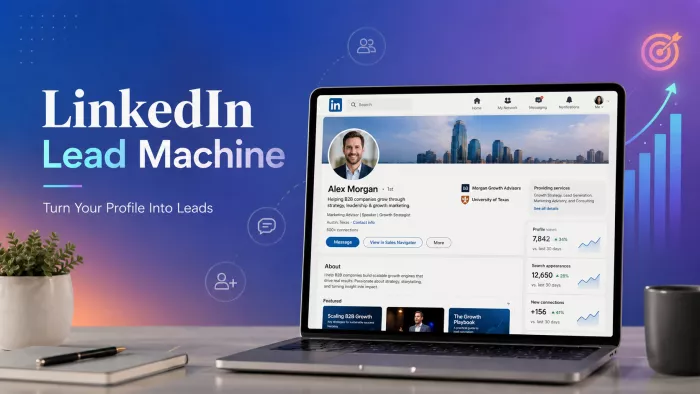
Most LinkedIn profiles are written like a résumé and then quietly expected to behave like a salesperson. That gap is the whole problem. A résumé lists what you've done; a lead-generating profile answers a stranger's real question “can this person solve my problem, and what do I do about it?” in the fifteen or so seconds before they lose interest and click away.
This article is about closing that gap. We'll rebuild the profile piece by piece, from the headline down to the buttons a visitor never presses, with one rule sitting underneath all of it: your profile isn't the top of your funnel. It's the bottom.
Your profile is a conversion page, not a brochure
Your LinkedIn presence runs on two separate machines that people constantly confuse. The first is reach: your posts, your comments, and the threads you show up in this is what actually puts you in front of new people.
The second is conversion: your profile, which decides what happens once someone becomes curious enough to click your name. Almost every “optimize your profile” guide obsesses over the second machine while ignoring that it's fed entirely by the first.
That distinction tells you what your profile is genuinely for. Nobody lands on your profile in a neutral mood; they arrive mid-thought, having just read something you wrote or spotted your name in a comment, and they're deciding in real time whether you're worth a follow, a message, or a booked call. So the job of every section below isn't to impress. It's to move that one specific visitor a step closer to reaching out.
Know who actually lands on your profile

When someone clicks your name, they aren't reading. They're scanning, and they're running a silent checklist that takes about five seconds to finish. Before you touch a single word, it helps to know exactly what they're checking for, because everything you write is really an answer to one of three questions:
• “Does this person actually understand my problem?” Visitors are pattern-matching for signs that you live in their world. Vague language like “I help businesses grow” fails instantly because it could describe literally anyone; language about their exact situation passes.
• “Can someone like me get a result from them?” They want proof you've done this before for people in their position, not awards or years of experience, but evidence that the outcome they're after has already happened for someone similar.
• “What am I supposed to do next?” If the answer isn't obvious within a few seconds, most people do the easiest available thing, which is nothing. A warm visitor with no clear next step is a lead you paid for with your content and then threw in the bin.
Keep these three questions somewhere visible while you edit. If a section of your profile doesn't help answer at least one of them, it isn't working, it's decoration.
The zone above the fold, where most of the decision happens
The first screen someone sees before any clicking or scrolling carries most of the weight. On desktop that's your banner, photo, headline, and current-role line; on mobile it's squeezed even tighter. This is your shop window, and the mistake nearly everyone makes is filling it with facts about themselves instead of a reason for the visitor to stay.
Your headline is the single most valuable line of text on the entire profile, because it travels with you everywhere into search results, comment threads, and connection requests. The default move is to list your job title. The upgrade is to state who you help and what changes for them.
Headline: from listing your job to naming their outcome
| Résumé-style (about you) | Conversion-style (about them) |
| Digital Marketing Manager | SEO | PPC | Social Media | I help B2B SaaS teams turn cold traffic into booked demos without inflating ad spend |
| Freelance Copywriter | Content Creator | Storyteller | Sales pages and email sequences for course creators who are tired of launches that flop |
| Business Coach | Speaker | Author | I help agency owners hit $50K months without doubling the size of their team |
The pattern on the right is always the same: a specific audience, a specific outcome, and ideally a hint of how you're different. That little “without…” clause does a surprising amount of quiet work; it separates you from everyone else promising the same result. That same clarity should carry through your personal branding, so people get a consistent sense of what you do wherever they find you.
As for the rest of the window: your banner is prime space that most people waste on a stock skyline, when it should carry exactly one idea (a short promise, one proof point, or a single instruction like “DM me ‘AUDIT’ for a free teardown”). And your photo matters less than people think and more than they'd like the only real variables are whether you look approachable and whether you look like you belong in your prospect's world.
The About section is a sales letter, not an autobiography
If the headline earns the click, the About section is where the visitor decides whether to trust you and it's where most profiles collapse into third-person corporate mush (“a results-driven professional with a passion for delivering value”). The fix is to stop writing a bio and start writing a short, direct letter to one person: your ideal client, reading it alone.
A few structural things matter more than clever phrasing. LinkedIn only shows the first two or three lines before the “see more” button, so those opening lines have to earn the expansion the way a subject line earns an open lead with the reader's problem or a sharp claim, never with “I am a…”. From there, a reliable shape is to name the problem your audience is stuck on, make it concrete enough that they feel understood, then introduce what you do as the resolution and back it with a specific result. Close with a plain instruction for what to do next.
Here's the difference in practice:
• Weak opening: “I am a results-driven marketing consultant with over 10 years of experience helping businesses of all sizes achieve their goals.” It's about you, says nothing specific, and wastes the only two lines a visitor is guaranteed to see.
• Strong opening: “Most founders don't have a lead problem. They have a follow-up problem: leads come in, sit in an inbox, and quietly go cold. That's the gap I close.” It's about the reader, names a pain they recognise, and makes them want the next line.
One more thing people routinely get wrong: they hide the proof. If you helped a client double their reply rate or halve their cost per lead, that number belongs high up in the About section in plain language not buried at the bottom of a case study nobody scrolls to.
Build the funnel into the profile itself
A profile can say all the right things and still leak every lead if there's no obvious path forward. This is the most common and most expensive gap I see: the visitor is convinced, glances around for the next step, finds three half-options or none at all, and leaves. Your job is to make the next action unmissable and singular.
Three underused parts of the profile do this work, and they only work if you're disciplined about them:
• The Featured section sits directly under your About and is the closest thing LinkedIn gives you to a landing page. Point it at one lead magnet, one strong case study, or a direct link to your booking calendar, not a scrapbook of everything you've ever posted. One clear asset consistently outperforms five competing ones.
• A single call to action, repeated. Decide on the one thing you want visitors to do book a call, grab a resource, send a specific DM and make the headline, About section, and Featured section all point at that same action. Offering five ways to reach you is functionally the same as offering none, because every extra choice creates a moment of hesitation, and hesitation is where people drop off.
• Frictionless contact. Where it fits your goals, allow messages from people you're not connected to, put a real destination in your contact details, and don't send an interested stranger on a scavenger hunt for your email. Every step between “I'm interested” and “here's exactly how” quietly costs you conversions. When that next step leads off LinkedIn, a focused lead-gen bio link can keep the path from interest to enquiry just as clear.
The content engine nobody wants to hear about
Now the uncomfortable part. You can build the most persuasive profile on the platform and still generate zero leads from it, because a profile is a destination and destinations need traffic. If you aren't posting or commenting, the only people seeing your beautifully rewritten headline are the handful who already know your name and they were never the leads you were chasing.
This is exactly why the “profile as conversion page” framing matters. Content and comments are what send strangers to your profile in the first place, so the two have to operate as a pair: your posts manufacture curiosity, your profile converts it. The practical consequence is that your profile should echo the themes you talk about publicly. If your posts are all about cold email but your profile talks about “integrated marketing solutions,” the visitor feels a small jolt of inconsistency that quietly erodes trust and when someone reads three of your posts on a topic and then lands on a profile clearly built around that same topic, the whole thing feels coherent. Coherence is a big part of what actually makes people act.
Credibility signals that actually convert
By the time a serious prospect is thinking about reaching out, they've quietly slipped into skeptic mode. They want to believe you, but they're scanning for a reason not to. Credibility signals exist to remove those reasons and they only earn their place if they answer the skeptic's real questions instead of padding your profile with vanity metrics.
Recommendations are the strongest signal you have, but they aren't all equal. A recommendation that says “great to work with, very professional” is pleasant and instantly forgettable; one that says “she cut our onboarding from six weeks to nine days” is a genuine sales asset. When you ask for one, ask the person to name the specific problem you solved and the result they got, because a testimonial with a number in it does more than ten without.
What each signal is really worth to a skeptical buyer
| Signal | What a skeptical buyer reads from it | How to make it work harder |
| Recommendations | Real proof but only when they mention a specific outcome | Request ones that name the problem and the result, not just the vibe |
| Skills & endorsements | Weak proof; mostly a search-and-keyword function | Pin only the three skills you actually want to be found for |
| Recent activity feed | Whether you're active, relevant, and worth trusting right now | Post or comment regularly a dead feed reads as “gone quiet” |
| Follower / connection count | Minor social proof at best | Stop chasing it; the number follows good content, not the reverse |
The last row hides the biggest silent killer on the list: a stale profile. If your most recent activity is from eight months ago, a prospect reasonably assumes you've moved on, gone quiet, or simply aren't paying attention and no amount of headline polishing overcomes that first impression.
Measure what matters, then keep editing
A lead machine is something you tune, not something you set up once and admire. The trouble is that LinkedIn hands you a pile of flattering numbers, profile views, post impressions, follower growth that feel like progress while telling you almost nothing about leads. The move is to separate the metrics that measure attention from the ones that measure intent.
Attention metrics (views, impressions) tell you whether your content is doing its job of driving traffic. Conversion metrics tell you whether your profile is doing its job once that traffic arrives. The ones actually worth watching:
• Connection acceptance and inbound request rate. If plenty of the right people are viewing your profile but few connect or reach out, the problem is almost always the profile itself: the headline or About section isn't closing the visit.
• Direct messages and replies. The number of real conversations started is the closest thing to a true north-star metric, because conversations are where leads actually turn into clients. Everything upstream exists to produce these.
• Booked calls or link clicks from the profile. The final step. If people are messaging you but never taking your intended next action, your call to action is either unclear or asking for too much, too soon.
Then treat your profile as a page you're allowed to change. Rewrite the headline and watch what your inbound does over the next month; swap the Featured asset and see whether link clicks move. Small, deliberate edits tested one at a time will teach you more about your specific audience than any best-practices list including this one.
Myths worth retiring
A lot of popular LinkedIn advice is either outdated or was never true, and quietly following it works against you. A few worth dropping for good:
Common advice, and why it backfires
| Common advice | Why it works against you |
| “Stuff your headline and About with keywords” | It reads as robotic to actual humans, and relevance and engagement now matter far more to discovery than raw repetition |
| “Connect with everyone to grow your network” | A bloated network of irrelevant contacts pollutes your feed and dilutes the exact audience your content needs to reach |
| “Use ‘Open to Work’ it can't hurt” | For consultants and business owners it signals availability out of need rather than demand, which is the opposite of the positioning you want |
| “Just describe what you do” | Describing your service isn't the same as naming the outcome a buyer wants people buy the result, not the activity |
The thread running through all four is the same mistake in different costumes: optimising for the platform, or for sheer volume, instead of for the one specific human you want to hear from. Almost every LinkedIn myth falls apart the moment you ask a single question “would this make my ideal client more likely to reach out, or just make a number go up?”
Final Thought
If you take one idea from all of this, make it the reframe: your profile is the conversion page at the bottom of a funnel that your content feeds, and its only real job is to turn a curious visitor into a conversation. Everything else, the headline formula, the sales-letter About section, the single clear call to action is just a way of serving that one goal.
So don't rewrite your whole profile tonight; you'll burn an evening and change nothing. Do one thing instead. Open your profile, look hard at your headline, and ask whether a total stranger could tell in five seconds who you help and what changes for them. If they can't, rewrite that one line today it's the piece of text that travels farthest across LinkedIn, it's the first thing every visitor reads, and fixing it is the closest thing to a genuine quick win this platform hands you.


Comments