Where Is Mandy Smith Now? From PWL's First Signing to a Life Away From the Spotlight



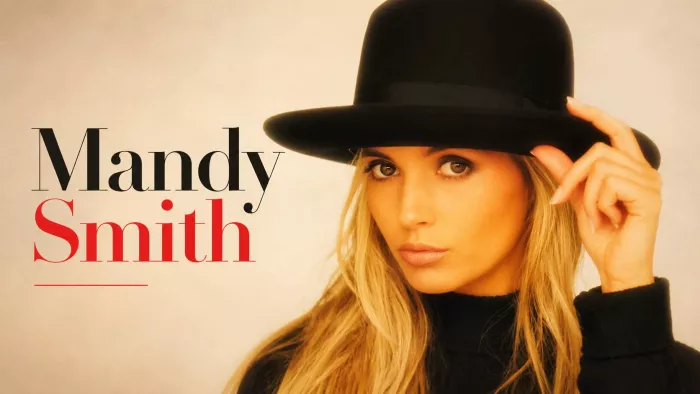
Where is Mandy Smith now? The most accurate answer, based on the latest verifiable public information, is that Mandy Smith lives a private life away from mainstream entertainment. There is no reliable evidence of new recordings, acting roles, television projects, or regular public appearances from her in 2024–2026. Her back catalogue has continued to be licensed and reissued without her participation, most recently in April 2026. The last clearly documented chapter of her public working life shows that she moved into public relations after leaving pop and modelling, running the agency Kiss PR with her older sister Nicola. Companies House records show that she resigned her directorship of Kiss PR Limited on 6 February 2015 and that the company was dissolved on 22 September 2015.
That absence from the spotlight has not ended public curiosity. Searches for Mandy Smith now, Mandy Smith today, and Where is Mandy Smith now continue because her story sits at the crossroads of 1980s modelling, pop music, tabloid celebrity, a much-discussed relationship with Rolling Stones bassist Bill Wyman, and a later retreat from fame. Her only recent visibility appears to come through retrospectives and reissues rather than new public activity. Cherry Pop released an expanded edition of her 1988 album Mandy in 2009 and repressed that same edition in March 2024; in December 2025, the Swedish magazine Fokus revisited her 1980s television appearances; and in April 2026, the London label Balearic London issued an official remix of her debut single.
Mandy Smith’s life now is not a mystery in the sensational sense. It is more simply a case of a former child and teenage celebrity choosing, or at least maintaining, distance from the entertainment industry that once defined her. Public records and reputable reporting support that conclusion. Beyond that, the responsible answer is to stop before speculation begins.
Who Is Mandy Smith?
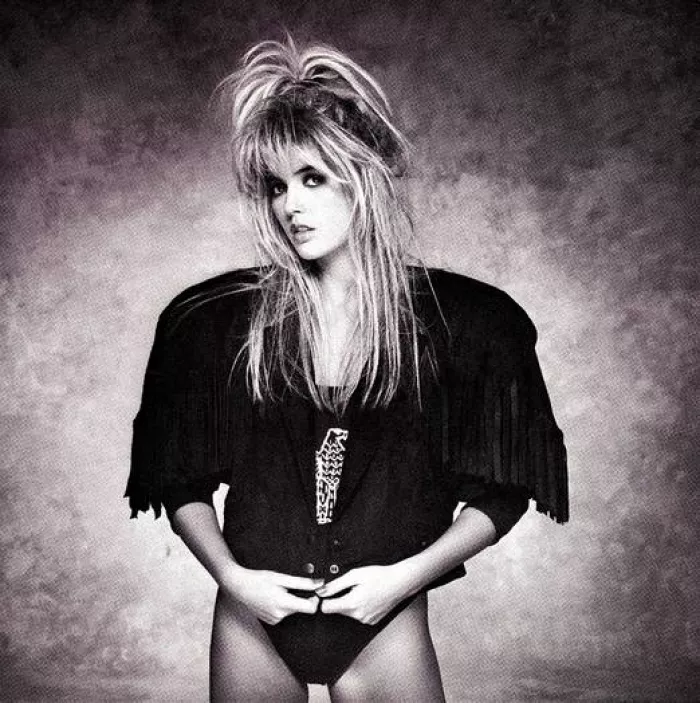
Mandy Smith was born Amanda Louise Smith on July 17, 1970, in Tottenham, London. She became known in Britain during the 1980s as a model, pop singer, and tabloid personality, entering the public eye while still a teenager. Official Charts identifies her as an English former pop singer and model, and notes that she modelled for notable 1980s labels including BOY and Katharine Hamnett before moving into music.
Her early fame came at a time when British youth culture, fashion, pop music, and tabloid press were tightly intertwined. A striking teenage model could move quickly from magazine pages to television appearances and then into the recording studio. Smith’s public profile grew not only because of her looks and music-industry connections, but also because the press attached her name to one of rock’s most controversial relationships.
A concise Mandy Smith biography has to hold those strands together. She was a teenage model who became a Stock Aitken Waterman-era pop singer, appeared on television, published a memoir, later worked in PR, and eventually stepped out of regular public life. She is still remembered less for one single career achievement than for the unusual intensity of attention that surrounded her before she had even reached adulthood.
The Rise of Mandy Smith : Modelling and Early Fame
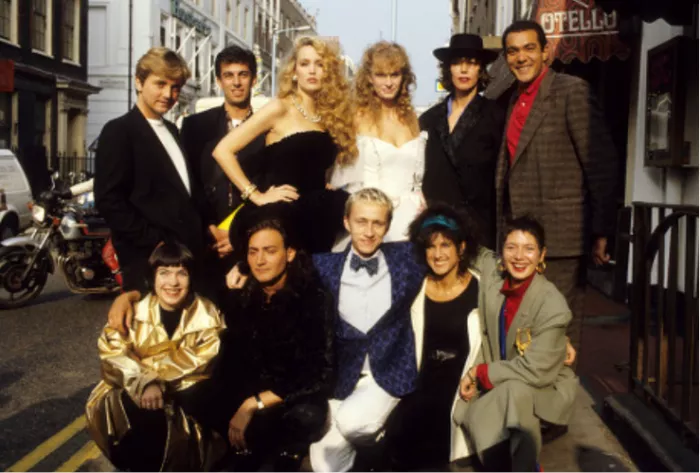
Mandy Smith’s rise belonged to a very specific media moment. Britain in the 1980s had an appetite for youth, gloss, controversy, and fast-moving celebrity. Fashion magazines, music television, red-carpet photography, and tabloid columns all fed each other. A model did not need today’s social media machinery to become famous quickly; a few magazine covers, high-profile parties, and the right (or wrong) association could make a name nationally recognizable.
Smith entered that machine early. Contemporary and retrospective sources consistently describe her as a model before she became a singer. Official Charts and Stock Aitken Waterman-related sources note her modelling work for BOY and Katharine Hamnett, two names that carried very different but equally strong associations in 1980s British fashion: BOY with streetwear and club culture, Hamnett with bold slogans and politically conscious design.
There is also contemporary evidence of her presence in fashion coverage, though it does not say what it is usually assumed to say. In October 1987, The Washington Post reported on the London designer shows and observed that celebrities had been brought in to brighten them up, listing Simon LeBon in one audience, Boy George in a Brompton Arcade shop, and 17-year-old Mandy Smith in Katharine Hamnett's show. The report did not identify her as a model. It identified her as Bill Wyman's teenage former girlfriend. That detail matters because it shows how the industry actually placed her: on a real runway, in a real show, and there because the press already knew her name.
The phrase “1980s supermodel” is often used loosely around figures from that era, but Smith’s documented career is better understood as a mix of modelling, teen celebrity, and pop-culture visibility. She was photographed, promoted, discussed, and watched. Her face suited the glossy, highly styled mood of the decade, while her public life gave newspapers something to write about. That combination made her a media sensation.
Reliable archives are thinner when it comes to detailed advertising campaign records. What is better verified is her modelling for well-known labels, magazine visibility, and later pop-image packaging. She represented a type of celebrity that became common in the late 1980s: young, visually marketable, music-adjacent, and made famous as much by coverage as by craft.
That is not a dismissal of the Mandy Smith model years. It is the point. Her career shows how modelling could function as a doorway into celebrity long before Instagram or TikTok. The industry did not simply sell clothes; it sold personalities. Smith became one of them.
Music Career
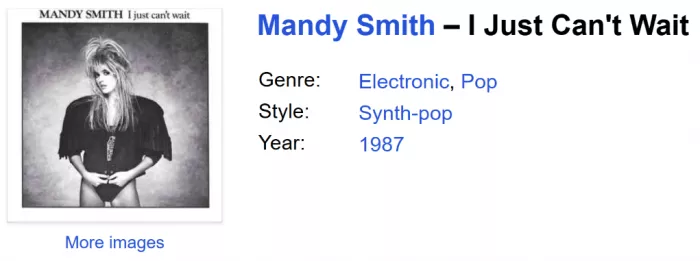
Mandy Smith’s move into music was part of the natural celebrity pipeline of the period. If a young model had enough name recognition, a single could turn that attention into a pop career. In Smith’s case, the transition came through PWL, the label and production world associated with Stock Aitken Waterman, whose bright, efficient, dance-pop sound dominated British charts in the second half of the 1980s. Smith was the first artist Pete Waterman signed to the label, in 1986, when she was 16. She reached him on the recommendation of Pete Burns of Dead or Alive, and her debut became the first record PWL ever released - three years before the label became the UK home of Kylie Minogue and Jason Donovan.
Her debut single, "I Just Can't Wait," was released in January 1987 and was written and produced by Stock Aitken Waterman. Official Charts records it as her first UK charting single, peaking at No. 91 and spending three weeks inside the Top 100. Her later single "A Victim of Pleasure" reached No. 93 in 1988, while "Don't You Want Me Baby," a cover of the Human League's "Don't You Want Me," became her highest-charting UK single, reaching No. 59 in 1989.
Those numbers show the limits of her British chart success. She was famous in the press before she was a major hitmaker, and the records did not turn her into a dominant UK pop act. Still, the Mandy Smith singer chapter should not be written off as a novelty footnote. Her music had a life beyond Britain. Retrospective accounts note that her singles performed better in parts of Europe and Japan than they did at home.
One complication is rarely mentioned in retrospectives. Suzanne Rhatigan, a PWL backing singer, has said she was contracted to ghost-sing the project after Smith struggled with the material, and that her vocals were layered over Smith's on the finished records. Smith is credited as the lead vocalist. That does not diminish her, but it does explain something about how the pop industry of the period handled a young performer it had signed for her name rather than her voice.
Her 1988 album Mandy sits firmly in the PWL era: polished, synthetic, danceable, and built around the image of a young star being introduced to the pop market. It did not chart in the UK. Cherry Pop released an expanded CD edition in 2009, adding eight bonus tracks including the shelved hi-NRG cover of Twinkle's "Terry" and her original version of "Got to Be Certain," a song later given to Kylie Minogue. That edition was repressed in March 2024 under the same catalogue number, CRPOP17, confirming its ongoing archival interest for fans of the period.
Critically, Smith’s music career was always complicated by the fact that the media already had a larger story about her. For some listeners, she was a PWL pop act. For newspapers, she was the teenage girlfriend and later wife of Bill Wyman. That imbalance mattered. It meant her records were rarely allowed to stand alone.
The music changed her career by giving her a new professional identity, but it did not free her from the old narrative. In fact, it probably intensified it. Pop television, magazine interviews, and record promotion kept her visible at the very moment the press was most interested in her personal life.
The career also ended abruptly, and not by choice. Promotion for "Don't You Want Me Baby" was cut short in 1989, at the exact moment the single was becoming her highest-charting UK release, because Smith had become seriously ill. A former PWL engineer later said she was simply unable to work. By the end of her marriage her weight had fallen to five and a half stone. Her recording career did not wind down gradually. It stopped.
Television and Acting
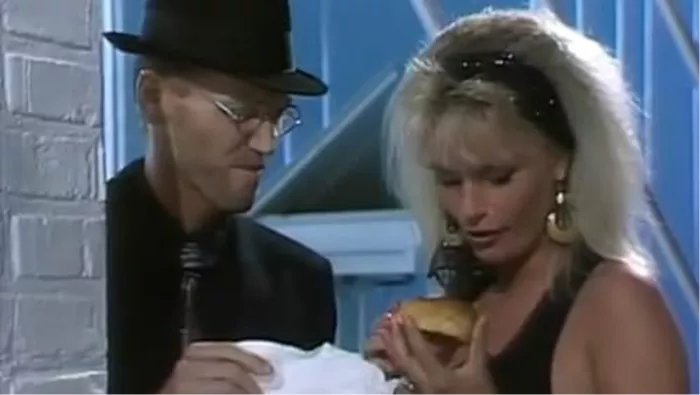
Mandy Smith’s television and acting work remained secondary to her modelling and music, but it added another layer to her 1980s profile. She appeared on entertainment programmes, music shows, and in European television contexts connected to her pop career.
One of the more interesting pieces of verified television history comes from Sweden. In 1987 Smith appeared on Solstollarna, a fast, glossy SVT variety series built around pop performances and mock commercials. IMDb credits her across five episodes, performing "I Just Can't Wait" and appearing in the programme's fake advertisements alongside Samantha Fox, Lena Philipsson and Pernilla Wahlgren. In December 2025, the Swedish magazine Fokus revisited the series and the way it presented very young women, illustrating the piece with an SVT production still of Smith. That detail is useful because it shows how her profile extended beyond the British tabloid market.
She also appeared in British television contexts tied to her public life. Records for Wogan note that Bill Wyman and Mandy Smith appeared on the programme after marrying in secret earlier that day in 1989. That appearance reflects the kind of media moment she occupied: entertainment television was not only promoting work, it was processing celebrity events in real time.
Her IMDb listing can give the impression of a broader screen career than the record supports. Her acting-related credits and sketch appearances were real, but acting did not become her primary vocation. There is no evidence that she built a sustained film or television acting career comparable to her modelling and music visibility.
The more accurate description is that television amplified her existing celebrity. It placed her in front of audiences who might not buy fashion magazines or follow PWL releases. But it did not redirect her life toward acting. Like much of her early career, it was part opportunity, part publicity, and part consequence of being a heavily watched young woman in a fame economy that rarely made privacy easy.
The Bill Wyman Relationship
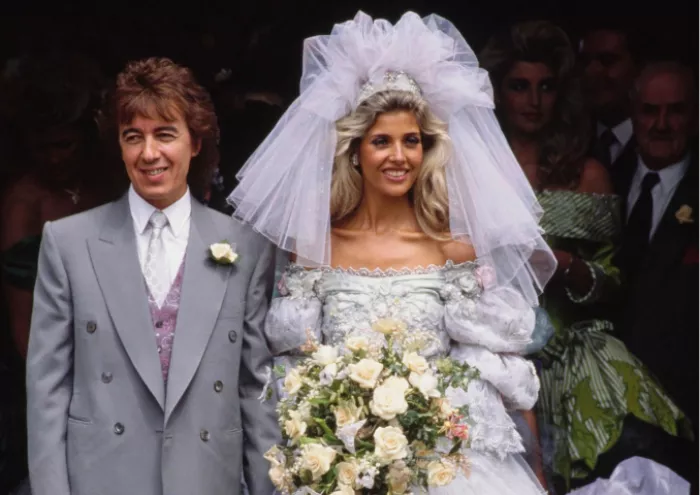
Any serious article about Mandy Smith has to address her relationship with Bill Wyman carefully. It is the reason many people still look her up, and it is also the area most vulnerable to sensational writing. The facts are striking enough without embellishment.
Bill Wyman was the bassist for the Rolling Stones, one of the most famous rock bands in the world. Smith was 13 when she met him at the BPI Awards in 1984, where she had gone with her older sister Nicola. Wyman was 47. In his 1990 autobiography he wrote that she took his breath away and that she was a woman at thirteen. By Smith's own later account the relationship became sexual when she was 14. It stayed private until she turned 16, the age of consent in the United Kingdom, at which point it became a national story. The two married on 2 June 1989 in a civil ceremony at Wyman's Suffolk estate, when Smith was 18 and Wyman was 52. She moved out within weeks. The divorce was finalised after 23 months, with a reported settlement of around $880,000.
The age difference was controversial even at the time, but public attitudes have changed sharply since the 1980s. What was once often framed in the press as scandal, glamour, or rock-star excess is now more commonly discussed through the language of safeguarding, power imbalance, consent, and the sexualization of teenage girls.
Later reporting has revisited the relationship in that changed context. In 2019, The Guardian reported that a documentary about Wyman, The Quiet One, was dropped by Sheffield Doc/Fest after protests over what critics said was insufficient attention to the circumstances of his marriage to Smith. The same report referred to allegations that Wyman had groomed Smith from age 13, and noted that Smith later said she had been underage.
An earlier interview with Smith, published by The Independent on 6 July 1994, is still the most direct source for her own perspective, and it is a first-person account rather than a profile. Speaking to Susan de Muth, Smith described her first night at Wyman's country house at the age of 13, and the ghost story he told her that night about a young girl who married the much older lord of the manor and starved herself to death there. She described the allergies and depression that took her weight to five and a half stone, the months she spent unable to leave her bed, the faith she turned to during them, and the effect the marriage had on her afterwards. On Wyman she was unambiguous: "He was 47 when we met - surely old enough to know right from wrong." The interview also records her occupation at the time as model and television presenter.
The marriage’s continued hold on public memory says as much about media culture as it does about the people involved. Smith’s modelling, music, and television appearances are searchable and documented, but the relationship dominates because it raises questions that have only grown more urgent with time. How did the entertainment industry treat teenage girls? How did newspapers profit from turning private vulnerability into public spectacle? Why were power imbalances often softened into celebrity gossip?
Those questions help explain why the relationship still appears at the top of online interest. It is not merely nostalgia. It is reassessment.
Career and Life After the Spotlight
After the music and modelling years, Mandy Smith gradually moved away from the public career that had made her famous. Her 1993 memoir, It’s All Over Now: My Life with Bill Wyman, placed her story in her own name at a time when much of it had been told by others. Bibliographic records confirm the book’s publication in London by Blake in 1993.
Her personal life in the years immediately after the divorce is well documented and rarely reported in full. In 1993, Wyman's 30-year-old son Stephen married Smith's mother, Patsy, then 46, which made Smith's former husband her step-grandfather; that marriage lasted two years. On 19 June 1993, Smith married the footballer Pat Van Den Hauwe, and that marriage also lasted about two years. In 2001 she was briefly engaged to the model Ian Mosby, with whom she has a son, Max. She raised him as a single mother.
The memoir belonged to a period when Smith was trying to reclaim the narrative around her marriage, health, and public image. It did not launch a long second act as a confessional celebrity. Instead, over time, she became less visible.
Reports from later years describe her moving into a different kind of life. The Sun reported in 2023 that Smith had left London for Manchester, and that by 2011 she was living there as a single mother while running a PR company, Kiss PR, with her sister Nicola. Companies House records show that the business was later incorporated: Kiss PR Limited, company number 08770102, was registered on 11 November 2013 as an advertising agency, with Mandy Louise Smith, born July 1970, and Nicola Jane Smith, born June 1968, appointed as directors on the same day.
There were also reports of religious faith and work with young people. In April 2010, Smith made her clearest public intervention since the memoir, calling for the age of consent in the United Kingdom to be raised from 16 to 18. She acknowledged that the argument would sound strange coming from her, and said that a person is still a child at 16, and that she never got that part of her own childhood back. A Guardian column by Victoria Coren two days later took the point seriously; most coverage did not. Coren described Smith as a single mother and devout Catholic and referred to voluntary work with young people. Because that was commentary built around an interview rather than a current official biography, it should be treated as a reported snapshot of that period, not a complete account of her present life.
That distinction matters. Celebrity profiles often freeze people in one version of themselves. Mandy Smith’s life after fame appears to have moved through several identities: former pop singer, memoir author, mother, PR professional, person of faith, and private individual. Not all of those identities are equally documented today, and not all should be forced into a neat public narrative.
What can be said is that she did not keep returning to the entertainment industry in the way many former 1980s pop figures have. There is no reliable evidence of a sustained reality-TV reinvention, a comeback album, or a public-facing nostalgia-tour career. Her retreat looks more deliberate than accidental.
Where Is Mandy Smith Now?
The most important point about her life now is that the public record is limited. As of July 2026, there is no verified recent interview, official entertainment project, active music campaign, acting credit, or public statement that establishes a new professional chapter for Mandy Smith.

Her last clearly documented business record is Kiss PR Limited, and the filings are more specific than most accounts of her allow. Companies House lists Mandy Louise Smith, born July 1970, as a director appointed on 11 November 2013 and resigned on 6 February 2015. Her co-director, Nicola Jane Smith, born June 1968, was appointed on the same day and did not resign. Both gave the same correspondence address: a desk at Dartington Space, Dartington Hall, in Totnes, Devon. The company filed a single annual return, made up to November 2014, and was dissolved on 22 September 2015. The identification rests on more than a matching name and birth month, which would not be enough for one of the most common names in Britain. The co-director's name and age correspond to Smith's older sister Nicola, who was with her at the BPI Awards in 1984, and independent reporting places the two sisters as joint operators of the agency. There is no filing anywhere after February 2015 that places Mandy Smith in any company. That, and not a rumour, is where the documented trail ends.
One caution follows from that record. A registered address does not establish where a person lives, since registered offices are routinely held by accountants or virtual-office services, and a desk in Devon proves nothing about a home in Manchester. But it is a reminder that the frequently repeated claim that Mandy Smith lives in Manchester rests on reporting that is now roughly fifteen years old and has been recycled since without fresh sourcing. She may well still be there. No recent source establishes it.
That record is important because it corrects a common outdated claim. Some older online summaries still imply that Smith currently runs a PR company. The reliable public record does not support that as a present-tense statement. It supports a past-tense one: she worked in PR and was associated with Kiss PR, but that company is no longer active.
There is also no reliable evidence that she remains active in entertainment, though her catalogue is. The 2009 expanded edition of Mandy was repressed in March 2024, and on 22 April 2026 the London label Balearic London issued an official remix of "I Just Can't Wait" by Holmes Price, on 12-inch vinyl and digital, backed with the Cool and Breezy Jazz Version given a full side for the first time since 1987. These are licensing decisions made by rights holders. They show continuing commercial interest in her recordings. They are not proof of a new performance career, and there is no indication that Smith was involved in either.
The same caution applies to social media. Searches can surface accounts, fan pages, and namesakes, but reliable sources do not currently identify a verified official social media account that can safely be attributed to Mandy Smith. For publication, it would be misleading to claim she is active online unless that claim is confirmed by a reputable source or a verified account connected to her.
Public appearances also appear rare. The most recent substantial mentions found in reliable or semi-reliable public sources are retrospective rather than participatory: discussion of her television appearances in Sweden, reissues of her music, and renewed cultural analysis of the Wyman relationship.
So, where is Mandy Smith now? She appears to be living outside the celebrity system. Her current occupation, if any, is not publicly confirmed. Her current location is not reliably documented in recent sources. Her entertainment career appears inactive. The responsible conclusion is that Mandy Smith today has largely remained out of the public eye, and that the available evidence supports privacy rather than a hidden comeback.
That may disappoint readers looking for a dramatic “then and now” reveal, but it is also the most respectful answer. Not every former celebrity owes the public a third act. Sometimes the story is that a person who was made famous very young eventually chose a life that no longer required being watched.
Mandy Smith’s Legacy
Mandy Smith’s legacy is complicated because her fame was complicated. She was a model, singer, television personality, memoir author, and tabloid figure. She was also a young woman whose image and relationships were consumed by a press culture that often cared more about spectacle than welfare.
Mandy Smith’s career sits at the intersection of modelling, pop music, and 1980s celebrity culture. She had the unmistakable look of the era: bright, styled, camera-ready, and instantly suited to magazine pages as much as music promotion. At the same time, her story carries the vulnerability of someone pushed into a public system before she had the adult distance to fully manage it.
Her music also keeps her connected to the wider Stock Aitken Waterman and PWL story. While her singles did not turn her into a major UK chart star, they still attract collectors and fans of 1980s pop. The 2009 Cherry Pop expanded edition of Mandy, its repressing in 2024, and the official remix of her debut single in 2026 all show that her recordings continue to hold a niche audience decades later.
Her relationship with Wyman has become the most reinterpreted part of her public life. What earlier coverage often framed as scandal is now more likely to be discussed as a troubling example of how fame, age, gender, and power operated in the rock-and-tabloid economy of the time. The 2019 controversy around Wyman’s documentary showed how sharply the cultural lens had shifted.
That shift has changed how readers understand Smith’s story. She is no longer only a figure from a lurid 1980s headline. She is also part of a broader conversation about how teenage girls were represented, judged, marketed, and blamed in public culture.
This is why people continue to search for Mandy Smith now. Some are driven by nostalgia. Some remember the songs, the magazine covers, or the Wyman headlines. Others are trying to understand what became of someone who seemed, for a brief period, to be everywhere. The answer is quieter than the question. Mandy Smith’s legacy is a story about early fame, public scrutiny, reinvention, and the right to disappear.
Final Assessment
Mandy Smith’s life has been written about for more than four decades, but the most important part of her story may be the part she no longer performs for the public. She was introduced to fame as a teenager, turned into a model and pop figure, attached to one of the most controversial relationships in British celebrity history, and then left to live with the consequences once the headlines moved on.
Today, there is no verified evidence that Mandy Smith is seeking a return to entertainment. The public record points instead to a former 1980s celebrity who moved into private life after modelling, music, television, a memoir, and PR work. Her name still resurfaces through reissues, retrospectives, and reassessments of the culture that made her famous, but she herself appears to have stepped away.
That decision deserves to be part of the story, not treated as a gap in it. Fame gave Mandy Smith visibility, opportunity, and a place in 1980s pop culture. It also brought scrutiny at an age when most people are still learning who they are. If her life now is largely private, that privacy may be the clearest sign of how far she has travelled from the world that once claimed her.


Comments