
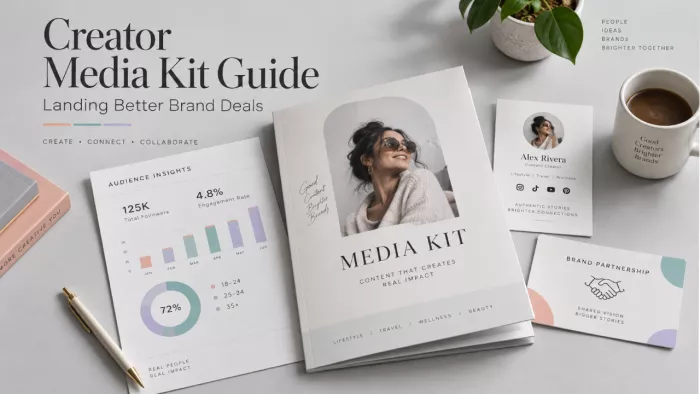
Most media kits fail for the same quiet reason: the creator wrote a résumé when the brand wanted a sales pitch. A kit isn’t a page about you, it's a document that answers, in about the length of a coffee sip, whether your audience is worth paying to reach.
This guide builds the kit backwards from that moment. We’ll look at what the person on the other end is actually deciding, how to make saying yes easy, and since you’re a creator, how to host the whole thing right in your link in bio so brands find it the second they land on your profile.
What a brand actually does with your media kit

Before you write a line of your own, picture where it lands. Your kit rarely opens on the desk of a decision-maker having a thoughtful afternoon. More often it’s one of forty attachments a campaign coordinator is triaging into a shortlist before they log off.
They’re not reading you. They’re scanning you hunting for reasons to keep you in or cut you fast.
While they scan, they’re really answering only two questions. First: is this creator’s audience my customer? Not “is it big,” but “does it overlap with the people I sell to.”
Second, quieter and more important than most creators realise: is this person low-risk to work with? Will they deliver on time, represent the brand cleanly, and not turn out to have bought half their followers? A kit that only shouts about reach answers neither. One that speaks to both gets the reply.
Through the brand’s eyes Every element in your kit is read as evidence in one of two cases: “your people are my people” and “you’re safe to hand my budget to.” Anything that serves neither is clutter. |
When you actually need one and when you don’t
The advice to build a media kit on day one is well-meant and mostly wrong. If you have three hundred followers and no body of work, a polished kit is a suit on a toddler, it draws attention to the gap it’s trying to hide.
The kit becomes worth building at a threshold: when brands start noticing you (that first inbound DM), when you decide to pitch proactively, or when a platform asks for one. Before then, your energy is better spent making the work a kit would eventually point to.
There’s a flip side worth sitting with. A few very established creators deliberately skip a standard kit, their reputation and inbound demand do the selling, and a formal document would flatten a relationship meant to feel exclusive.
You’re probably not there yet, and neither am I. But the point stands: the kit is a tool for a job, not a badge you’re required to wear. Build it when it earns you something.
The core anatomy: what every kit needs
There’s a standard set of sections, but the sections aren’t the point of the job each one does. Here’s the backbone, framed by what it’s actually there to prove.
● A positioning line, not a life story. One or two sentences on who you serve and what you’re known for the promise, not the biography.
● Your niche and content pillars, so a brand can instantly see whether their product belongs in your world or would look bolted on.
● An audience snapshot who follows you, not just how many. This is the section brands weigh most, and most creators bury it.
● Platform stats with context, chosen to make a case rather than to list everything a dashboard can measure.
● Content samples, ideally your best-performing and most brand-relevant posts, shown as proof you can make things people stop for.
● Services and deliverables, spelled out so the brand knows exactly what they can buy and doesn’t have to guess.
● Social proof past partners, testimonials, results to lower the perceived risk of working with you.
● Rates, or a clear signal about them, so you’re filtering for the right conversations instead of every conversation.
● A single, obvious call to action and contact, because a kit that doesn’t tell the reader what to do next has wasted its own momentum.
Everything after this is a deeper look at the parts that decide whether the kit works or just exists.
Positioning: the part that actually converts
Stats get you considered. Positioning gets you chosen. Two creators can have identical numbers, and the one who’s articulated a sharp angle, a specific audience they own, a specific outcome they drive will win the deal, because they’ve made the brand’s decision effortless.
The other is just a number the coordinator has to interpret.
Sharp positioning names three things without spelling them out as a list: the exact slice of people you reach, the reason they trust you specifically, and the outcome a brand gets by borrowing that trust.
“Fitness creator” is a category. “I help desk-bound women in their thirties start lifting without a gym and actually stick with it” is a position. A beauty brand, a supplement brand, and an activewear brand can all instantly see where they fit.
If a brand covered up your follower count, would the rest of your kit still make the case for you? If not, you’ve built a stats sheet, not a pitch.
Presenting your metrics honestly and persuasively
The instinct is to lead with your biggest number. Resist it. A raw follower count with no context is the least persuasive metric you own, because everyone knows it can be inflated, bought, or bot-padded.
The numbers that move a marketer are the ones that are hard to fake and show behaviour: engagement rate, saves and shares (a save is someone deciding your content is worth returning to), story completion, video watch-through. Those say people don’t just follow you, they act on you.
This is where creators with “small” audiences quietly win. Ten thousand followers who trust you and buy what you recommend is a far easier sell than a hundred thousand who scrolled past one viral clip.
Don’t apologise for a tight niche price as the asset it is. And wherever you can, show real analytics screenshots rather than typed figures. In a market nervous about fake metrics, verifiable proof is a selling point in itself.
| Lead with these | Keep in a supporting role and why |
| Engagement rate | Follower count alone impressive-looking but easy to distrust on its own |
| Saves & shares | Total likes a vanity figure that says little about intent |
| Story / video completion rate | Raw impressions big and hollow without engagement beside them |
| Audience demographics & buying intent | One-off viral spikes flattering, but they misrepresent a normal week |
| Results from past brand work | Follower-growth charts useful context, not a headline |
Through the brand’s eyes An inflated or unexplained number doesn’t read as impressive it reads as a risk the coordinator will get blamed for if the campaign underperforms. Credibility is now part of what you’re selling. |
Audience demographics: the data brands weigh most
Here’s the uncomfortable truth for anyone chasing follower count: a brand often cares more about who follows you than how many do. A skincare label would rather reach eight thousand demonstrable buyers than eighty thousand people who’ll never touch the product.
Your demographics age, location, gender split, interests, and the kind of accounts your audience also follows are what let a brand picture their customer inside your comments.
Every major platform hands you this data in its analytics; the work is translating it into something a marketer can act on in one read. Don’t dump a pie chart and walk away.
Turn it into a sentence: “72% of my audience are women aged 25–34, based in the US and UK, who also follow beauty and wellness accounts.” That single line does more than a page of graphs, because it hands the brand a verdict instead of homework.
Proof of results: from “I have an audience” to “I drive outcomes”
The strongest kits make a leap most don’t: they stop selling attention and start selling results. Anyone can claim reach. The creator who shows what their reach did clicks, sign-ups, sales, user-generated content the brand reused in its ads is playing a different game entirely.
Frame each past collaboration as a tiny case study: the brand’s goal, what you made, and the result. “Three-video series for a coffee brand; drove 4,200 link clicks and a sold-out launch batch” beats a logo salad every time.
Testimonials and repeat clients do heavy lifting too, because a brand that hired you twice is the clearest proof you’re safe to work with.
No paid deals yet? You have more than you think: organic brand mentions, an affiliate link that actually converted, a product you featured unpaid that a brand later noticed, even a self-initiated “spec” collaboration mocking how you’d promote something you love. Real and specific beats an empty section labelled Past Partners.
Rates and packages: how to price on paper
The oldest debate in creator pitching: do you list your rates, or write “rates on request”? Both are defensible. Listing prices filters out time-wasters, signals confidence, and is kinder to brands working within a fixed budget.
Withholding them keeps room to price each deal by its value and by what the brand can clearly afford. If you’re early, leaning toward transparency usually saves everyone a week of email.
However you handle the number, structure matters more than the digits. Sell scoped packages, not loose deliverables a bundle reads as a considered offer, while a bare per-post price invites a haggle.
And price the things creators habitually give away for free: usage rights (the brand running your content in their own ads), exclusivity (not working with their competitor for a window), and whitelisting (letting them run ads from your handle). That’s where real money hides.
Through the brand’s eyes A bare number (“$400/post”) invites negotiation. A scoped package (“3 Reels + 2 Stories + 30-day usage rights, $X”) moves the conversation from haggling on price to buying an outcome. |
Put it where brands already tap: your link in bio
Your kit’s design is a trust signal before a single word is read. A clean, on-brand, phone-readable layout tells a brand you’ll treat their content with the same care; a cramped, mismatched one tells them the opposite. You don’t need to be a designer, you need hierarchy, restraint, and consistency.
Borrow the old couturier’s rule: before you send it, look it over and remove one thing. A cluttered kit reads as an unclear creator.
Then decide where it lives and as a creator, the most natural home is your link in bio. A kit page on Linktree, Beacons, or a creator platform like tieup.io sits one tap from your profile, stays current whenever you edit it, and means a brand never has to email you for an attachment.
A PDF still has its place for the agencies that ask for one, but it goes stale the second you send it. A live link is always up to date and can even tell you when someone opened it. Here’s the honest trade-off.
| Format | Stays current | Tracks opens | Looks custom | Upkeep |
| Link-in-bio page | Yes | Often, yes | Medium–high | Low |
| PDF attachment | No frozen when sent | No | Yes, with effort | Re-export to update |
| Canva link | If you edit the source | Limited | Templated unless reworked | Low |
| Own website page | Yes | Yes, via analytics | Fully | Higher upfront |
A common, creator-friendly setup: a live link-in-bio kit as your main version, plus a clean PDF export for anyone who insists on an attachment. You don’t have to choose one forever.
Tailor the kit to each pitch
This is the move most guides skip, and it’s the one that separates a good kit from a great pitch. One universal kit sent to everyone is a broadcast; a lightly tailored kit is a conversation.
You don’t rebuild it each time you keep a master version and swap a few high-impact pieces per pitch.
● Swap the featured case study so it mirrors the brand’s category show the coffee campaign to the beverage brand, the skincare one to the beauty brand.
● Highlight the audience segment that overlaps most with their customer, even if it’s not your largest segment overall.
● Lead with sample content in the format they’re likely buying Reels-first for a brand that lives on short video, carousels for one that doesn’t.
Ten minutes of tailoring signals that you understood the brief before you asked for money. That alone puts you ahead of most of the folder.
Where the media kit fits in the deal flow
A media kit doesn’t close deals on its own, and expecting it to is a quiet source of disappointment. It’s one instrument in a small ensemble: the outreach message, the kit, and the follow-up.
Each has one job. The email earns the open and makes the ask specific. The kit earns the reply. The follow-up keeps the thread warm without nagging.
For a creator, that ensemble often starts on your profile: a brand finds you, taps your link in bio, and lands on your kit before you’ve exchanged a word. That’s exactly why it belongs there and why it should always be current.
Read this way, the pressure comes off. The kit doesn’t have to be a masterpiece that lands a contract single-handed. It has to be clear, credible, and easy to say yes to a conversation about.
Mistakes that quietly cost you deals
Most rejections aren’t dramatic. A coordinator just infers something from a small slip and moves on. Here’s what each common mistake silently tells the reader.
● Vanity metrics with no context suggest you either don’t understand what brands buy, or you’re hiding weaker numbers behind big ones.
● No clear contact or call to action reads as “I haven’t done this before,” and adds friction exactly where you wanted momentum.
● Outdated stats imply the kit and maybe the creator isn’t actively maintained.
● No rates or scoping at all can stall a deal a busy marketer would otherwise have moved on quickly.
● A bloated ten-page kit tells a scanner you can’t identify what matters a worrying trait in someone you’d hand creative control to.
● No audience data leaves the single question brands care about most unanswered.
● Generic positioning makes you interchangeable, and interchangeable creators compete only on price.
● Broken links or a kit that’s unreadable on a phone quietly undercuts every professional claim the kit just made.
Treat the kit as a living asset
A media kit is never really finished, and the good ones aren’t meant to be. Refresh your stats monthly so they never look stale, and give the whole thing a proper once-over each quarter new case studies in, tired samples out, positioning tightened as your niche sharpens.
Keep your best recent work at the top, because a brand judges what you can do now, not what you did eighteen months ago. Hosting on your link in bio makes this painless: edit once, and every brand who taps through sees the current version. The kit that lands you a five-figure deal next year will barely resemble this week’s and that’s the point.
The mindset that lands better deals
Strip away the templates and formats, and a media kit is one thing: the clearest possible articulation of your value as a business. The creators who consistently land better brand deals aren’t the ones with the slickest PDF, they're the ones who’ve internalised that they aren’t asking a brand for a favour.
They’re offering something genuinely scarce: direct, trusted access to an audience that listens to them and not to an ad.
Build the kit from that footing, and everything in this guide gets easier. You lead with the right numbers because you know what you’re selling. You price your usage rights because you know their worth. You tailor each pitch because you respect the brand’s problem.
Better deals rarely go to the biggest creator in the folder. They go to the one who made it easiest to say yes.


Comments