Why Every Freelancer Needs a Professional Digital Portfolio in 2026

Snigdha Das
The Number That Should Worry Your Best Work
Let me open with the finding that sent me down this path, because it broke an assumption I had been carrying for years.
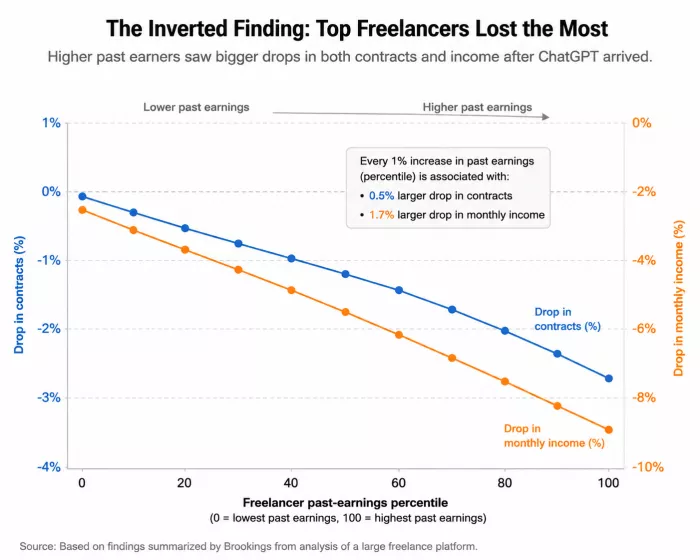
Economists studying a large freelance platform tracked what happened to freelancers after ChatGPT arrived. The headline result was predictable enough. Freelancers in AI-exposed categories lost about 2% of their contracts and roughly 5% of their monthly earnings.
Then they sorted those freelancers by track record, and the pattern turned upside down.
The freelancers with the strongest histories took the heaviest losses. Every 1% increase in a freelancer's past earnings came with an additional 0.5% drop in job opportunities and a 1.7% fall in monthly income. Brookings, summarising the research, put the mechanism plainly: generative AI compressed the performance gap. Freelancers who had been average could suddenly ship work that approximated top-tier output, and the premium that expertise used to command quietly evaporated.
Sit with that for a second. Being demonstrably excellent at production made you more exposed, not less.
I spent a long time trying to argue my way out of that number. I could not. What I arrived at instead is the argument of this article, and it is why I think 2026 is the year the portfolio stopped being optional.
A portfolio used to prove you could produce the work. Producing the work got cheap. So the freelancers who lost the most were, in a sense, the ones whose portfolios were doing the best possible job of demonstrating a skill that had just been commoditised.
Your portfolio matters more now than it ever has. It simply has to prove something else. The rest of this article is about what that something is, and why the version most freelancers are still running works against them.
What Actually Broke
Before I argue about what to do, let me put numbers on the damage. This is the point where I stopped reading opinion pieces and went looking for transaction data.
Researchers at Imperial College London and Harvard Business School analysed roughly two million freelance job postings across 61 countries between July 2021 and July 2023. Their finding, published in Management Science: within eight months of ChatGPT's launch, postings for automation-prone work fell about 21% relative to manual-intensive work.
The damage was not spread evenly.
| Category | Change in job postings |
|---|---|
| Writing | down 30.37% |
| Software, website and app development | down 20.62% |
| Graphic design, after image models arrived | down 18.49% |
| 3D modelling | down 15.57% |
| Engineering | down 10.42% |
Survey data can be argued with. Spending data cannot. In February 2026, Ramp's economics team published Payrolls to Prompts, built on actual corporate expense records rather than opinions, tracking firm spending from late 2021 through Q3 2025.
What they found:
- The share of company spend going to freelance marketplaces fell from 0.66% to 0.14%.
- The share going to AI model providers rose from zero to 2.85%.
- More than half the businesses that used freelance platforms in 2022 had stopped entirely by 2025.
- Among the most exposed firms, every $1.00 of reduced freelance spend was replaced by roughly $0.03 of AI spend.
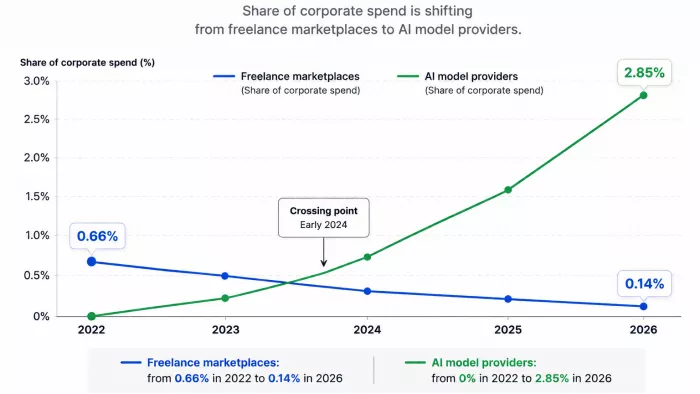
Three cents on the dollar. And the companies that had spent the most on freelancers moved to AI the fastest.
That is the floor collapsing, measured in bank transactions rather than sentiment. If the story ended there, the honest advice would be to find another line of work. It does not end there, and the next section is the reason I am still writing this.
The Market Did Not Shrink. It Moved Upstairs.
There is a sentence in that same Imperial College and Harvard paper that gets quoted far less often than the 21%. The automation-prone jobs that survived were of greater complexity and offered higher pay.
The market did not empty out. It sorted.
Watch the same migration from the buyer's side of the transaction:
- Upwork's active client count fell to 794,000 in Q3 2025, down 7% from 855,000 a year earlier, while total spend stayed roughly flat.
- Entry-level projects dropped below 9% of Upwork's mix in 2025, down from 15% the year before.
- Upwork told investors its sharpest pressure sits in contracts under $500.
- Fiverr's spend per buyer rose 8.3% year over year even as its active buyer count declined.
- Freelancers working on AI-related projects earn roughly 44% more per hour than those who are not.
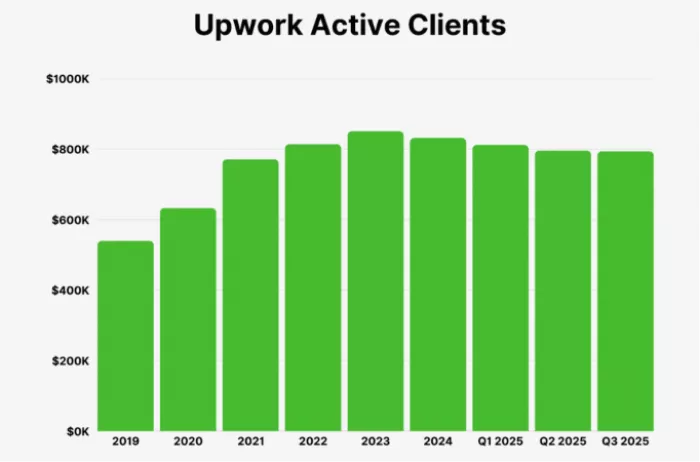
Fewer clients. Bigger cheques for harder problems.
Every line above describes one movement. The buyer who wanted a $40 blog post has left and is not coming back, because they have a subscription now. The buyer who stayed has a problem the subscription did not solve.
That buyer reads you differently. They already know a machine can produce a deliverable. What no subscription can tell them is whether you will make good decisions about their expensive, half-defined problem.
Nothing in a marketplace profile answers that question, which is what the next section is about.
Your Marketplace Profile Cannot Follow You There
I am not going to tell you to quit the platforms. They still route real money, and the section above shows exactly where it went. My claim is narrower: a profile is structurally unable to do the job I just described.
Start with the arithmetic. Upwork hosts roughly 18 million registered freelancers against those 794,000 active clients. That is about 23 freelancers for every client with a pulse. The Imperial College team also found that as postings thinned, applications per remaining posting rose 8.57%. More people, fewer jobs.
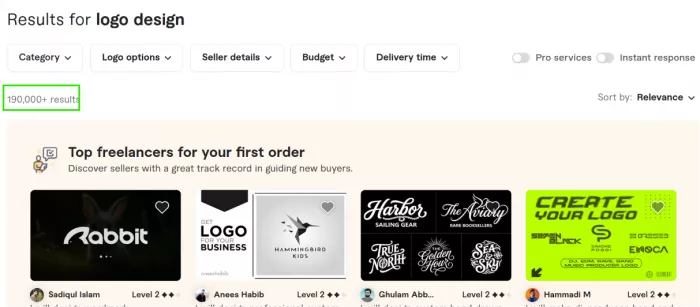
Now look at what a profile physically permits you to say. A fixed template. Skill tags drawn from a standard vocabulary. A star rating. A gig card. Thumbnails.
A marketplace profile is engineered to make you comparable. Comparability is the entire product. It is what lets a client line up 23 of you and choose on price.
Comparability is also the precise opposite of what you need when your value is a judgment the client cannot assess at a glance.
Then there is the landlord problem. Two facts already on the table: more than half the businesses using these platforms in 2022 had gone by 2025, and active clients fell 7% in a single year. Your reputation there is denominated in a currency whose issuer is losing customers. It does not travel with you. You cannot link to it. You cannot put a case study inside it. It sits behind a login, in a format the landlord chose.
Which brings me to what a case study actually does.
What the Remaining Clients Are Buying
Here is the distinction that reorganised my thinking.
AI produces output. It does not produce the decision about which output was right for this client, this budget, this deadline, this stakeholder who hates the colour green. Every project contains dozens of those decisions, and every one of them is invisible in the finished artifact.
A gallery shows the artifact. It hides the decisions. A gallery in 2026 is therefore a display case for the exact half of your work that got commoditised.
A case study is the only common format that carries the decisions out into the open.
| What a gallery shows | What a case study shows |
|---|---|
| The final screen | The three options you weighed and why two died |
| A logo | The constraint that made the obvious answer wrong |
| A finished article | The client's real problem before you were hired |
| Polish | Judgment under a live constraint |
| That you can execute | That you can be trusted to decide |
The market data agrees. As covered above, the work that survived is more complex and better paid, and complexity is another word for “the decisions here are hard.” A client buying a hard-decision project is buying decision-making. Show them the artifact and they see a machine's output with your name on it. Show them how you decided and you have shown them the one thing that did not get cheap.
I would rather see four projects with honest case studies than forty thumbnails. Most portfolios contain forty thumbnails, for reasons worth naming.
The Real Reason Most Freelance Portfolios Fail This Test
Open almost any freelancer's site and you find the same architecture. A hero line. A grid of images. An About page. A contact form.
That architecture was correct in 2015. It fails now for a single reason, and it is the reason this whole article has been circling: it is optimised to prove production.
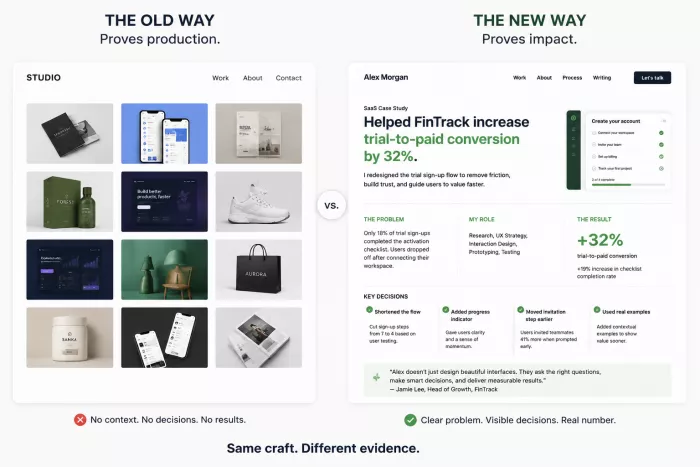
The failures I keep running into:
The grid with no words. Twelve images, zero context. A reader cannot tell which parts were your decisions and which were handed to you in the brief.
The About page that is about you. Your journey, your passion, your tool stack, your design philosophy. The client is sitting there thinking about their problem. Nothing on the page connects your history to their outcome.
Everything you have ever made. Volume signals availability, and availability is not scarce. Twenty-three freelancers per active client, remember.
No numbers. “Redesigned the homepage.” And then what happened? If you do not know, email the client and ask. They usually tell you.
The generic hero line. “I am a graphic designer.” Against: “I help SaaS companies turn free trials into paid accounts through landing page design.” The first is a job title. The second is a problem statement, and problem statements are what people search for and what a colleague forwards.
That last failure carries a consequence most freelancers have not priced in, because your hero line is now read by software before any human sees it.
Your Portfolio's First Reader Is a Machine
This shift happened fast, and quietly.
By 2026, around 87% of companies use AI somewhere in hiring, and roughly 61% of employers use generative AI to screen applicants directly. Only 29% keep full human oversight on every AI-driven rejection. Freelance hiring is studied less closely than employment hiring, but the buying behaviour is converging. Clients shortlist with the tools they already use for everything else, and they arrive at your site with an assistant open in the next tab.
Two consequences follow, and neither is priced into most portfolios.
Your images are invisible. A model reading your portfolio reads text. A grid of JPEGs named final_v3.png transmits nothing to it. The case study you did not write is the case study that does not exist to the software deciding your shortlist.
Generic gets filtered twice. About 80% of hiring managers say they can spot AI-written applications at a glance. Greenhouse's chief executive has a name for the loop this created: candidates use AI to apply to more jobs, so employers use AI to filter harder. Both sides escalate from there. Interview rates have fallen from roughly 1 in 7 to 1 in 33 over a decade. Anything that reads like everyone else gets sorted out by the machine, then sorted out again by a human who is exhausted by machine output.
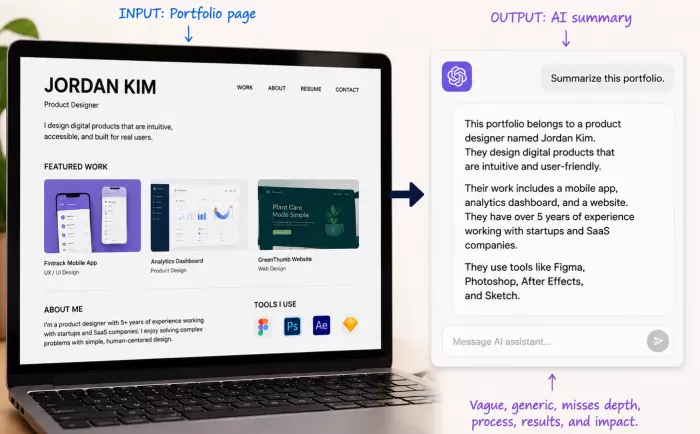
One thing survives both filters. Specific, written evidence of decisions you made. Which is a description of a case study, and a description of the thing a profile cannot hold.
Why a Portfolio Compounds and a Proposal Does Not
Everything so far has been about being chosen. This section is about arithmetic.
A proposal is linear. You write it, you send it, it resolves, and its value drops to zero. Tomorrow you start again from nothing. With applications per posting up 8.57% and postings down, you run that race against more people for a smaller prize, every day, forever.
A portfolio is an asset. A case study you write once gets read at 2am by someone you will never meet. It gets forwarded inside a company you have never heard of. It surfaces in a search six months later. It does not resolve. It accrues.
The behaviour data says this is already how the work moves. In the Freelancer Kompass 2026 survey, 56% of freelancers found work through personal networks, up from 30% in 2024. A network cannot refer you if there is nothing to send. “You should talk to Sarah” is a weak referral. “You should talk to Sarah, here is the thing she did for a company like yours” is most of a closed deal.
This is also where pricing lives. Two freelancers with the same skills charge $25 and $150 an hour. The gap is not skill. The gap is that one of them has evidence a client can forward to a finance director without having to explain it first.
When You Genuinely Do Not Need One
I would rather lose this argument honestly than win it by pretending the exceptions do not exist. There are four.
- Your work sits under NDAs strict enough to make public case studies impossible, common in defence and parts of finance.
- Two or three retained clients fill your capacity, and have done for years.
- Your pipeline is entirely inbound referral from a network you did not have to build.
- You are leaving freelancing inside a year.
I have met people in every one of those categories. Their businesses work.
Here is the uncomfortable part. Each of those positions is a single event away from vanishing. The retainer ends. The referrer changes jobs. The anchor client gets acquired and the new procurement team runs a competitive process. On that day you begin building your evidence from zero, at the exact moment you have no time to do it well, in the market described at the top of this article.
The NDA case has a workaround, incidentally. Anonymise it. “A Series B fintech” plus the problem, the constraint you worked under, the decision you made, and the number it moved. Clients care about the reasoning. The logo was never the point.
A portfolio is insurance whose premium is one weekend. That is why I will still say every freelancer.
Four Tests to Run on Your Own Portfolio This Week
I am not going to hand you a list of beautiful sites to envy. Beautiful was never the problem. Run these instead.
Test 1: The stranger test. Show your homepage to someone outside your field for five seconds, then ask what you do and who you do it for. If they say “design” rather than “helps SaaS companies with trial conversion,” your hero line is a job title.
Test 2: The decision test. Open your best project page and count the decisions a reader can see. Not the outcomes. The decisions: what you rejected, what constrained you, what surprised you, what you would do differently now. If the count is zero, you have published a gallery.
Test 3: The machine test. Paste your project page into any AI assistant and ask it to summarise what you did and why you were the right person to do it. Whatever comes back is roughly what a client's assistant will tell them. If it reads as vague, your page is vague. This test costs nothing and takes ninety seconds. Almost nobody runs it.
Test 4: The forwarding test. Could a client drop one URL from your site into Slack and have a colleague understand why you should be hired, with no covering explanation? If not, nothing on your site can travel. As the section above argued, travelling is how the work now arrives.
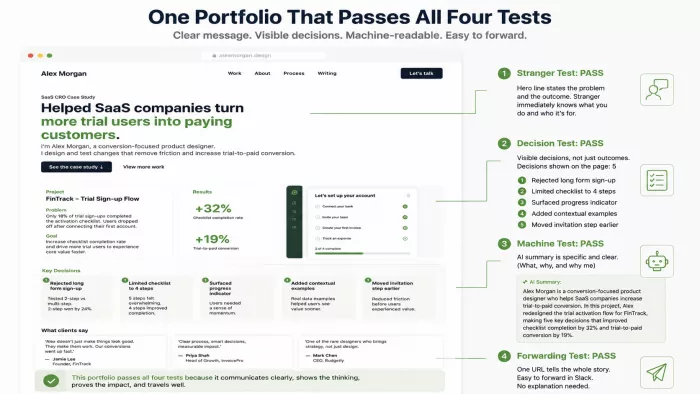
Then go and write one case study. One page, this weekend, about the project you are proudest of, built around the four decisions that made it work. The whole site can wait. That single page will outperform the twelve thumbnails sitting above it, and it will be the only thing on your site that a machine can read, a client can forward, a colleague can understand, and a competitor with a subscription cannot generate.
The Bottom Line
Your reasoning has a shelf life.
The artifact keeps. Screenshot a 2023 project today and it looks exactly as good as the day you shipped it. The thinking behind it is decaying right now. The direction you killed in week two, the offhand client sentence that changed the brief, the constraint that made the obvious answer wrong, the number you moved: that material lives in your head for months, not years.
Every project you close without writing it up becomes a thumbnail permanently, because a thumbnail is all you will be able to reconstruct later.
Write up the last one while you still remember why you made the calls you made. In six months you will have the screenshots and none of the reasons.


Comments