Add Me to Google: What It Was, Why It's Gone and What Actually Works Now

Bharat Sharma
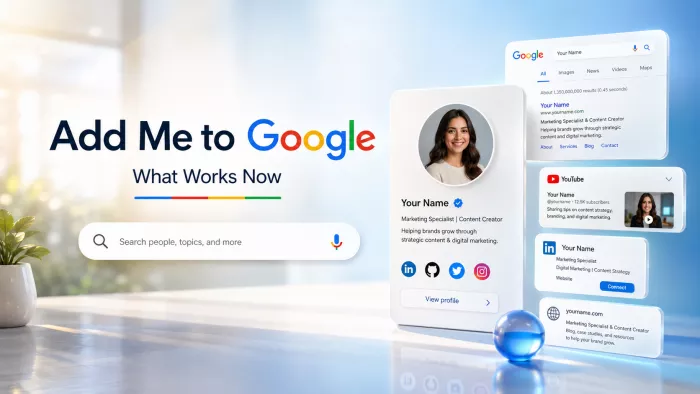
Anyone searching "add me to Google" in 2026 hoping to create a profile card in search results is chasing a feature that no longer exists. Add Me to Google officially the Google People Card was discontinued on April 7, 2024. It is not available in any country, existing cards were removed from search, and no setting or workaround restores it.
That leaves two things worth covering properly. First, the full story of what the feature was, how it worked, and why Google shut it down. Second, and more useful: what replaces it. The real goal behind that search was never a card, it was controlling what appears when a name gets searched, and that goal remains entirely achievable.
Is Add Me to Google Still Available in 2026?
The answer is No and confirming it takes under a minute. Signed in to Google on a phone, search "add me to Google" or "add me to search." While the feature was live, a prompt titled "Add yourself to Google Search" sat above the results with a Get Started button. Today the same query returns ordinary results articles, forum threads, nothing interactive.
A second check settles any remaining doubt: searching "edit my people card" once opened an existing card for editing. It now returns nothing of the kind. Two searches, no button, no card.
This needs stating plainly because a surprising number of recently dated articles still walk through the card creation steps as if the feature works. The keyword continues to attract searches, so old tutorials keep resurfacing with fresh dates on top. Any guide pointing at a Get Started button is describing 2020, not 2026 the one-minute test above is the tiebreaker.
What Add Me to Google Actually Was
Google launched the feature in August 2020, in India first, in English and Hindi. The problem it targeted was real and specific: millions of tutors, freelancers, performers, shop owners, and job seekers had no website and no press coverage, so a search for their name returned either nothing or a complete stranger.
The answer was a self-serve identity result from a small public profile, hosted by Google, that surfaced when someone searched the owner's name. In practice it worked like a digital visiting card embedded in the results page: photo, bio, profession, links, all created through a form rather than a website.
In 2021 the feature expanded to Kenya, Nigeria, and South Africa, and the map ended there. It never reached the US, UK, or Europe, and that footprint reveals how Google classified it internally: an experiment for markets where personal websites are rare, not a global product with a roadmap. It stayed frozen in four countries for the rest of its life.
The full lifespan fits in one small table:
| Date | What happened |
| August 2020 | Launched in India, in English and Hindi |
| 2021 | Expanded to Kenya, Nigeria, and South Africa |
| 2021–2023 | No new countries, no major feature additions |
| Early 2024 | Wind-down notices began appearing for users |
| April 7, 2024 | Discontinued everywhere; cards removed from search |
How It Worked
Card creation was mobile-only; the prompt never once appeared on desktop across the feature's four years. The requirements were light:
● A personal Google account, signed in on a phone, with Web & App Activity switched on
● A phone number verified by OTP Google's anti-spam gate, with one account and one number allowing exactly one card
● The search itself typing "add me to Google" or "add me to search" surfaced the Get Started prompt, and the card form filled out directly inside the results page
A saved card typically went live in search within a few hours to a couple of days. Editing also ran through the search bar "edit my people card" opened the card with an edit option and deletion happened from the same screen.
What a card could contain, and where each field appeared:
| Field | Where it showed |
| Name, photo, location, profession | Collapsed preview module in search results |
| Bio / About section | Expanded card, after a tap |
| Job title, company, education | Expanded card |
| Website link | Expanded card |
| Social links (LinkedIn, X, Instagram, Facebook, YouTube and others) | Expanded card |
| Email and phone (optional, public if added) | Expanded card |
The four preview fields carried nearly all the weight. Searchers saw a small module with a name, city, and profession, and only the curious tapped through to the rest. Name, bio, location, and profession were effectively mandatory; everything else was optional.
When several people shared a name extremely common in India, the feature's biggest market, the module became a carousel, and searchers scrolled through lookalike cards hunting for the right person. That detail turns out to matter a great deal in the feature's downfall.
Who It Actually Helped and Who It Didn't
At its best, the card delivered exactly what it promised for a narrow group. A tutor with an uncommon name and no website could go from invisible to findable in a day, free, with a photo and contact details in front of anyone searching for them. For that person, in that market, it was genuinely useful a lower bar to visibility than anything Google has offered individuals before or since.
The further a user sat from that ideal profile, the less the card delivered. People with common names disappeared into carousels of namesakes. Anyone already holding a website or LinkedIn profile found the card ranking below assets they controlled, adding little. Professionals outside the four launch countries never saw the feature at all. The sweet spot of uncommon names, no web presence, inside India or three African markets was real but small, and it shrank each year as LinkedIn adoption grew in exactly those regions.
Why Google Killed It
Google's official explanation at shutdown was thin, as it tends to be when a product dies quietly. But the causes were visible to anyone watching the feature closely. Three problems, each serious enough alone, stacked on top of one another.
1. Spam moved into Google's most valuable real estate. Most platforms can absorb junk profiles a spammy listing on a directory damages only the directory. People Cards placed user-generated content directly inside Google search results, the most valuable screen on the internet. The consequences followed quickly: SEO agencies mass-produced keyword-stuffed cards, impersonation cards appeared for celebrities, and fabricated personas multiplied.
The OTP requirement slowed none of it meaningfully, since phone numbers are not scarce. Google added report flags, ran automated sweeps, and purged cards tied to inactive accounts, a growing moderation bill for a product earning nothing. No ads, no subscription, no data play. Every new card was pure cost.
2. It failed hardest exactly where it was needed most. The entire pitch was helping ordinary people get found, and ordinary people share names. A search for a common Indian name produced that carousel of near-identical cards with the same name, similar photos, vague professions with no verification badge, no claimed status, and no ranking logic a card owner could influence.
Searchers could not separate the real person from an impostor, and a genuine card owner had no way to rise above four namesakes. In the feature's flagship market this was not an edge case; it was the median experience. A discovery tool that cannot disambiguate is not a discovery tool.
3. It was a strategic orphan. The card shipped without analytics of any kind, owners never learned whether ten people or ten thousand had viewed theirs, a remarkable gap for a visibility product and a clear sign nobody was resourcing it. Four countries, no expansion after 2021, no integration with anything else in Google's ecosystem. When the 2023–24 wave of cost discipline swept Google's product portfolio, a feature carrying real moderation costs and no strategic value had no defenders left.
Wind-down notices reached users in early 2024, and on April 7, 2024, the feature closed for good.
The shape of the story is familiar. People Cards followed the classic Google graveyard arc: launch an experiment in a limited market, let it run without iteration, retire it once maintenance outlives curiosity. Google Q&A on Search went the same way, as did Google Podcasts and dozens of products before them. The heaviest losses in April 2024 fell on card owners who had treated a free Google form as their entire identity strategy: no website, no profile of their own, everything inside a box Google could delete. Which it did, without asking.
What Happened to Existing Cards
All cards are gone, fully. Cards were removed from search results entirely, not archived, not frozen, removed. No export tool existed, no migration path, no successor product. A card that was never screenshotted now survives only in its owner's memory.
One footnote most coverage skipped: the cards leaned toward exposing more than owners realized. The email and phone fields were pulled from the connected Google account, and anything added was public to every searcher on earth with no analytics to reveal whether anyone was looking. Plenty of people published a personal number to the open web for an invisible audience. The shutdown quietly resolved a privacy problem many card owners never knew they had, though old third-party scrapes of search results may still hold that data.
What the Card Was Always a Substitute For
A People Card was a manual, budget version of a Knowledge Panel the box Google builds automatically for people and organizations its systems recognize and trust. Google allowed a hand-filled miniature version because it held no other data about the person.
The card is dead, but the underlying goal never depended on it. Owning the search results for a name comes down to feeding Google's entity systems enough consistent, corroborated information that they assemble the picture themselves. That takes more than filling one form, but the result is stronger and far more durable than the card ever was.
What to Do Instead: The Replacement Stack
Five assets, in priority order. Each covers what it is, why it works, and the first move.
1. LinkedIn, treated as the primary name-rank asset. For name searches in India, a completed public LinkedIn profile lands on page one almost by default Google trusts the domain more than anything an individual can build quickly. The fields shaping what searchers actually see are the headline, the current position, and the opening lines of the About section, so those deserve to be written for a stranger reading two lines. First move: full public visibility, a clean custom URL carrying the name, and a headline that describes the work in plain words rather than a job title.
2. A one-page personal site with Person structured data. A single page ideally with the name as the domain carrying a bio, photo, and links, marked up with Person schema: name, image, jobTitle, and sameAs links pointing at each profile. That sameAs field is the quiet workhorse; it tells Google's entity graph explicitly that this page, this LinkedIn, and this Instagram belong to one human. It is the closest 2026 equivalent to the card, except the owner controls it, it ranks, and nobody can retire it. Realistic cost: a domain, an evening, any static hosting.
3. A Google Business Profile only where a service is attached to the name. A tutor, consultant, photographer, or practitioner whom clients find and pay by name earns a map presence and a panel-like box no personal page can match. Without a service attached, the listing should be skipped, forcing a business profile onto a purely personal identity breaks Google's guidelines and invites a takedown later. First move, where it applies: verify the profile, then treat the description and category with the same care as a landing page.
4. Third-party corroboration. Google confirms entities the way a journalist confirms a story: through independent sources agreeing. Author bios on established sites, a listing in one or two credible directories for the profession, a podcast appearance, a mention in a local publication each is a vote that the person exists and matches what their own pages claim. Name, photo, and one-line bio need to stay identical everywhere, because consistency is precisely what entity matching runs on.
5. The Knowledge Panel, honestly framed. Done consistently, the steps above can eventually lead Google to build a Knowledge Panel for the name of the real version of what the card imitated. The honest caveat: most people never cross the prominence threshold, and it matters less than the "guaranteed panel" services claim. When a name search returns the owner's site, LinkedIn, and two corroborating mentions in the top five results, the outcome the panel represents has already been won.
The 30-Day Version
As a sequence rather than a stack, a realistic month looks like this. Week one goes entirely to LinkedIn: public visibility, custom URL, rewritten headline and About, a current photo. Week two: register the domain, build the one-pager, add Person schema with sameAs links, submit it in Search Console.
Weeks three and four handle corroboration: bringing every existing profile into agreement, landing one directory listing and one genuine mention or author bio, and adding the Business Profile only where a service justifies it. An incognito search for the name at day thirty, compared against day one, tells the whole story. A month of this beats four years of what the People Card ever delivered.
The Verdict
Add Me to Google offered one small box in search results, in four countries, with zero analytics until Google took it away without a replacement. The stack above delivers the whole first page, in every country, built on assets the owner controls.
The feature's death is less of a setback than it first appears. It marks the end of a shortcut that never led anywhere much, and its real lesson outlasts it: an online identity should never be rented entirely from a single free feature that someone else can switch off.
Frequently Ask Questions
1. Is Add Me to Google coming back?
Nothing suggests it. Google announced no successor at shutdown and has shipped nothing card-like since April 2024.
2. Can old People Cards still be edited or viewed?
No. Cards were removed from search entirely, with no archive or export, and the "edit my people card" query no longer returns anything.
3. Is there an official replacement from Google?
No single product. The practical replacement is the stack above; the aspirational one is a Knowledge Panel, which Google grants algorithmically and which cannot be applied for.
4. Why do some recent articles still show the creation steps?
Because the keyword still gets searched and old tutorials keep being republished with updated dates. The one-minute test near the top of this article settles what any guide claims.
5. Was Add Me to Google the same thing as a Knowledge Panel?
No, though they looked related. A Knowledge Panel is built automatically by Google for entities its systems recognize, cannot be self-created, and still exists today. The People Card was its manual, self-serve cousin the half that Google retired.
6. What is the fastest single fix available today?
A fully public LinkedIn profile with a clean custom URL and a headline describing the work in plain words. For a name search in India, that one asset does more than the People Card ever did.


Comments