
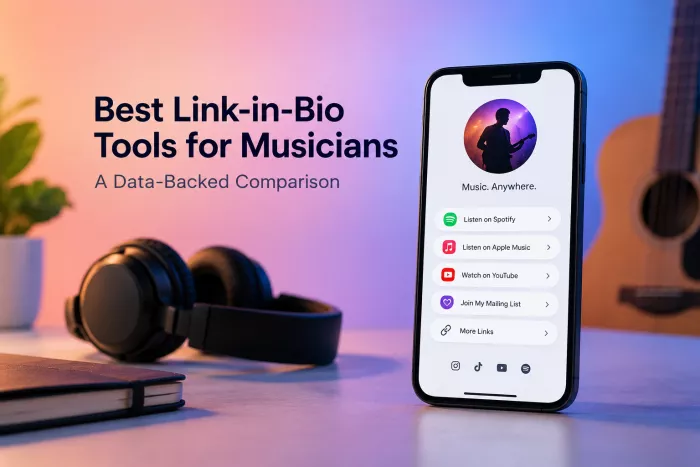
For most independent artists, one link carries almost all of the weight. It sits in your Instagram bio, at the bottom of every TikTok, in your YouTube description, and on your business cards. Every time someone hears a hook they like and thinks "who is this?", that single link is what stands between a curious listener and a lifelong fan.
So it is worth being precise about what that link actually does. If it opens a plain list of social icons, you are handing a warm listener a menu and asking them to do the work. Most will not. A link built for musicians does the opposite. It routes fans to your release on whatever streaming app they already use, and it captures a way to reach them again. It also tells you which posts and platforms are driving real listens.
This guide compares the link-in-bio and smart link tools that independent musicians are actually using in 2026, with pricing and features verified against current sources rather than repeated from older roundups. Two tools that still show up on a lot of "best of" lists, ToneDen and Koji, have shut down, and I have flagged them so you do not waste a release day on a dead link. Everything below is a platform you can sign up for today.
At-a-Glance Comparison
| Tool | Best for | Music-specific? | Pre-saves | Email capture | Entry paid price |
| Lnk.Bio | Affordable all-purpose hub | Partial | No | No | $0.99/mo |
| Feature.fm | Campaign-grade releases + ads | Yes | Yes | Yes | ~$8/mo |
| Linkfire | Labels & data-heavy teams | Yes | Yes | Yes | ~$16/mo |
| Hypeddit | EDM/hip-hop, download gates | Yes | Yes | Yes | ~$10/mo |
| Beacons | Creator commerce + email | Partial | No | Yes | ~$10/mo |
| NotNoise | Indie release marketing | Yes | Yes | Yes | ~$9/mo |
| Carrd | Full custom design | No | No | Via embed | ~$9/yr |
Prices are current at the time of writing and billed monthly unless noted; annual billing usually lowers the effective rate. Always confirm on the provider's pricing page.
What Makes a Link-in-Bio Tool Right for Musicians
A generic link-in-bio tool treats your music as just another link. A music-first tool understands that a release lives in a dozen places at once and that a listener's attention is fragile. Five things separate the two.
Streaming detection and coverage. The best tools take one Spotify or Apple Music URL and automatically build buttons for every service your track is on: Spotify, Apple Music, YouTube Music, Amazon, Deezer, Tidal, SoundCloud, and more. If you have to paste each destination by hand for every release, you will eventually stop bothering, and your links will fall out of date. The best music smart links send fans straight to their preferred streaming service.
Pre-save support. Between the day your track is delivered to your distributor and release day, a pre-save link lets fans commit to saving your song before it drops. That early activity signals momentum to streaming algorithms on day one. For any artist with a release schedule, this is not a nice-to-have.
Email (and fan data) capture. Streaming platforms own your listeners; you rent access to them. An email address is the one direct line to a fan that no algorithm can throttle. A link page that collects emails, or offers a download in exchange for a follow, turns passive traffic into an audience you actually control.
Analytics that mean something. A single click count tells you nothing. You want views versus clicks (your conversion rate), which platforms fans choose, where in the world they are, and which social channel sent them. That is the difference between guessing and knowing where to spend your next hour of promotion.
Pricing that respects a working artist. Most independent musicians are funding their own releases. A free tier should be genuinely usable, not a locked demo, and paid plans should be priced for a one-person operation rather than a label with a data team.
Keep those five in mind as you read. Almost every tool below is strong on some and weak on others; the "best" one depends entirely on which of these matters most to you right now.
How These Tools Were Compared
Pricing and feature details in this guide were checked against each platform's current public pricing and recent independent reviews as of mid-2026, because this category changes fast, and at least two once-popular tools have closed. Where a platform's tiers vary by source or region, I have said so rather than pretend at false precision. Treat the numbers as accurate at the time of writing and confirm the latest on each provider's own pricing page before you pay.
1. Lnk.Bio: The Affordable All-Purpose Hub
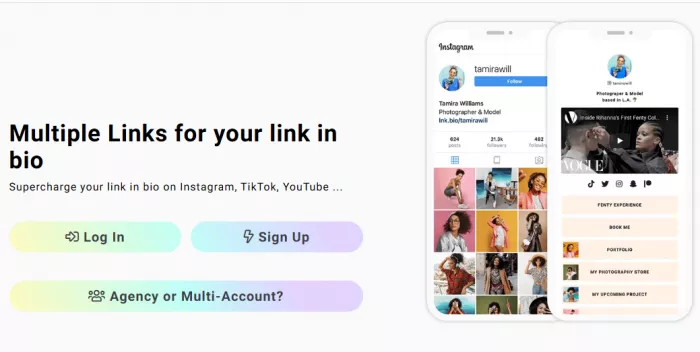
Lnk.Bio has quietly become the second-largest link-in-bio service, with more than 1.5 million creators across 215 countries, and it has held the same prices since it launched in 2016. It is the pick for artists who want a clean, all-purpose page without a monthly subscription hanging over them. Setup takes about five minutes and the free plan carries unlimited links, and its 147 embed services let fans play a track from Spotify, Apple Music, SoundCloud, or Bandcamp without leaving your page.
Where Lnk.Bio earns its place for musicians is breadth and price, not campaign depth. If your bio link needs to point to your music and a merch store and tour dates and a YouTube channel and a newsletter, it handles that mixed bag in one page, with 577 templates and 3,000-plus icons to make it yours. The standout is the pricing model: instead of a recurring bill, you can pay once and keep the upgrade for the life of the account.
The trade-offs matter, though. It is not built for release campaigns, so you will not find pre-save automation or the release-focused analytics that specialized tools offer. It is also independent and lean, which keeps prices low but means it ships new features more slowly than the market leaders.
Best for: Artists who want a familiar, affordable all-purpose page covering music, social, merch, and more, ideally without a subscription.
Pricing (2026): Free ($0) with unlimited links, basic analytics, templates, and media embeds; Mini $0.99/mo or $9.99 once for scheduling, advanced analytics, and extra pages; Unique $24.99 once removes branding and adds custom colors, more pages, and a free .bio domain for a year. Agency plans start around $2/mo for three accounts, and a custom domain is a $29.99/yr add-on.
Watch out for: No music-specific pre-saves or playlist tools, no native email capture on the page, and analytics that are basic next to purpose-built smart link platforms.
2. Feature.fm: The Music Marketer's Workhorse
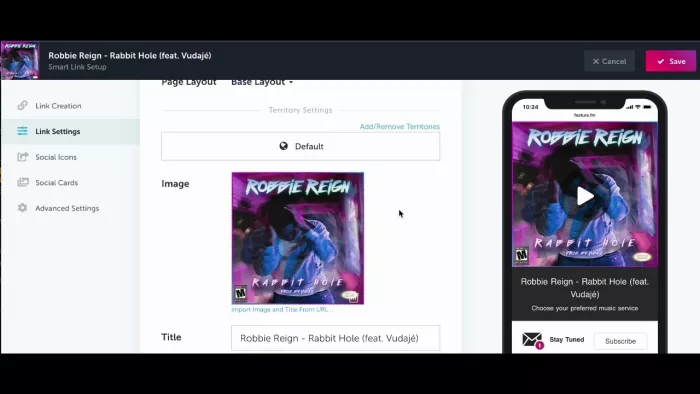
Feature.fm is one of the most established smart link platforms built specifically for release campaigns, and it shows in the feature set. You get smart links and pre-save pages, plus "action" or unlockable links where a fan completes a step (following you on Spotify, joining your email list) to reach a reward like early access or a bonus track. It also leans hard into advertising, integrating with Meta and offering its own ad and audio placement tools, which makes it a natural fit if paid promotion is part of your plan.
For an artist running structured rollouts several times a year, Feature.fm covers the whole window from "track delivered" to "release day plus thirty," which is exactly where most smart link tools either shine or fall short. The analytics are solid and pre-saves are dependable. Retargeting pixel support means your links can feed ad audiences.
The catch is cost as you climb. The genuinely useful features (full pre-save store coverage, custom domains, and unlimited pixels) sit on the higher tiers, so the effective price for a "complete" setup lands above the entry sticker.
Best for: Artists who release on a regular cadence and want a proven, campaign-grade tool, especially if they are already running ads.
Pricing (2026): A free tier exists; paid artist plans run roughly from $8/mo (Basic Artist) to about $19/mo (Artist) to around $39/mo (Pro Artist), with higher label and agency tiers above that. Exact tiering shifts periodically, so verify current numbers before committing.
Watch out for: Meaningful features are gated behind mid and upper tiers; it can get expensive once you want the full stack.
3. Linkfire: Label-Grade Data (Probably More Than You Need)
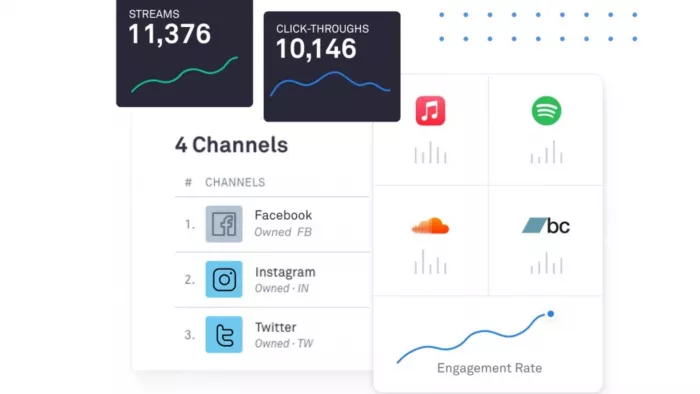
Linkfire is the smart link platform behind a great deal of major-label release marketing, used across the big three and countless established acts. If your bottleneck is data (attribution depth, DSP integrations, clean multi-artist management, retargeting), Linkfire's analytics are among the most serious in the category.
That strength is also the reason to think twice. The product is architected around workspaces and user seats, which is exactly right when you manage fifty artists and have someone reading dashboards daily, and slightly awkward when you are a solo artist trying to spin up one pre-save link.
You are, in effect, renting infrastructure designed for teams.
For an independent musician releasing a couple of projects a year, the depth rarely pays for itself. The data is excellent; the question is whether you have the volume and the time to turn that data into decisions.
Best for: Labels, managers, and established artists with the release volume and analytical appetite to justify enterprise-grade attribution.
Pricing (2026): Paid plans start around $16/mo for basic features and climb toward roughly $79/mo for the fuller product, depending on tier and seats.
Watch out for: Overkill for most solo artists; the interface and pricing assume a team.
4. Hypeddit: Download Gates and Fast Follower Growth
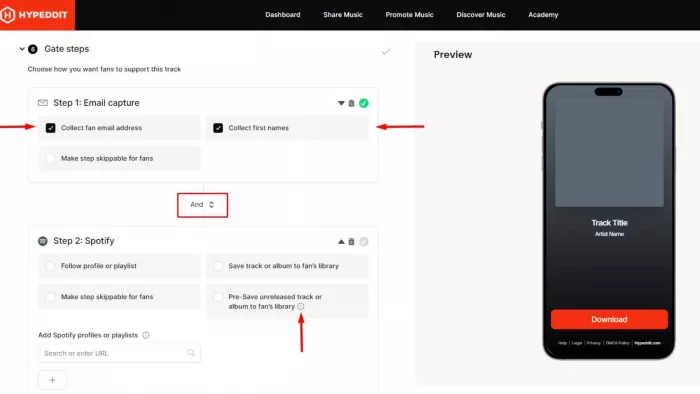
Hypeddit built its reputation in the electronic and hip-hop scenes on one clever mechanic: the download gate. A fan unlocks a free track by following you on Spotify or SoundCloud, or by reposting or joining your list. For producers and DJs sitting on remixes and edits and loosies, it is a fast, direct way to convert plays into followers and email addresses.
Beyond gates, Hypeddit offers smart links and pre-save pages, plus ad automation across platforms on higher tiers. The free tier is unusually generous, giving you unlimited smart links and download gates without paying, which is rare in this space.
The honest caveat is about quality of growth. Followers who arrive for a free download are not always the same as fans who follow because a song moved them. Gating can inflate vanity numbers, and some audiences find the follow-to-unlock exchange a little transactional. Used with intent (genuinely good free music, aimed at the right community), it works well; used lazily, it builds a hollow follower count.
Best for: Electronic, dance, and hip-hop artists who want to trade free downloads for follows, saves, and emails.
Pricing (2026): Free (Rookie) with unlimited smart links and download gates; Basic around $10/mo adds tracking pixels, email capture, and custom domains; Pro around $20/mo adds AI-assisted ad automation.
Watch out for: Gated follows can be lower-intent; the mechanic fits some genres far better than others.
5. Beacons: The All-in-One Creator Page
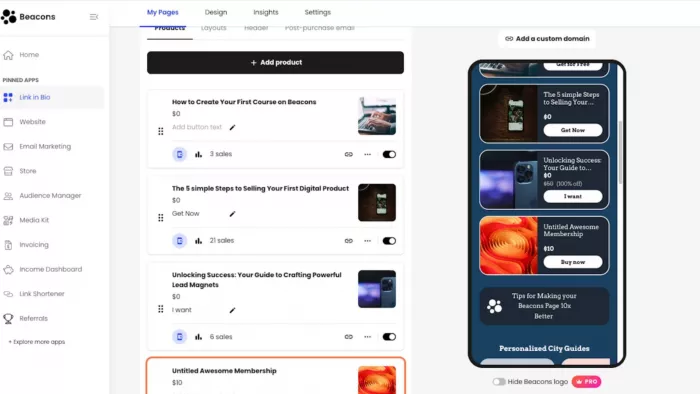
Beacons sits at the creator-commerce end of the spectrum. It is less a pure smart link tool and more an all-in-one home base: a link-in-bio page plus a storefront for digital products, email marketing, a media kit builder, and AI-assisted setup that gets a usable page live quickly. For a musician who is also a content creator (selling sample packs, beats, presets, or merch, and pitching brand deals), that bundle can replace several separate subscriptions.
It stepped neatly into a gap left by Koji, the interactive bio-page tool that shut down in early 2024, offering the same "your bio page can also make money" pitch with a more polished, modern stack behind it.
The thing to scrutinize is the fee structure. Beacons' free and lower paid tiers apply a seller fee (around 9%) on digital product sales, on top of payment processing, and that only drops to 0% on higher-priced plans. If selling is central to your page, run the math on volume before assuming "free" is actually free.
Best for: Artists who are also creators and want bio page, email list, digital storefront, and media kit in one tool.
Pricing (2026): Free plan available (with a seller fee on sales); paid Creator tiers commonly start around $10/mo, with commerce-focused and business tiers ranging up to roughly $30–$90/mo depending on features and fee removal. Tiers and fees vary by source, so confirm current pricing directly.
Watch out for: Seller fees on lower tiers; it is broader than a music campaign tool, so pre-saves and release analytics are not its focus.
6. NotNoise: Purpose-Built Music Smart Links
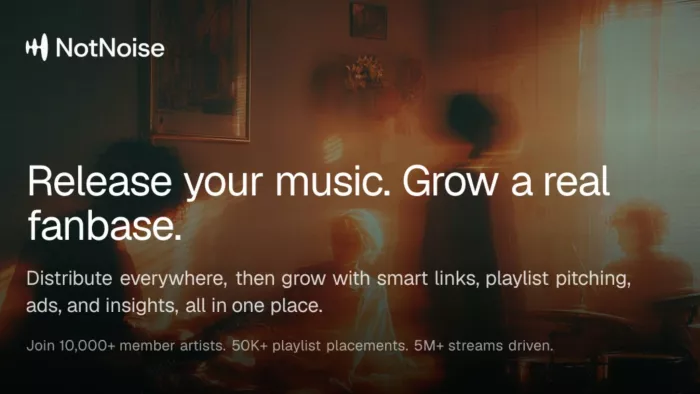
NotNoise is a newer, music-focused entry that builds release destinations from a single Spotify URL and pairs smart links with pre-saves and fan email capture, plus analytics that scale by plan. Its pitch is squarely at independent artists who want campaign-grade features (email capture on the link page, pre-save flows, geographic and referral data) without the enterprise pricing or complexity of a label tool.
On the free plan you get a handful of smart links covering the major platforms with basic analytics; paid tiers add wider platform coverage, fan email capture, city-level and geographic data, longer analytics history, and eventually tracking pixels, custom domains, and branding removal. For an artist whose main goal is turning bio-link traffic into streams and a mailing list, that feature ordering makes sense.
As a younger platform, its community and integrations are smaller than long-established names like Feature.fm or Linkfire, and some teams will still prefer the depth or familiarity of the older tools. But on price-to-value for a solo release marketer, it is one of the stronger options to evaluate.
Best for: Independent artists who want per-release smart links with email capture, pre-saves, and real analytics at indie-friendly pricing.
Pricing (2026): Free (a few links, basic analytics); Pro around $9/mo (unlimited links, email capture, pre-saves, richer analytics); Max around $19/mo (tracking pixels, custom domains, branding removal). Annual billing available.
Watch out for: Smaller community and fewer third-party integrations than the veteran platforms.
7. Carrd: Total Design Control, Built by Hand
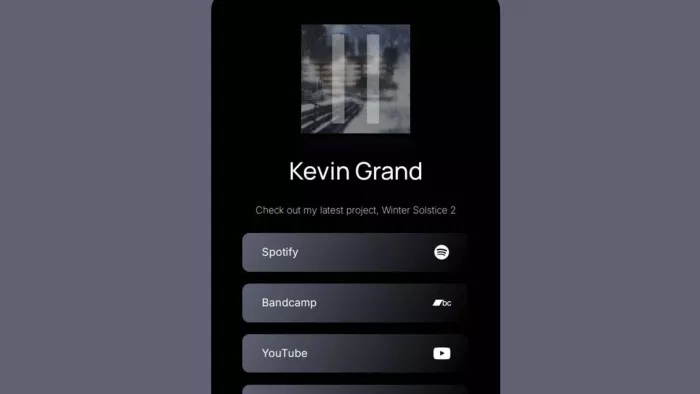
Carrd is not a music tool at all. It is a simple, elegant one-page website builder, but a lot of design-conscious artists use it precisely because it gives them complete control. You can embed a Spotify player, drop in an email signup form, add your own imagery and typography, and end up with a bio page that looks nothing like a template. The result feels like your site, not a service's default.
The trade-off is effort. There is no "detect my release and build the buttons" magic, and no native pre-save engine or music analytics. You assemble everything yourself, and you maintain it yourself. For an artist with a strong visual identity and a little patience, that control is the whole point. For someone who wants to paste a Spotify link and move on, it is more work than the moment usually allows.
Best for: Artists with a clear visual brand who want a fully custom page and do not mind building and updating it manually.
Pricing (2026): Free (limited); Pro tiers roughly $9 to $49 per year depending on features. That is inexpensive compared with monthly-subscription competitors.
Watch out for: No automatic streaming detection or pre-saves, and no music analytics; you build and maintain everything.
How to Choose Based on Where You Are
The right tool tracks your stage more than your genre.
If you are just starting and have no budget, begin free. NotNoise or Hypeddit both offer genuinely useful free smart links and pre-saves, and a free Lnk.Bio can hold your non-music links. You lose nothing by testing.
Someone who are releasing regularly and want to run real campaigns, step up to a music-first paid tool with pre-saves and email capture, plus pixel tracking. Feature.fm, NotNoise, or Hypeddit's paid tier all qualify. Pair it with one promotion channel you will actually maintain. For many artists, short-form video is an easy way to stay visible between releases.
For a creator-artist who sells things, Beacons consolidates your bio page with your list and storefront, though you should price in its seller fees.
If you are on a team or label with release volume, Linkfire's analytical depth starts to justify itself.
And if design identity is everything to you, Carrd gives you a canvas nobody else's page will look like, at the cost of doing the work by hand.
The Bottom Line: Match the Tool to the Job in Front of You
There is no universally "best" link-in-bio tool for musicians. There is only the best fit for what you are trying to do this season. The trap most artists fall into is choosing based on which page looks prettiest, then discovering months later that it never captured a single email or told them which TikTok actually drove streams.
So decide from your goals, not the aesthetics. If you are early and cash-strapped, start free with a music-first tool like NotNoise or Hypeddit and learn what your traffic does before you spend anything. If you release on a schedule and want to grow deliberately, invest in a campaign-grade tool with pre-saves and email capture and pixel tracking, and commit to reading the analytics. If you are building a small business around your art, let Beacons or Lnk.Bio carry the commerce while a smart link handles the music. And if your brand lives and dies by how it looks, Carrd rewards the effort with a page that is unmistakably yours.


Comments