
The creator economy has a publicity problem, and it's the opposite of what you'd expect. The numbers everyone repeats make it sound like a gold rush; the numbers nobody repeats show most of the prospectors leaving empty-handed. Analysts have the market sprinting toward a trillion dollars within a decade and in the same breath, earnings surveys show more than half of creators making under $15,000 a year. Both are true. Everything worth understanding lives in the gap between them, so that's where these statistics are pointed.
The state of play, in six numbers
~$250B+ Estimated market size in 2025 Goldman Sachs / Grand View | ~207M Content creators worldwide Higher counts reach 300M+ | 50%+ Earn under $15,000 a year Creator earnings surveys |
~4% Earn more than $100,000 Creator earnings surveys | ~70% Of creator income is brand deals Influencer Marketing Hub | 86% Of big U.S. marketers use creators Up from ~70% in 2021 |
How big is it, really?
Start with the number that gets top billing, because it deserves an asterisk roughly the size of the number itself. Depending on which firm you ask, the creator economy was worth somewhere between $200 and $256 billion across 2024 and 2025, and forecasts for the early 2030s run from Goldman Sachs' relatively sober figure of about $480 billion by 2027 all the way to Grand View Research's $1.35 trillion by 2033. That is not a rounding difference. That is one research house saying the market will be nearly three times the size another does. When estimates diverge that hard, the divergence itself is the story.
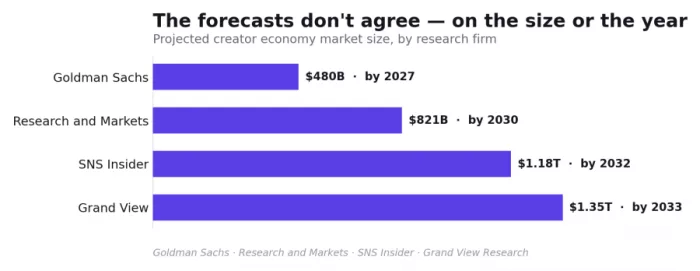
The gap comes down to a definitional question nobody has settled:
• Some firms count only what creators themselves earn sponsorships, tips, subscriptions, ad revenue share. Others count the entire ecosystem built around them: the editing apps, the management agencies, the analytics tools, and the brand budgets flowing in. The second definition is easily double the first, which alone explains much of the spread.
• Growth-rate assumptions do the rest. A 14% annual rate (Goldman's) and a 24% one (SNS Insider's) look similar on paper but end up a trillion dollars apart by 2032, because compounding is unforgiving over a decade.
• Most of these figures come from research firms that sell market reports, which carry a mild commercial incentive to describe the market as large and fast-moving. That doesn't make them wrong, but it's worth reading the direction of travel rather than the decimal points.
CREATOR ECONOMY MARKET SIZE, BY SOURCE
| Source | Recent value | Projection | Implied growth |
| Goldman Sachs | ~$250B (2024) | ~$480B by 2027 | ~14% (most conservative) |
| Research and Markets | $256B (2025) | $323B (2026); $821B by 2030 | ~26% |
| Grand View Research | $205B (2024) | $1.35T by 2033 | 23.3% |
| SNS Insider | ~$200B (2024) | $1.18T by 2032 | 24.6% (most aggressive) |
Figures compiled from Goldman Sachs, Research and Markets, Grand View Research, and SNS Insider (2024–2026).
The honest takeaway: the creator economy is unambiguously large and growing at double-digit rates, faster than most traditional advertising categories. But anyone quoting a single precise figure for it has either skipped the source or is hoping you will.
How many creators there are and why that word is slippery
The count usually cited is around 207 million creators worldwide in 2026, with looser definitions from Adobe and Linktree pushing past 300 million. Raw headcount, though, hides the more useful fact underneath it: Adobe estimates that only about 14% of creators are “influencers” in the brand-deal sense. The other 86% are hobbyists, side-hustlers, and people posting to a few hundred followers. Of the whole population, perhaps 50 million are professional or semi-professional.
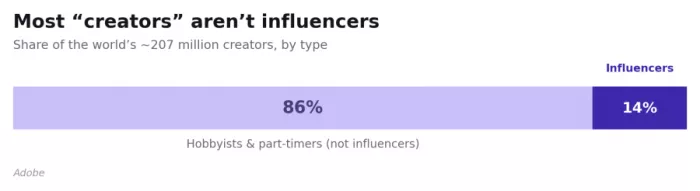
This distinction matters more than almost any other stat in this article, because nearly every alarming or exciting claim about “creator income” is really a statement about that thin professional slice, not the 200 million. When a headline says creators earn some amount, the first question is always: which creators? In the U.S. alone, MBO Partners counted 10.1 million independent creators in 2025, up 13% year over year a genuine workforce, but a small fraction of the sprawling global “creator” label.
Who the creators actually are
The mental image of a Gen Z teenager filming in a bedroom is mostly wrong. By Adobe's numbers, Millennials are the largest cohort at roughly 42%, with Gen Z closer to 14%, though Gen Z is growing fastest and clearly dominates short-form video. The busiest age bracket for both making and watching content is 25 to 34. And around 70% of creators do it part-time; only about 30% are full-time. The ones who make the leap take roughly 18 months to get there and spend an average of about $10,700 setting up the business, according to The Tilt.
Gender is where you can watch the statistics openly contradict one another. ConvertKit's data puts creators at 64% female; other broad surveys put the total population at roughly 53 to 55% male. Both can be defensible at once, because they are counting different populations: women dominate the beauty, fashion, and lifestyle niches that anchor most brand-sponsorship data, while men cluster in gaming, tech, and business. The lesson is a practical one: when a gender split surprises you, check which slice it's measuring before you trust it.
The income reality (the part most articles rush past)
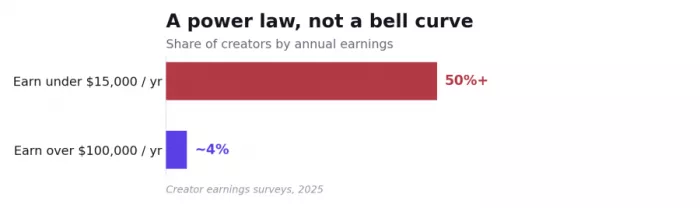
Here is the number that should reframe everything above it. Across the major earnings surveys, more than half of creators make under $15,000 a year, and only about 4% clear $100,000. The distribution is not a bell curve; it's a power law the same shape you find in music, acting, and professional sport, with a small cluster of winners at the top and a very long, very flat tail.
50%+ of creators earn under $15,000 a year the long tail | ~4% earn over $100,000 a year the short head |
The averages are quietly misleading, too. When you see a cheerful “average creator income” figure, know that it's being hauled upward by a tiny group of outliers earning in the millions a group that, per the Influencer Marketing Hub's 2025 Creator Earnings Report, skews heavily male. Which leads to the least-discussed number in the whole space: at the same follower count, female creators earn an estimated 30 to 40% less than male creators. That gap isn't a sampling quirk; it's structural, and it mirrors the offline entertainment industry the creator economy grew out of.
And yet, a genuinely strange counterpoint: surveys such as Lightricks' find that around 74% of creators say they feel fairly compensated. Make of that what you will. Either expectations are calibrated to “this started as a hobby anyway,” or the non-financial payoffs audience, autonomy, a sense of identity are doing real work that a dollar figure doesn't capture. It's almost certainly both.
How creators actually make money
Follow the revenue and one source towers over the rest: brand partnerships account for roughly 70% of total creator income. That single fact explains a great deal of creator behaviour: the sponsored posts, the affiliate links, the swerve toward whatever brands happen to be buying this quarter. It's also the sector's biggest fragility, because sponsorship money is lumpy, seasonal, and the very first line item cut when an ad recession hits.
The creators who build something durable tend to spread their bets instead of betting the business on brand deals:
• Affiliate commissions are nearly universal; around 98% of creators earn something from them, per Urlgeni, even when they're rarely the main event. They're the passive baseline layer under everything else.
• Subscriptions and memberships are the quiet workhorse. Patreon alone has paid creators more than $10 billion cumulatively and passed 25 million memberships by 2025 money that arrives every month regardless of what the algorithm is in the mood to promote.
• For expertise-led creators, services beat sponsorships outright. The Tilt found that 49% of them earn the majority of their income from consulting and coaching rather than from posting at all.
The pattern across every serious earnings report is identical: single-stream creators are exposed, multi-stream creators endure. Diversification is the closest thing this industry has to job security.
That shift also explains why more creators are starting to operate like small businesses rather than relying on platform payouts alone. The move toward creators becoming entrepreneurs often means combining sponsorships with products, memberships, events and other revenue streams that make income less dependent on a single source.
The demand side: where the money comes from
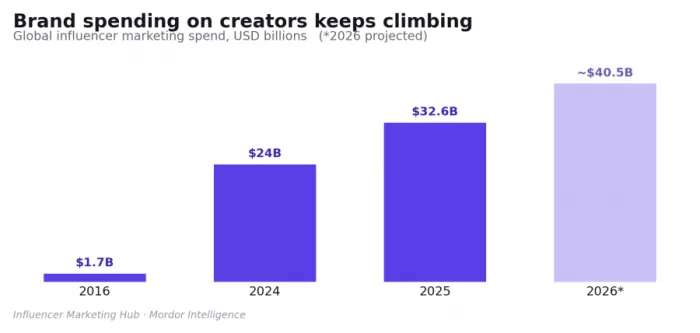
Creator income has to come from somewhere, and increasingly it comes out of brand marketing budgets. Influencer marketing, the largest slice of brand spend flowing to creators has gone from a $1.7 billion curiosity in 2016 to $32.55 billion in 2025, a 35.6% jump in a single year, with Mordor Intelligence projecting north of $40 billion in 2026.
The adoption numbers say more than the dollars do. By 2025, 86% of large U.S. marketers were using influencer marketing, up from around 70% in 2021, and they report an average return of $5.78 for every dollar spent, with top campaigns claiming $11 to $18. In plain terms: this is no longer an experimental line item a bold marketing chief has to defend in a meeting. It's a mainstream channel approaching saturation among big advertisers which is exactly why creator rates still have room to climb even as the creator population balloons.
Platforms and the problem of building on rented land
Every statistic here sits on top of one uncomfortable dependency: the creator owns the relationship with the audience, but the platform owns the distribution. An algorithm tweak can halve someone's reach overnight, with no warning and no appeal. Payout terms change on the platform's schedule, not the creator's. And the platforms themselves are not permanent fixtures of the on-again, off-again threat of a U.S. TikTok ban stranded millions of creators mid-strategy and sent them scrambling to rebuild an audience somewhere else.
This is why the more clear-eyed creators treat their follower count on any single app as a lease rather than a deed, and why email lists, memberships, and owned storefronts keep turning up in the earnings data of the people who actually last. Platforms give reach and take it away; the creators who plan for the taking-away are the ones still standing five years later.
That is also why creators are building systems instead of audiences. Social platforms remain useful for discovery, but email lists, websites and communities give creators a way to keep the relationship when reach drops or an algorithm changes.
Why everyone suddenly wants in
The cultural pull is a statistic in its own right. In Morning Consult's polling, about 57% of Gen Z say they would become an influencer if given the chance a figure that has barely moved since 2019 and even among U.S. adults overall, roughly 41% would take the job. The stated reasons are consistent across surveys: money, flexibility, and fun, in roughly that order.
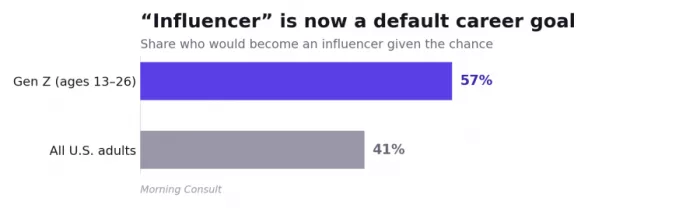
That represents a remarkable inversion. “Content creator” now sits alongside doctor and lawyer as a default career aspiration for teenagers, at the very moment young people are souring on conventional corporate work and citing a lack of autonomy. Whether that optimism can survive contact with the under-$15,000 reality laid out earlier is the open question hanging over the entire sector.
The frontier: AI and where the smart money is going
Two forces are reshaping the next few years. The first is AI, and it is already here rather than coming: about 86% of creators report using generative AI in their day-to-day work scripting, editing, thumbnails, dubbing, translation, audience analysis. The second is capital: creator-focused startups pulled in more than $767 million across 2023 and 2024, a 49% increase, with AI tooling leading the funding rounds.
The real question is whether AI is a leveller or a flood. The optimistic reading is that it hands a solo creator the production capacity of a small studio. The pessimistic reading is that it lets everyone produce infinitely more content, cheapening attention and making an already-brutal discovery problem worse. Both are probably happening at once and the creators who win with AI will likely be the ones who use it to become more distinctly themselves, not more generically prolific.
The global picture
The creator economy tends to get discussed as an American phenomenon, and the money does still concentrate there North America holds roughly 35% of the market, and the U.S. creator economy alone was worth around $51 billion in 2024. But the growth is migrating. Asia-Pacific is expanding fastest, at a 20%-plus annual clip, powered by mobile-first creation across India, Indonesia, and Southeast Asia. The next hundred million creators are far more likely to be filming vertical video on a phone in Jakarta or Mumbai than editing footage in Los Angeles.
The asterisks: what the numbers don't tell you
A stats article that only stacks up impressive figures is doing half the job. These are the caveats that make the rest of the numbers honest:
• Income inequality is the headline almost nobody leads with. A trillion-dollar market where the median participant earns pocket money is not a contradiction, it's a power law. It means “the creator economy is booming” and “I can't pay rent from this” are both accurate at the same time, for different people.
• The statistics themselves are soft. Market sizes disagree by hundreds of billions, gender splits flip depending on the sample, and “number of creators” means whatever the counter wants it to mean. It's healthiest to treat any single figure as an estimate wearing a suit.
• Burnout is under-measured and over-experienced. Creators describe the work as constant, seven days a week, because stepping away for a few days can visibly tank your reach. That always-on schedule is a feature of the business model, not a personal failing, and it rarely shows up in the cheerful growth charts.
• Survivorship bias colours everything. The creators quoted in trend pieces and case studies are, by definition, the ones who made it. The roughly 96% who never clear six figures don't get interviewed, which quietly tilts the collective picture rosier than the data warrants.
What it means for you
• If you want to create: assume a long ramp around 18 months to full-time, if you get there at all, diversify your income from day one, treat any single platform as rented, and keep the day job until multiple streams are genuinely paying. The people who last are, unglamorously, the most business-minded.
• If you're a brand: this works, and it's maturing fast, with 86% of your peers already in. The edge now is in operational discipline, clear briefs, real tracking, long-term creator relationships not in whether to participate at all. That decision has effectively been made for you.
• If you're investing or just watching: follow the infrastructure and AI-tooling money more than any individual creator. In a power-law market, the picks-and-shovels businesses tend to capture value far more reliably than any single act on the stage.
Conclusion
Strip away the trillion-dollar confetti and the creator economy in 2026 is easy to describe honestly. It's genuinely enormous, growing faster than almost any traditional media sector, and increasingly central both to how brands market and to how young people want to work. It's also brutally top-heavy, structurally dependent on platforms nobody controls, and full of statistics that come apart the moment you press on them.
None of that is a reason for cynicism. It's a reason for literacy. The creator economy rewards the people creators, brands, and investors alike who read past the headline number to the distribution underneath it. The gold rush is real. So is the fact that most of the gold sits with very few people. Hold both of those at once, and you'll understand this sector better than most of the articles ranking above this one.


Comments