
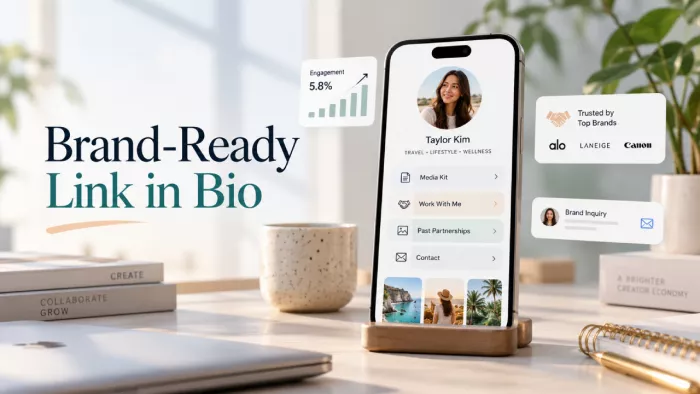
Most creators treat the link in bio as a drawer for fans: latest video here, merch there, a music link nobody taps. But when a brand weighs up paying you, the first thing they do is open that link and size you up in seconds, well before any call or contract.
That changes what the page is for. It stops being a list of things and becomes a sales page, and the buyer is a marketing manager deciding whether you are a safe place to spend money. Build it for that person, and the deals start to follow.
| Stat | What It Means |
| ~87% | Brands want to see a media kit before starting a conversation. |
| <30 sec | Typical time a brand spends scanning a media kit before deciding whether to continue. |
| 72% | Brands that weigh engagement rate more heavily than raw follower count when choosing creators. |
Two People Read This Page
Your link in bio quietly serves two audiences who want opposite things. Fans want your newest content and somewhere to buy your stuff. Brand decision-makers want proof you can sell, numbers that hold up, and a quick way to reach you.
The error is building only for the first group. A page that is all fan-candy and no credibility tells a brand nothing about whether you convert, so they move on to a creator who made it obvious. The answer is not to pick a side. It is to layer the page so a fan finds their link in two taps while a brand finds your proof and your contact route just as fast.
Sell One Clear Thing
Brands do not buy "lifestyle." They buy a clear category attached to a clear audience, because that is what they can match to a product and defend to their boss. A creator who is plainly "the budget-skincare person for acne-prone twenty-somethings" is instantly buyable. One who posts a little of everything is a risk nobody wants to sign off on.
So the first words on your page should do positioning work. Say who you help and what you are known for, in plain language, before a single link appears. Vague reads as amateur. Specific reads as a professional who knows exactly what they sell.
“Stop asking what your followers want here. Ask whether a stranger with a five-thousand-dollar budget would believe you can move their product.”
The Platform Decides What You Can Prove
The tool you pick sets the ceiling on what you can show. Some platforms only route clicks; others bake in a media kit, lead capture, and analytics, which is the exact machinery a brand-focused page needs. Match the tool to the job instead of defaulting to the one everyone uses.
One detail worth knowing: most of these tools open links inside the app's in-app browser rather than a real one, which quietly adds friction and loses clicks. It is a small thing that matters once you are sending valuable traffic through the page.
| Tool | Strongest for | Worth knowing |
| Linktree | Fast, free click routing and name recognition | Clean but common; the free page advertises Linktree and leans toward links over proof. |
| Beacons | An all-in-one creator setup with a built-in media kit and outreach tools | Media kit, email capture, and monetisation in one login; can feel cluttered as you add features. |
| Stan Store | Selling products, coaching, or bookings straight from the bio | Really a storefront with a link page on top; flat fee around 29 USD a month suits active sellers. |
| Tieup.io | Building a polished link-in-bio page for creators and brands | Useful for keeping important links, offers, and creator information together in one clean page. |
| Carrd | A custom, designed one-page site | The most design control and the most premium look; you build the proof sections yourself. |
If you remember one thing: a brand-ready page needs room for proof and a clear contact path, not just a stack of buttons. Pick whichever tool lets you show numbers and past work without shipping people off to a separate file.
Win the First Three Seconds
Everything above the first scroll is your headline. In a few seconds a brand should grasp your name, your niche, a one-line statement of value, and a single obvious way to work with you. Make them hunt for any of those and you have already lost their attention.
What the top of the page must answer
● Who you are and what you cover, paired so a brand places you instantly
● One line that sells the value, like "I help skincare brands reach Gen Z with honest reviews"
● One primary action ("Work with me" or "Brand inquiries"), not five competing buttons
● A sense that partnerships are welcome here, not an afterthought buried at the bottom
Put the Media Kit One Tap Away
This is the part that earns money. A media kit is your creator resume: who follows you, how your content performs, and proof you have delivered before. Since most brands want one before they will even begin a conversation, putting it a single tap from your bio removes the biggest delay between interest and a deal.
Surface it instead of making brands ask. Some tools host a live kit right inside the link in bio; if yours cannot, link a tidy one-to-three-page version. Keep it short, because a brand gives it well under a minute before they decide to keep reading or close it. A live kit has a quiet advantage too: when a brand checks back weeks later, they see current numbers rather than a stale PDF.
The Numbers That Move a Budget
Follower count is close to meaningless now, and brands know it. The first figure they look for is your engagement rate, because it tells them whether anyone is actually paying attention. A creator with 8,000 followers at a 6 percent engagement rate routinely beats one with 80,000 at 0.8 percent, since both deliver the same real reach but the smaller one feels alive.
Show the metrics that map to a buying decision, and present them honestly, because a large share of brands cross-check your claims against what is publicly visible before they pay a cent.
| Show this | Why a brand cares |
| Engagement rate, with its trend | Signals a live audience; a rate climbing over 30, 90 and 180 days beats a higher but falling one. |
| Audience demographics | Age, gender split and top locations tell them whether your people are their customers. |
| Saves, shares and reach | Shares and saves show intent and spread, which predict sales far better than likes. |
| Conversion proof | Clicks driven, codes redeemed or units sold turn you from "exposure" into "revenue." |
| Follower count on its own | Easy to inflate and weakly tied to results; fine as context, useless as a headline. |
If you can, frame a number or two the way brands think internally: cost per view and cost per engagement. Speaking their language signals you understand you are an investment, not a favour.
Receipts Beat Promises
Numbers say you could deliver. Proof says you already have. A short strip of past collaborations, a testimonial or two, and a mini case study ("drove 340 sales for a skincare launch in two weeks") does more than any amount of self-description.
No paid deals yet? You can still build proof. Manufacture the evidence a brand needs before anyone hands you money.
● Make spec content. Produce a genuine, well-shot post for a product you already love, clearly labelled as a sample, so a brand sees exactly what a partnership would look like.
● Show organic wins. A screenshot of a post that quietly sent a product viral, or a comment thread of people asking where to buy, is real proof of influence with no contract attached.
● Collect micro-testimonials. A few lines from a small brand you gifted a product to, or a follower who bought on your word, builds a track record from nothing.

Remove Every Reason to Hesitate
Each extra click between interest and contact is a chance for a brand to drift off and forget you existed. The aim is a route so smooth they reach out before the impulse fades.
That means a real inquiry path, not "just DM me." Give them a short contact or booking form, a professional email on your own domain if you have one, and a clear sense of what happens next. A line like "I reply to brand inquiries within two days" sets expectations and quietly says you run this like a business.
Look Expensive on Purpose
A page that looks designed reads as safe to pay. Consistent colours, one or two fonts, a sharp profile image, and a look that carries across your bio, feed and media kit all tell a brand you treat your presence as a product rather than a hobby.
You do not need to be a designer. Choose two or three colours and a font pairing, use them everywhere, and resist cramming in every link you own. Visual restraint is itself a signal of professionalism, and a cluttered page reads as a chaotic partner.
Feed the Page the Right Traffic
A brilliant page is worthless if nobody with a budget reaches it. Your content is the funnel that feeds it, so part of the job is steering qualified attention toward it on purpose.
Most creators only ever speak to fans in their captions. Speak to brands sometimes too. A pinned post or a caption line that says "brands, my media kit is in my bio" does slow, constant outreach while you sleep, and it signals to the marketing managers already lurking that you are open for business.
What Makes a Brand Close the Tab
Some mistakes do more harm than any missing feature, because they end the visit instantly. They are all fixable in an afternoon.
Deal-killers to clear out today
● Dead links and stale stats, which say you do not maintain your own storefront, and outdated data is a known deal-breaker
● No contact path, so a brand has to work to reach you and simply does not bother
● Too many links, burying the two that matter under twenty that do not
● No proof at all, giving a brand nothing to justify paying you over the next creator
● Looking identical to everyone else, which makes you forgettable in a feed of dozens of lookalikes
Treat It Like a Living Asset
A link in bio is never finished. Your metrics shift monthly, your best work keeps improving, and the brands checking back want current numbers, not a snapshot from last spring.
Set a rhythm. Refresh your stats and newest results on a schedule, review your rates each quarter, and actually read your click analytics to see which links brands tap and which they ignore, then cut or reorder based on what the data shows rather than what you assume.
Your Move
A link in bio that lands brand deals is not a prettier list of links. It is a page built for the one visitor who can pay you, carrying clear positioning, honest numbers, real proof, and a frictionless way to say yes.
Get that right and the page starts pitching for you. A brand arrives curious and leaves half-convinced, because you answered their questions before they had to ask. That is the whole aim: a passive bio turned into an asset that sells you while you sleep.
Do this today: open your own link in bio cold, on your phone, as a brand would, and ask whether it proves you can sell anything at all. Fix the first place it does not. That single honest pass is usually what stands between getting scrolled past and getting paid.


Comments