SERPInsight Link Insertion Explained : What I Learned Before Paying for a Placement

Sakshi Purna
I explored SERPInsight to assess whether its marketplace could reduce the time typically spent identifying suitable publishers, negotiating placements and managing link-building outreach. The public-facing workflow was straightforward, but evaluating the complete buying experience would have required purchasing a backlink.
I examined the marketplace structure, pricing approach, publisher-selection process, policies and quality controls. This provided a clearer view of where the platform may improve efficiency, which decisions still depend on the buyer’s SEO judgment, and what should be verified before committing to a placement.
Two Ideas Under One Name
The phrase SERP insight link insertion can refer to a link-building method, while SERPInsight is also the name of a commercial marketplace.
A standard link insertion, often called a niche edit, adds a backlink to an article that is already published. The publisher edits an existing paragraph or adds a short supporting section rather than creating a completely new guest post.
The “SERP insight” part describes how the host page is selected. Instead of buying a link because a domain has an impressive authority score, the buyer studies pages already ranking for relevant searches and looks for one with useful traffic, stable visibility and a natural reason to mention the target page.
SERPInsight, the platform, provides access to publishers willing to accept guest posts and link insertions. Buyers can search listings, compare visible metrics, submit a destination URL and anchor, pay per placement and follow the order through a central dashboard.
That distinction is important. SERPInsight can help buyers find available publishers, but marketplace availability does not mean every page has already been selected through detailed SERP analysis.
Why Link Insertions Appeal
Traditional outreach usually involves building a prospect list, finding contact details, sending emails, negotiating a price and following up several times. Even after a publisher agrees, a guest post still needs to be written, reviewed, published and indexed.
A link insertion removes some of that work because the article already exists. The buyer is paying for an edit to a live page rather than the production of a new article.
That can make the process faster, but an existing article is not automatically a valuable article. A page can be live while receiving no traffic, ranking for irrelevant terms or sitting several clicks away from the rest of the website.
The benefit therefore depends on the page chosen, not simply on the fact that it has already been published.
How the Marketplace Works
SERPInsight operates more like a self-service marketplace than a managed SEO agency. Publishers control their prices, editorial requirements and estimated delivery times. They can also reject an order if the destination page or requested anchor does not fit their content.
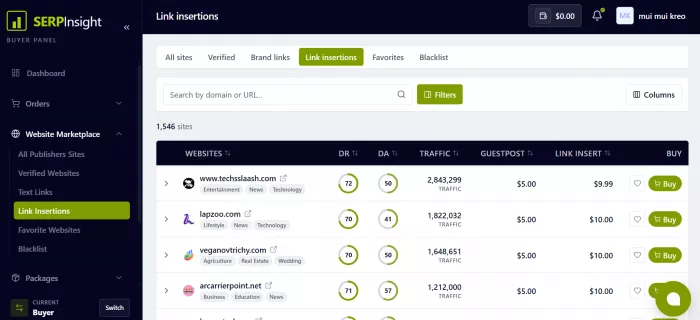
The general process follows these stages:
1. The buyer searches the publisher inventory and applies filters for niche, traffic, country, language, authority, price or turnaround.
2. A publisher or available placement is selected after the buyer reviews its suitability.
3. The buyer submits the target URL, preferred anchor and any relevant instructions.
4. The publisher reviews the request and either accepts it, asks for changes or rejects it.
5. Once the link is added, the live URL is submitted for platform verification.
6. The buyer inspects the final placement and raises a dispute if the order does not match the agreed terms.
This structure removes much of the administrative work involved in manual outreach. It does not remove the strategic work involved in choosing a worthwhile backlink.
Marketplace Filters
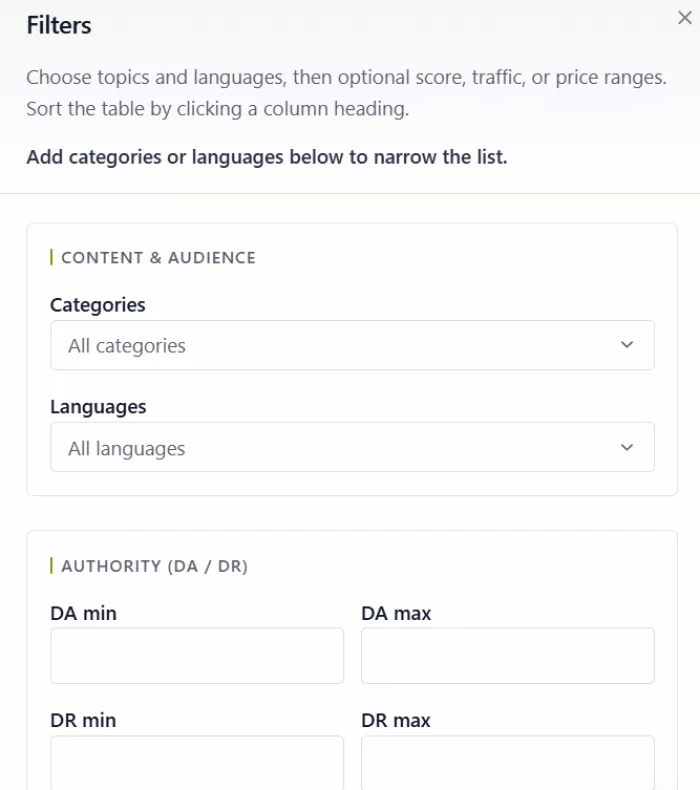
The platform promotes filters based on metrics such as Domain Rating, Domain Authority, estimated organic traffic, category, country, language, price and delivery time.
These filters are useful for reducing a large inventory, but each answers only one part of the decision.
| Filter | Useful For | What It Cannot Confirm |
| Niche | Removing websites unrelated to the target subject | Whether the exact article is contextually relevant |
| Organic traffic | Avoiding domains with little visible search activity | Whether the host page receives any traffic |
| DR or DA | Comparing broad authority signals | Whether the site’s current content is trusted or useful |
| Country | Matching the publisher with the intended market | Whether the audience is commercially relevant |
| Price | Staying within budget | Whether the placement offers value |
| Turnaround | Estimating fulfilment speed | Whether the publisher will accept the request |
A common mistake is to sort by the highest DR and assume the first result is the strongest opportunity. That approach ignores the exact article, its search visibility and the quality of the surrounding content.
The Page Is the Product
The most important part of a link insertion is the page receiving the backlink.
A domain may attract thousands of monthly visits while the selected article receives none. It may also have a strong authority score because of old backlinks that have little connection to its current editorial quality.
Before buying, the host page should be checked for:
● Indexing and accessibility: The page should be publicly available, indexable and free from technical barriers that prevent search engines from processing it.
● Relevant rankings: Its keyword footprint should overlap with the topic of the destination page rather than rely on unrelated searches.
● Stable visibility: A page that recently lost most of its rankings may provide less long-term value than one with modest but consistent performance.
● Internal links: The article should be connected to the rest of the website rather than functioning as an isolated URL.
● Editorial quality: The surrounding content should be accurate, readable and maintained well enough to support a credible reference.
● Outbound-link quality: Existing links should support the topic rather than reveal a pattern of unrelated commercial placements.
This is where buyers need independent SEO tools and manual inspection. Marketplace metrics can create a shortlist, but they cannot determine whether the final paragraph deserves a link.
Topical Fit Over Authority
A specialist site with moderate authority can be a better choice than a large general publication.
The specialist may have fewer backlinks overall, but its articles could be more closely aligned with the destination page. That alignment gives the publisher a clearer editorial reason to include the reference.
A broad site can still be useful, but the relevant category and article should be examined separately. A technology link placed on a general business website may make sense if the article already covers software, automation or digital operations. It becomes weaker when the publisher has to introduce an unrelated sentence only to accommodate the anchor.
The best placement should remain informative even if the hyperlink is removed. The sentence needs to belong in the article before it can support a backlink.
Anchor and Destination Quality
SERPInsight allows buyers to submit a target URL and preferred anchor. That control can be useful, but it also creates room for poor decisions.
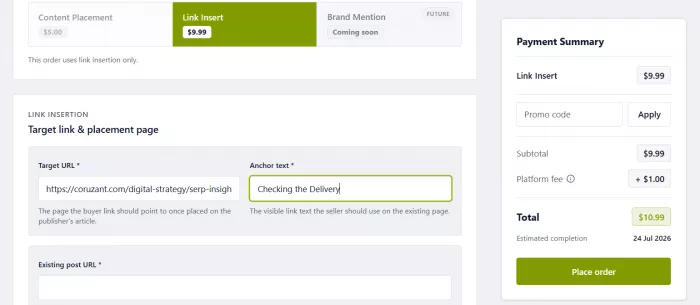
An exact-match commercial anchor may appear desirable because it matches a target keyword. Repeating the same type of wording across several backlinks can create an obvious pattern, especially when the phrase does not fit the host article’s natural style.
A healthier anchor profile usually includes a mixture of:
● branded names used where the company or product is directly relevant;
● partial-match phrases that describe the linked resource naturally;
● descriptive wording based on the surrounding sentence;
● occasional URL anchors where a direct reference is appropriate.
The destination page also needs to justify the link. Detailed guides, research, useful tools, category resources and well-developed service pages are easier to integrate than thin sales pages.
Before submission, the buyer should confirm that the destination is live, indexable, accurate and genuinely helpful to someone reading the host article.
Pricing Structure
SERPInsight’s current model is presented as pay-per-order. Registration is free, and buyers do not appear to need a monthly subscription to access the marketplace.
Publishers set individual prices, which means two websites with similar authority metrics may charge very different amounts. The final cost can also include a platform fee, commonly described as a percentage added at checkout.
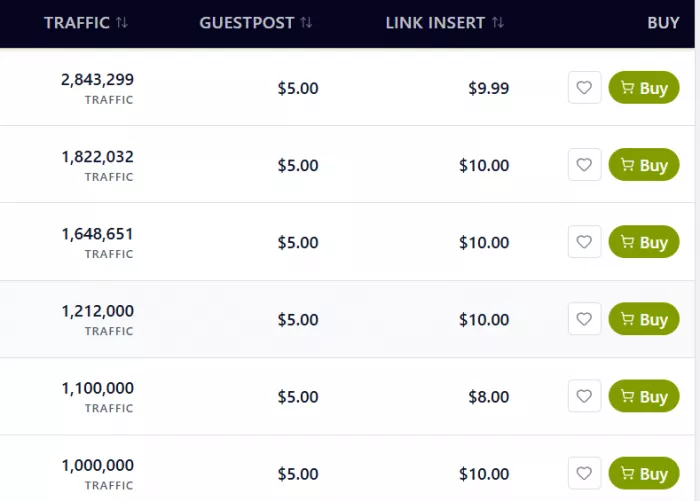
The full cost may include:
| Cost Area | Possible Charge |
| Publisher placement | The amount set by the individual website owner |
| Platform fee | An additional percentage shown before checkout |
| Content adjustment | A charge for writing or editing supporting text |
| Currency conversion | A payment-provider or bank conversion fee |
| Applicable tax | A location-dependent tax added to the transaction |
SERPInsight also uses a wallet-based payment system. Wallet funds are prepaid platform credits rather than money held in a normal bank account. When an order is rejected or cancelled, the remedy may be wallet credit instead of a return to the original payment method.
That distinction matters for one-time buyers. Credit is useful only when there is another suitable publisher worth purchasing from.
Pricing Inconsistency
One issue buyers should notice is that different public SERPInsight pages have displayed different pricing structures.
The main marketplace describes publisher-controlled pricing and per-order payment. An older link-insertion page has also displayed package-style offers with multiple placements bundled together.
The older page has included claims relating to dofollow links and indexing, while the current terms state that indexing and SEO results are not guaranteed.
The safest approach is to rely on the current dashboard checkout, order details and legal terms rather than older promotional pages. Before paying, buyers should confirm exactly what is included, how the platform fee is calculated and whether unused wallet credit can be withdrawn.
Publisher Approval
Selecting a listing does not guarantee that the publisher will accept the link.
Publishers may reject a destination because it is unrelated to their content, falls within a prohibited niche or does not meet editorial standards. They may also request a different anchor or supporting paragraph.
This approval stage is not necessarily a weakness. A publisher willing to accept every anchor and destination without review would raise more serious quality concerns.
Estimated turnaround times should also be treated as estimates. A placement advertised as quick may take longer because of publisher workload, requested revisions or internal review.
Speed matters less than editorial fit. A rushed backlink in an awkward paragraph is not better simply because it went live within a few hours.
Checking the Delivery
A completed order should be inspected immediately. SERPInsight’s verification indicates that a link was live at a particular time. It does not guarantee that the article will remain indexed, the publisher will preserve the anchor or the link will improve rankings.
The buyer should check:
● whether the destination URL is correct and does not pass through an unnecessary redirect;
● whether the approved anchor appears as expected;
● whether the surrounding paragraph reads naturally;
● whether the link sits inside the main article rather than a footer, sidebar or author biography;
● whether the page is indexable and uses the correct canonical URL;
● whether the link is dofollow, nofollow or sponsored;
● whether the article remains internally linked from the publisher’s site.
SERPInsight’s policies describe a limited dispute window after completion. That makes it risky to leave a delivered placement unchecked for several weeks.
Results Need Time
A live backlink is a deliverable. It is not proof of an SEO result.
Claims that link insertions produce gains within a fixed number of weeks are too broad to be reliable. The effect depends on the host page, crawl frequency, target-page quality, keyword competition, existing backlink profile and other SEO work taking place at the same time.
A proper evaluation should track:
● whether the host article remains indexed;
● whether the backlink is discovered by search and third-party tools;
● whether Search Console impressions change;
● whether rankings move for relevant queries;
● whether referral visits appear;
● whether the placement survives over time.
Even when rankings improve, one link should be treated as a contributing factor rather than the sole cause.
Link Protection Explained
SERPInsight promotes a 36-month link-protection programme. The wording can sound like a guarantee that the original backlink will remain live for three years, but the detailed terms are more limited.
Replacement assistance may be discretionary and can depend on why the link disappeared. Site sales, policy changes, deindexing, penalties, migrations and altered link attributes may affect eligibility.
A replacement may also differ from the original placement in traffic, price, authority or topic strength. Possible remedies can include another link, wallet credit or no remedy under excluded circumstances.
The programme gives buyers a route for asking for help. It should not be read as a guarantee that the original backlink is permanently secured.
Google Policy Risk
Paid link insertion carries an unavoidable search-policy issue.
Google states that paid placements should generally be marked with rel="sponsored". nofollow can also be used where a website does not want to associate ranking signals with the linked page.
The conflict is straightforward. Many buyers purchase link insertions because they want an unqualified dofollow link to influence search rankings. That is also the type of paid placement most likely to raise policy concerns.
A sponsored link can still send referral traffic, support brand awareness and help readers discover a useful resource. It should not be treated as an ordinary editorial backlink earned without payment.
The fact that a publisher offers a dofollow link through a marketplace does not mean Google approves the arrangement. Buyers need to decide how much policy risk they are prepared to accept.
Where SERPInsight Helps
SERPInsight’s strongest advantages are operational:
● It can reduce the time required to find publishers already open to link placements.
● It places pricing, metrics and order information inside one marketplace.
● It removes much of the email negotiation involved in manual niche-edit outreach.
● It allows buyers to pay per placement instead of committing to a subscription.
● It gives agencies a central place to follow multiple orders.
These benefits matter most to buyers who already know how to evaluate websites.
What It Cannot Replace
SERPInsight does not replace publisher research, page auditing, anchor planning or performance monitoring.
The buyer still needs to determine whether the domain is relevant, whether the exact page has value, whether the paragraph supports the link and whether the campaign fits the organisation’s risk tolerance.
The platform can make a transaction easier. It cannot turn a weak placement into a strong backlink.
Best-Fit Users
SERPInsight is likely to be most useful for:
● SEO agencies managing placements across several client campaigns;
● freelance link builders who want faster access to publisher inventory;
● in-house teams with tools for checking traffic, keywords and indexing;
● SaaS or e-commerce companies promoting useful guides and category resources;
● experienced buyers combining selective insertions with outreach and digital PR.
It is less suitable for beginners who plan to choose links only by DR, brands with strict paid-link policies or businesses expecting one placement to guarantee ranking growth.
Alternatives Worth Considering
| Method | Main Strength | Main Limitation |
| SERPInsight | Faster discovery and centralised ordering | Quality control remains with the buyer |
| Manual outreach | More control over the publisher relationship | Requires more time and negotiation |
| Guest posting | Greater control over the article’s subject | Needs content, approval and indexing |
| Managed agency | Strategy and execution may be handled together | Usually costs more |
| Digital PR | Can earn genuine editorial coverage | Results are difficult to guarantee |
| Linkable assets | May attract natural citations | Requires original research, design or development |
SERPInsight works best as one channel within a broader link-building plan, not as a replacement for useful content, internal linking, technical SEO or genuine editorial relationships.
Verdict: Useful Marketplace, Careful Purchase
After examining how SERPInsight handles publisher discovery, pricing, order submission and link protection, I found its strongest value in convenience. It brings several parts of the link-insertion process into one marketplace, which can save experienced SEO teams from managing repeated outreach, negotiations and publisher follow-ups.
However, I would not treat access to its publisher inventory as proof of backlink quality. The authority of the domain matters less than the relevance of the exact article, its search visibility, editorial condition, outbound-link profile and natural connection with the destination page.
I would begin with one carefully selected placement rather than immediately funding a large campaign. Before ordering, I would inspect the host page independently, compare the full checkout cost, review the refund conditions and confirm what the 36-month protection actually covers.
SERPInsight can make link-insertion purchasing faster and easier to organise. The eventual value of the backlink still depends on the quality of the page selected and the research completed before payment.


Comments