Link in Bio for Real Estate Agents: Listings, Tours and Lead Capture

Christine Davis

A real estate agent's Instagram bio gets one clickable link. The business behind it runs on far more: active listings that turn over weekly, video walkthroughs, a home-valuation tool, a showing calendar. The gap between that single link and everything a buyer or seller needs is where deals quietly leak.
The link in bio page closes that gap. It turns one slot into a routing hub that sends the right person to the right place in a tap or two. Built poorly, it becomes a link dump nobody scrolls. Built well, it does the quiet work of a website without the cost or the wait.
The One-Link Bottleneck
Most businesses get by with a single link to a homepage. Agents cannot, because their inventory is the product and it keeps turning over.
A homepage sits still. A listing is perishable. A property can move from active to pending in days, and a buyer who taps through to a sold home loses a little trust in the feed. The bottleneck is sharper than a link limit: the one destination an agent points to keeps changing underneath them.
Networks like LinkedIn and X tend to show in-feed posts carrying outbound links to fewer people, which pushes the real link back into the bio and concentrates pressure on that one slot. Mobile adds the final squeeze, since most property browsing happens on a phone, often late in the evening, when a slow or confusing page ends the session before it starts.
What the Bio Page Replaces

Before a bio page, an agent handled overflow by hand. Each of those small tasks is something the page can absorb, around the clock, without the agent awake for it.
| Old workaround | Page equivalent |
| Answering "is this still available?" DMs | A live listings block that shows current status |
| Texting listing links one at a time | A gallery buyers browse on their own |
| Printed open-house flyers | A tour or event link with directions attached |
| "Email me for a valuation" | A self-serve seller valuation form |
The page does not add another channel to manage. It consolidates work the agent already does, moves it off the inbox, and gives repeat contacts one place to find current reviews and a referral path instead of digging back through old posts.
Anatomy of a Converting Page
Order decides outcome. The blocks near the top collect the taps, and attention falls off fast after the third or fourth item.
A workable priority runs from identity to action: a headshot and brokerage line so the visitor knows who they found, then featured listings, then a tour, then the lead form, then secondary contact options. These choices also reflect the basic principles of improving link-in-bio conversion rates, where clear priorities and fewer competing actions help visitors find what they need.
● The top block should establish identity within a second, through a photo and a brokerage name rather than a bare logo.
● One action, usually the lead form or a headline listing, should visually outweigh everything else so a skimmer still knows what to do.
● Each block added past the fifth earns less attention than the one before it, which is the argument for a short page over a long one.
In practice a page of six to eight blocks holds together. Past that it reads like a menu, and a menu invites a visitor to leave without choosing anything.
Listings Without the Clutter
The instinct is to post every active listing. That turns the page into a directory, and directories do not convert.
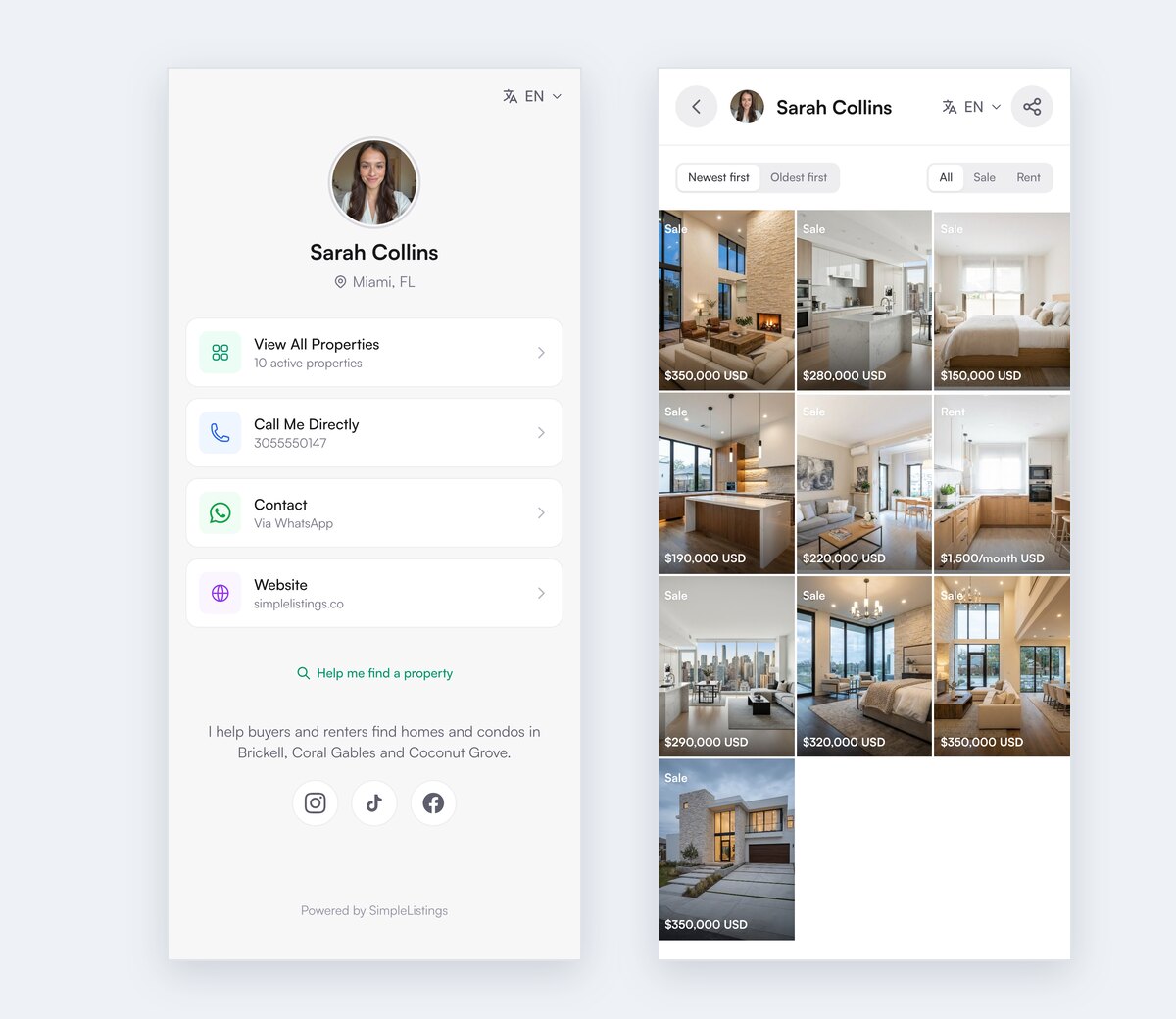
Curation beats completeness. A featured set of the best two to four properties, refreshed as they sell, gives a buyer a reason to look closely. Agents with deep inventory do better linking out to an IDX or MLS-powered gallery where buyers filter by price and area, while the bio page itself shows only the headline listings.
Automatic syncing is the cleaner fix for stale inventory. A page wired to an IDX feed updates status on its own, where a hand-maintained list depends on the agent remembering to pull a sold home down. A single outdated listing on a public page is the small miss that quietly costs credibility.
Status tags carry more weight than agents expect. Marking each property active, pending, under contract or sold keeps the page honest, and a visible record of sold homes doubles as proof the agent closes.
Where Tours and Video Belong
Video is the strongest hold on a property page, and placement changes how much of it gets watched. A walkthrough reel or a Matterport tour near the top lifts dwell time, which hands the lead form a warmer visitor by the time they reach it.
Embedding against linking out is a genuine tradeoff. An embedded tour keeps the visitor on the page but can slow the load. A linked tour loads fast but risks losing the visitor to the external site. A thumbnail that expands on tap tends to balance both, and a still cover frame with a one-line caption sets expectations before the tap, which raises the odds the visitor finishes watching.
Not every listing needs a cinematic tour. A clean two-minute phone walkthrough often outperforms an over-produced edit, because buyers want to read the space, not the videographer.
Lead Capture Mechanics
This is where the page earns its keep. A visitor who browses and leaves is traffic; a visitor who submits is a lead.
Form length is the first lever. Every extra field lowers completion, so the strongest forms ask for a name and one contact method, then let the follow-up conversation gather the rest. Intent-qualifying questions about budget or timeline can help an agent prioritize, and even those cost submissions.
Different magnets pull different audiences:
● A home-valuation or "what's my home worth" tool draws sellers, who will trade an address and an email for a number.
● A new-listing or price-drop alert sign-up draws buyers who are not ready today but want to watch a market.
● A buyer's guide or neighborhood report gives first-time buyers a low-pressure reason to raise their hand.
An instant autoresponse holds the lead in the seconds after they submit, while the agent is still unaware a form came in. Where a phone number is collected for texting, an explicit opt-in checkbox keeps the agent on the right side of messaging rules and filters out the least serious entries. Gating a tool behind a form captures more leads, while leaving it open builds goodwill at the cost of fewer direct captures.
Separating Buyers and Sellers
Most agents build one page for everyone, and that is the quiet reason many pages underperform. A buyer and a seller want opposite things, and a single flat list of links serves neither well.
A buyer wants to browse inventory and set alerts for new matches. A seller wants a valuation and proof the agent markets well. Forcing both down the same column means each one wades through the other's content before reaching anything built for them.
The fix is an early split. A two-button choice near the top, buy on one side and sell on the other, sends each visitor to a tailored set of blocks. It costs one extra tap and removes most of the friction that follows, and it doubles as a signal of intent the agent can act on.
Picking the Right Platform
The tooling falls into three broad camps, and the right pick depends on how an agent's inventory and follow-up actually work.
| Option | Strengths | Trade-off |
| Generic link-in-bio tools | Fast setup, low cost, flexible design | Thin IDX and CRM depth; leads may route through a third party |
| Real-estate builders | IDX feeds, valuation widgets, CRM sync built in | Higher cost, more setup, sometimes rigid templates |
| Self-built landing page | Full control of design, data and lead ownership | Needs upkeep and some technical skill |
Cost is rarely the deciding line, since most options land in a modest monthly range. The expensive mistake is a tool that locks leads or listings inside it, because moving later means rebuilding the page and re-exporting a contact history that may not come out clean. Lead ownership and IDX integration are the factors that matter, and the second one weighs far more for a high-inventory agent than for one carrying four listings at a time.
Design and Speed Basics
A page that reads clean and loads fast removes the reasons a visitor bounces. Since nearly all of this traffic is mobile, the design brief is a phone first.
Tap targets need room, so links sized for a thumb beat a dense stack that invites mis-taps. Visual brand match matters too: the same headshot and colors as the agent's feed reassures the visitor they landed in the right place rather than on a scam clone. Readable contrast and a single consistent typeface keep the page legible on a bright screen outdoors, which is exactly where a buyer checks a listing between showings.
Speed is the silent killer. A page loaded with embedded tours and full-resolution images can take seconds to appear on a weak signal, and a measurable share of visitors leave before the form renders. Compressed images and lazy-loaded video recover most of that loss.
Tracking and Attribution
Without tracking, an agent is guessing which post or platform produced a lead. With it, the budget and the effort follow what works.
UTM parameters on the bio link, set per platform, show whether Instagram, a YouTube description or an email signature drove the click. Beyond traffic sources, link-in-bio analytics helps distinguish which destinations attract attention and which actions lead to actual inquiries. Click-level data then guides what to feature next.
A retargeting pixel extends the same data. Visitors who browsed a listing but never submitted can be reached again through paid social, which recovers a slice of the traffic that would otherwise vanish. The deeper payoff is attribution that reaches the form fill, since tying a submitted lead back to its source separates the agent who knows their reels convert from the one posting on instinct and hoping.
Compliance and Fair Housing
This is the section most marketing-led articles skip, and it is where a real estate audience decides whether the writer knows the industry.
A bio page is advertising, and real estate advertising carries rules. Many states require a license number and the brokerage name on an agent's marketing, and a bio page counts as marketing. Leaving them off is a compliance gap, not a design choice.
Fair housing language applies as well. Listing copy and any text on the page should avoid wording that signals a preference around protected classes, and an equal-opportunity housing logo belongs where space allows. Testimonials carry their own standard, since a displayed review should reflect a real client experience and some jurisdictions expect disclosure where an incentive was given for it. A page that captures leads while ignoring these rules exposes the agent and the brokerage both.
CRM and Follow-Up
A captured lead decays fast, and the page is worthless if the lead sits. Speed to lead is the whole game once the form is submitted.
Response time drives contact rates hard. A lead answered within minutes connects far more often than one answered hours later, and most online leads expect a reply the same day. A page that drops submissions into an inbox nobody checks wastes every click that fed it.
The stronger setup routes each submission straight into a CRM that fires an instant acknowledgment and assigns a follow-up. Beyond that first reply, a short nurture sequence keeps a slow lead warm, because a buyer six months from purchase will not answer a hard push but will stay with a steady drip of new listings and market notes. The page captures; the system works the lead. Treating the two as one pipeline is what turns bio traffic into closings.
The Conclusion
The link in bio is the most valuable piece of property an agent owns online, and most treat it as a formality. It sits at the end of every post and every profile visit, and it carries the full weight of turning attention into a conversation.
The agents who win with it think like operators rather than decorators. They curate listings instead of dumping them, split buyers from sellers, respect the compliance rules, and wire the form to a system that answers fast. The page is small, but the discipline behind it shows up in the pipeline.


Comments