Best Alternatives to Pixverse AI: 8 Powerful Video Generators Transforming Creative Workflows in 2026



Pixverse AI has earned recognition for generating stylized video content with impressive character consistency, but creative professionals are discovering platforms that push beyond its 1080p ceiling, opaque credit systems, and limited photorealistic capabilities. Whether you're frustrated by Pixverse's single-model lock-in, hunting for native 4K output, or seeking tools that bundle image generation with video creation, these eight alternatives deliver where Pixverse falls short.
From multi-model powerhouses to budget-friendly options with transparent pricing, this guide reveals the platforms redefining AI video generation with superior motion quality, extended video lengths, and seamless audio integration that Pixverse AI simply cannot match.
1. Morphed : The Multi-Model Powerhouse
What Morphed Offers
Morphed eliminates the fundamental limitation plaguing Pixverse by delivering access to 15+ AI models for both image and video generation within a unified workspace. The platform features Nano Banana for photorealistic images competing directly with Midjourney, Nano Banana 2 with roughly 80% first-try text rendering accuracy, and Flux Pro for versatile artistic output across diverse styles. Built-in upscaling extends to 4K+ resolution, background removal streamlines compositing workflows, and the AI Headshot Generator produces professional portraits without requiring separate subscriptions.
Model-switching capability allows creators to route prompts to whichever engine handles them best rather than forcing everything through a single model architecture, measurably reducing wasted generations by approximately 40% compared to single-model platforms.
Primary Use Case
Morphed serves creators who need comprehensive content production spanning product photography, headshots, social media graphics, and video generation without managing multiple tool subscriptions.
Greatest Asset
The multi-model architecture delivers superior photorealistic output quality compared to Pixverse's stylized-first approach while offering different aesthetic interpretations of identical prompts for creative variety that Pixverse's single model cannot provide.
Notable Drawbacks
Morphed lacks purpose-built anime style presets like Pixverse's specialized focus, and the character consistency engine on anime content remains less refined than Pixverse V6's dedicated approach.
Pricing Details
Free tier available with basic access and usage limits. Paid plans vary by usage with commercial licensing included. Starting from competitive monthly rates with transparent credit systems.
How Morphed Surpasses Pixverse
Morphed consolidates product photography, headshots, social media graphics, and video generation into one subscription, eliminating the additional $10-30 monthly most Pixverse users spend on secondary tools. The built-in upscaling to 4K+ transforms output into production-ready content suitable for professional delivery and large-screen presentations, far surpassing Pixverse's 1080p ceiling. Multiple models offer fundamentally different training sets and optimization approaches suited for specific content types, whereas Pixverse applies surface-level styling to one underlying model architecture.
2. Kling 3.0 Omni : The Value Champion
What Kling 3.0 Delivers
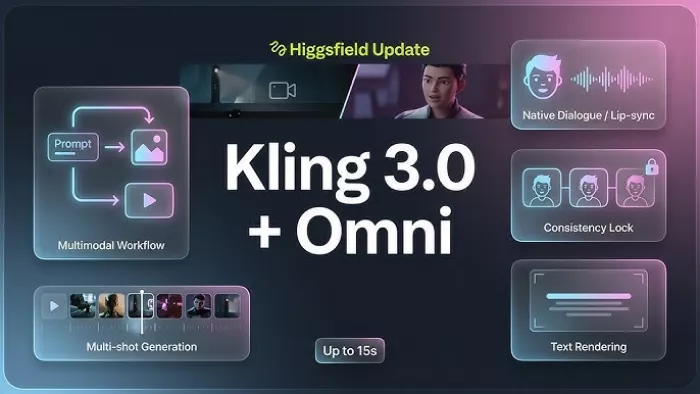
Kling 3.0 Omni prioritizes photorealistic output with native 4K generation at 60fps alongside audio capabilities in six languages. The platform's physics engine renders glass reflections, water dynamics, fabric movement, and object weight with measurably greater accuracy than Pixverse's motion model. Kling extends video duration to three minutes with maintained character consistency, though quality naturally degrades after 15-20 seconds of extensions. Native audio integration includes lip-synced dialogue, ambient sound generation, and sound effects produced simultaneously with video, enabling multi-character scenes where each character speaks different languages.
Primary Use Case
Kling 3.0 targets creators producing photorealistic content for professional delivery, projection work, and large-screen applications where 4K resolution becomes non-negotiable.
Greatest Asset
Native 4K generation at 60fps establishes Kling's defining competitive advantage, delivering resolution and frame rates that exceed industry standards while requiring an average of 1.4 re-rolls per usable clip compared to Pixverse's 3.2 attempts.
Notable Drawbacks
Kling 3.0 is not optimized for anime content with less refined art direction tools compared to Pixverse's specialized character consistency, and quality degrades noticeably after 15-20 seconds on extended generations.
Pricing Details
Free tier with 66 daily credits (720p with watermarks). Standard plan starts at $6.99/month with 660 credits. Pro plan at $28.99/month for enhanced volume.
How Kling 3.0 Surpasses Pixverse
Kling includes audio capabilities at its $6.99 Standard tier while Pixverse restricts audio to the $24 monthly Pro plan, representing a 71% cost savings for equivalent functionality. The platform delivers native 4K at 60fps when Pixverse caps at 1080p, creating advantages for professional delivery and large-screen content that cannot be resolved through post-production upscaling. Kling's physics engine produces realistic material interactions and motion dynamics that outperform Pixverse's stylized approach for commercial and marketing applications requiring photorealistic presentation.
3. Runway Gen-4.5 : The Professional Standard
What Runway Gen-4.5 Provides
Runway Gen-4.5 establishes the industry benchmark for frame-to-frame motion consistency, producing output where hair strands move naturally, fabric textures maintain coherence, and surface reflections track with precise accuracy. Act-Two performance capture translates user facial expressions and body movements into generated characters with a capability no other platform including Pixverse currently offers. Professional editing tools enable extending, expanding, modifying, and inpainting generated video with granularity that Pixverse's basic editing features cannot approach. Adobe Firefly integration as of January 2026 positions Gen-4.5 as the most native option for workflows centered in Premiere Pro and After Effects.
Primary Use Case
Runway serves professional studios, production companies, and commercial creators whose delivery standards require absolute motion quality and whose workflows already center on Adobe Creative Cloud tools.
Greatest Asset
Motion consistency requiring just 1.3 re-rolls per usable photorealistic clip versus Pixverse's 3.2 attempts demonstrates superior prompt interpretation, while Act-Two performance capture creates unique character animation possibilities that text-to-video approaches fundamentally cannot replicate.
Notable Drawbacks
Effective cost per video approximates $1.20 versus Pixverse's $0.07-0.13 range, and performance on anime and stylized content remains weak compared to platforms with dedicated anime optimization like Pixverse.
Pricing Details
Free tier with 125 one-time credits. Standard plan starts at $12/month with 625 credits. Pro at $28/month, Unlimited at $76/month.
How Runway Gen-4.5 Surpasses Pixverse
Adobe Firefly integration eliminates export-import workflows for professionals whose production environments already center on Creative Cloud tools, streamlining post-production processes that would require separate rendering and ingestion steps with Pixverse output. The Act-Two performance capture enables facial and body movement translation creating animation possibilities that Pixverse's prompt-based system cannot approach regardless of prompt engineering skill. Industry-leading motion consistency produces premium quality output that commands higher production value perception and justifies use in commercial applications with strict quality standards where Pixverse output might appear noticeably AI-generated.
4. Seedance 2.0 : The Storytelling Specialist
What Seedance 2.0 Delivers
Seedance 2.0 from ByteDance holds the number one Elo score of 1,269 on the Artificial Analysis arena as of March 2026, surpassing both Kling 3.0 at 1,248 and Runway Gen-4.5 at 1,247. The platform specializes in coherent multi-scene narrative generation where characters, settings, camera angles, and transitions persist across shots with benchmark-leading consistency. The @ Reference System accepts up to 12 reference files including images, videos, and audio to extract camera movements, choreography, and visual style. Unified audio-video architecture generates spatial effects like natural reverb for characters speaking in large rooms and appropriate proximity effects for whispered dialogue, with lip-sync support across 8+ languages.
Primary Use Case
Seedance 2.0 targets narrative creators producing multi-scene stories, short films, episodic content, and commercial applications requiring character and setting consistency across multiple shots.
Greatest Asset
Multi-scene narrative coherence scores 9 out of 10 on temporal consistency versus Pixverse's estimated 6-7, while the @ Reference System transforms creative control from prompt-based generation to direction-based workflows.
Notable Drawbacks
Resolution remains limited to 1080p matching Pixverse but falling below Kling's 4K capability, and individual clips cap at 15 seconds maximum duration.
Pricing Details
Pay-per-use model starting around $0.10 per minute. Also accessible through Morphed's bundled subscription. Direct ByteDance platform access offers variable pricing with volume discounts.
How Seedance 2.0 Surpasses Pixverse
Seedance delivers superior multi-scene narrative coherence through benchmark scores that quantifiably exceed Pixverse V6's newer multi-shot engine. The @ Reference System accepting up to 12 reference files creates what users describe as "directing instead of prompting" for unprecedented creative control that Pixverse's text-based approach fundamentally cannot match. Unified audio-video architecture produces tighter integration between visual generation and soundtrack compared to Pixverse V6's more recent and less mature audio addition, with spatial audio effects responding intelligently to scene geometry for enhanced realism in narrative storytelling.
5. Krea AI : The Real-Time Innovation Leader
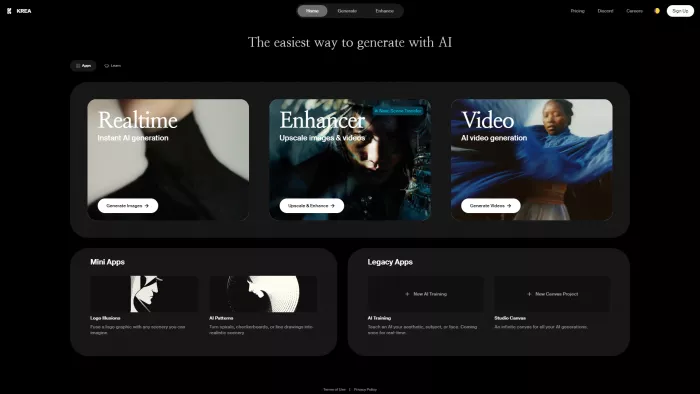
What Krea AI Provides
Krea AI distinguishes itself through 64+ selectable models including specialized anime engines, illustration specialists, photorealistic generators, and experimental styles, providing fundamentally different training approaches and output characteristics. Real-time generation feedback delivers sub-50ms response times that no competitor including Pixverse currently offers, transforming iterative creative work by eliminating the traditional generate-wait-evaluate-regenerate cycle entirely. Video upscaling extends to 8K resolution with frame interpolation reaching 120fps, transforming basic generations into production-quality output. The platform allows creators to watch images form as prompt adjustments occur, providing immediate visual feedback during the creative process.
Primary Use Case
Krea targets creators who iterate extensively during creative development and those requiring access to fundamentally different model architectures for specialized content types.
Greatest Asset
Real-time generation feedback under 50ms creates workflow efficiency gains that cannot be replicated through faster generation speeds alone, fundamentally changing how creators iterate and refine their work.
Notable Drawbacks
Quality varies significantly across the 64+ models requiring experimentation to identify which engines suit specific creative needs, and server reliability remains inconsistent during peak usage hours.
Pricing Details
Free tier with 50 images + 10 videos daily (no watermarks). Pro plan starts at $28-35/month with access to all 64+ models, priority generation, 8K upscaling, and commercial licensing.
How Krea AI Surpasses Pixverse
Krea's 64+ distinct models provide access to fundamentally different training sets, architectures, and optimization approaches suited for specific content types, whereas Pixverse applies surface-level styling to one underlying model. The free daily allocation of 50 images plus 10 videos refreshes every 24 hours without watermarks, compared to Pixverse's free tier that watermarks all output and restricts to 720p resolution. Real-time generation feedback eliminates wait cycles entirely, allowing creators to refine prompts while watching results form rather than waiting for complete generation cycles before evaluating output and making adjustments.
6. Luma Ray3.14 : The Cinematic Quality Master
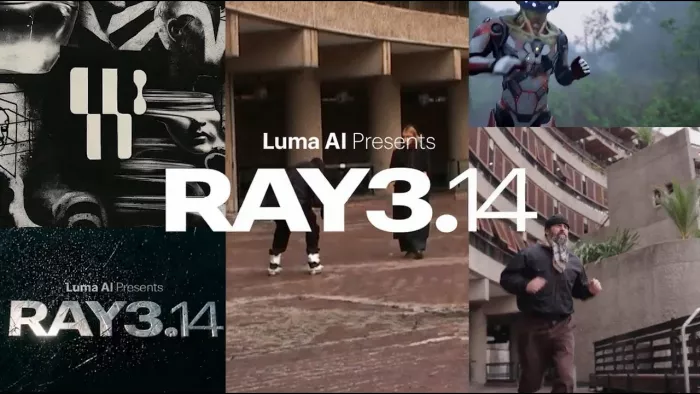
What Luma Ray3.14 Offers
Luma Ray3.14 produces the most film-like lighting, color grading, and composition among current AI video models, establishing a distinctive visual signature that professionals recognize immediately. Dual keyframe interpolation allows creators to define precise start and end frames, then the system generates motion between them with creative direction that Pixverse's prompt-only approach fundamentally cannot match. HDR and EXR export formats enable professional color grading workflows in industry-standard tools like DaVinci Resolve and Adobe Premiere. Six native aspect ratios including 9:16 portrait and 21:9 ultrawide provide format flexibility for diverse distribution channels, while Character Reference functionality maintains identity consistency across multiple generations.
Primary Use Case
Luma Ray3.14 serves cinematographers, commercial directors, and professional creators whose output requires film-quality lighting and composition with integration into established post-production pipelines.
Greatest Asset
Film-like visual quality with superior lighting and composition makes Ray3.14 output immediately recognizable as premium content, while dual keyframe interpolation provides frame-level creative control that prompt-based generation cannot replicate.
Notable Drawbacks
Luma Ray3.14 lacks native audio generation requiring separate soundtrack production, and resolution caps at 1080p matching Pixverse but falling below Kling's 4K capability.
Pricing Details
Plus plan starts at $30/month with standard allocation. Pro at $90/month (4x usage). Ultra at $300/month (15x usage) for professional production volume.
How Luma Ray3.14 Surpasses Pixverse
Dual keyframe interpolation provides frame-level creative control that Pixverse's prompt-based generation cannot replicate, enabling precise choreography, timing, and motion direction for professional applications. HDR and EXR export formats integrate Ray3.14 output into established post-production pipelines where Pixverse's standard video exports would require additional conversion and color space management steps. The film-like lighting, color grading, and composition create premium visual quality that appears professionally captured rather than AI-generated, commanding higher production value perception in commercial applications where Pixverse output might reveal its synthetic origins.
7. ImagineArt : The Unified Platform Solution
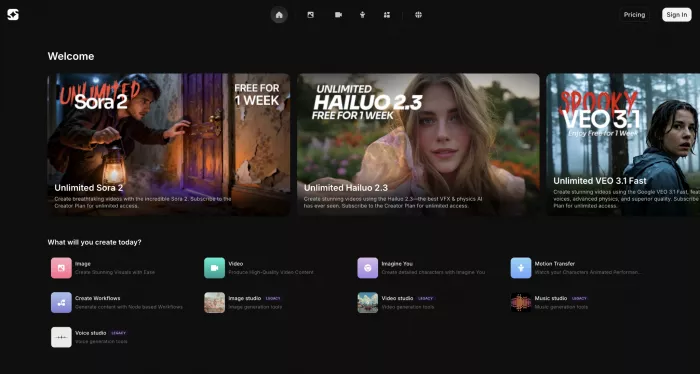
What ImagineArt Provides
ImagineArt positions itself as a complete AI creative suite consolidating thumbnails, banners, shorts, avatars, and video generation into one unified platform. The Video Studio hosts 15+ AI video generation models including Pixverse itself alongside Kling 2.1, Hailuo 02, Google Veo 3, Luma Ray 2, and Imagine V3. The platform allows up to eight concurrent video generations with three aspect ratio options and image preview capabilities before actual rendering begins. Text-to-video, image-to-video, AI movie maker, and talking head video features integrate with customizable style, lighting, speed, and length parameters adjustable pre-generation.
Primary Use Case
ImagineArt serves content creators needing comprehensive creative tools spanning social media graphics, video content, thumbnails, and promotional materials without managing multiple platform subscriptions.
Greatest Asset
Hosting 15+ video generation models including Pixverse itself alongside competitors under one subscription eliminates separate platform accounts and allows creators to choose from affordable to premium models based on specific project requirements.
Notable Drawbacks
Credit costs vary wildly by model from 30 to 900 per generation creating budgeting uncertainty, and the platform is not optimized specifically for anime compared to Pixverse's specialized focus.
Pricing Details
Free plan with 100 daily credits (personal use). Pro plan starts at $10/month for commercial use. Professional plan at $34/month with enhanced features.
How ImagineArt Surpasses Pixverse
ImagineArt eliminates Pixverse's single-model limitation by providing 15+ video generation engines including Pixverse V4 and V4.5 alongside competitors under one subscription, allowing model selection based on specific project requirements. Creators can access affordable to premium models within a single interface rather than maintaining separate subscriptions for different capabilities, with commercial use starting at just $10 monthly. The comprehensive creative suite consolidates thumbnail generation, banner creation, avatar tools, and video production that would require additional subscriptions beyond Pixverse's video-only focus, reducing total tool costs for multi-format content creators.
8. Pika 2.5 : The Accessible Entry Point
What Pika 2.5 Delivers
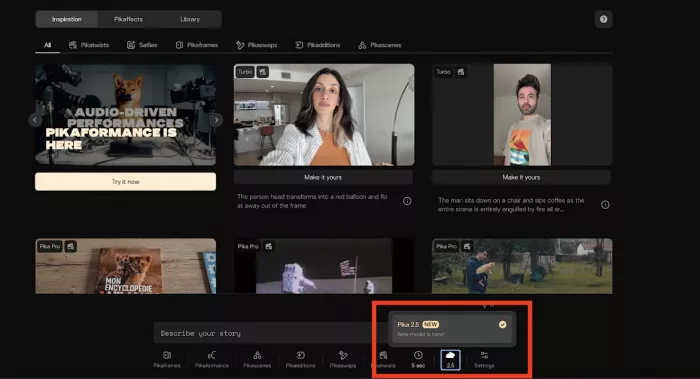
Pika 2.5 delivers the most generous free tier in AI video generation with 80 monthly credits producing watermark-free output immediately suitable for professional use. Interface simplicity enables first-time users to generate video clips in under 30 seconds from initial login without tutorials or learning curves. Sound effects generation adds basic audio dimension that Pixverse's free and Standard tiers entirely lack. The straightforward credit system eliminates confusion surrounding Pixverse's opaque consumption patterns, while the Standard paid plan at $8 monthly matches Pixverse's entry price but provides 700 credits with more predictable consumption rates.
Primary Use Case
Pika 2.5 serves beginners testing AI video generation, social media creators producing quick clips, and budget-conscious users requiring watermark-free output without financial commitment.
Greatest Asset
The 80 free monthly credits producing watermark-free usable output create immediate value without requiring credit card registration or subscription commitments, while interface simplicity reduces friction for quick content creation.
Notable Drawbacks
Generic output on anime prompts produces significantly worse quality than Pixverse's specialized character consistency, and clips limit to 3-10 seconds maximum duration.
Pricing Details
Free tier with 80 monthly credits (watermark-free). Standard plan starts at $8/month with 700 credits. Professional tiers offer expanded allocation with volume discounts.
How Pika 2.5 Surpasses Pixverse
Pika's 80 free monthly credits produce watermark-free output immediately usable in professional contexts, whereas Pixverse's free tier watermarks all content and restricts to 720p resolution. Sound effects generation included on the free tier provides audio capabilities that Pixverse restricts to its $24 monthly Pro plan, representing significant value for budget-conscious creators exploring AI video tools. The simplified interface and predictable credit consumption eliminate the confusion surrounding Pixverse's opaque system where generation costs vary unpredictably based on complexity, duration, and quality settings.
Comparison table
| Tool | Best for | Starting price | Main strength | Main limitation |
| Morphed | Multi-model image + video workflows | Custom / usage-based | 15+ models, 4K+ upscaling, image + video in one place | Weaker anime specialization than Pixverse |
| Kling 3.0 Omni | Photorealistic video | $6.99/month | Native 4K 60fps and audio support | Less suited for anime-heavy work |
| Runway Gen-4.5 | Professional production teams | $12/month | Best motion consistency, Adobe-friendly workflow | Higher effective cost per video |
| Seedance 2.0 | Storytelling and multi-shot scenes | About $0.10/minute | Strong multi-scene consistency and reference control | 1080p cap and 15-second clips |
| Krea AI | Fast iteration and creative testing | $28/month | Real-time generation and 64+ models | Quality varies by model |
| Luma Ray3.14 | Cinematic visual quality | $30/month | Film-like lighting and keyframe control | No native audio, 1080p cap |
| ImagineArt | All-in-one creator suite | $10/month | 15+ video models plus thumbnails, banners, avatars | Credit use varies a lot by model |
| Pika 2.5 | Beginners and free usage | $8/month | Watermark-free free tier and simple UI | Short clips and weaker anime output |
Verdict
If the goal is the best overall replacement for Pixverse AI, Kling 3.0 Omni is the strongest pick for value and high-resolution output, Runway Gen-4.5 is the better choice for professional production quality, and Krea AI is the most flexible option for creators who want fast experimentation across many models. If budget matters most, Pika 2.5 and ImagineArt offer the easiest starting point with usable free access and lower entry pricing than premium-heavy competitors.


Comments